
Summary and Key Points: Christian D. Orr, Senior Defense Editor and former Air Force officer, evaluates the Aviation Museum of Kentucky’s premier military exhibits during a March 2026 visit.
-Led by Vietnam-era Huey pilot Orrin Messinger, the tour highlights an OIF-veteran F-14A Tomcat and a Vietnam-era F-4S Phantom, noting the “eerie” reality that both platforms are still fielded by Iran during current operations.

Aviation Museum of Kentucky Entrance, March 1, 2026. Taken by 19FortyFive.com
-This 19FortyFive report analyzes the technical evolution of the Tomcat’s F110-400 engines and the museum’s upcoming 2028 expansion, concluding that AMK remains a vital bridge between legacy warbirds and modern tactical aviation.
Aviation Museum of Kentucky Visit by 19FortyFive – The F-14 Tomcat Legacy: Inside the Kentucky Specimen with 50 Strike Missions
As the saying goes, “When life deals you lemons, make lemonade.” This writer was vacationing in the Commonwealth of Kentucky over the weekend, straddling February and March to visit friends, but alas, those friends had to cancel at the last minute.
Well, as luck would have it, my hotel was a mere 40-minute drive from the Aviation Museum of Kentucky (AMK). So, to emulate another great saying, “Carpe Diem (Seize the Day),” I decided to fill my additional downtime with a spur-of-the-moment tour of this excellent museum.
Arriving at the Museum
The museum—incorporated in 1989 and opened to the public in April 1995—is located on the grounds of Blue Grass Airport in Lexington, Kentucky (home of the Kentucky Derby). Business hours are Tuesday to Friday from 10 am to 5 pm (except between January and March, when they close an hour earlier), Saturday from 10 am to 5 pm, and Sunday from 1 pm to 5 pm. Ticket prices are $18.00 USD for adults (17-59 years), $16.00 for seniors (60+ years), veterans, active-duty military, first responders, and teachers, $12,00 for youth (4-17 years), FREE for children age 3 and below (with a paid admission), $50.00 for family of 4 (with youth in the same household), and $11.00 for scheduled group tours.
I was pleased to see a reserved parking spot for military veterans in addition to the required handicapped parking spots. Upon entering the museum, the first staffer to greet me was the delightfully pleasant Mrs. Emily Hirst, the museum’s Front Desk Coordinator. Upon telling her of my prior experience as an Air Force officer and current status as a defense journalist, she jumped at the chance to provide me with a top-notch museum docent.
That top-notch docent turned out to be Orrin Messinger, a retired U.S. Army Chief Warrant Officer 2 (CW2) who flew Huey helicopters during the Vietnam War (he had fallen in love with helicopters back when he was a 2nd grader). Like nearly all American aviators from that war, he is not fond of the way LBJ and Robert McNamara mismanaged that war, so naturally I referred him to the song “Viet Vet” by Dick Jonas (Lt. Col., USAF, Ret.). CW2 (Ret.) Messinger really knows his stuff, fixed-wing and rotary-wing assets alike, in addition to being an all-around great guy.
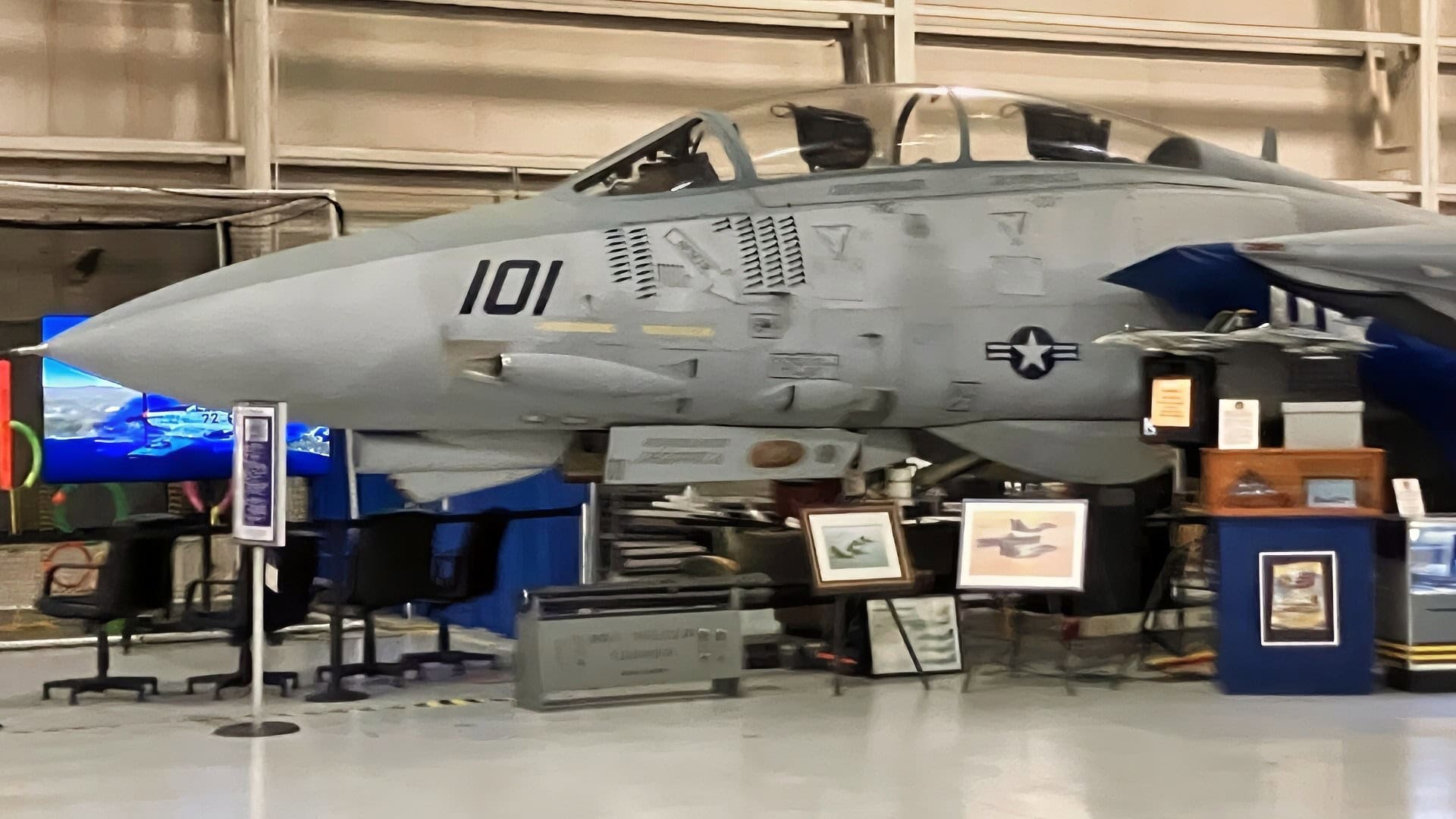
Highlight #1: F-14 Tomcat

F-14 Tomcat at Aviation Museum of Kentucky. Taken on March 1, 2026. By Christian D. Orr.
Somewhat of an eerie coincidence that I ended up viewing and photographing this exhibit on the same day that Operation Epic Fury/Operation Roaring Lion commenced, seeing as how the Islamic Republic of Iran Air Force (IRIAF) is the only entity still using the F-14 in an official operational capacity.
This particular Tomcat specimen is an F-14A bearing U.S. Navy Bureau Number (BuNo) 161860, and, judging by the decals stenciled underneath the cockpit, is an Operation Iraqi Freedom (OIF) veteran that flew 50 strike missions.
To the left of the airframe are inert examples of the Tomcat’s 20mm M61A1 Vulcan cannon and famous AIM-54 Phoenix missile.
Here’s what Orrin had to say about the Tomcat: “When they first came out with the F-14, it had a Pratt & Whitney TF30 engine in it, and they were having problems with engine stalls. You get into a dogfight, and there’s a pilot trying to clear a stall while he’s trying to dogfight! They came out in ’76, they were gonna retire it in ’86 [coincidentally the same year the original ‘Top Gun’ movie debuted at the box office and made movie audiences fall in love with the Tomcat]. But General Electric worked out a deal with the Navy, and they re-engined it with the F110-400, and they finally retired it in 2006. The one pilot I talked to, I say, ‘Can you compare the two airplanes for me?’ and he said, ‘I used to have to fly the engines, now I fly the airplane! If I want power, I push the lever; if I don’t, I pull ’em back; otherwise, I forget they’re there. And the one engineer from Grumman I talked to, he said, ‘Finally, the aircraft will fly to its designed specification.’ It’s a whale of an airplane!”
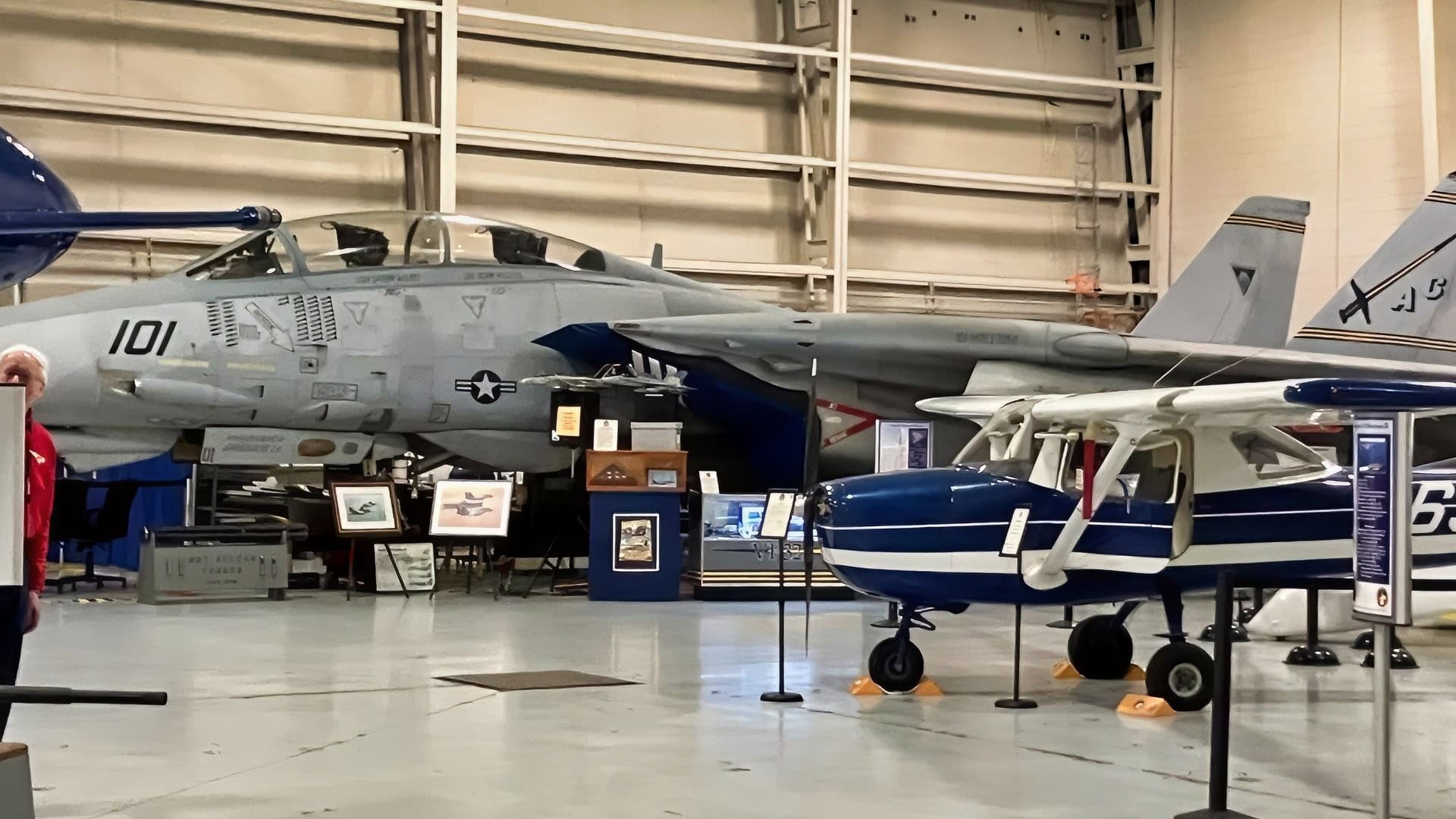
F-14 Tomcat at the Aviation Museum of Kentucky. Taken by 19FortyFive.com by Christian D. Orr.
Querying Orrin further, like both the aviation history geek and movie buff that I am, I presented this follow-up inquiry: “The flat spin that killed Goose in the movie [“Top Gun”], that was a real-life danger?”
CW2 (Ret.) Messinger replied, “Oh yeah, especially with the TF30s in it, because you could flame one out, and of course, the engines sit side-by-side, so you’ve got that asymmetrical thrust problem, which could very easily throw into the flat spin.”
Highlight #2: F-4 Phantom II at Aviation Museum of Kentucky
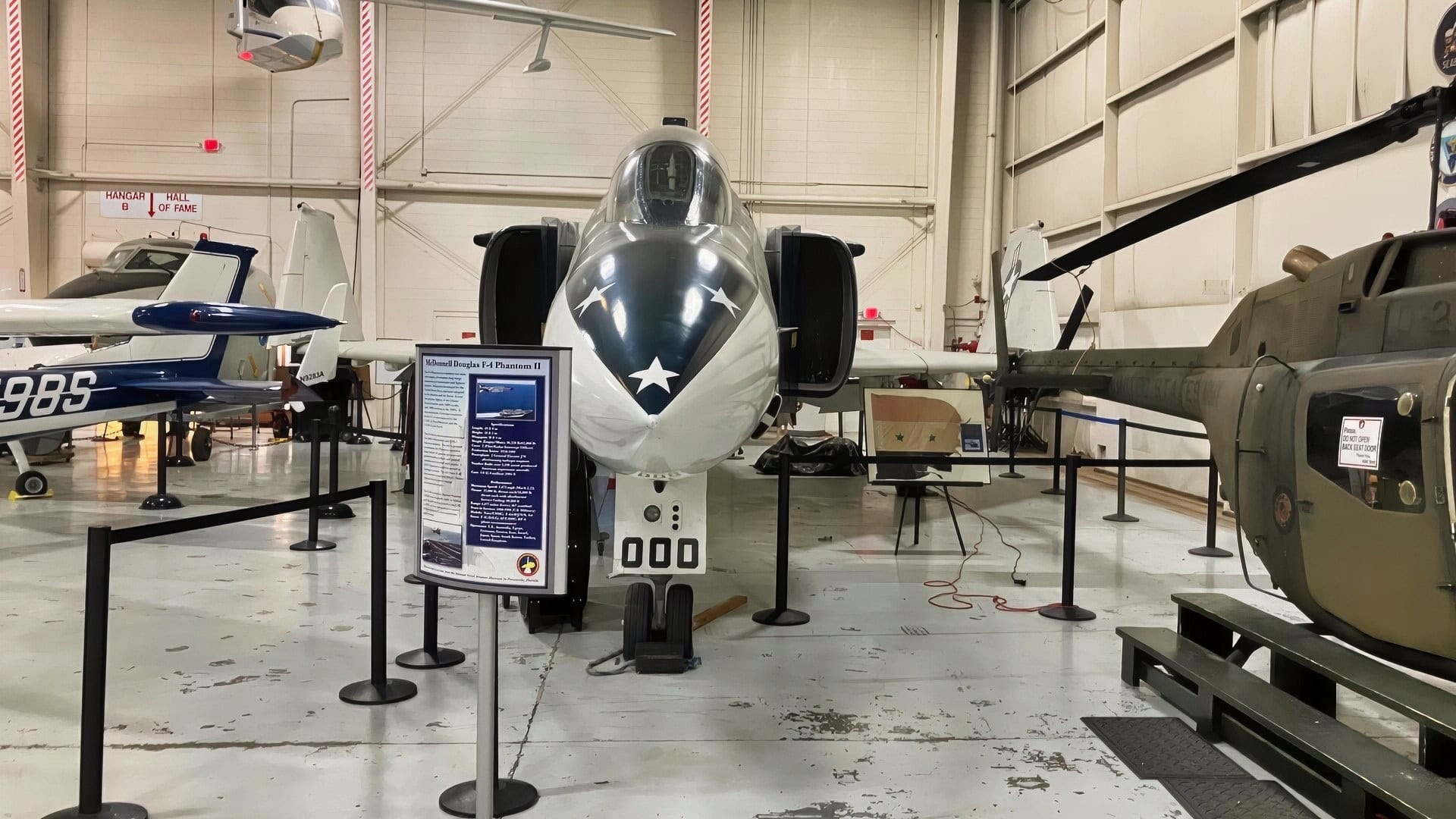
F-4 Phantom Fighter Aviation Museum of Kentucky. Taken by 19FortyFive on March 1, 2026.
Somewhat of an eerie coincidence once again, as the IRIAF is among the few (though not the only) entities still using the F-4 in an operational capacity. Bearing BuNo 153904, AMK’s Phantom specimen is a Marine Corps F-4S that fought in the skies over Vietnam.
Here’s what Orrin had to say about the Phantom: “It’s got the folding wings for carrier storage. We actually have a billboard back there [telling the story of] someone [who] took off and forgot to put those down. He got it back on the ground, but I think he was way above top landing speed just to keep in the air, but they got it on the ground, okay.”
I followed up with “You’ve probably heard the saying that ‘The F-4 is proof you could make a brick fly if you put a big enough engine on it.'” Mr. Messinger replied with, “It had a pair of J79s in it, so yeah, it had a pair of big ones!”
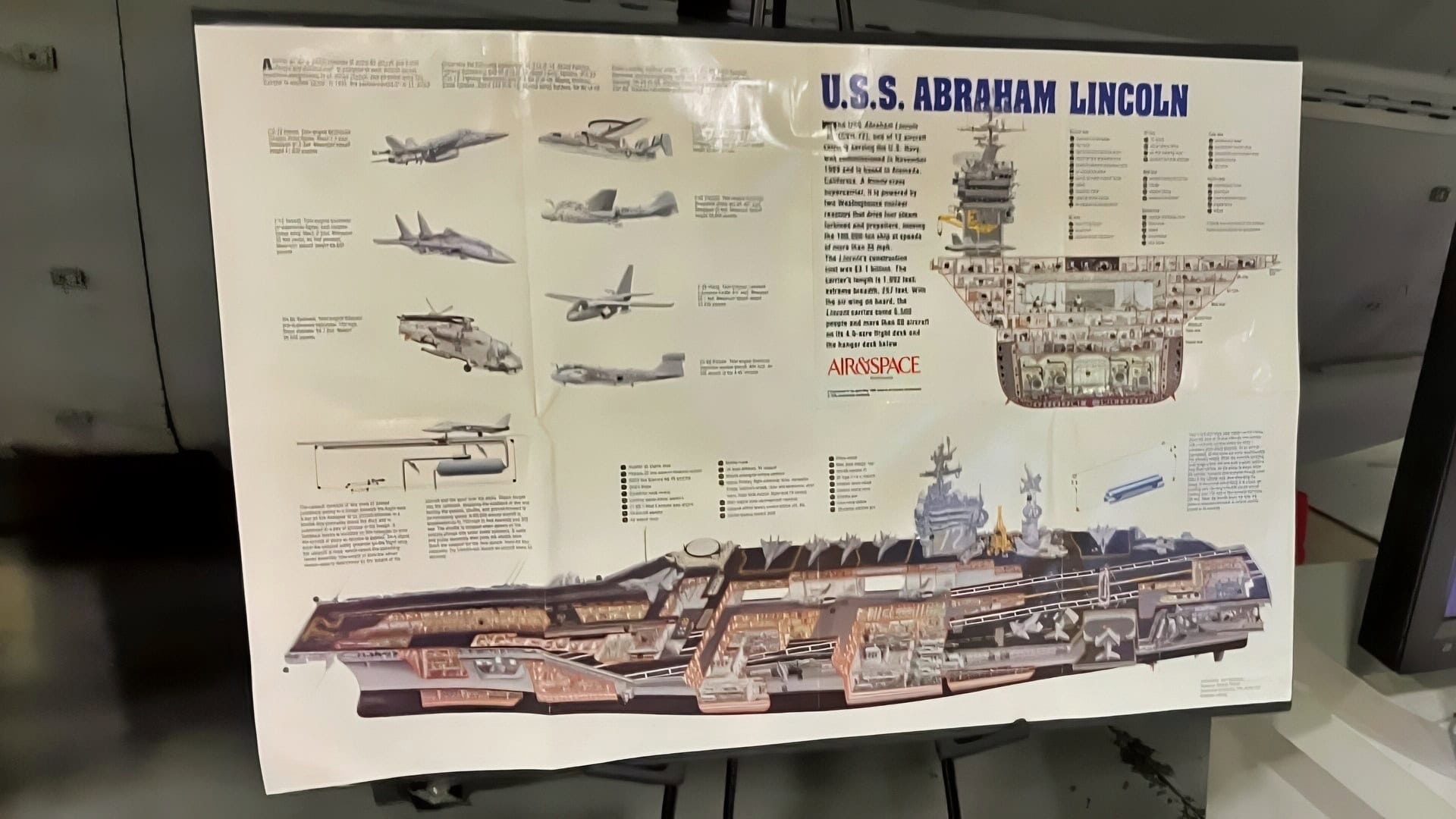
Aviation Museum of Kentucky USS Abraham Lincoln Carrier Photo. 19FortyFive.com Image.
Additional Military-Themed Exhibits
–A3D Skywarrior (cockpit section only): The largest combat aircraft routinely catapulted off and recovered on the deck of an aircraft carrier. Orrin told me that the cynical joke about the A3D is that the alphanumeric designation stood for “All 3 Dead.” The reason is that though there was an escape hatch atop the fuselage just behind the cockpit, there were no ejection seats! After sharing a grim laugh with Orrin about that one, I pointed out that the E-3 Sentry AWACS plane (basically a militarized Boeing 707) has essentially the same problem; in the Sentry’s case, the escape hatches are on the underside of the fuselage, and for (not so) good measure, there are no parachutes on the plane either!
–Doolittle Raiders exhibit: Jimmy Doolittle’s intrepid B-25 Mitchell aviators (all now gone but not forgotten) who carried out the America’s unforgettable first bombing raid on Tokyo—America’s first significant act of payback against Imperial Japan during World War II (immortalized in the movie “Thirty Seconds Over Tokyo“, starring Spencer Tracy and Van Johnson)—held their 53rd anniversary reunion at AMK, and accordingly, the museum has a section dedicated to that event, including group photographs, paintings, and a section of B-25 stabilizer autographed by the Raiders.
–AH-1F Cobra: This helicopter gunship—Serial No. 67-15759—is also a Vietnam veteran that served in the U.S. Army, just like CW2 Messinger.
–A-4L Skyhawk: Though the Skyhawk also most definitely served in the Vietnam War, I wasn’t able to ascertain whether this particular Navy Blue Angels specimen—BuNo [147708]—actually did so (though Lord knows the Blue Angels nexus is plenty prestigious history in and of itself).

Aviation Museum of Kentucky A4-L Skyhawk fighter. Image Credit: 19FortyFive Taken on March 1, 2026.
–AT38B Talon: Not to be outdone by their USN counterparts and friendly rivals, the Air Force Thunderbirds also have an aircraft on display at AMK. The AT-38B was a weaponized training variant of Northrop’s supersonic T-38, developed to better prepare U.S. Air Force pilots for the realities of combat aviation. (My apologies, I didn’t get the Tail No. or Serial No. of this particular specimen.)
-Nieuport 17: A 7:8 scale mockup of the famous French World War I fighter plane, but a pretty cool sight to see up close and personal nonetheless. The Nieuport 17 has a pretty prestigious combat history; as noted by the Military Aviation Museum of Virginia Beach, Virginia, “In addition to being flown by the principal French aces, the Nieuport 17 was flown by British aces Albert Ball, ‘Mick’ Mannock, and ‘Billy’ Bishop, Italian Ace Francesco Baracca (carrying his prancing stallion emblem latter presented to Enzo Ferrari by Baracca’s mother) and Russian Ace Alexander Kozakov.”
-Stearman Model 75: As noted by the High Sierra Pilots website, “When Boeing signed Stearman on as a subsidiary in 1934 and put them to work building a trainer for the military, no one anticipated just how successful their little biplane trainer would become. Easy to fly and simple to maintain, this incredibly sturdy wood, metal, and fabric biplane became known as fairly forgiving of new pilots while still requiring their full attention (mostly regarding coordination).”
-Piper J-3 Cub: Officially redesignated the L-4 Grasshopper in military parlance, this high-wing, strut-braced monoplane—originally designed as a trainer—proved itself well suited for a variety of military uses such as reconnaissance, liaison, and ground control.
-RF-101 Voodoo: This specimen—Serial No. 56-0125—sits on the outside rather than the inside of the museum building. Though the F-101 Voodoo was originally designed as a long-range bomber escort and fighter-bomber, this warbird proved itself much more valuable in its RF-101 reconnaissance version, which, among other things, played a crucial role during the Cuban Missile Crisis and saw extensive service during the Vietnam War
The Way Forward for Aviation Museum of Kentucky
Orrin concluded his tour by noting that “We’re growing! In March of 2028, we’ll be out here on the corner of Man O’War Boulevard and Airport Road with a much bigger facility. Actually, there’s a picture over here if you wanna take a picture of it. And, we’re gonna have, ah, somebody’s trying to line up a DC-3, we’re going to have more space, we’re going to have more airplanes. The only reason we don’t is we don’t have a place to put ’em.”
In addition, on the way out, Emily informed me that:
-The museum will be receiving an AV-8B Harrier II jump jet in May.
-Weather and other conditions permitting, the museum will host a restored B-24 Liberator and B-29 Superfortress bomber in July, courtesy of the Commemorative Air Force (CAF).
Stay tuned, dear readers!
About the Author: Christian D. Orr, Defense Expert
Christian D. Orr is a Senior Defense Editor. He is a former Air Force Security Forces officer, Federal law enforcement officer, and private military contractor (with assignments worked in Iraq, the United Arab Emirates, Kosovo, Japan, Germany, and the Pentagon). Chris holds a B.A. in International Relations from the University of Southern California (USC) and an M.A. in Intelligence Studies (concentration in Terrorism Studies) from American Military University (AMU). He is also the author of the newly published book “Five Decades of a Fabulous Firearm: Celebrating the 50th Anniversary of the Beretta 92 Pistol Series.”