
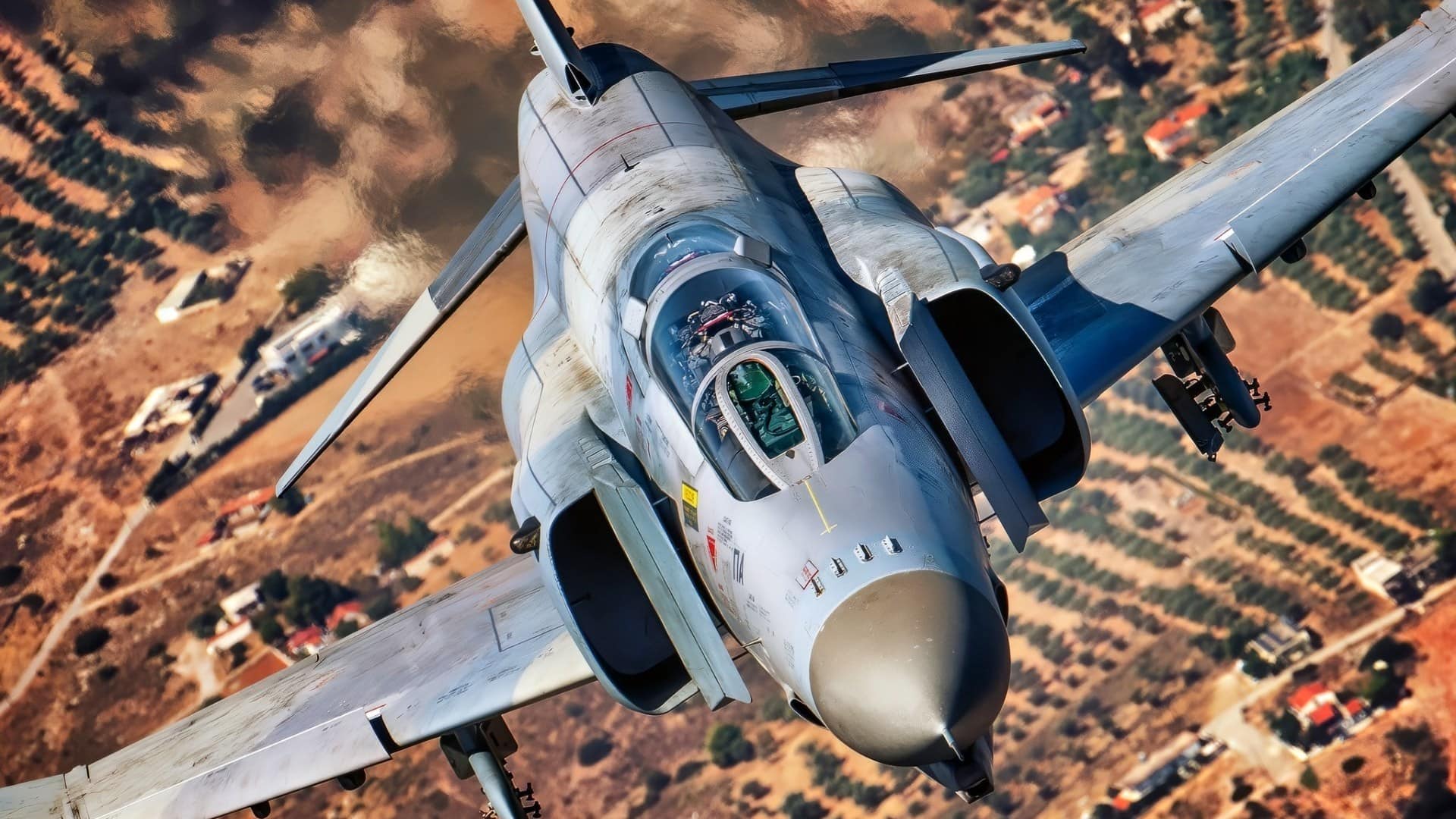
Summary and Key Points: The F-4 Phantom II, a legendary Cold War relic, refuses to fade into history. While most nations retired the “Double Ugly” decades ago, the Turkish Air Force is keeping its specialized “Terminator 2020” variants combat-ready through 2030.
-Upgraded with advanced Israeli avionics and precision-strike capabilities, these “Terminators” remain a vital component of Turkey’s air power alongside the F-16.
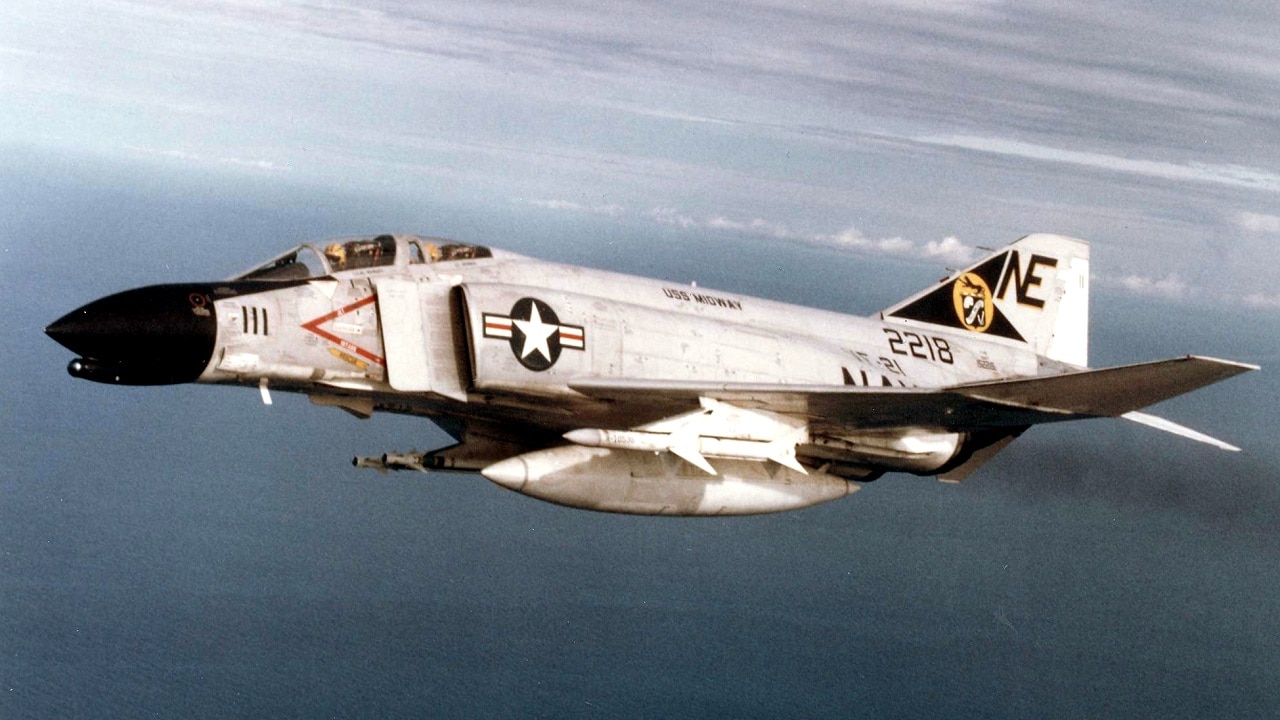
Vietnam War F-4 Phantom. Image Credit: Creative Commons.
-As Ankara navigates a rocky relationship with Washington over the F-35 and S-400 missiles, these aging Phantoms serve as a lethal bridge to the future indigenous TF Kaan. This “antique” fighter is still earning its keep in the modern sky.
From Vietnam to 2030: The Secret Upgrades Keeping the F-4 Phantom in the Fight
Two of the most iconic and successful U.S.-made fighter jets of the Cold War era were the fourth-generation F-14D Tomcat and the third-generation F-4 Phantom II.
These mighty warbirds were both known for speed (the Phantom held a whopping 16 world speed and altitude records between 1959 and 1962; the Tomcat inspired the famous line “I feel the need, the need for speed” in the original 1986 “Top Gun” film); power (Vietnam veteran pilot Dick Anderegg joked that the F-4 was “proof that if you put enough thrust behind a brick you can make it fly”); and impressive air-to-air kill tallies.
The F-4 and the F-14 flew their last combat missions for the United States in 1991 (the Wild Weasel missions of Operation Desert Storm) and 2006 (Operation Iraqi Freedom) respectively. However, their operational histories are still being written as I type these words.
The F-14 is still being used by a major U.S. adversary, Iran, while the F-4 is still under the employ of Iran and one of America’s NATO allies (albeit a troublesome one), namely Türkiye.
In fact, the Turkish Air Force keeps its Phantoms going strong with the so-called “Terminator” variants.
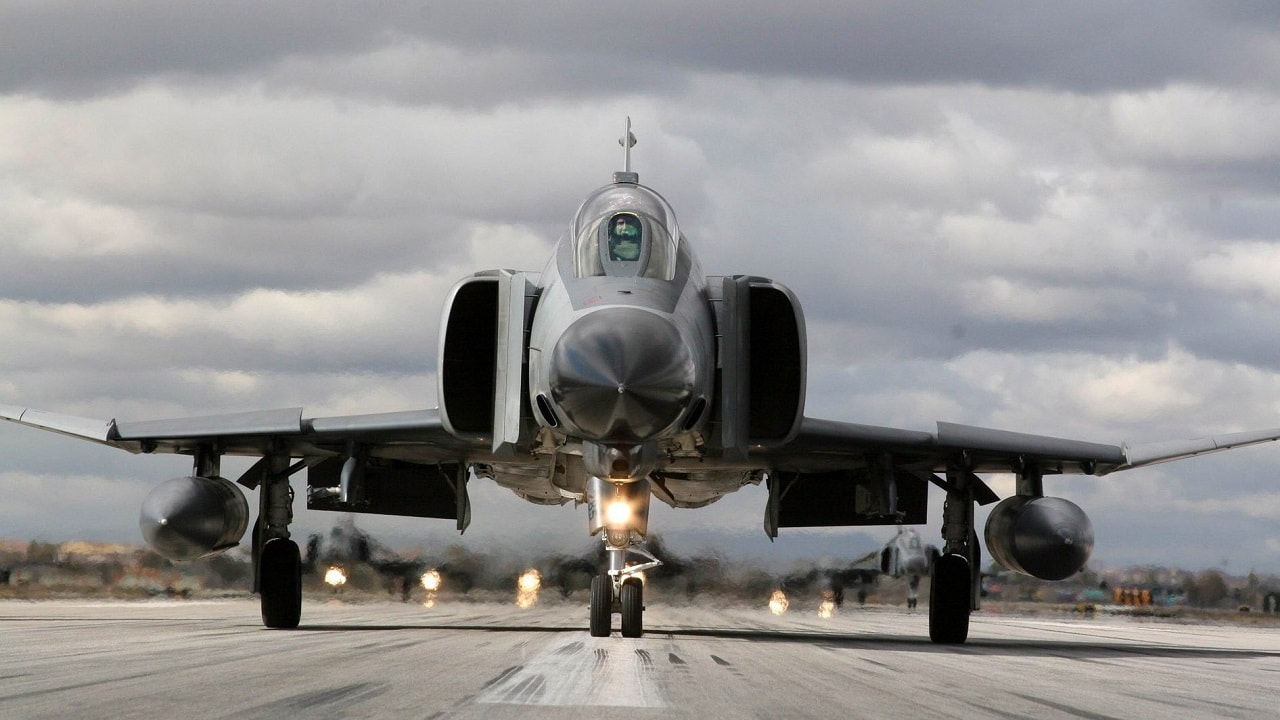
F-4 Phantom. Image Credit: Creative Commons.
Phantoms Faithfully Flying: Turkish Terminators
The inspiration for this story comes to us from The War Zone:
“Today, only one Turkish F-4 squadron remains — 111 Filo ‘Panterler’ based out of the Eskisehir Air Base. Four of the iconic fighters from the unit were deployed to Konya for this edition of AE [Anatolian Eagle].
“Speaking about the relevance of these aircraft in training operations, the deputy chief of the Turkish Air Force Public Affairs Office, Maj. Akbay, told The War Zone, ‘We still actively use the F4-E-2020, as its avionics improved thoroughly in the air-to-ground role. Since it is also equipped with self-protection ECM pods, we primarily rely on it as an air-to-air escort and protection in the air theater. In both the AE exercise and in real-life operations, we coordinate and fly with both national and international air-to-air assets, such as F-16s and UAVs.’”
The article concludes that, “It is clear that these nearly antique fighters are not hangar queens just yet, and are still actively involved in operations that benefit from their unique attributes. … Regardless, getting to see F-4s still earning their keep in 2023 is something to behold.”
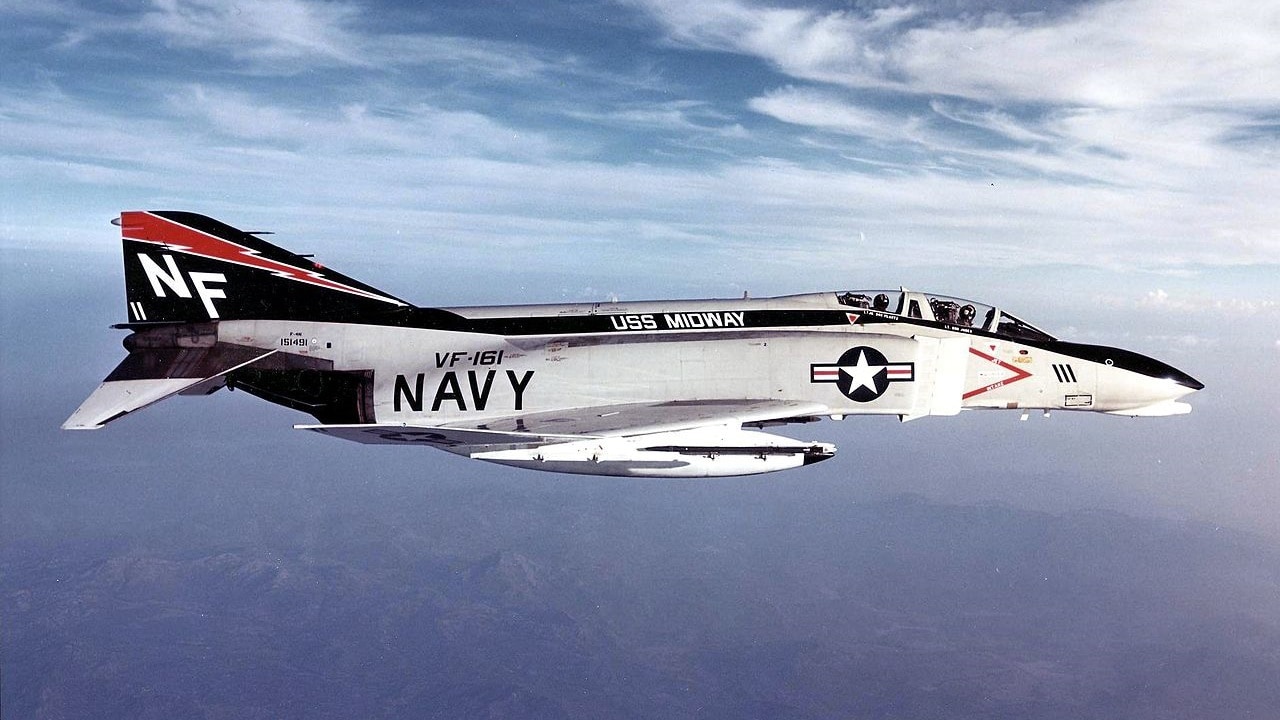
A U.S. Navy McDonnell F-4N Phantom II (BuNo 151491) of Fighter Squadron VF-161 “Chargers” in flight. 151491 was assigned to VF-161, Carrier Air Wing 5 (CVW-5), aboard the aircraft carrier USS Midway (CV-41) from 1973 to 1977. It was retired to the MASDC as 8F0077 on 3 November 1977.
About Anatolian Eagle (AE)
AE began in 2001. Its 55 iterations have involved more than 41,000 personnel, 3,300 air platforms, and approximately 27,000 sorties.
The exercise focuses on strengthening cohesion and refining combat skills among NATO-allies’ aircrews.
About Those Terminators
The Turks’ F-4Es certainly haven’t remained frozen in time.
They were upgraded to the “Terminator 2020” configuration courtesy of Israel Aerospace Industries back in the 1990s—in happier times for Israeli-Turkish relations.
That upgrade package included:
Elbit’s ELOP 976 wide-angle head-up display (HUD) and hands on throttle and stick (HOTAS) flight controls;
Higher-performance Elta EL/M-2032 multimode airborne fire-control radar (initially developed for IAI’s Lavi indigenous fighter program);
Elta EL/L-8222 electronic countermeasures pod;
Dual MIL-STD-553B databus avionics package;
AN/ALQ-178 passive self-protection suite;
New UHF/VHF radio antennas and onboard multifunction displays;
New GPS/INS precision targeting navigation equipment
Enhanced air-to-ground capabilities, including the AGM-142 Popeye standoff missile, AGM-65A/B Maverick air-to-ground missiles, and GBU-10/12 Paveway laser-guided bombs
The Way Forward for the Turkish F-4 Phantom Fighters
The Turkish F-4Es are now expected to remain in service until 2030, which is a full decade beyond their originally planned shelf life. According to the World Directory of Modern Military Aircraft (WDMMA), the Turkish Air Force still has 19 F-4E airframes left in its fleet. However, the lion’s share of the Turks’ fighter arsenal is comprised of the fourth-generation F-16 Fighting Falcon (or as most of its crews prefer to call it, the “Viper”). WDMMA lists the Turkish Air Force as having 234 F-16C/D variants, divided among Blocks 30, 30M, 40M, 50M, and 50+.
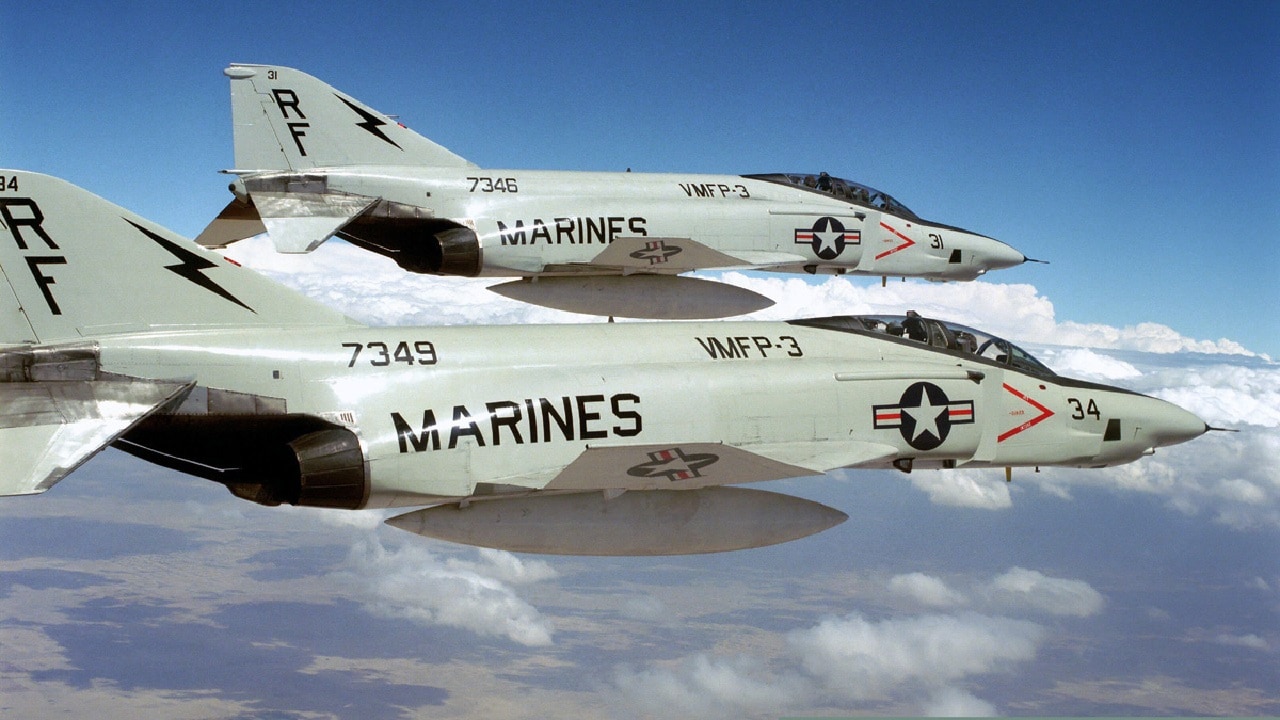
A right rear view of two RF-4B Phantom II aircraft of Marine Photo Reconnaissance Squadron Three (VMFP-3) over El Toro Marine Corps Air Station during a training mission.
What about acquiring fifth-generation stealth fighters such as the F-35 Lightning II? Well, as I wrote, Turkey is a “troublesome” ally to the United States.
This is due to strongman Recep Tayyip Erdoğan’s support for Hamas and his cozy relationship with Russian President Vladimir Putin.
Erdoğan is trying to get back in America’s good graces—and thus rejoin the waiting list to purchase the F-35—by offering to give back the S-400 missile systems Ankara previously purchased from Russia.
Meanwhile, Türkiye is also working on its own homegrown next-generation fighter, the TF Kaan. But although that plane made its maiden flight in 2024, it is still very much uncertain it will be fully operational by the Terminators’ projected 2030 swan song.
Time will tell.
About the Author: Christian D. Orr, Defense Expert
Christian D. Orr is a Senior Defense Editor. He is a former Air Force Security Forces officer, Federal law enforcement officer, and private military contractor (with assignments worked in Iraq, the United Arab Emirates, Kosovo, Japan, Germany, and the Pentagon). Chris holds a B.A. in International Relations from the University of Southern California (USC) and an M.A. in Intelligence Studies (concentration in Terrorism Studies) from American Military University (AMU). He is also the author of the newly published book “Five Decades of a Fabulous Firearm: Celebrating the 50th Anniversary of the Beretta 92 Pistol Series.”