
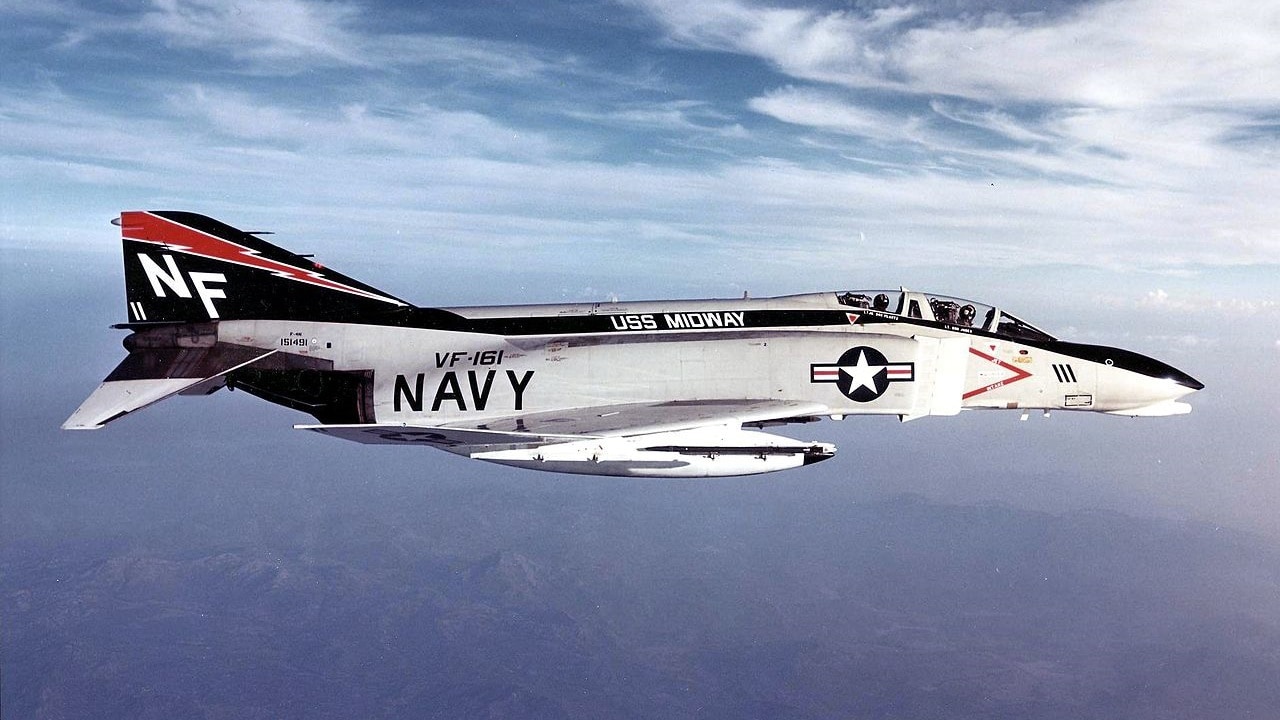
Key Takeaways – The McDonnell Douglas F-4 Phantom II was a Cold War workhorse for the U.S. and Israel, racking up an impressive kill tally from Vietnam to Desert Storm.
-Yet pilots and RIOs knew it had serious flaws.
-The big jet bled energy in tight turns, struggled against more nimble MiGs, and early variants lacked an internal gun just as unreliable missiles were exposed in combat.
-Smoky engines made it easy to spot, maintenance was brutal, and older radars were cluttered and temperamental.
The F-4 Phantom Fighter Had 5 Big Flaws – And Still Became a Legend
Even so, crews adapted, upgrades followed, and the Phantom’s final scorecard still came out decisively in its favor.
The McDonnell Douglas F-4 Phantom II was a workhorse fighter-bomber for the United States Air Force, Navy, and Marine Corps alike for four decades, and in the Israeli Air Force (IAF) for five decades.
The Phantom performed superbly in several conflicts in its time of service, from the Vietnam War to the Arab-Israeli Wars of the 1970s to its combat swan song performing Wild Weasel missions (suppression of enemy air defenses [SEAD]) during the 1991 Persian Gulf War, AKA Operation Desert Storm.
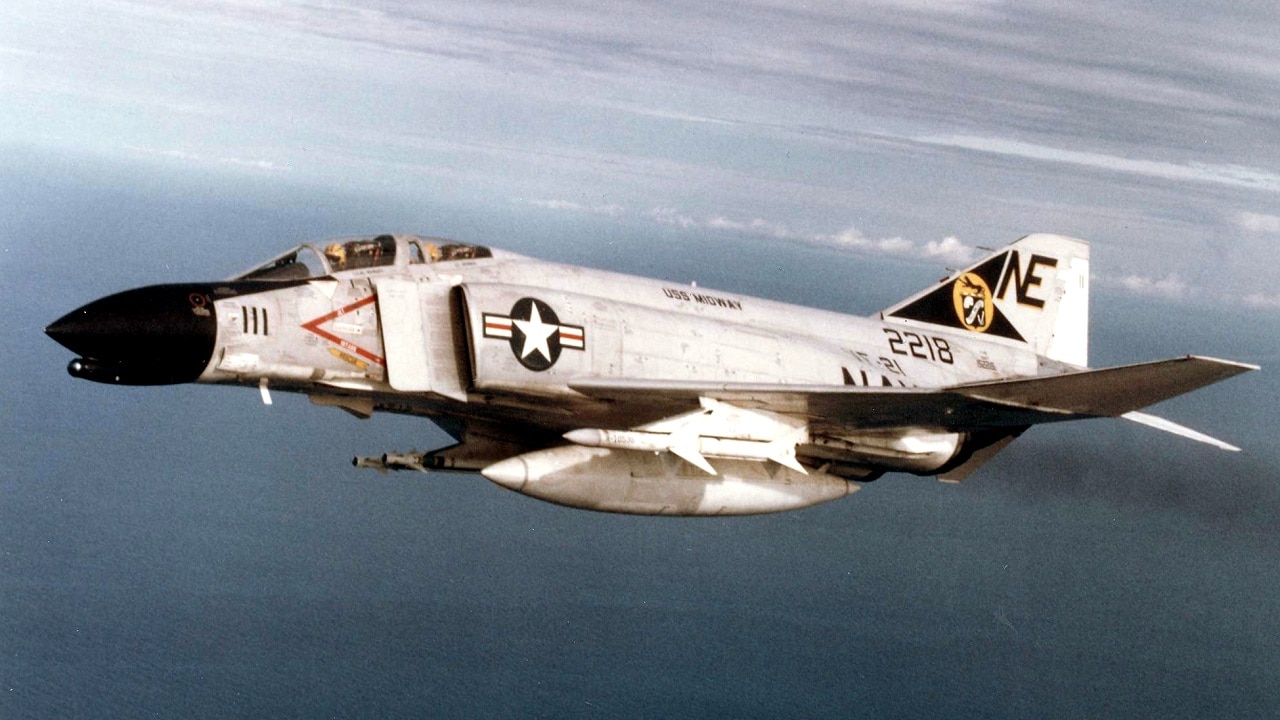
Vietnam War F-4 Phantom. Image Credit: Creative Commons.
However, like any manmade object, the Phantom II has its weaknesses (just like Superman has his Kryptonite).
Accordingly, we now provide a rundown of the F-4 Phantom’s five foremost flaws.
NOTE: Two key sources of helpful information for this piece were (1) “F-4 Crew Members Speak about Phantom II’s Issues. And they Explain why they Loved Flying it despite its Flaws” by Dario Leone of Aviation Geek Club and (2) “What Couldn’t the F-4 Phantom Do?” by Stephen Joiner of Smithsonian Air & Space Magazine.
Phantom Flaw #1: Maneuverability Maladies
Make no mistake: the F-4 Phantom was super-fast. Sixteen (that’s right, 16) world speed and altitude records between 1959 and 1962. Five of those records would stand until the F-15 Eagle—another McDonnell Douglas (now Boeing) product—came along in 1975.
Those speed records came despite the warbird’s enormous size—a max takeoff weight of 60,000 lbs. (27, 215 kg), a length of 63 feet (19.2 meters), a wingspan of 37 feet 5 inches (11.7 meters), and a height of 16 feet 5 inches (5 meters)—prompting Vietnam veteran pilot Dick Anderegg to joke that this big bird provided “proof that if you put enough thrust behind a brick you can make it fly.”
However, this size and speed combo came at a price: maneuverability. The big F-4 wasn’t as nimble as North Vietnam’s slower but more maneuverable Soviet-built MiG-17 “Fresco”, MiG-19 “Farmer,” and MiG-21 “Fishbed.”
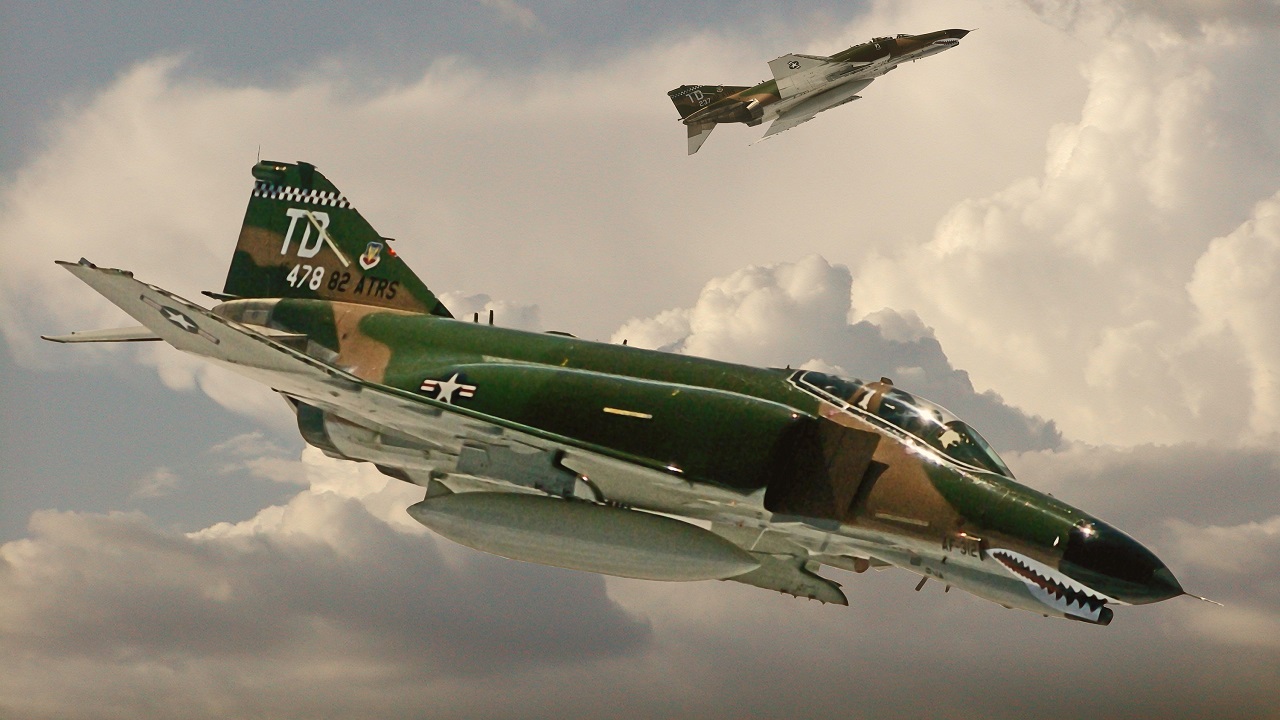
At one point, the Americans’ air-to-air kill ratio against their Communist adversaries dropped to a paltry 2:1. (Of course, the ridiculous rules of engagement [ROEs] imposed by then-President LBJ and then-SECDEF Robert S. McNamara certainly didn’t help either.)
Phantom Flaw #2: Lack of a Gun (At Least in the Early Versions)
What, no cannon?!?!
The debates of the merits of a gun on a supersonic fighter aircraft can be debated until one is blue in the face. However, there’s something to be said about “Better to have and not need than vice versa.”
Initial iterations of the F-4 didn’t have a gun built in, as airpower strategists of that time assumed that air-to-air missiles (AAMs) would render guns obsolete. However, those early-generation AAMs left something to be desired in terms of accuracy and reliability when Phantom drivers in the deadly skies over Vietnam ran out of missiles, only to find their cannon-armed “Fresco,” “Farmer,” and “Fishbed” enemies still very much alive, which turned out to be more than a trifle trouble.
John Chesire, a retired Commander in the US Navy who flew 197 combat missions in the Phantom during two tours in Vietnam, put it this way: “Bullets are cheap and tend to go where you aim them. I needed a gun, and I really wished I had one.”
Fortunately, better late than never, the military brass and McDonnell Douglas listened to the men doing the fighting and dying in the cockpits of the F-4 and finally armed the fighter with a 20mm cannon. This decision would be vindicated on June 2, 1972, when then-USAF Maj. Phil “Hands” Handley scored history’s only recorded supersonic air-to-air gun kill, doing so against a MiG-19.
As a side note, all these decades later, the Chinese People’s Liberation Army Air Force (PLAAF) apparently still fails to heed the lessons of the early F-4s: its much-ballyhooed J-20 “Fagin” 5th-generation stealth jet omits the gun.

Image: Creative Commons.
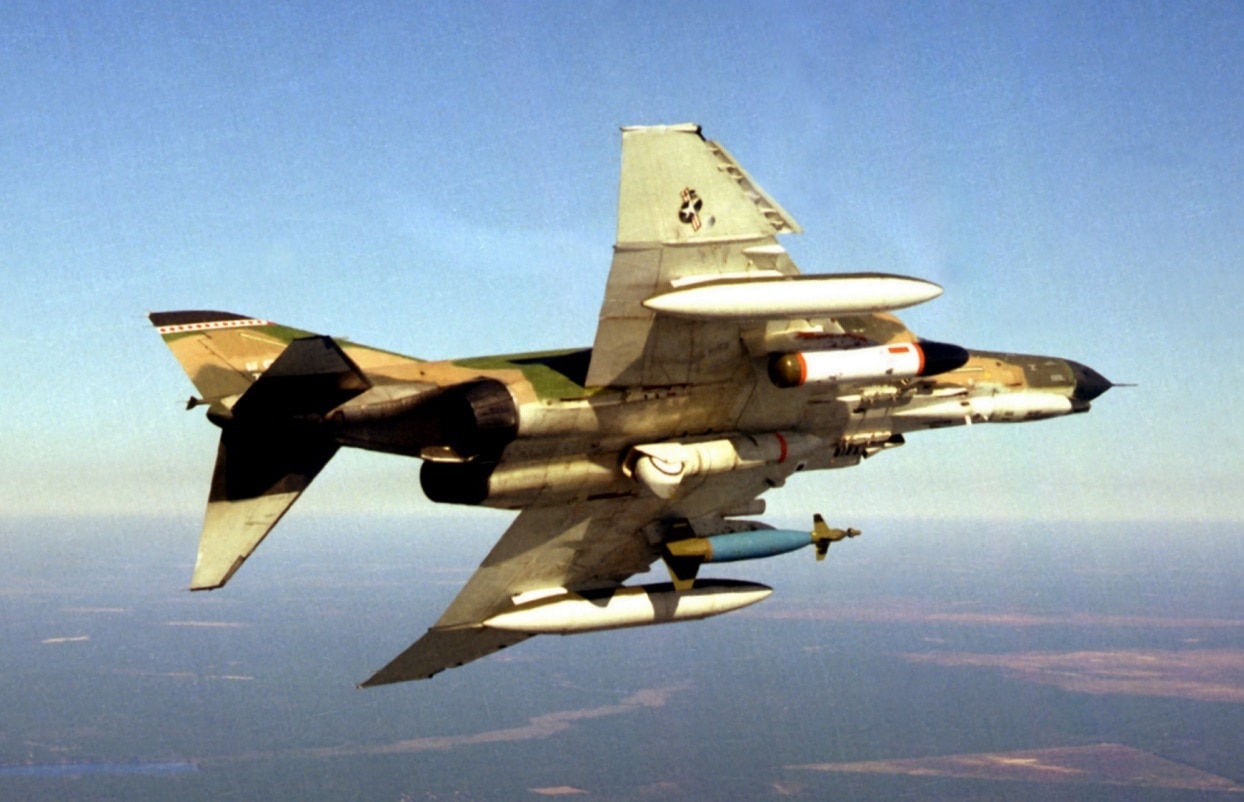
Image: Creative Commons.
Phantom Flaw #3: “Smoke Gets In Your Eyes”
The F-4 was a 3rd-generation fighter jet, and therefore, it was not designed with stealth in mind. Going back to Dick Anderegg’s wisecrack equating the Phantom with a “brick,” the huge size of the warbird meant that it was easy to pick up on radar. However, even in the pre-stealth era, it was highly desirable to avoid visual detection by the enemy as long as possible. In that regard, the hulking F-4 was compromised by engines that generated excessive smoke.
Phantom Flaw #4: Maintenance Maladies
In other words, reliability issues. According to Randy Raines, former USMC Capt. (1972 – 1980) and F-4 Radar Intercept Officer (RIO; known in USAF jargon as the Weapon System Officer or “Wizzo”), “‘They were always broken. When you reported in from a flight it was “up & up” if the plane and the avionics were working. “up & Down” if the plane was OK but the avionics was down. I can probably count on two hands the number of times I called in “up & up”. I was in four squadrons over my career and everyone of them had all the planes grounded until something could be fixed. Fuel leaks were a huge problem.”
Phantom Flaw #5: Radar Frustrations
The F-4B variant used by the USMC in Vietnam had a pulse radar, which was susceptible to ground clutter and could negatively impact the crew’s lookdown-shootdown capabilities. The F-4J rectified this with the pulse Doppler radar. “But,” to quote Randy Raines again, “our F-4s were old Navy’ hand me downs.’
Positive Postscript for the F-4 Phantom
To end this piece on a positive note, despite all those issues, the F-4 Phantom II nonetheless ended its illustrious career with a highly positive air-to-air kill ratio, both in the hands of (1) American fighter pilots against Communist foes and in the hands of (2) IAF fighter jocks against Arab adversaries.
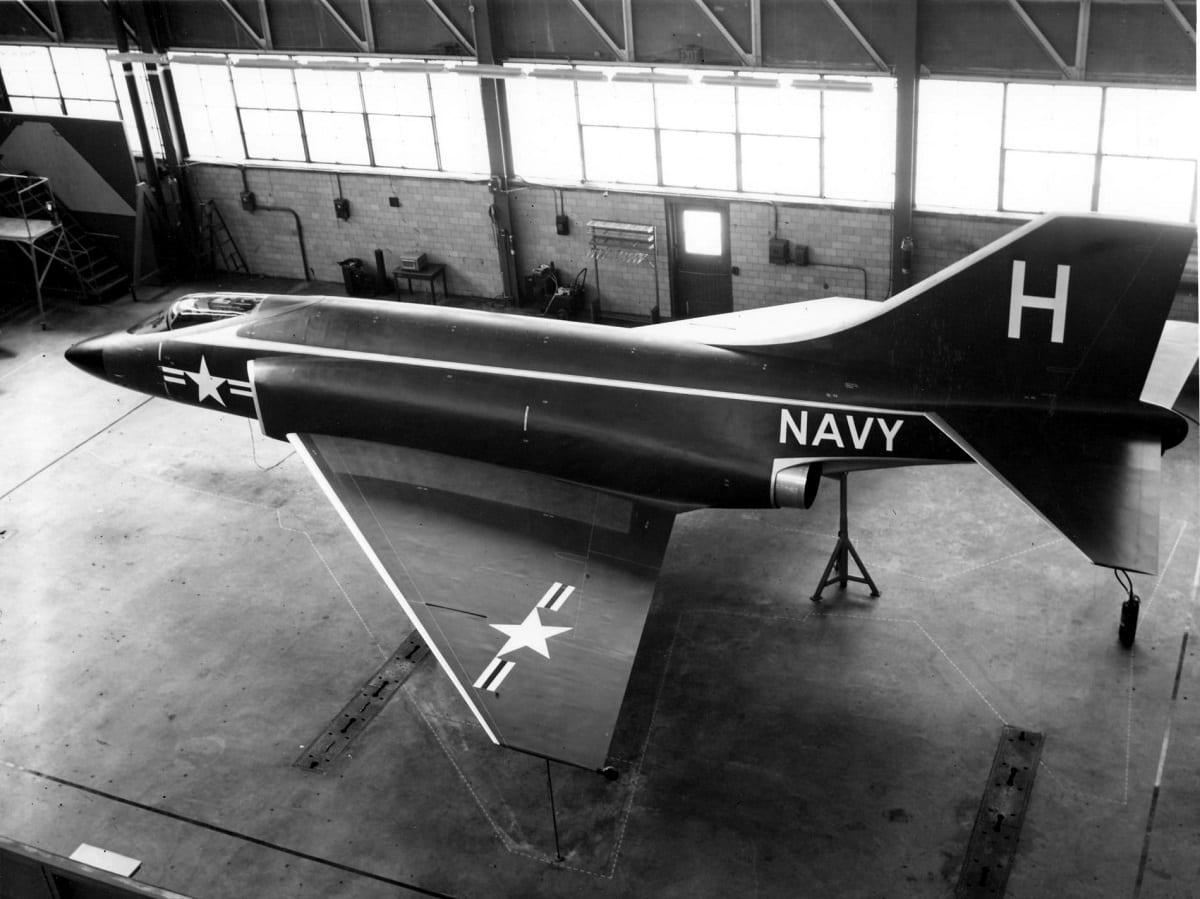
Mockup of the proposed U.S. Navy McDonnell F3H-G/H. In 1953, McDonnell Aircraft began work on revising its F3H Demon fighter, seeking expanded capabilities and better performance. The company developed several projects including a variant powered by a Wright J67 engine, and variants powered by two Wright J65 engines, or two General Electric J79 engines. The J79-powered version promised a top speed of Mach 1.97. On 19 September 1953, McDonnell approached the United States Navy with a proposal for the Super Demon. Uniquely, the aircraft was to be modular — it could be fitted with one- or two-seat noses for different missions, with different nose cones to accommodate radar, photo cameras, four 20 mm cannon, or 56 FFAR unguided rockets in addition to the nine hardpoints under the wings and the fuselage. The Navy was sufficiently interested to order a full-scale mock-up of the F3H-G/H. It depicted the different sizes of the Wright J65 and General Electric J79 afterburners, with the J79 on the right side of the mockup and the J65 on the left. The further development led directly to the F4H Phantom II.
As former Vietnam War pilot Dick Jonas (Lt. Col, USAF, Ret.) turned “fighter pilot’s minstrel,” notes at the end of his song “MiG-21,” “But just have a look at the scoreboard, friend: It’s all in favor of the Phantom.”
About the Author: Christian D. Orr, Defense Expert
Christian D. Orr is a Senior Defense Editor. He is a former Air Force Security Forces officer, Federal law enforcement officer, and private military contractor (with assignments worked in Iraq, the United Arab Emirates, Kosovo, Japan, Germany, and the Pentagon). Chris holds a B.A. in International Relations from the University of Southern California (USC) and an M.A. in Intelligence Studies (concentration in Terrorism Studies) from American Military University (AMU). He is also the author of the newly published book “Five Decades of a Fabulous Firearm: Celebrating the 50th Anniversary of the Beretta 92 Pistol Series.”