
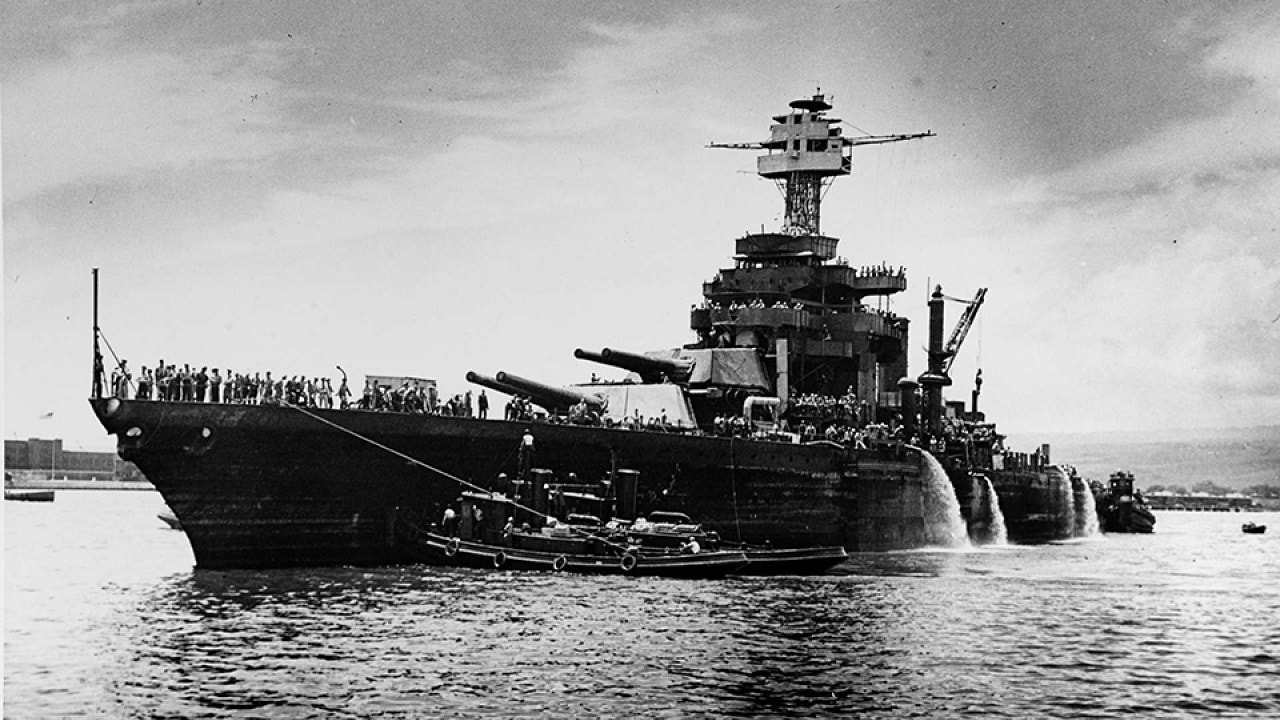
USS West Virginia by the Numbers: Eight 16-Inch Guns, Seven Torpedo Hits and 93 Shells at Surigao – USS West Virginia’s defining numbers stretch from construction to combat: 33,590 long tons at full load, eight 16-inch guns, at least seven torpedo hits at Pearl Harbor, 93 heavy shells fired at Surigao Strait, and five World War II battle stars.
Congress authorized the ship under an $11.5 million ceiling that excluded armor and armament. A history maintained by the USS West Virginia Association places the completed price closer to $25 million, making the lower figure a construction cap rather than the cost of the complete battleship.
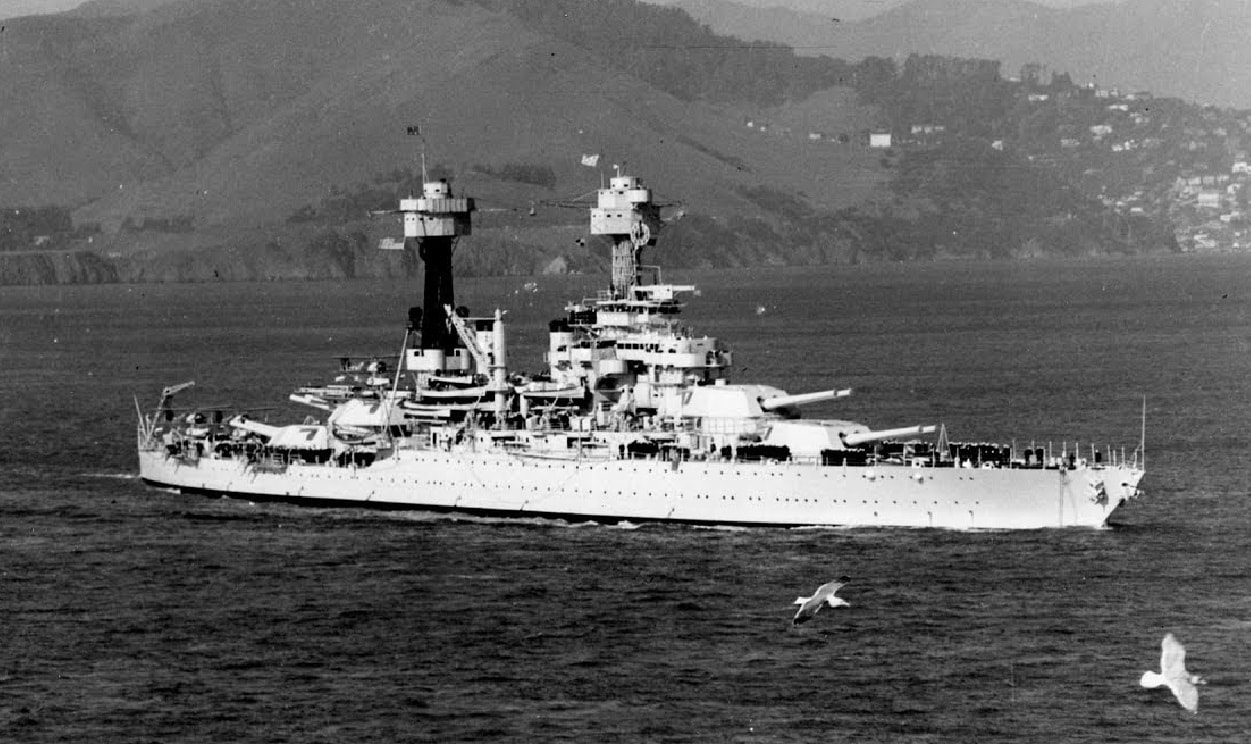
USS West Virginia – Image: Creative Commons.
Newport News Shipbuilding and Dry Dock Company laid BB-48’s keel on April 12, 1920, launched the hull on November 19, 1921, and delivered the ship for commissioning on December 1, 1923. Keel laying to active service took three years, seven months, and 19 days.
Four Colorado-class battleships were authorized, but only Maryland, Colorado, and West Virginia were completed. Washington was canceled under the Washington Naval Treaty. West Virginia became the last American battleship commissioned until USS North Carolina entered service in 1941.
33,590 Tons Moved on 28,900 Shaft Horsepower
West Virginia measured 624 feet long and 97 feet 3 inches across the beam. Eight oil-fired Babcock & Wilcox boilers supplied steam to turbo-generators, which produced electricity for four General Electric propulsion motors. The plant delivered 28,900 shaft horsepower to four propellers, a top speed of about 21 knots, and a normal endurance of roughly 8,000 nautical miles at 10 knots.
Turbo-electric drive distinguished the Colorado class from most battleships. The main belt reached 13.5 inches, turret faces measured 18 inches, and the conning tower had 16 inches of armor. West Virginia was also part of the final generation of American standard-type battleships, designed to operate with earlier classes in one battle line.
Eight 16-Inch Guns Fired a 17,920-Pound Broadside
The Colorado class was the first American battleship class completed with 16-inch guns. West Virginia carried eight 16-inch/45-caliber weapons in four twin turrets. By World War II, each could fire a 2,240-pound armor-piercing projectile, producing a 17,920-pound broadside.
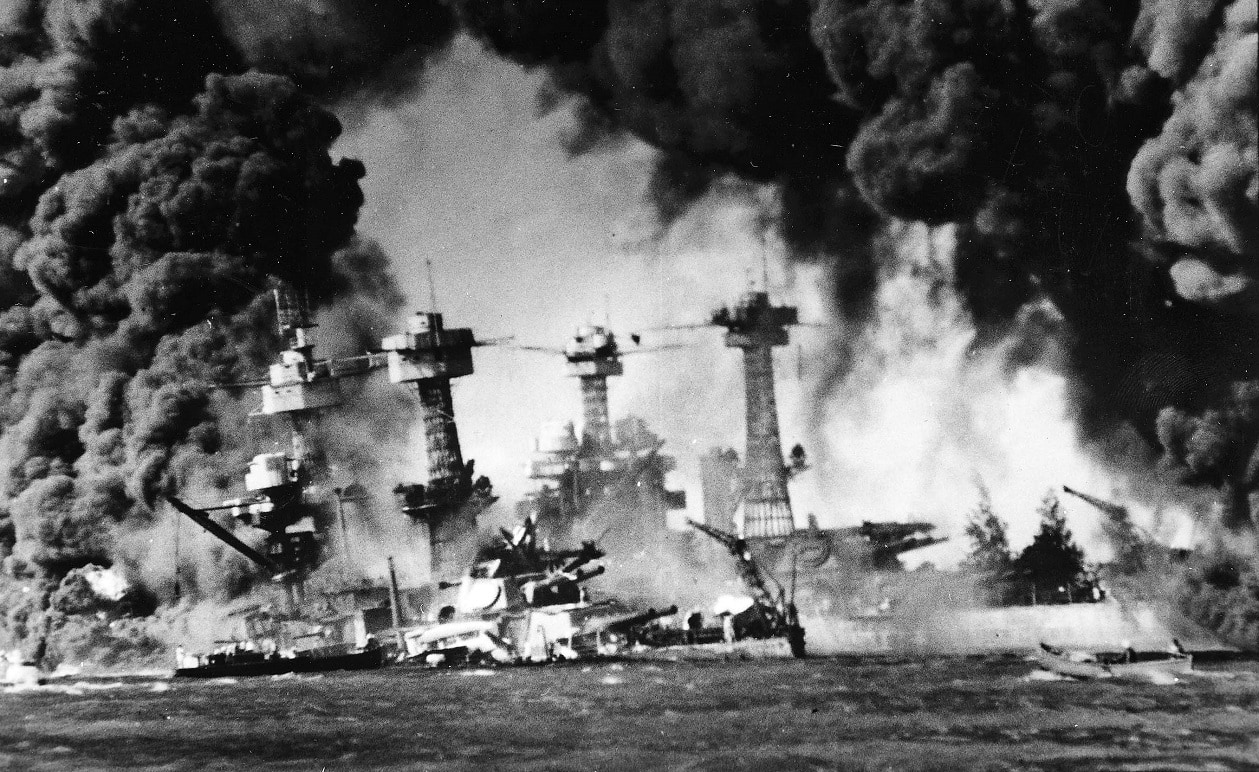
Battleship USS West Virginia sunk and burning at Pearl Harbor on Dec. 7, 1941. In background is the battleship USS Tennessee.
The guns reached roughly 35,000 yards at their maximum 30-degree elevation and fired about one and a half rounds per minute.
They were built to penetrate enemy battleship armor, a mission reflected in comparisons with Japan’s largest capital ships, although most of West Virginia’s wartime ammunition went against defenses ashore.
As completed, the ship also carried sixteen 5-inch/51-caliber guns, eight 3-inch anti-aircraft guns, and two submerged torpedo tubes.
Her 1944 reconstruction replaced that mixed battery with sixteen 5-inch/38 dual-purpose guns, 40 Bofors 40mm barrels, and 43 Oerlikon 20 mm cannons.
Pearl Harbor Put Seven Torpedoes Into the Port Side
West Virginia was moored outboard of USS Tennessee when Japanese aircraft attacked Pearl Harbor on December 7, 1941.
At least seven torpedoes struck the port side, two armor-piercing bombs hit from above, and fires spread from the nearby USS Arizona. The battleship settled onto the harbor floor.
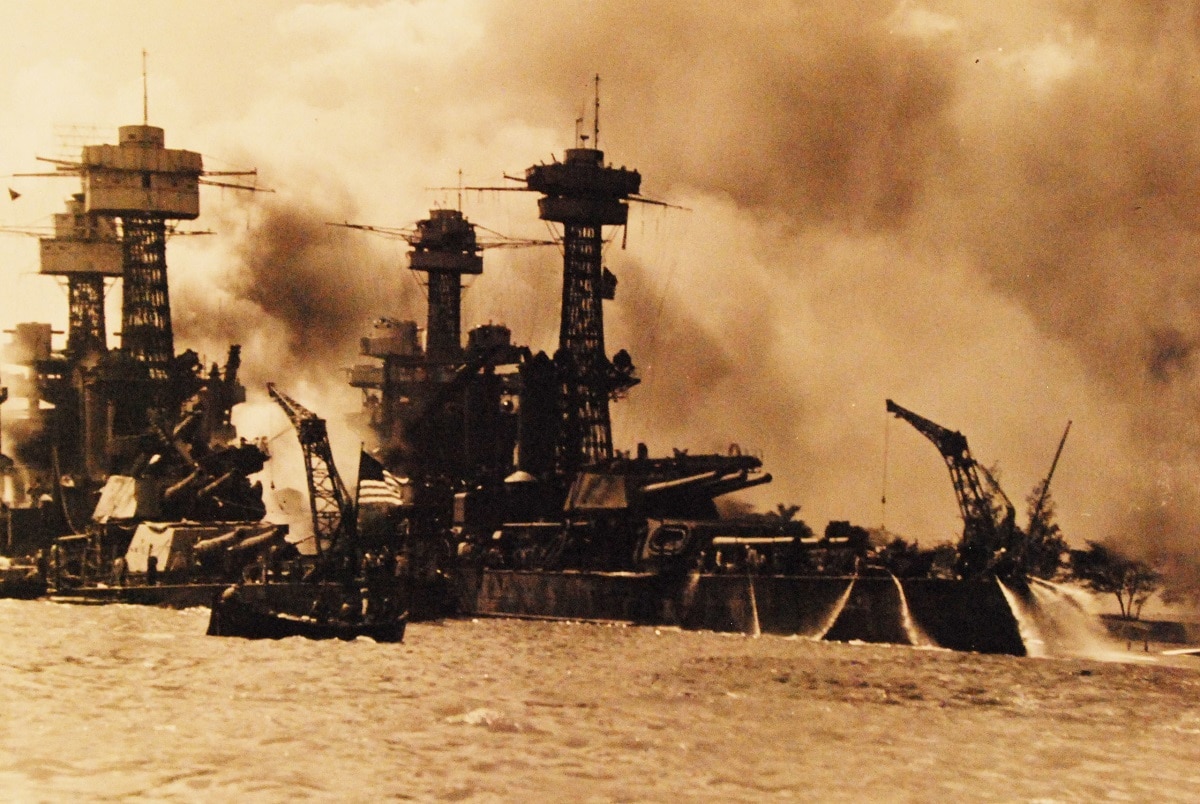
Pearl Harbor Attack, 7 December 1941. USS Tennessee (BB-43) and the sunken USS West Virginia (BB-48). (9/15/15).
Counter-flooding kept the ship upright instead of allowing it to capsize, preserving the possibility of salvage.
The attack killed 106 members of the crew. Captain Mervyn Bennion remained at his post after suffering mortal wounds and received the Medal of Honor. Doris Miller helped move wounded sailors and manned an anti-aircraft gun, earning the Navy Cross.
Workers refloated West Virginia on May 17, 1942. Temporary repairs allowed her to leave Pearl Harbor for the Puget Sound Navy Yard in April 1943, where the Navy rebuilt much of the ship rather than restoring it to its 1923 configuration.
The Rebuild Produced a Different Battleship
New torpedo bulges widened the hull and restored the buoyancy needed for additional armor and equipment.
Workers removed the cage masts and one funnel, installed a compact tower superstructure, increased deck protection, and added modern radar.
The new secondary and anti-aircraft batteries transformed the ship’s ability to defend itself and nearby vessels.
West Virginia also received the Mark 8 fire-control radar, able to track a surface target in darkness and feed range data into the gunnery system.
The equipment made her one of the most capable reconstructed battleships in the fleet. She completed trials in July 1944 and returned to Pearl Harbor on September 23, more than two and a half years after Japan left her on the bottom.
West Virginia Fired 93 Heavy Shells at Battlship Yamashiro
The battleship reached the Philippines in time for the Leyte invasion. On October 19, West Virginia fired 278 16-inch shells and 1,586 rounds from its 5-inch battery against Japanese positions. Six days later, those guns received the surface target for which the ship had been designed.
At 3:53 a.m. on October 25, West Virginia opened fire at about 22,800 yards during the Battle of Surigao Strait. Radar had tracked the Japanese battleship Yamashiro before visual contact. West Virginia fired 93 main-battery rounds, including 89 armor-piercing and four high-capacity shells, in 16 salvos.
Five of Rear Admiral Jesse Oldendorf’s six battleships had been sunk or damaged at Pearl Harbor. They crossed the head of the Japanese formation and concentrated fire on Yamashiro in history’s last battleship-against-battleship engagement. West Virginia’s report recorded a first-salvo straddle and observed hits, although the combined American fire makes an exact hit count impossible.
Five Battle Stars Ended With Japan’s Surrender
West Virginia continued through Mindoro, Lingayen Gulf, Iwo Jima, and Okinawa, using its heavy guns as floating artillery.
A kamikaze struck the superstructure on April 1, 1945, killing four sailors, but the ship resumed gunfire support after damage-control teams contained the attack.
West Virginia entered Tokyo Bay on August 31 and was present for Japan’s formal surrender on September 2.
After three Operation Magic Carpet voyages, the Navy decommissioned her on January 9, 1947, after just over 23 years in commission. She was struck from the register in 1959, sold to Union Minerals & Alloys Corporation and towed to Todd-Pacific Shipyard in Seattle on January 3, 1961, for scrapping.
Local Connection: Parts of USS West Virginia Are Back in the State of West Virginia
West Virginia did not survive as one of the museum battleships preserved around the United States, but several pieces remain in its namesake state.
An anti-aircraft gun stands in City Park in Parkersburg, the ship’s bell and other artifacts are held by the West Virginia State Museum in Charleston; and the mainmast remains at West Virginia University. The mast was dedicated on May 11, 1963, and still stands in Memorial Plaza in front of Oglebay Hall.
MORE: USS Nevada Was the Warrior Battleship
About the Author: Harry J. Kazianis
Harry J. Kazianis (@Grecianformula) was the former Senior Director of National Security Affairs at the Center for the National Interest (CFTNI), a foreign policy think tank founded by Richard Nixon based in Washington, DC. Harry has over a decade of experience in think tanks and national security publishing. His ideas have been published in the NY Times, The Washington Post, The Wall Street Journal, CNN, and many other outlets worldwide. He has held positions at CSIS, the Heritage Foundation, the University of Nottingham, and several other institutions related to national security research and studies. He is the former Executive Editor of the National Interest and the Diplomat. He holds a Master’s degree focusing on international affairs from Harvard University.