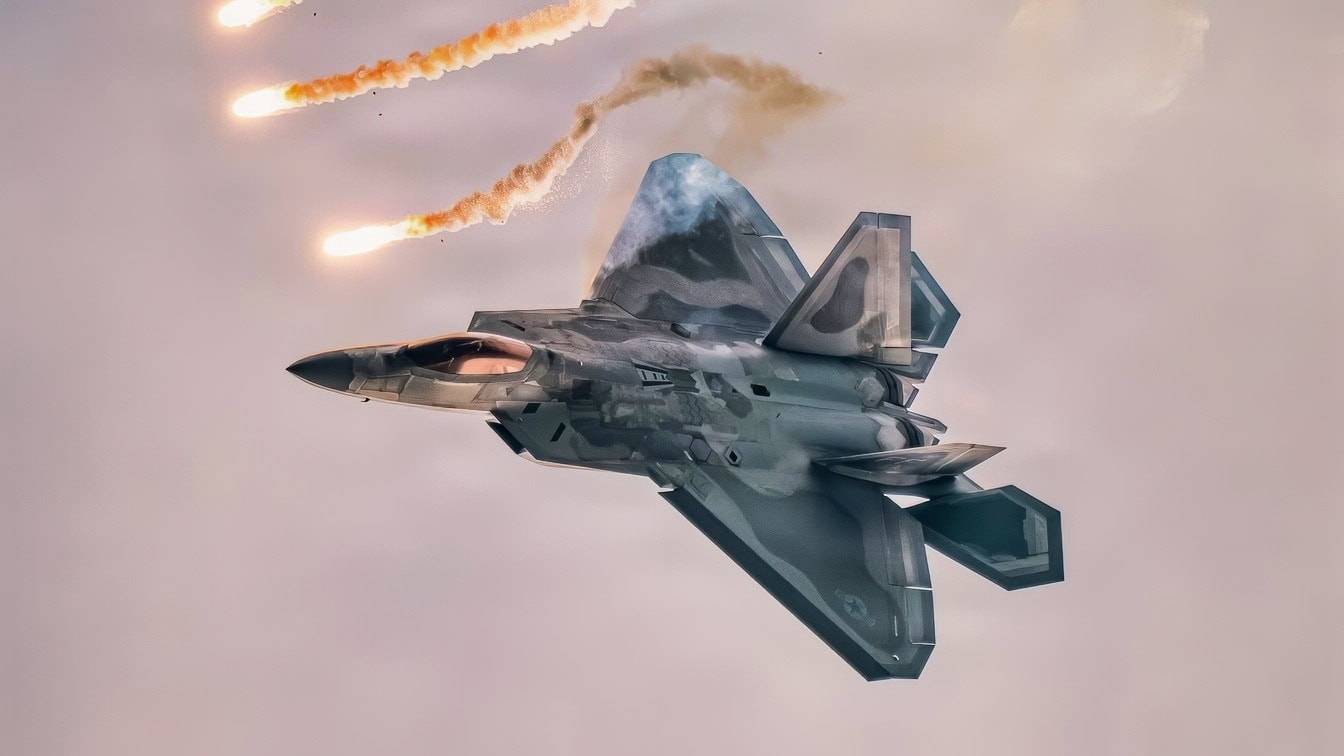
Lockheed Martin’s F-22 Raptor fifth-generation air superiority stealth fighter has often been described as the greatest warplane flying today. Indeed, its sleek, science fiction-looking airframe, its next-level stealth, and its mystery (Congress won’t allow the plane to be exported to America’s closest allies) all lead to the notion that the F-22 is unbeatable.
F-22 Raptor: Weapons Matter More
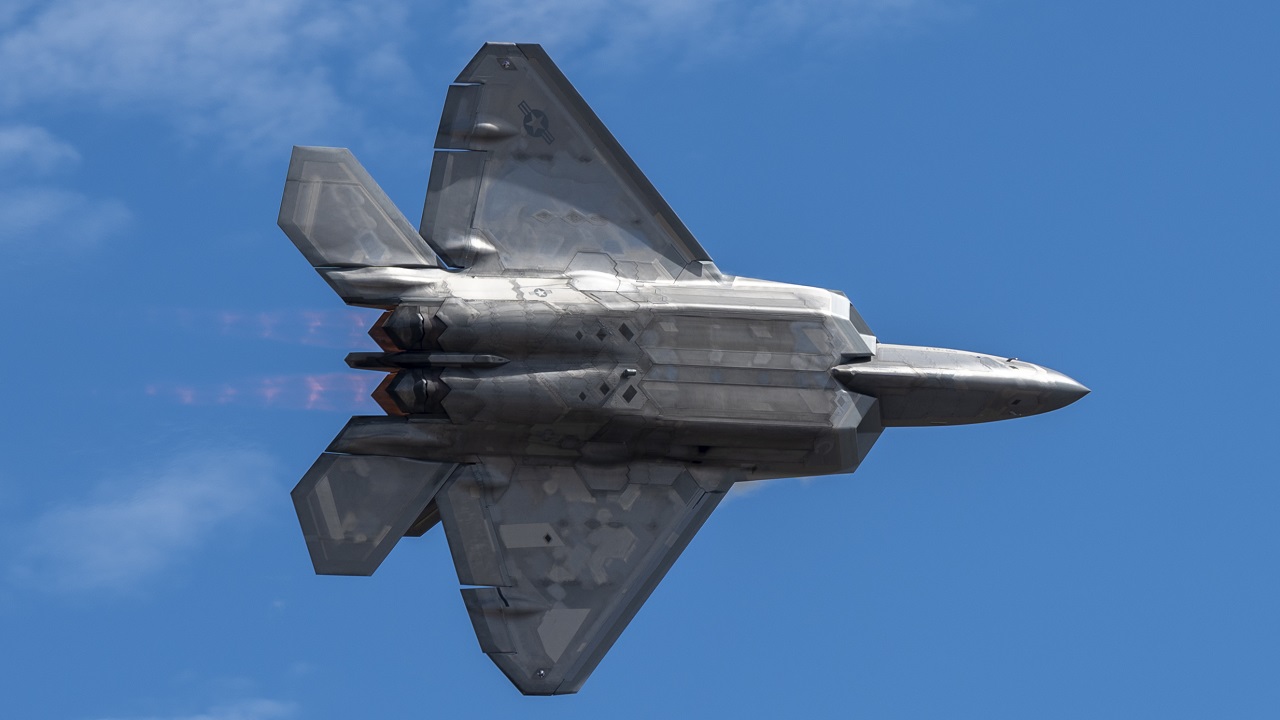
A U.S. Air Force F-22 Raptor conducts a heritage flight during the 2022 Marine Corps Air Station Miramar Air Show at MCAS Miramar, San Diego, California, Sept. 24, 2022. The F-22 Raptor is the Air Force’s fifth-generation fighter aircraft. Its combination of stealth, super-cruise, maneuverability, and integrated avionics, coupled with improved supportability, represents an exponential leap in war-fighting capabilities. The theme for the 2022 MCAS Miramar Air Show, “Marines Fight, Evolve and Win,” reflects the Marine Corps’ ongoing modernization efforts to prepare for future conflicts. (U.S. Air Force photo by Adam Bowles)
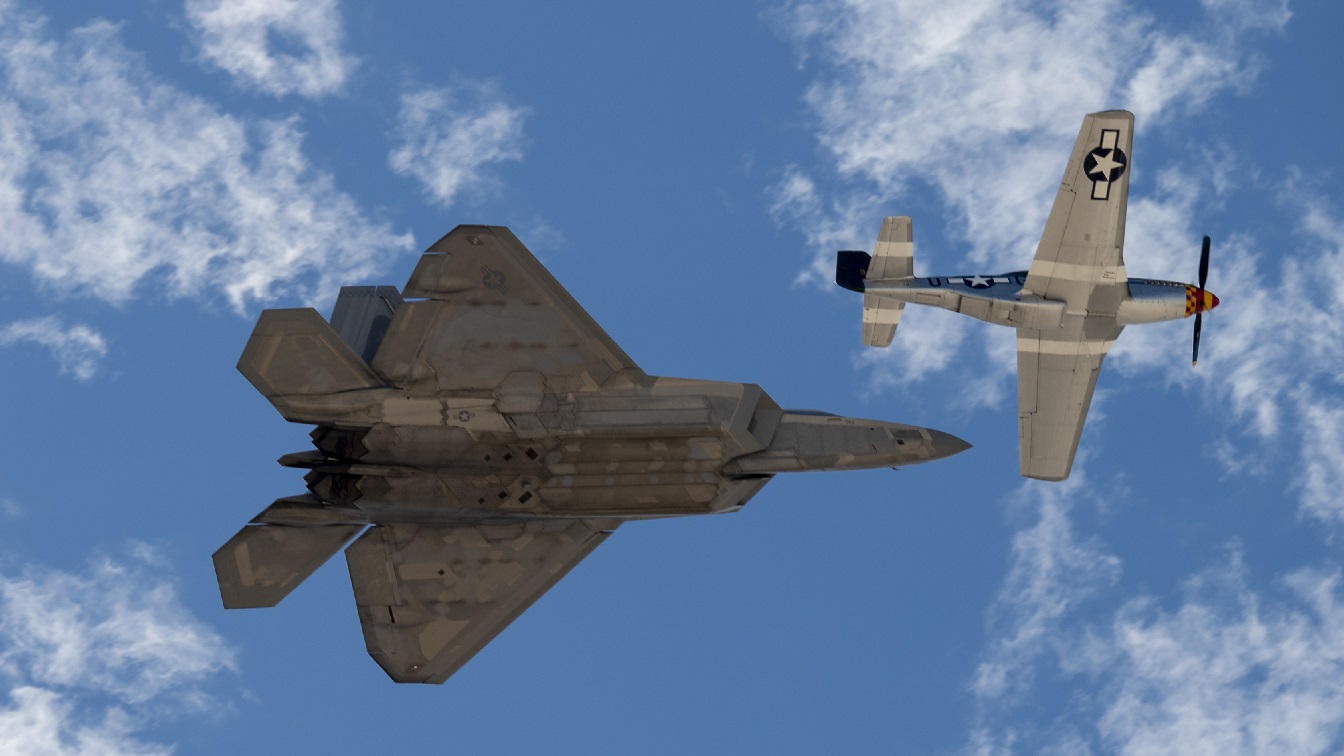
A P-51D Mustang and F-22 Raptor participate in a traditional “Heritage Flight” during the 2022 Marine Corps Air Station Miramar Air Show at MCAS Miramar, San Diego, California, Sept. 24, 2022. The theme for the 2022 MCAS Miramar Air Show, “Marines Fight, Evolve and Win,” reflects the Marine Corps’ ongoing modernization efforts to prepare for future conflicts. (U.S. Air Force photo by Adam Bowles)
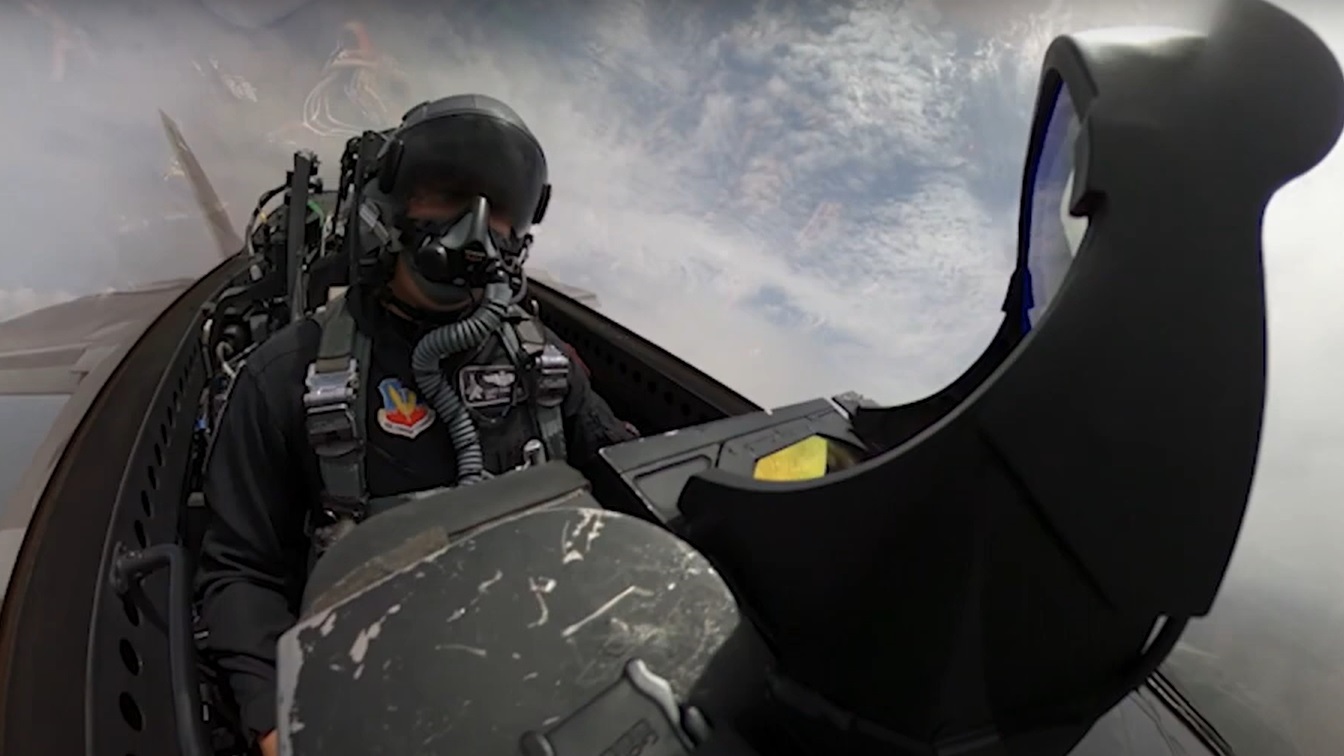
Maj. Joshua “Cabo” Gunderson, F-22 Demo Team pilot and commander, preforms a F-22 Raptor demonstration at the Space Coast Int. Air Show, May 22, 2022, with this video taken from inside the cockpit of an F-22.
Most people think that the F-22’s stealth capabilities set it apart.
But in an age where stealth is more available than ever before, when enemy air defenses are growing into exceptional counter-stealth systems, the F-22’s stealth is not its greatest feature.
The reason that the Air Force’s primary air superiority warplane remains lethal two decades after it entered operational service is its weaponry. In a way, that’s the most important part of any warplane, isn’t it?
And those weapons are paired with world-class electronic warfare (EW) capabilities and high-end sensors that give the pilot advanced situational awareness (and the capacity to wage war well beyond visual range).
Let’s look at the weapons.
In its standard air-to-air configuration, the F-22 can carry six AIM-120 Advanced Medium-Range Air-to-Air Missiles (AMRAAM) in its main internal weapons bays, along with two AIM-9 Sidewinders in smaller side bays. The F-22 Raptor also carries an internally mounted M61A2 Vulcan 20mm cannon capable of firing 480 rounds.
This bird can fight both beyond visual range (BVR), a key feature of the modern aerial battlefield, and up close in traditional dogfighting scenarios.
Packing a Punch
The AIM-120 is the cornerstone of the F-22’s primary air-to-air arsenal. AMRAAM is an all-weather, radar-guided missile designed for BVR attacks.
This system replaced the older AIM-7 Sparrow as the plane’s primary medium-range air-to-air missile. Paired with the F-22, the AMRAAM delivers an unbelievably lethal punch.
That’s because the aforementioned advanced sensor suite on the Raptor can detect and track enemy targets while relying on its exceptional stealth to shroud it as long as possible from its enemies.
The plane is a natural prowler. Indeed, the Air Force has dubbed this perfect fusion of sensors, stealth, and BVR air-to-air missile capabilities as a “first-kill opportunity” against enemy aircraft.
In fact, the newest AMRAAM, the AIM-120D, drastically increases the F-22’s reach, ensuring that the F-22 is better protected against the threat of those increasingly advanced enemy air defenses.
Close-In Kill Capacity
As noted above, the Raptor employs the AIM-9X, the newest short-range, infrared-guided air-to-air missile for close-quarters combat.
And the Sidewinder pairs nicely with the AMRAAM. The latter employs radar guidance to lock onto a distant target and fly to it, whereas the AIM-9X uses infrared guidance.
And don’t forget the powerful M61A Vulcan cannon. Hidden behind a door on the underside of the aircraft to maintain stealth, the cannon is deployed against truly close-range threats.
Together, these weapons form a perfect combination of offensive and defensive capabilities, creating a nearly impenetrable bubble around the F-22.
Can the F-22 Raptor Bomb Targets, Too?
The plane was developed primarily as an air-superiority fighter that prioritizes BVR warfare. Yet, if a pilot needed to “go retro” and drop classic bombs, the F-22 can do that, too.
The Air Force lists a typical air-to-ground configuration as two 1,000-pound GBU-32 Joint Direct Attack Munitions (JDAMs), two AIM-120s, and two AIM-9s.
All these systems–including the JDAMs–are carried internally to ensure maximum stealth.
JDAM is essentially a “dumb bomb” that has been given a brain by adding GPS-aided precision guidance to the bomb. So, the F-22 can penetrate enemy airspace and attack fixed ground targets without ever abandoning its air-to-air capability.
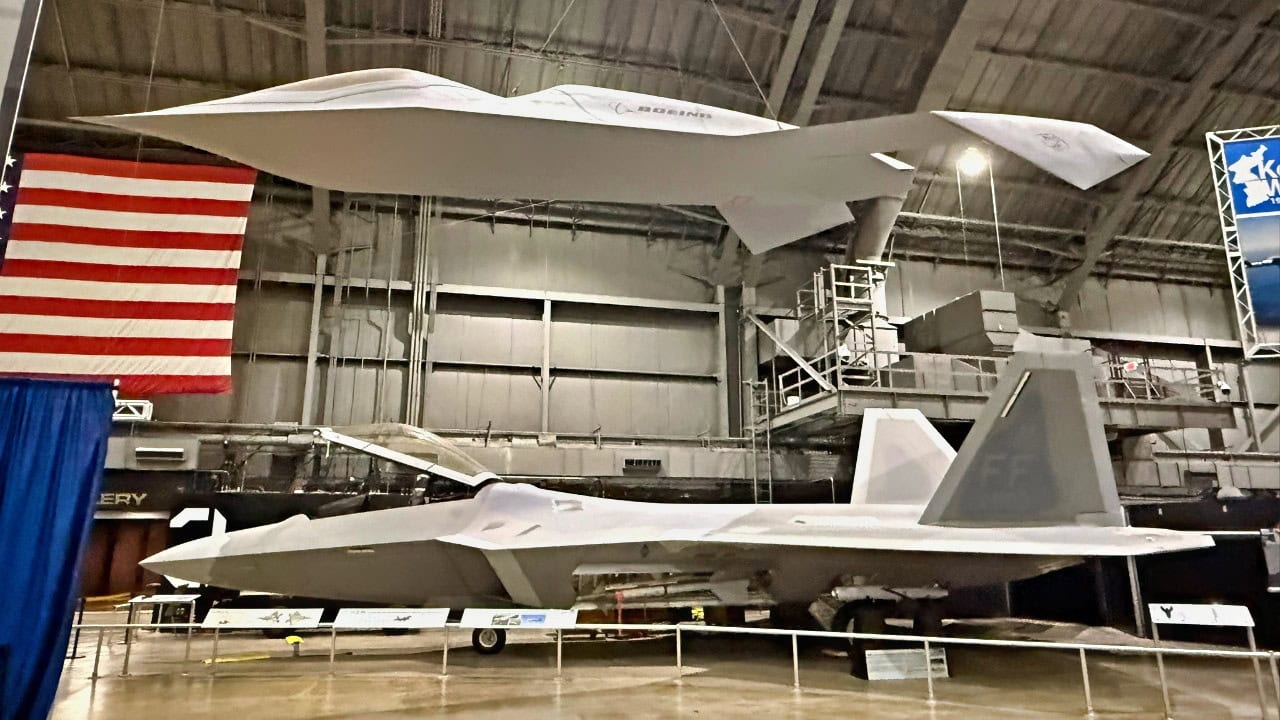
YF-118G. Image taken by Harry J. Kazianis for 19FortyFive.
The Air Force then added the 250-pound GBU-39 Small Diameter Bomb to the F-22’s arsenal. Because that weapon is relatively small, the F-22 can carry many more weapons internally.
The GBU-39 is an extended-range, all-weather precision weapon that employs GPS guidance. The F-22 can carry upwards of eight of these Small Diameter Bombs, thereby enhancing the number of ground targets that can be attacked during one mission.
Toward the AIM-260?
But the Air Force isn’t done upgrading the F-22’s firepower.
The AIM-260 Joint Advanced Tactical Missile is being developed as America’s next-generation long-range air-to-air weapon.
The program emerged partly in response to increasingly capable Chinese air-to-air missiles, including PL-15 and PL-17 (the former of which proved itself more than capable when Pakistani Air Force elements employed the PL-15 against Indian Air Force elements during the recent war).
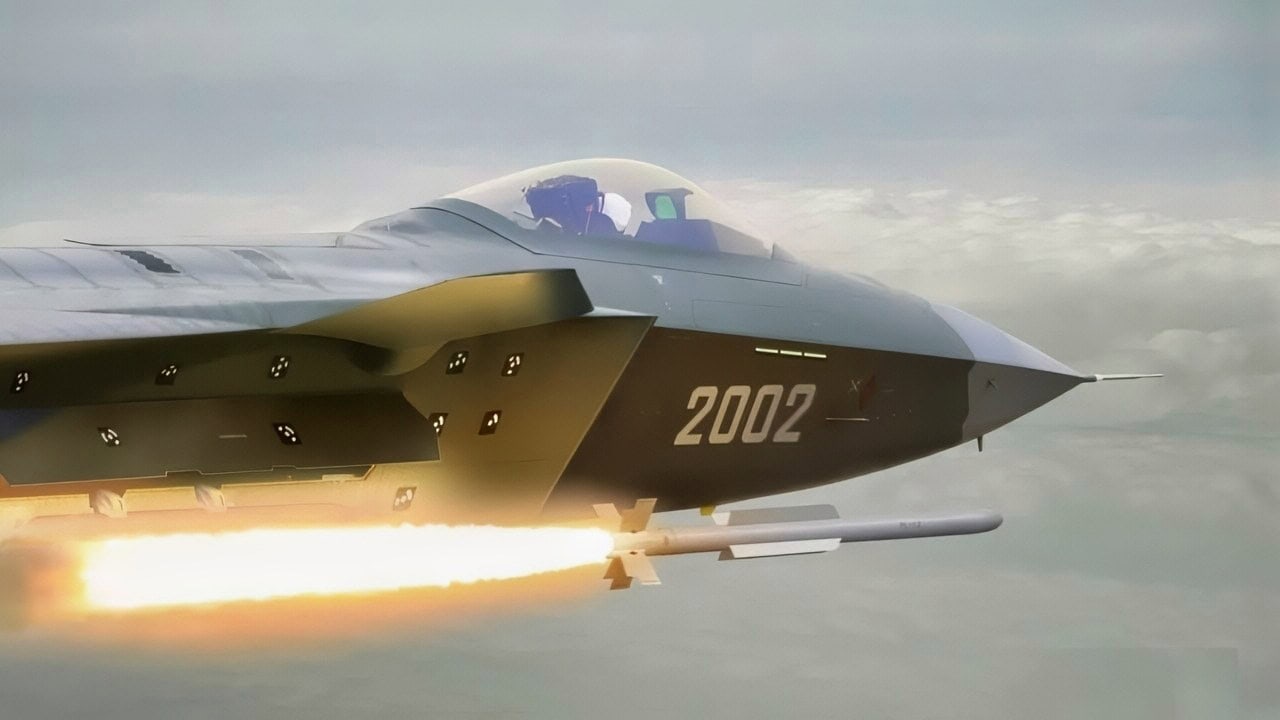
J-20 Mighty Dragon Stealth Fighter
Not much is known about the AIM-260’s capabilities. What can be inferred, though, is that this system will provide substantially greater range while still being launched from the stealthy internal bays of the F-22.
Indeed, the Air Force’s F-22 Raptor carries one of the most balanced arsenals imaginable: AIM-120s for BVR combat, AIM-9Xs for dogfighting, a 20mm cannon for truly close air combat, and bombs for ground-attack mission sets.
The F-22 isn’t just about stealth and speed. It’s about sensors and weapons. And that’s why the F-22 Raptor will continue being one of America’s most impressive warplanes for years to come.
About the Author: Brandon J. Weichert
Brandon J. Weichert is the Senior National Security Editor at 19FortyFive.com. He also manages The Weichert Brief on Substack. Weichert also hosts “National Security Talk” on Rumble. He is the author of four bestselling national security books, the most recent of which is A Disaster of Our Own Making: How the West Lost Ukraine (Encounter Books). Follow him via Twitter/X @WeTheBrandon.