
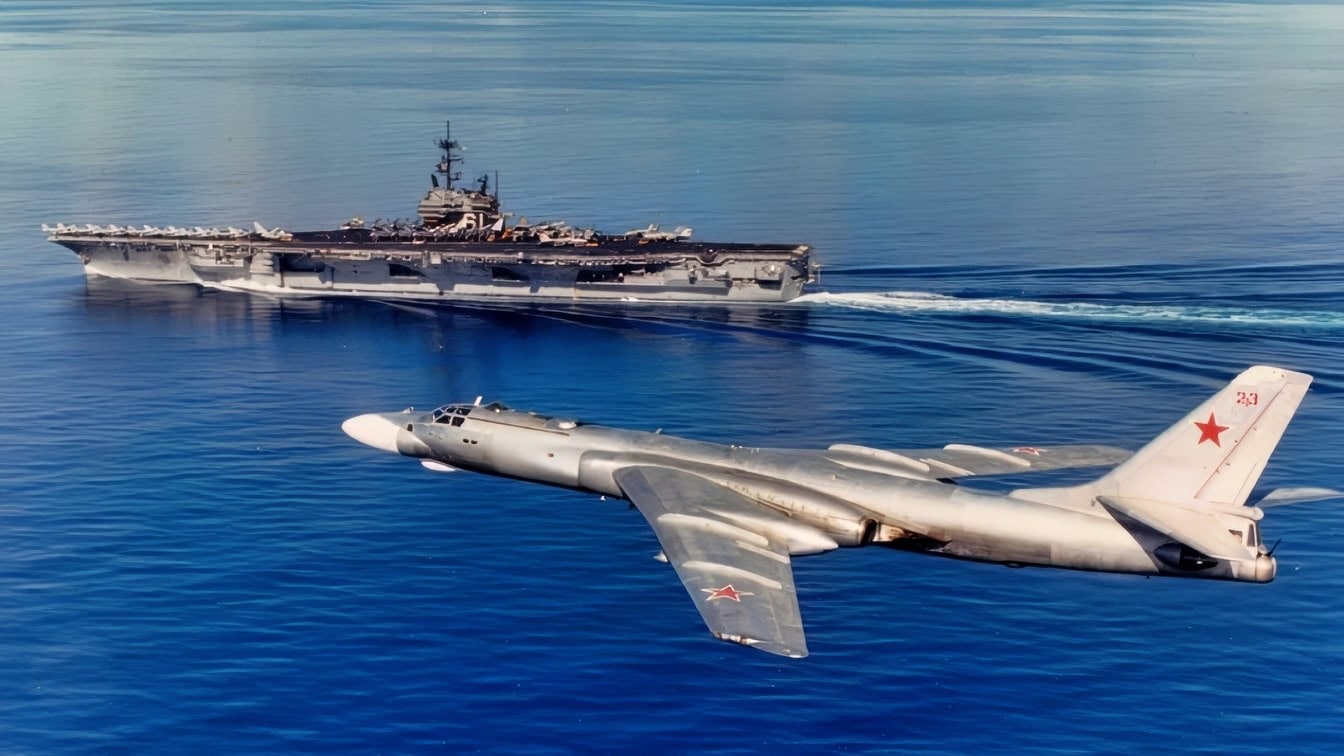
On May 25, 1968, the aircraft carrier USS Essex was involved in one of the Cold War’s most distinct encounters. Sailors aboard the Essex watched as a Soviet Tupolev Tu-16 Badger made an extremely low reconnaissance pass alongside the carrier in the Norwegian Sea.
The bomber completed the pass and turned around for a second pass.
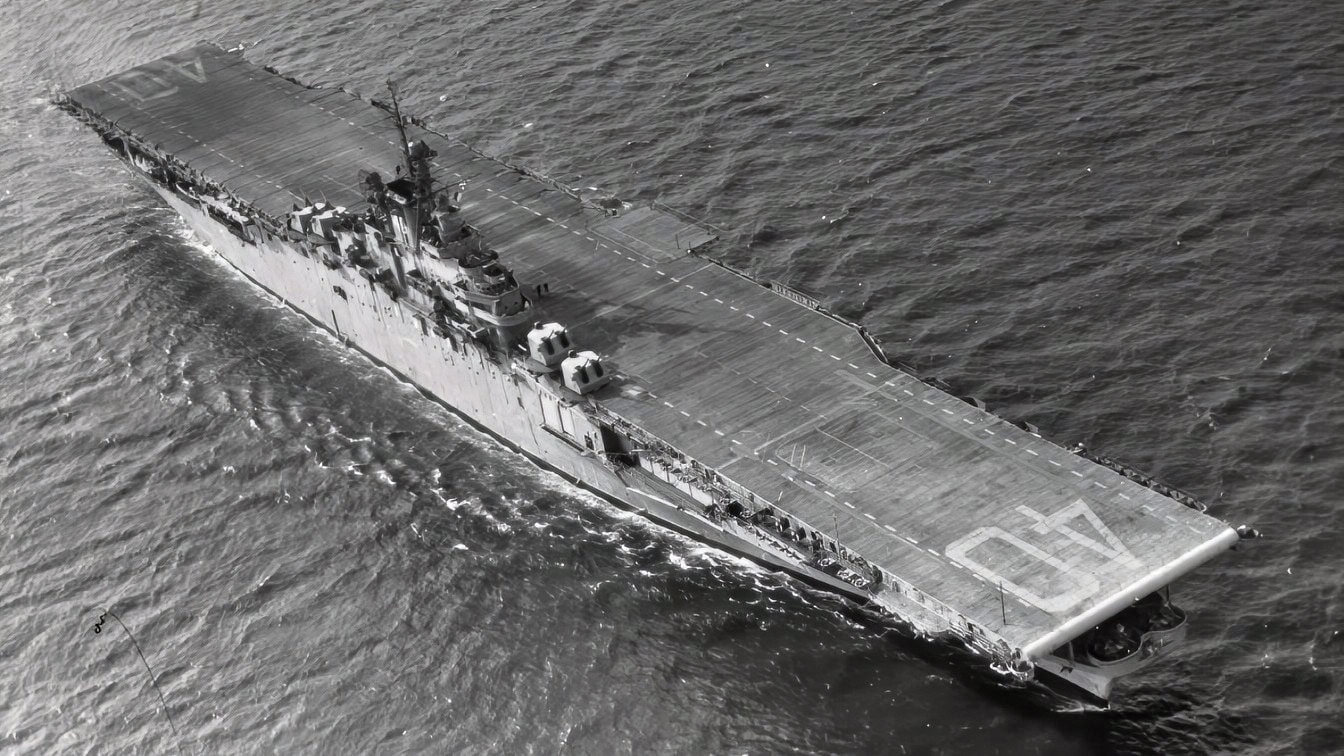
Essex-class US Navy Aircraft Carrier USS Tarawa (CV-40)
While banking, barely above the water, the bomber’s long wing clipped the water.
The aircraft disintegrated and exploded.
All seven Soviet crewmen were killed. US sailors documented the entire encounter, proving just how close US and Soviet forces used to routinely operate within one another during the Cold War, sometimes leaving no margin for error.
Buzzing a Carrier?
Why was a Soviet bomber buzzing an American carrier? It wasn’t just bravado.
Shadowing American carrier groups was an important mission for Soviet naval aviation.
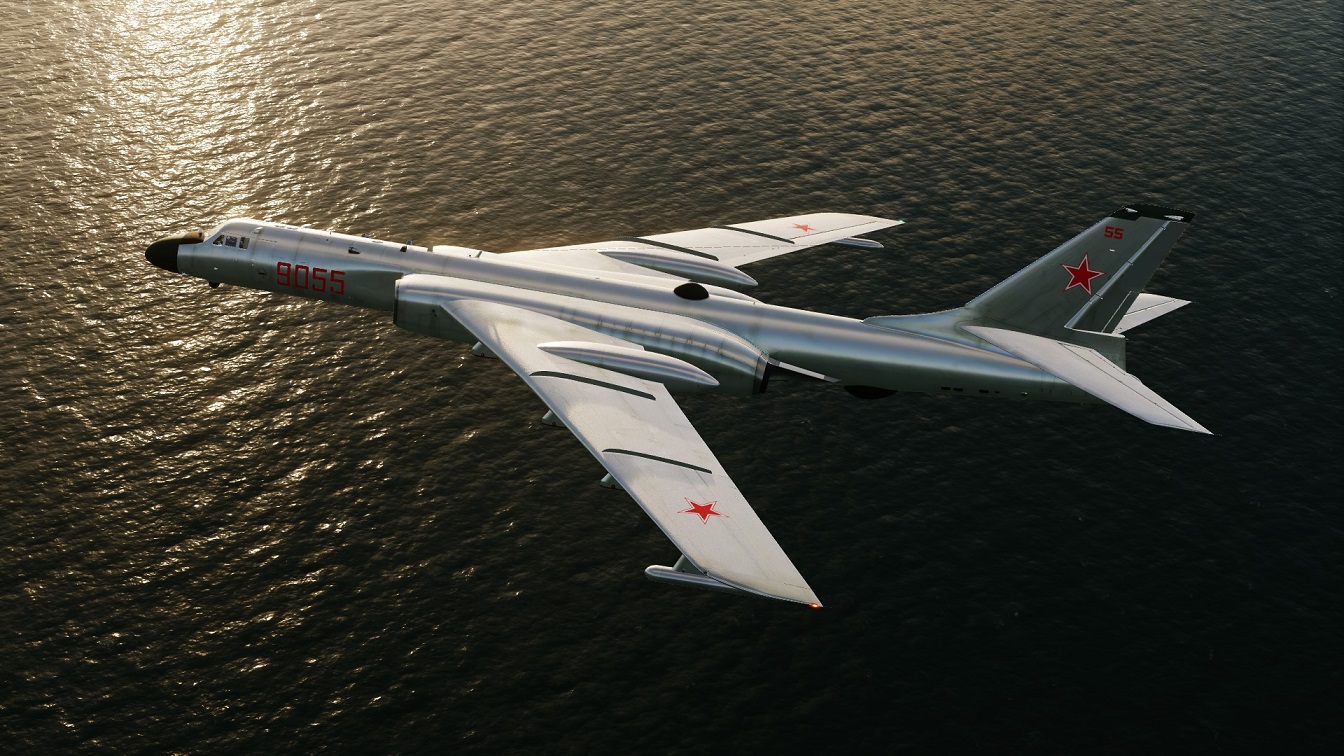
Tu-16. Image Credit: Creative Commons.
Carriers represented NATO’s global reach and its impressive strike capabilities.
Understandably, the Soviets had a vested interest in knowing where carriers were, their heading and speed, and the composition of their escorts.
The Soviets tracked flight operations and the carrier’s radar and defensive procedures.
Close passes were valuable because they could provide photography and electronic intelligence while also showing Americans that Soviet aircraft could find and approach an American carrier group.
But the reconnaissance went both ways; Americans could use the encounters to observe Soviet aircraft, photograph their equipment, and study their behavior.
These encounters became a strange sort of two-way dance, mixing intelligence collection with some peacocking.
The Tu-16
The Tu-16 wasn’t some lightweight prop recon plane.
It wasn’t at all the sort of thing you’d expect to be buzzing a carrier at sea level. Introduced during the 1950s, the Tu-16 was one of the Soviet Union’s most important early jet bombers.
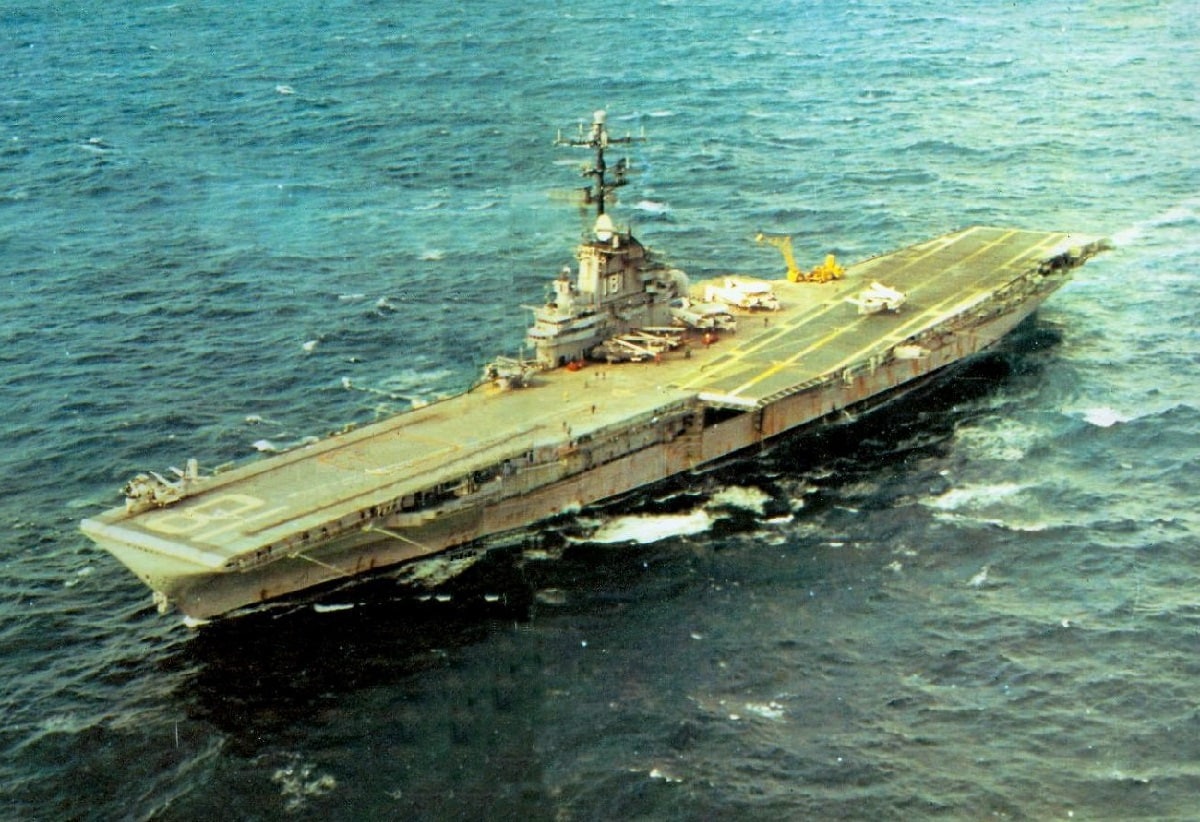
USS Wasp Essex-Class Aircraft Carrier. Image: Creative Commons.
Carrying the NATO designation “Badger,” the Tu-16 was 112 feet long with a 108-foot wingspan.
The maximum takeoff weight was about 175,000 pounds, while the two Mikulin AM-3 turbojets offered a maximum speed of around 650 miles per hour.
The bomber was long-range, capable of covering thousands of miles in a mission.
Originally conceived as a strategic bomber, the Tu-16 evolved into an extraordinarily versatile platform, with variants offering everything from nuclear strike and conventional bombing to maritime reconnaissance, electronic intelligence, electronic warfare, aerial refueling, and anti-ship missile attack.
Thanks to this versatility, the Tu-16 served as a central component of Soviet efforts to document and intimidate American carrier groups.
Approaching the Essex
By 1968, the Essex was no longer the World War II strike carrier people remember.
Since the end of the war, it had been converted into an anti-submarine warfare carrier, CVS-9.

Essex-Class Aircraft Carrier. Image Credit: Creative Commons.
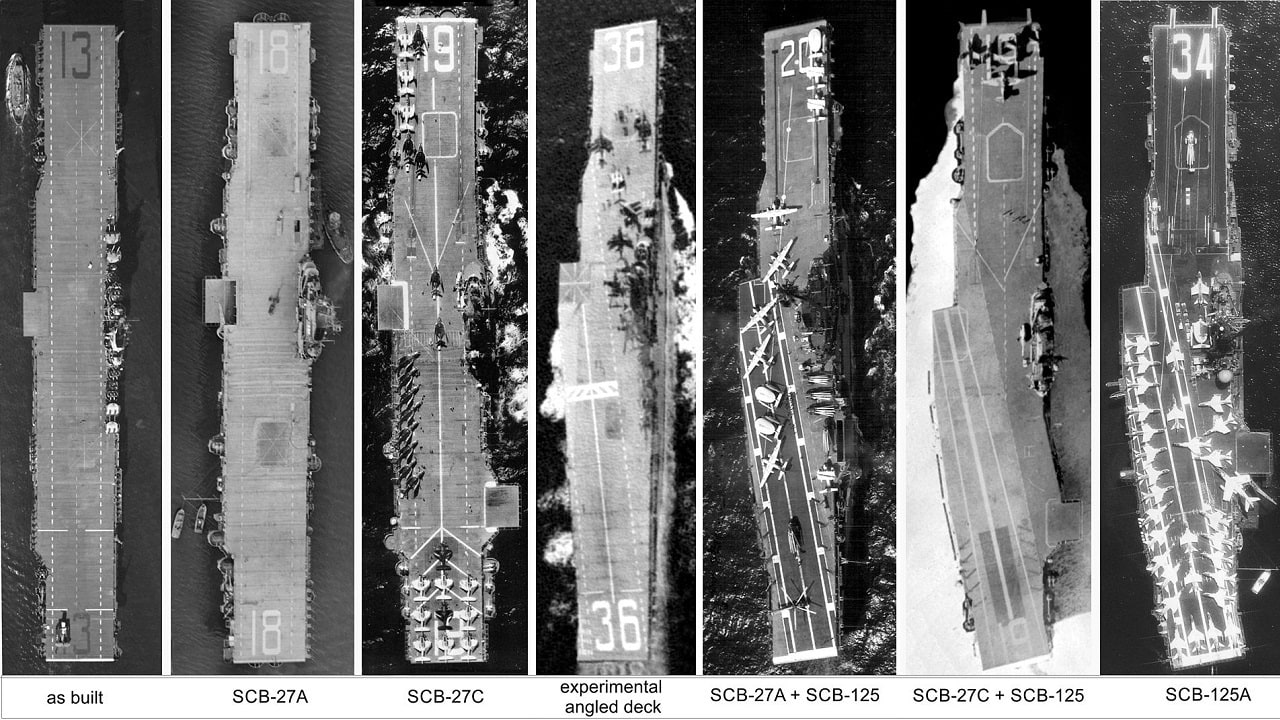
Seven aerial photographs showing the major different modernizations of the U.S. Navy Essex-class aircaft carriers (l-r): USS Franklin (CV-13), a “short hull” type as delivered, 21 February 1944. Franklin, USS Bunker Hill (CV-17), USS Boxer (CV-21), USS Princeton (CV-37), USS Tarawa (CV-40), USS Valley Forge (CV-45) and USS Philippine Sea (CV-47) received no or little modernization. USS Wasp (CV-18), after her SCB-27A conversion in late 1951: new hydraulic catapults, new island, removal of the deck guns, new bow. Modernized as such were USS Essex (CV-9), USS Yorktown (CV-10), USS Hornet (CV-12), USS Randolph (CV-15), Wasp, USS Bennington (CV-20), USS Kearsarge (CV-33) and USS Lake Champlain (CV-39). USS Oriskany (CV-34) was completed as such. USS Hancock (CV-19) after her SCB-27C modernization, circa 1955: like SCB-27A but new steam catapults and relocation of the aft elevator to the deck edge. USS Intrepid (CV-11) and USS Ticonderoga (CV-14) also received SCB-27C. USS Antietam (CV-36) after the installation of an experimental angled deck, circa 1954. USS Bennington (CV-20) after SCB-125: enclosed hurricane bow, angled deck, starboard deckedge elevator. USS Essex (CV-9), USS Yorktown (CV-10), USS Hornet (CV-12), USS Randolph (CV-15), Wasp, USS Bennington (CV-20) and USS Kearsarge (CV-33) received SCB-125. USS Hancock (CV-19) after SCB-125 in April 1957. The three SCB-27C ships were modernized as such an had the starboard deckedge elevator located further aft. The forward elevator was enlarged. USS Oriskany (CV-34) received SCB-125A, here on 30 May 1974. Similar to SCB-27C/SCB-125, only the starboard deckedge elevator was located further forward, as with the SCB-27A/SCB-125 ships. USS Lexington (CV-16), USS Bon Homme Richard (CV-31) and USS Shangri-La (CV-38) received SCB-27C/SCB-125 in one refit but had the starboard elevator in the same position as Oriskany.
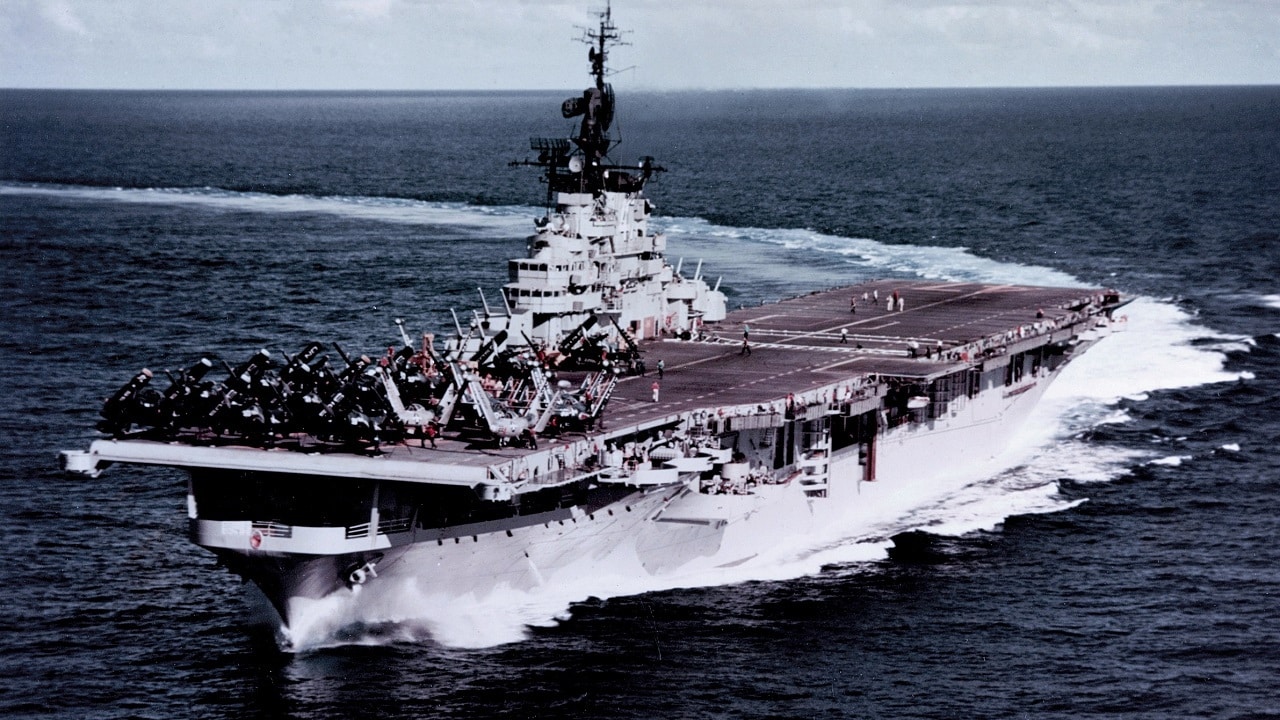
The U.S. Navy aircraft carrier USS Philippine Sea (CVA-47) makes a sharp turn to starboard, while steaming in the Western Pacific with the U.S. Seventh Fleet, 9 July 1955. Philippine Sea, with assigned Air Task Group 2 (ATG-2), was deployed to the Western Pacific from 1 April to 23 November 1955.
The aircraft aboard and the escorts helped NATO hunt Soviet submarines attempting to transit from northern Soviet bases into the open Atlantic.
The transit lane made the Norwegian Sea strategically important, which is why the Essex was there.
The Soviets didn’t appreciate the carrier’s presence, naturally, as they were forced to move through the area, through a chokepoint bounded by Norway, Iceland, Greenland, and Britain, to threaten Atlantic reinforcement routes. In this vital region, NATO kept a close eye on the Soviets, and vice versa.
The Fatal Pass
The Soviet Tu-16 approached the Essex repeatedly—at very low altitude.
Photographs of the encounter show just how close to the ocean the bomber operated.
It’s no surprise that on its final pass, when the Tu-16 entered a bank, the low wing and the water met.
The wings are huge. Banking in such an aircraft requires margins that the pilot didn’t allow for.
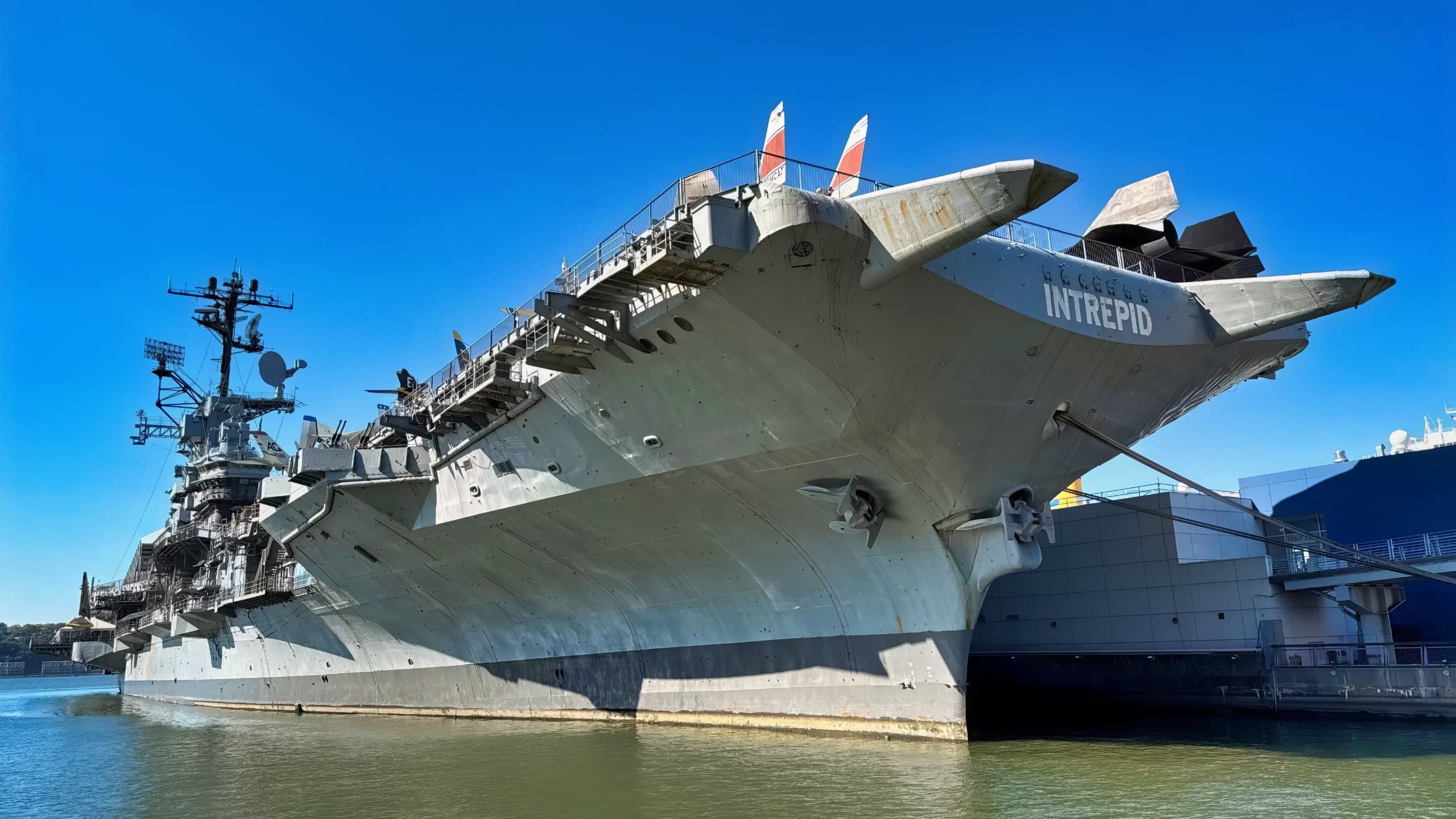
Essex-Class USS Intrepid 19FortyFive.com Photo
The crash was the obvious outcome for such a maneuver, especially considering that a bank changes an aircraft’s lift geometry.
That is, in a bank, not all of the aircraft’s lift generation remains vertical, so maintaining altitude in a bank requires an increase in total lift, which requires adjusted inputs on the controls.
Without sufficient corrective input, the aircraft naturally descends slightly.
Add high speed, waves of variable height, and the depth-perception problems inherent to featureless water, and the crash starts to feel inevitable.
When the Tu-16’s wing contacted the sea at hundreds of miles per hour, the bomber was forced into a cartwheel, which caused disintegration and ultimately an explosion.
About the Author: Harrison Kass
Harrison Kass is a writer and attorney focused on national security, technology, and political culture. His work has appeared in Tablet, City Journal, The Hill, The Spectator, and The Cipher Brief. He holds a JD from the University of Oregon and a master’s in Global & Joint Program Studies from NYU. More at harrisonkass.com.