
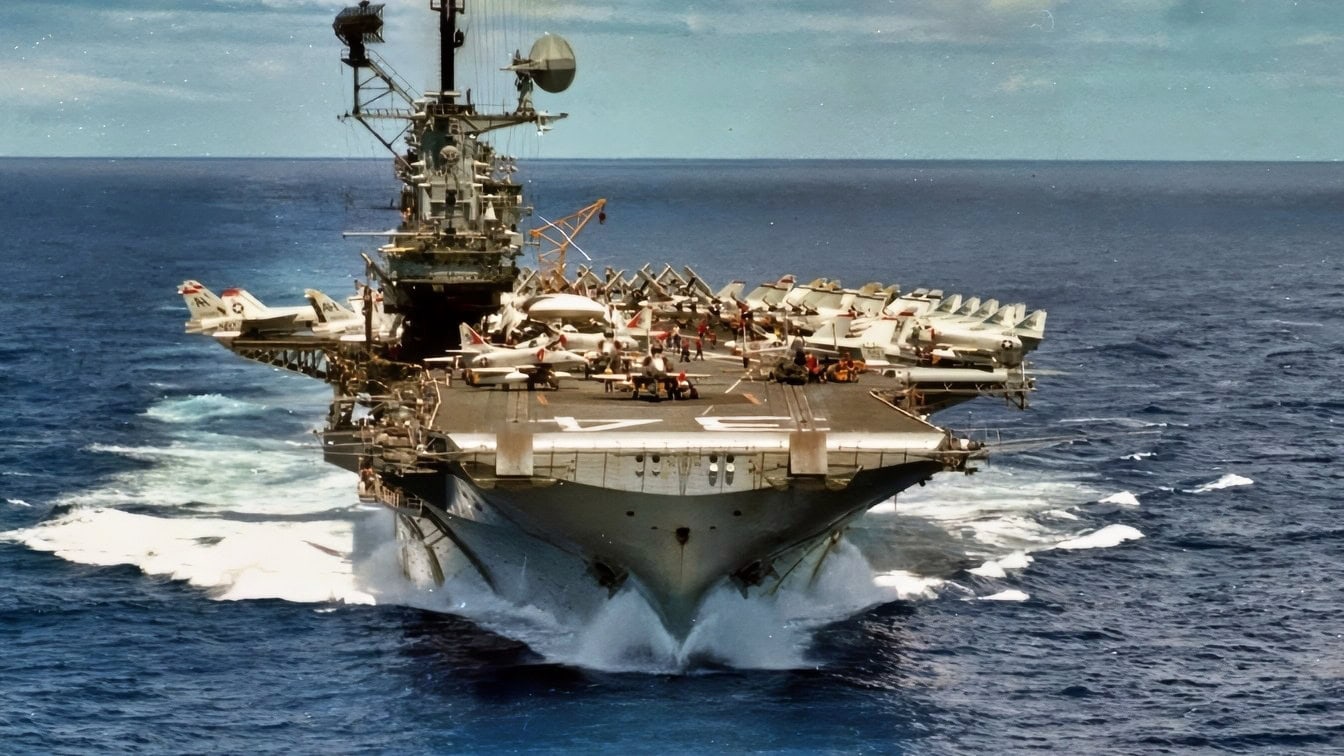
One accidentally armed magnesium flare killed 44 men, injured 156, and caused an estimated $11 million in material damage aboard USS Oriskany on October 26, 1966. The fire began at 7:28 a.m. while the Essex-class carrier operated on Yankee Station in the Gulf of Tonkin. It took three hours and seven minutes to extinguish. Forty-three victims died from asphyxiation. One died from burns and other injuries.
Oriskany was in the middle of the Vietnam air war. Aircraft and crews had been launching strikes against North Vietnam, though poor weather canceled three overnight launches before the fire. Aviators were sleeping in forward staterooms, mechanics worked in the hangar, and ordnance personnel returned unused Mk 24 Mod 3 parachute flares to storage. The Navy’s contemporary account describes an ordinary carrier morning becoming a shipwide emergency in one minute.
Two sailors were restowing the flares when one fell. Its igniter had not been reset to SAFE, and the fall pulled the safety lanyard. The flare fired. A sailor picked up the burning device, threw it into the magazine locker, and closed the door. The decision placed an armed pyrotechnic beside more flares and 2.75-inch rocket warheads filled with Composition B.
The flare started the casualty, but the nearby ordnance turned it into a disaster. Magnesium burned at thousands of degrees inside a closed steel space. Heat ignited more flares and detonated rocket warheads, blasting fire and caustic smoke into Hangar Bay No. 1 and the forward section of the ship. The fire reached fuel, aircraft, ammunition, and the liquid-oxygen storage area. Smoke moved through passageways before rescue teams cleared them.
Hangar Bay No. 1 Became a Smoke Trap
The flare locker stood on the starboard side near the forward aircraft elevator. Officers’ quarters and ready spaces were close by. Several aviators were still in their bunks after the canceled night launches. The location mattered as much as the heat. A flight-deck fire has open air and multiple approach routes. Oriskany’s fire burned inside the hull, where narrow passageways, warped bulkheads, and thick smoke cut off escape.
Five of the eight officers assigned to the ship’s HC-1 helicopter detachment died. In all, the fire killed 44 officers and sailors and injured 156. Most never suffered fatal burns; smoke and toxic gases overwhelmed them in enclosed compartments. A Naval History account records helicopter crewmen rescuing sailors who had jumped into the sea and carrying firefighting equipment from USS Constellation.
The material losses were also severe. Two helicopters and one A-4E Skyhawk were destroyed, while three more A-4Es were damaged. Hangar Bay No. 1, the forward officers’ quarters, catapults, the forward elevator, and electrical circuits suffered extensive damage.
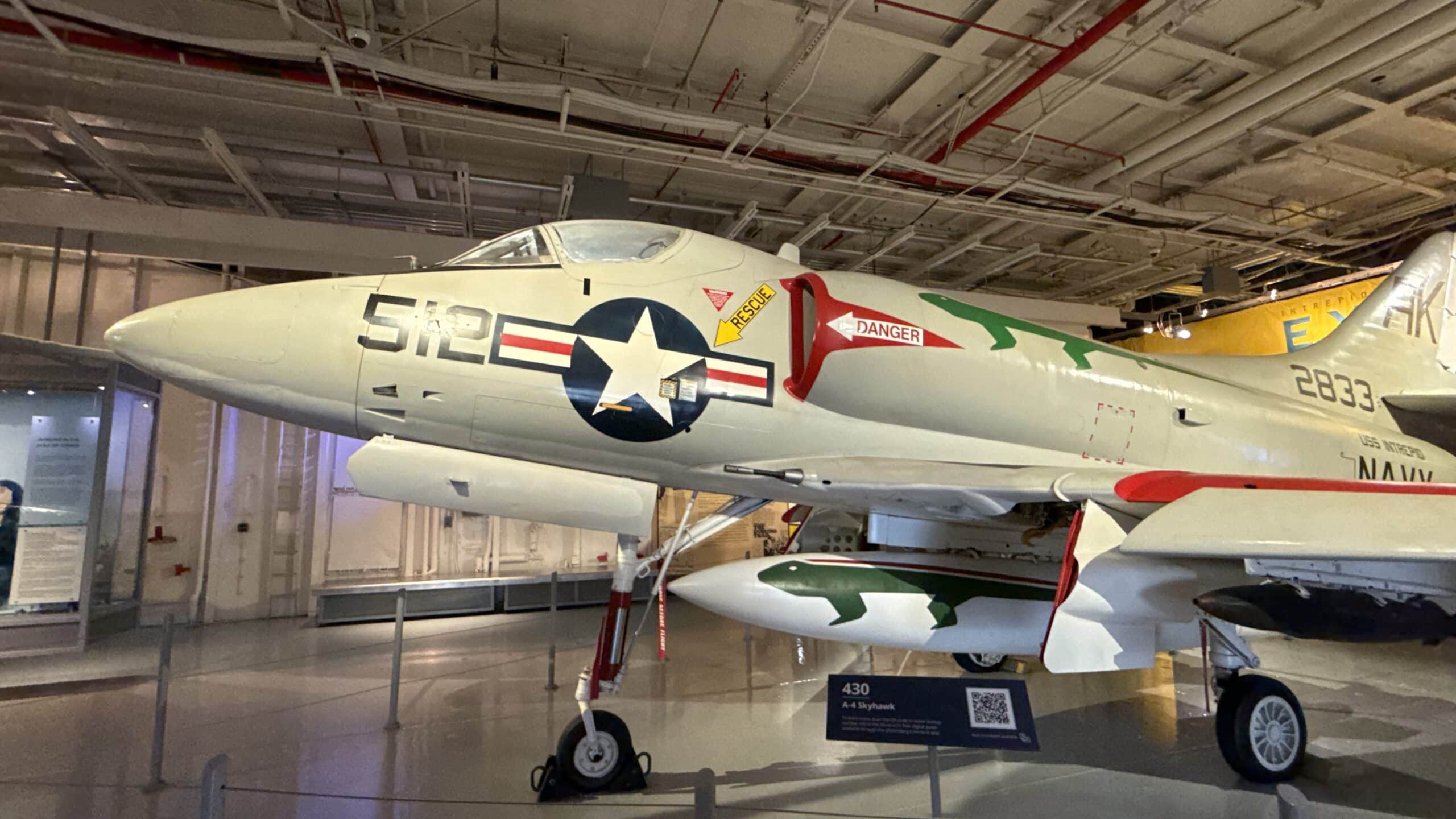
A-4 Skyhawk 19FortyFive Photo from USS Intrepid.
The estimated $11 million bill equals far more in modern purchasing power, but no conversion captures the loss of experienced aviators and sailors during an active combat deployment.
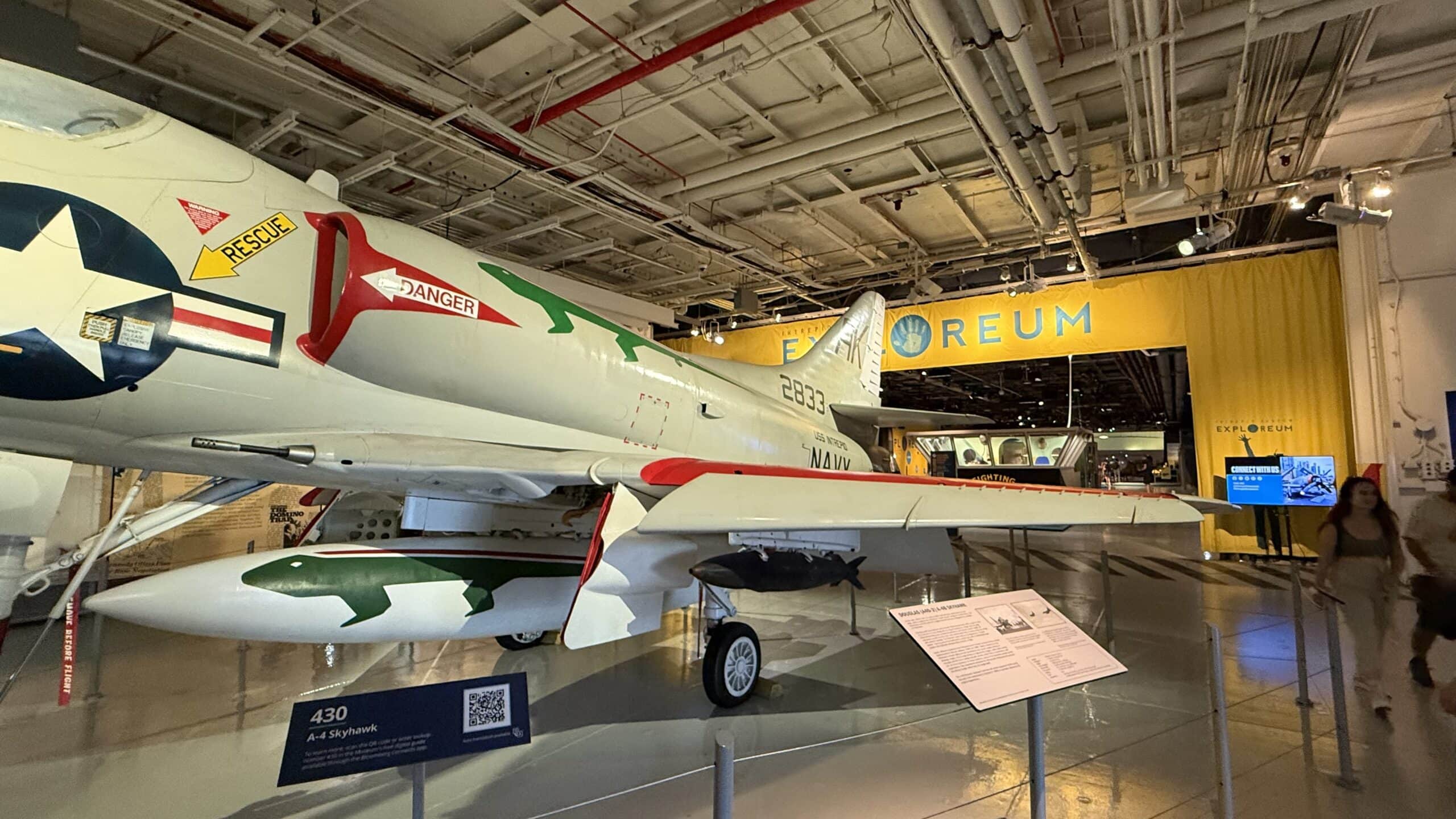
A-4 Skyhawk 19FortyFive Photo from USS Intrepid.
Oriskany’s Fire Parties Had Water on the Blaze in 30 Seconds
The first response began almost immediately. Under Aviation Boatswain’s Mate Second Class Henry Brooks, a fire party had hoses trained on the blaze in less than half a minute. An explosion then rolled a fireball through the hangar, knocked firefighters from their feet, and burned through hoses leading from forward areas. Some injured sailors stayed at their stations while replacement lines came from aft.
Water did not offer a simple way to extinguish burning magnesium. It was essential for cooling bulkheads, bombs, and surrounding fires. Ordnance teams pushed tons of bombs over the side before heat reached their explosive fillings. Lt. J.g. Robert Davis and his men removed five-inch ammunition, cooled bombs on the starboard sponson, and kept working while 20mm rounds cooked off in the smoke.
Damage Controlman Second Class Billy Coleman, Aviation Boatswain’s Mate First Class Noel Hartford, and fire marshal Lt. J.g. Robert Williamson fought their way toward the liquid-oxygen compartment with large hoses. Their boundary cooling kept the area from becoming a larger source of destruction. Other teams moved aircraft away from the forward hangar, searched staterooms with oxygen breathing apparatus, and rigged emergency lighting after electrical damage darkened the passageways.
USS Constellation received wounded men by helicopter and supplied equipment. Sailors aboard the Oriskany pulled survivors from smoke-filled spaces and rescued one trapped man with scuba gear. The fire was declared extinguished three hours and seven minutes after the alarm.
The Crew Stopped a Larger Ordnance Chain Reaction
The ship survived because its crew separated the fire from the explosives and fuel still within reach. Moving aircraft reduced the number of full tanks and cartridge-actuated devices exposed to heat. Jettisoning bombs prevented larger detonations. Cooling the liquid-oxygen area and surrounding compartments bought time. The men did not reverse the original mistake; they kept one flare from producing a carrier-wide magazine and fuel catastrophe.
The episode explains why fire remains an aircraft carrier’s most immediate internal enemy. A carrier concentrates aviation fuel, explosives, oxygen, electrical power, and thousands of people inside one moving structure. On Oriskany, the most lethal agent was not a bomb blast. It was smoke passing into spaces where men had little warning and few usable exits.
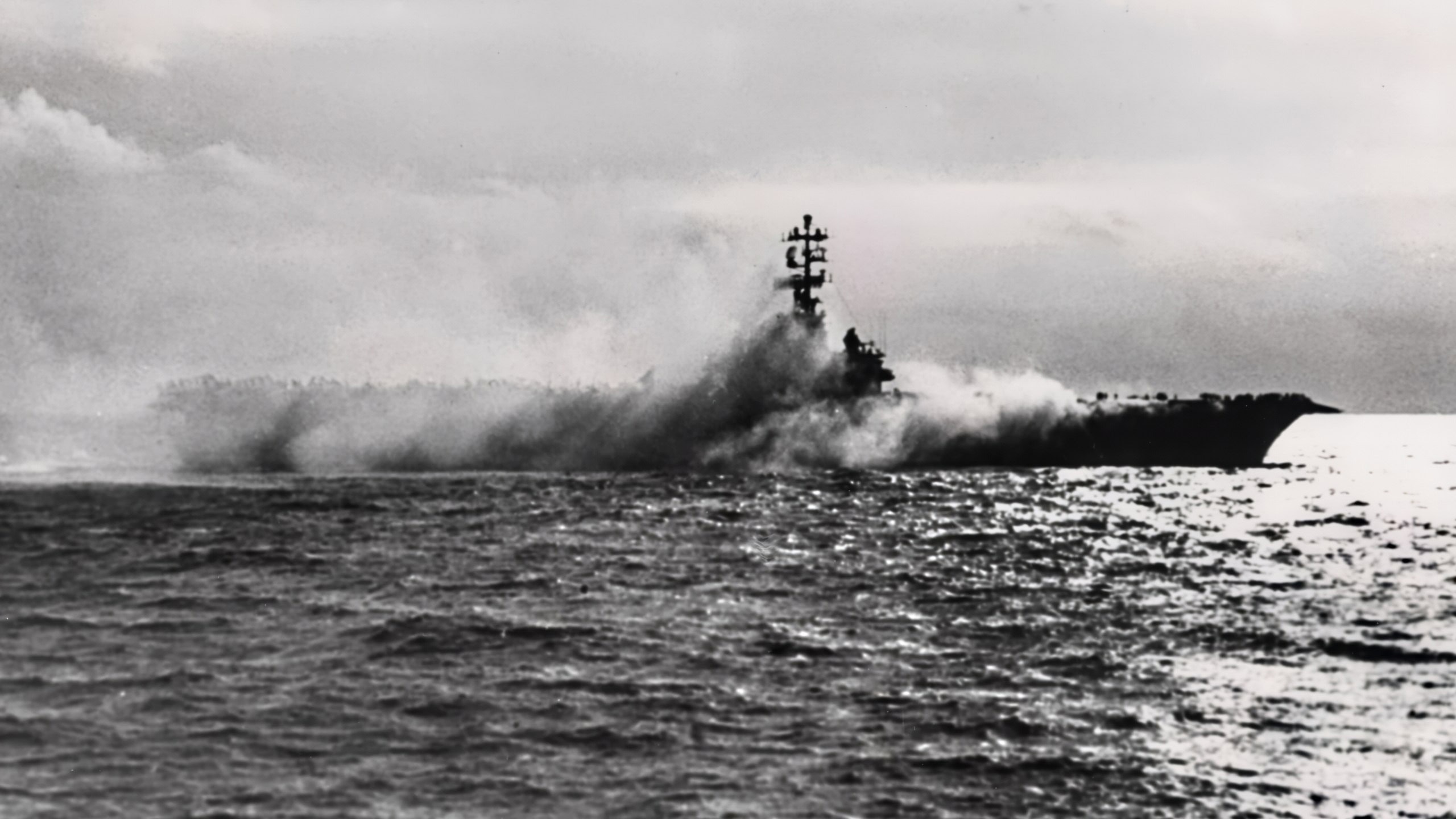
The U.S. Navy aircraft carrier USS Oriskany (CVA-34) on fire, 26 October 1966. Smoke pours from Oriskany’s Hangar Bay No.1, during the fire which killed 44 of her officers and men.
Oriskany Forced the Navy to Reconsider Ordnance Safety
The first lesson was larger than one sailor’s panicked decision. The safety chain had already failed before the flare hit the deck. Its igniter had not been returned to SAFE. Personnel were handling pyrotechnics beside sensitive warheads. One error reached an entire locker without enough physical or procedural margin to stop escalation. Later accounts of the Oriskany tragedy focus on the thrown flare, but storage, supervision, and weapon sensitivity determined the scale of the loss.
Oriskany became the first of three catastrophic American carrier fires in the period. A Zuni rocket started the USS Forrestal fire in July 1967, killing 134. A jet starter overheated a Zuni warhead aboard USS Enterprise in January 1969, killing 28. The three disasters drove tighter ordnance procedures, more rigorous firefighting instruction, and the creation of the Weapon System Explosives Safety Review Board.
The operational lesson was equally direct. Every sailor on a carrier has a damage-control role. Escape routes must be known before smoke erases signs and landmarks. Fire boundaries matter as much as the point of ignition. Explosives must be cooled, isolated, or removed before heat turns them into another incident. Those principles became harder institutional requirements after Oriskany, Forrestal, and Enterprise.
USS Oriskany Returned to Vietnam in 1967
After limited work at Subic Bay, Oriskany returned to California and entered the San Francisco Bay Naval Shipyard in November 1966. Repairs restored the hangar, forward living spaces, elevator, catapult equipment, and damaged electrical systems. The carrier deployed again in June 1967 and resumed combat operations from Yankee Station in July.
Oriskany remained in service until September 1976. On May 17, 2006, the Navy sank the retired carrier as an artificial reef after a three-year, $20 million environmental preparation. The ship went down in 37 minutes and settled upright off Pensacola in 212 feet of water. Her flight deck lies between 145 and 150 feet below the surface of the Gulf of Mexico.
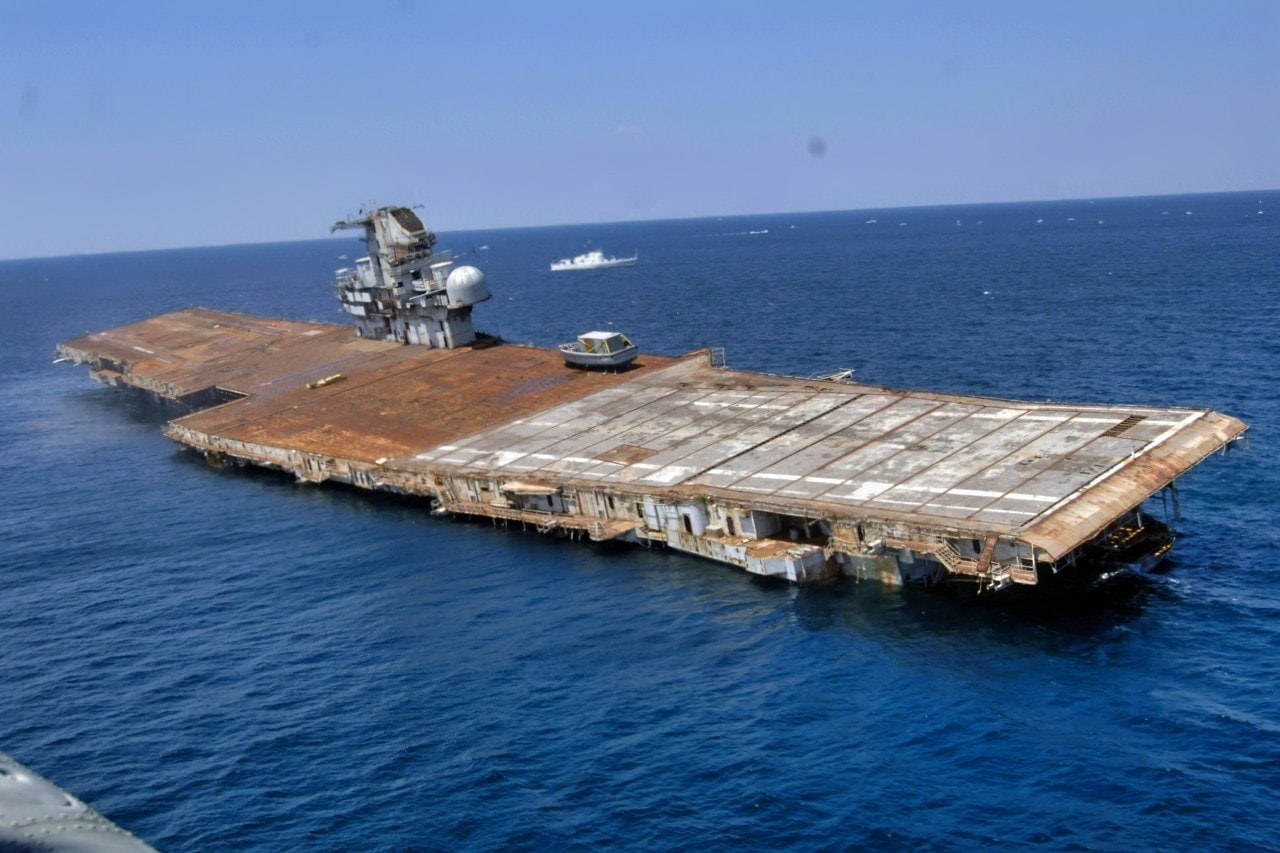
Aircraft Carrier Sinking from U.S. Navy in 2006. USS Oriskany. Creative Commons Photo.
MORE – 5 Worst US Navy Aircraft Carriers Ever
MORE – 5 Worst Aircraft Carriers Ever
About the Author: Harry J. Kazianis
Harry J. Kazianis (@Grecianformula) was the former Senior Director of National Security Affairs at the Center for the National Interest (CFTNI), a foreign policy think tank founded by Richard Nixon based in Washington, DC. Harry has over a decade of experience in think tanks and national security publishing. His ideas have been published in the NY Times, The Washington Post, The Wall Street Journal, CNN, and many other outlets worldwide. He has held positions at CSIS, the Heritage Foundation, the University of Nottingham, and several other institutions related to national security research and studies. He is the former Executive Editor of the National Interest and the Diplomat. He holds a Master’s degree focusing on international affairs from Harvard University.

