
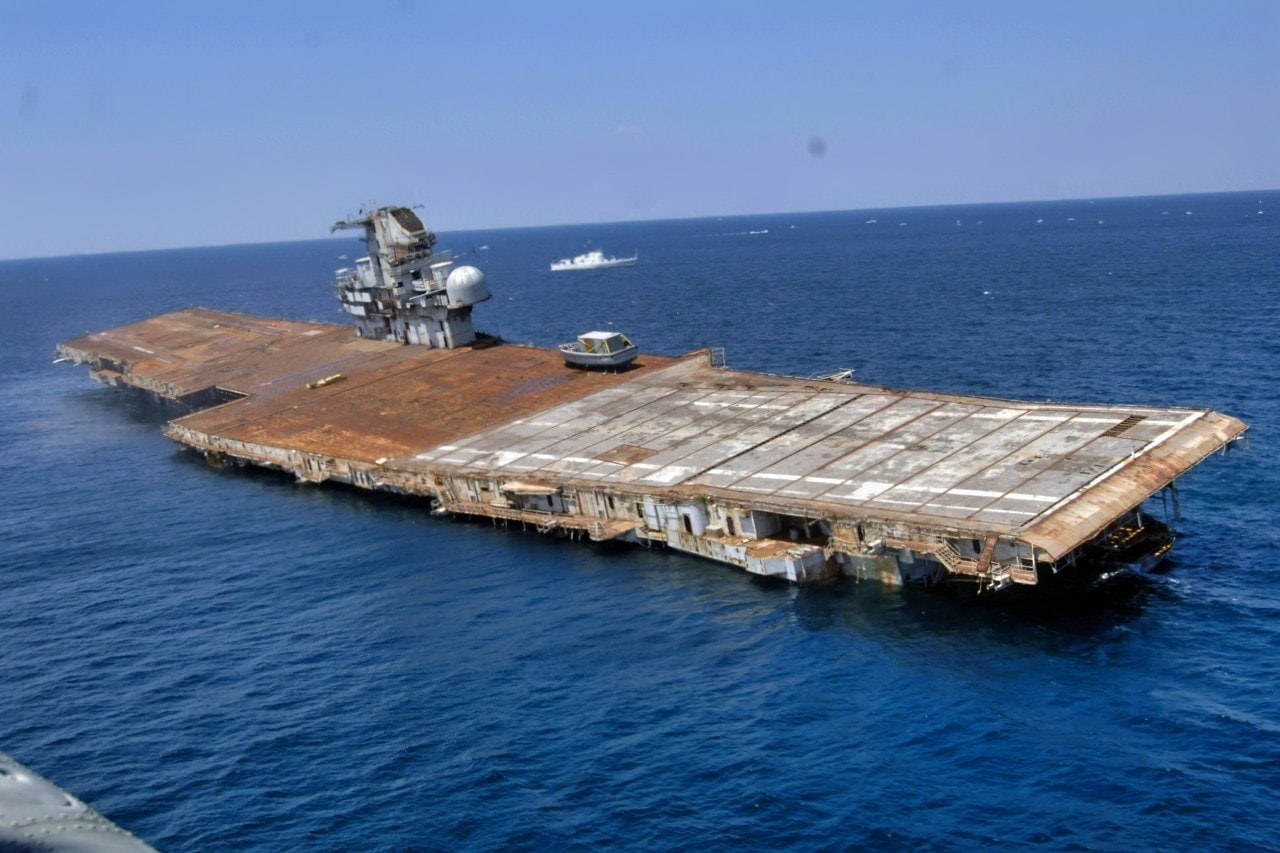
US Navy Essex-class Aircraft Carrier USS Oriskany Took $20 Million and Three Years to Become the Great Carrier Reef – On May 17, 2006, USS Oriskany slipped beneath the Gulf of Mexico 22.5 nautical miles southeast of Pensacola Pass. The retired carrier went down stern first in about 37 minutes and settled upright in 212 feet of water. The Florida Fish and Wildlife Conservation Commission now describes her as the first naval warship and largest artificial reef intentionally sunk in U.S. coastal waters.
Oriskany was not a small ship chosen because disposal looked easy. The Essex-class carrier measured 911 feet after modernization, displaced about 27,100 tons, and once operated as many as 80 aircraft. Her crew reached roughly 3,460 sailors during active service, according to the Navy’s Ships-to-Reef program history.
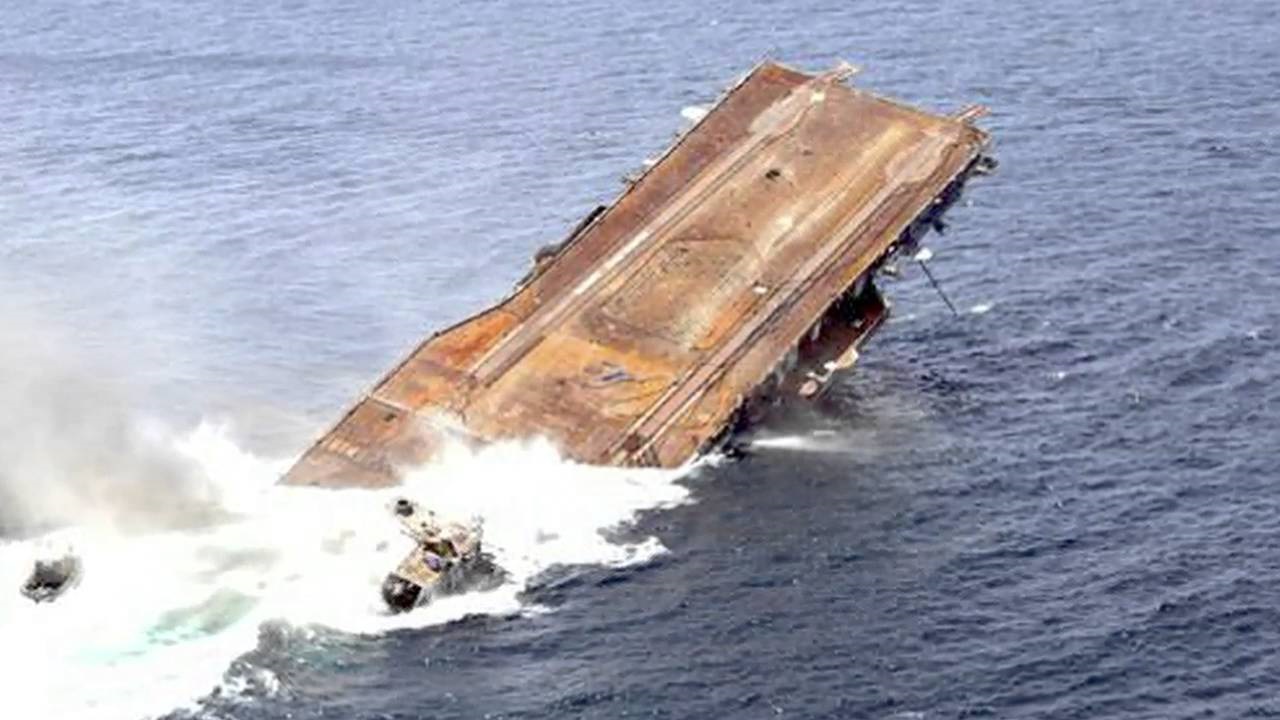
USS Oriskany Sinking in U.S. Navy Controlled Demolition. Image Credit: Creative Commons.
The Navy did not sink the Oriskany as a live-fire target. The plan was to transfer the prepared hull to Florida, place it inside an approved reef area, and create habitat for marine life while supporting fishing and recreational diving. The project became the first test of the Navy’s new reef-disposal authority under the fiscal 2004 National Defense Authorization Act.
It was not a cheap shortcut for disposal. The Navy later placed the environmental preparation and sinking cost at approximately $20 million. The work required years of cleaning, scientific review, towing, regulatory approval and a carefully engineered flooding plan.
Why the Navy Chose to Sink Essex-Class USS Oriskany
Oriskany entered service in September 1950 after the Navy completed her to a heavily modernized Essex-class design. She fought in Korea and Vietnam, earned two Korean War battle stars and 10 for Vietnam, and survived the October 1966 fire that killed 44 officers and sailors. The disaster remains one of the darkest events in the carrier’s long combat history.
The Navy decommissioned the Oriskany in September 1976 and kept her in reserve until striking the ship from the Naval Vessel Register in July 1989. Museum ideas failed. Scrap arrangements also failed, leaving the Navy with an aging conventional carrier that continued requiring storage, inspection, and disposal planning.
Oriskany was better suited to reefing than a nuclear-powered carrier because she had no reactor plant or spent nuclear fuel. She also offered an enormous steel structure for a marine habitat. Florida and Escambia County saw another value: a historic wreck large enough to attract divers and anglers from outside the region.
The decision still involved a trade-off. Conventional carrier dismantlement often recovers enough steel to reduce disposal costs. A later Navy review noted that scrapping became more economical as metal prices rose. Oriskany instead served as a pilot project for a new disposal path and preserved part of the Essex-class story underwater.
Cleaning USS Oriskany Took Years
Resolve Marine and its project partner moved the ship to Corpus Christi, Texas, for environmental preparation. More than 150 workers opened and cleaned over 500 tanks. They removed fuel, oil, antifreeze, batteries, fire-suppression materials, asbestos, loose debris, flaking paint, and other hazardous substances. The contractor also removed the entire wooden flight deck after testing found high PCB concentrations in the material.
Polychlorinated biphenyls created the hardest problem. PCBs had been used in electrical cable, insulation, gaskets, paint, and other products aboard ships built before the chemical was banned. The Navy removed all liquid PCBs, more than 70 percent of bulkhead insulation, and large quantities of other solid material.
About 700 pounds of PCBs remained in solid products, with roughly 97 percent contained inside electrical cables. Removing every cable would have required dismantling much of the ship. The Navy instead conducted leaching studies, computer modeling, and human-health and ecological risk assessments.
The Environmental Protection Agency issued a ship-specific approval in February 2006 after concluding the remaining material did not pose an unreasonable risk. Florida also agreed to monitor fish caught at the site. The approval applied only to Oriskany, rather than creating an automatic exemption for later ships.
The regulatory work delayed the sinking from 2005 into 2006. Oriskany had already reached Pensacola, but the Navy towed her back to Texas for the hurricane season while the review continued. She returned after the EPA decision for final work at Naval Air Station Pensacola.
How the Navy Sent the Aircraft Carrier to the Bottom
The State of Florida completed additional work around the island for diver safety. The Navy then followed a sinking plan developed specifically for the carrier. Workers removed selected external blanks from the underwater hull, allowing seawater to reach closed valves and internal barriers inside the sea-chest system.
Navy explosive-ordnance personnel placed small C-4 charges inside eight machinery spaces. The simultaneous detonations opened the main sea-chest piping, and progressive flooding pulled the carrier down. This was controlled scuttling rather than the type of weapons test used when the Navy sank USS America to collect survivability data.
Oriskany remained almost level as water filled the lower hull, then the stern disappeared, and the bow followed. Engineers wanted the ship upright, and it reached the bottom in that position. The bow points due south, with the hull aligned north to south.
Where USS Oriskany Rests Today
The top of the island begins at about 84 feet. The forward and aft gun platforms sit near 107 and 109 feet, while the bridge is roughly 118 feet down. The flight deck lies between 145 and 150 feet. The keel rests on the seafloor at about 212 feet.
Those depths split the wreck into different diving experiences. Advanced recreational divers explore the upper island and exterior. The flight deck and lower structure require technical training, specialized gas planning, and longer decompression times. Currents, the distance from shore, and the scale of the wreck increase the risk.
FWC now warns against entering the ship because corrosion, storm movement, and damage from the sinking have changed the internal structure. Removing objects is illegal. The warning is direct: nothing inside the carrier is worth dying for.
Why the Great Carrier Reef Draws Divers
The first attraction is size. A diver descending toward the island sees only part of the 911-foot carrier at one time. The superstructure, bridge openings, gun platforms, and edges of the flight deck create a dive site that takes repeated visits to understand.
The second attraction is life. The steel has become a habitat for reef fish, grouper, amberjack, barracuda, and pelagic visitors. An academic study of diving demand estimated recreational value between $480 and $750 per person for each Oriskany trip, evidence that the carrier created a regional attraction rather than a disposal site alone.
The history remains visible beneath the marine growth. Oriskany once launched aircraft over Korea and Vietnam, and the ship carried sailors through combat, accidents, and the 1966 fire. Divers now reach the top of her island at 84 feet, where flags move in the current, and the flight deck disappears into deeper blue below.
About the Author: Harry J. Kazianis
Harry J. Kazianis (@Grecianformula) was the former Senior Director of National Security Affairs at the Center for the National Interest, a foreign policy think tank founded by Richard Nixon in Washington, D.C. Harry has more than a decade of experience in think tanks and national security publishing. His ideas have been published in The New York Times, The Washington Post, The Wall Street Journal, CNN and many other outlets worldwide. He has held positions at CSIS, the Heritage Foundation, the University of Nottingham and several other institutions related to national security research and studies. He is the former Executive Editor of The National Interest and The Diplomat. He holds a master’s degree focusing on international affairs from Harvard University.

