
U.S. Navy Aircraft Carriers Go All Out to Make Sure a Fire Can Be Put Out Fast
Firefighting is one of the most basic skills sailors learn as trainees.
Fires can be devastating, rapidly causing serious injuries or death and damaging ships beyond repair. The recent fire in the aft laundry room of the USS Gerald R. Ford could have been a worse disaster than it was.
It burned for 30 hours, injured three people, and required medical attention for 200 sailors who suffered from smoke inhalation. The Ford blaze also ruined berths and destroyed mattresses, forcing sailors to sleep on the floor or on tables.

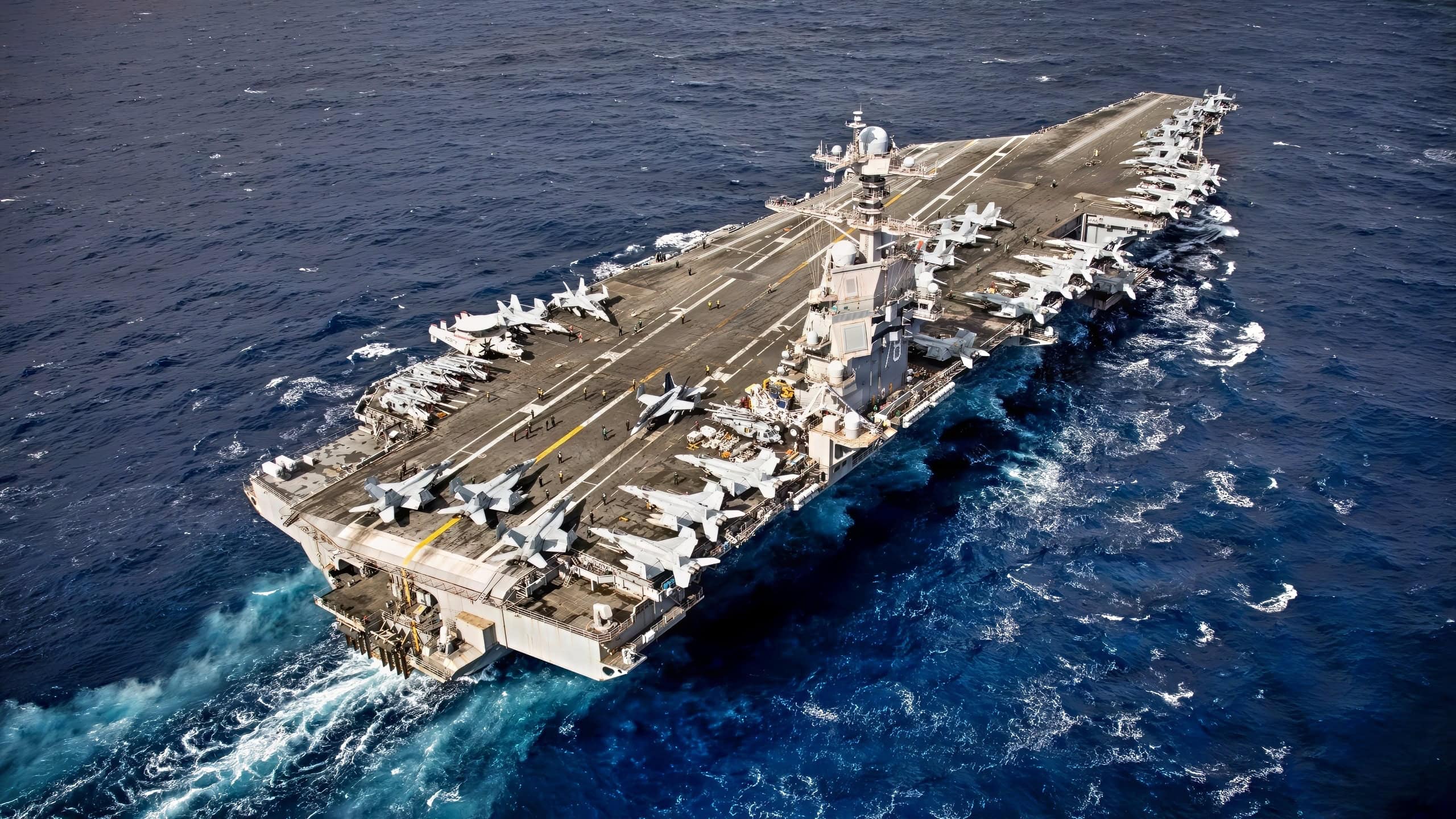
Oct. 9, 2022 – The first-in-class aircraft carrier USS Gerald R. Ford (CVN 78) steams the Atlantic Ocean during a simulated straits transit with the Gerald R. Ford Carrier Strike Group (GRFCSG) in the Atlantic Ocean, Oct. 9, 2022. The Gerald R. Ford Carrier Strike Group is deployed in the Atlantic Ocean, conducting training and operations alongside NATO Allies and partners to enhance integration for future operations and demonstrate the U.S. Navy’s commitment to a peaceful, stable and conflict-free Atlantic region. (U.S. Navy photo by Mass Communication Specialist 2nd Class Jackson Adkins)
Fires can spread quickly through carriers, and that is what happened with the Gerald R. Ford.
Thankfully, there were no fatalities, but the supercarrier is out of action for repairs in the Port of Split, Croatia.
Carriers are always at risk of fire, and any blaze on the flight deck would require an emergency crew to extinguish it promptly.
History of Carrier Fires
After World War II, the most horrific fire was aboard the carrier USS Forrestal in 1967. A Zuni rocket discharged on the flight deck, hitting an A-4 Skyhawk aircraft and igniting a severe blaze from spilled jet fuel. Subsequently, massive explosions occurred.
When the fire was finally put out, it had killed 134 personnel and wounded 161.
USS Oriskany Stricken By a Deadly Blaze
The USS Oriskany experienced a tragic fire in 1966. A flare was lit inside a flare locker. Due to high pressure near the incident, firefighters were unable to open the door to extinguish the initial flames.
Oct. 9, 2022 – The first-in-class aircraft carrier USS Gerald R. Ford (CVN 78) steams the Atlantic Ocean during a simulated straits transit with the Gerald R. Ford Carrier Strike Group (GRFCSG) in the Atlantic Ocean, Oct. 9, 2022. The Gerald R. Ford Carrier Strike Group is deployed in the Atlantic Ocean, conducting training and operations alongside NATO Allies and partners to enhance integration for future operations and demonstrate the U.S. Navy’s commitment to a peaceful, stable and conflict-free Atlantic region. (U.S. Navy photo by Mass Communication Specialist 2nd Class Jackson Adkins)
After ten minutes, the door blew off, igniting a helicopter. Heat and smoke spread to the berthing quarters, and the wind fanned the flames. Airplanes loaded with bombs and fuel were moved to the flight deck to reduce the danger. Then, all the remaining flares exploded, causing more aircraft to catch fire. A burning airplane was pushed off the carrier. By the end, 44 sailors had lost their lives.
The Enterprise Was Waylaid by a Costly Fire, Causing More Deaths
In 1969, on the USS Enterprise, another Zuni rocket problem occurred on an F-4 Phantom II.
A 15-pound warhead exploded after a malfunction in the engine starter on a tractor-mounted device used to start airplanes. Fire broke out under the fighter jet’s wing.
An explosion then ripped holes in the flight deck. Burning jet fuel spread downward. The fire killed 28 people, wounded 314, and destroyed 15 aircraft. Repairs cost over $126 million (about $1 billion today).
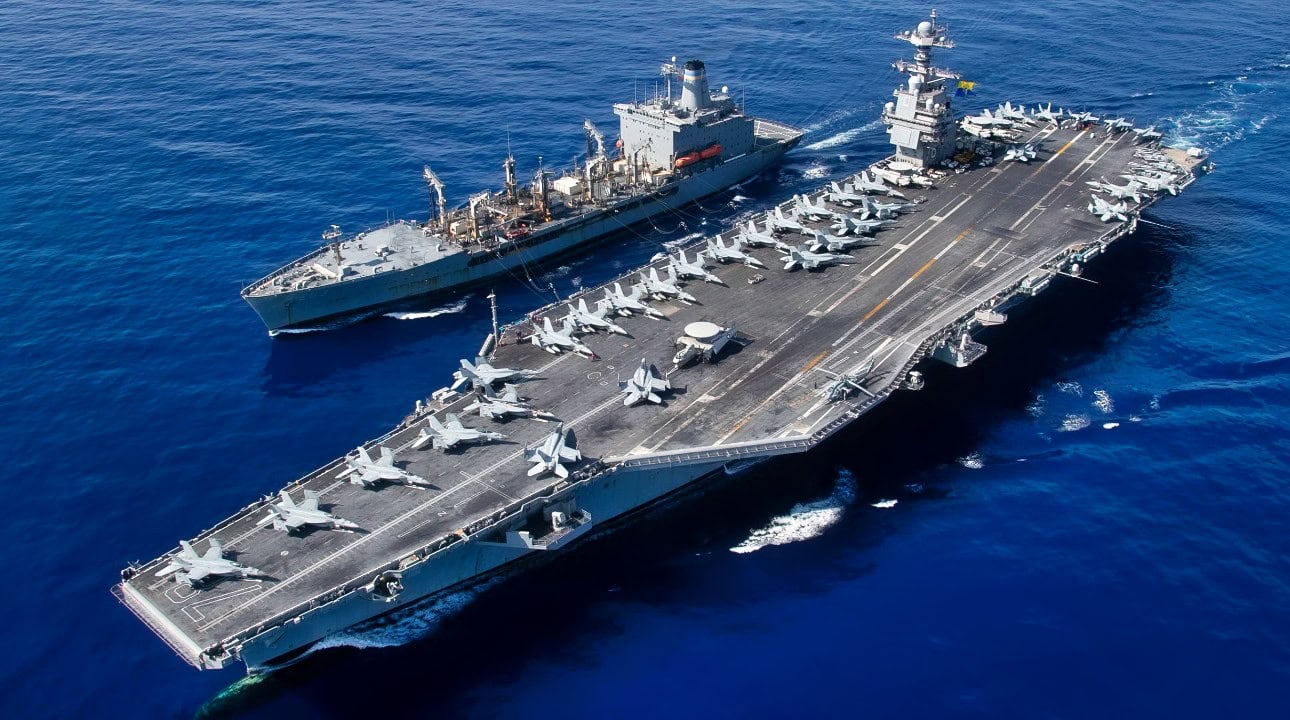
The world’s largest aircraft carrier USS Gerald R. Ford (CVN) 78 and the USNS Laramie (T-AO-203) conduct a refueling-at-sea in the Eastern Mediterranean Sea, Oct. 11, 2023. USS Gerald R. Ford is the Navy’s newest and most advanced aircraft carrier, representing a generational leap in the U.S. Navy’s capacity to project power on a global scale. The Gerald R. Ford Carrier Strike Group is currently operating in the Eastern Mediterranean Sea, at direction of the Secretary of Defense. The U.S. maintains forward deployed ready and postured forces to deter aggression and support security and stability around the world.(U.S. Navy photo by Mass Communication Specialist 2nd Class Jackson Adkins)
USS Nimitz Endured Another Deadly Eruption
The USS Nimitz caught fire in 1981 when an EA-6B Prowler crashed on the flight deck. It struck the tail of an SH-3 Sea King helicopter.
Then the blaze “hit three parked A-7E aircraft, a tow tractor and three F-14 aircraft before coming to rest on the port edge of the flight deck.
An intense fuel fire erupted,” according to InsensitiveMunitions.org. One F-14 Tomcat had a ruptured fuel line, adding jet fuel to the blaze. Fourteen sailors died, and 42 were injured.
Fighting Fires on Carriers
On a carrier’s flight deck, there are green markers with white letters that say “AFFF.” This acronym stands for Aqueous Film-Forming Foam, the main method used to fight fires on naval ships. Sailors are instructed to find the emergency telephone near the AFFF sign.
The activation button is also painted green.
Then, they must pull the fire hose out of the storage box. After pressing the button, the hose will charge and activate.
Then It’s Time for Purple-K-Powder
During the fire, the sailors can find a red painted marking with the words “PKP.” This stands for Purple-K-Powder.
PKP is a dry chemical agent used for “Charlie” fires, which are electrical, and “Bravo” fires, which spark from flammable liquids like jet fuel. This powder breaks the combustion chain.
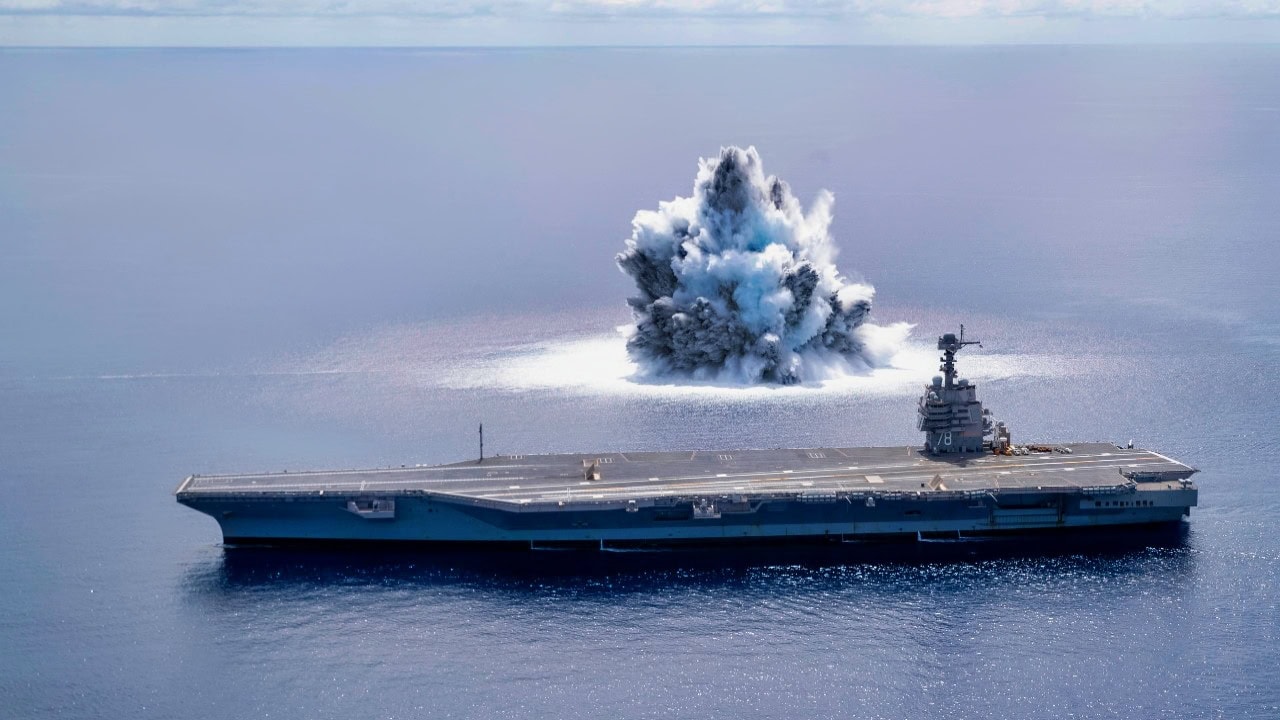
The aircraft carrier USS Gerald R. Ford (CVN 78) completes the first scheduled explosive event of Full Ship Shock Trials while underway in the Atlantic Ocean, June 18, 2021. The U.S. Navy conducts shock trials of new ship designs using live explosives to confirm that our warships can continue to meet demanding mission requirements under harsh conditions they might encounter in battle. (U.S. Navy photo by Mass Communication Specialist 3rd Class Riley B. McDowell)
Communication Is Vital
A shipmate needs to get on the phone quickly. After the call, the pumping station will start supplying AFFF. There are also CO₂ and saltwater fire-extinguishing stations. Sailors can find these easily.
AFFF Is Dangerous for Humans
During a fire inside a ship, sailors must use portable fire extinguishers and then report to Damage Control Central. Afterward, shipmates will apply the AFFF. This should be limited because AFFF can cause health issues for sailors who inhale fumes from per- and polyfluoroalkyl substances.
The Navy is gradually phasing out AFFF and replacing it with safer firefighting methods, such as High-Expansion Foam. Teams are instructed to seal off hatches and doors to contain the fire. The primary suppression system uses seawater, while CO₂ is used for electrical fires. PKP is also employed.
The world’s largest aircraft carrier, USS Gerald R. Ford (CVN 78), sails in formation with the Arleigh Burke-class guided missile destroyers USS Winston Churchill (DDG 81), USS Mitscher (DDG 57), USS Mahan (DDG 72), USS Bainbridge (DDG 96), and USS Forrest Sherman (DDG 98) in the Atlantic Ocean, Nov. 12, 2024. The Gerald R. Ford Carrier Strike Group is underway in the Atlantic Ocean completing Group Sail. Group Sail is the first at-sea integrated phase training event during a routine deployment training cycle. It is designed to challenge the Gerald R. Ford CSG’s ability to use the capabilities of the USS Gerald R. Ford (CVN 78), USS Winston S. Churchill (DDG 81), Carrier Air Wing (CVW) 8, Destroyer Squadron (DESRON) 2, and embarked Information Warfare team as a cohesive Strike Group to meet Navy and Joint Warfighting requirements that increases warfighting capability and tactical proficiency across all domains. (U.S. Navy photo by Mass Communication Specialist 2nd Class Maxwell Orlosky)
Everyone Onboard Fights Fires
It is important to note that every sailor onboard becomes a firefighter. All personnel should have duty stations to extinguish the fire before it spreads. Some teams are specialized as the main responders. They each wear an oxygen breathing apparatus.
Fire always poses a risk on a carrier because of jet fuel and munitions. Sailors train for every emergency, but it’s hard to predict how a fire will respond to firefighting efforts.
These fires ignite quickly, leaving sailors little time to react. An investigation will be held into the fire in Ford’s laundry room, and we should be glad that no one was harmed.
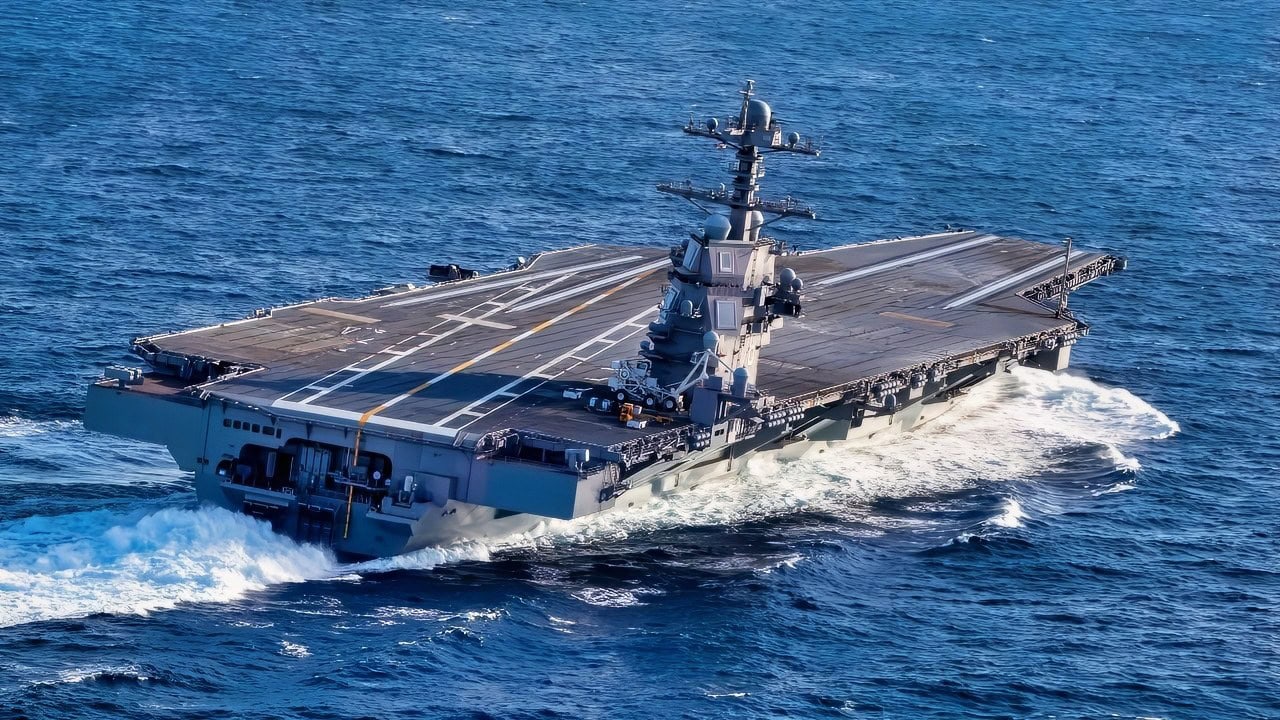
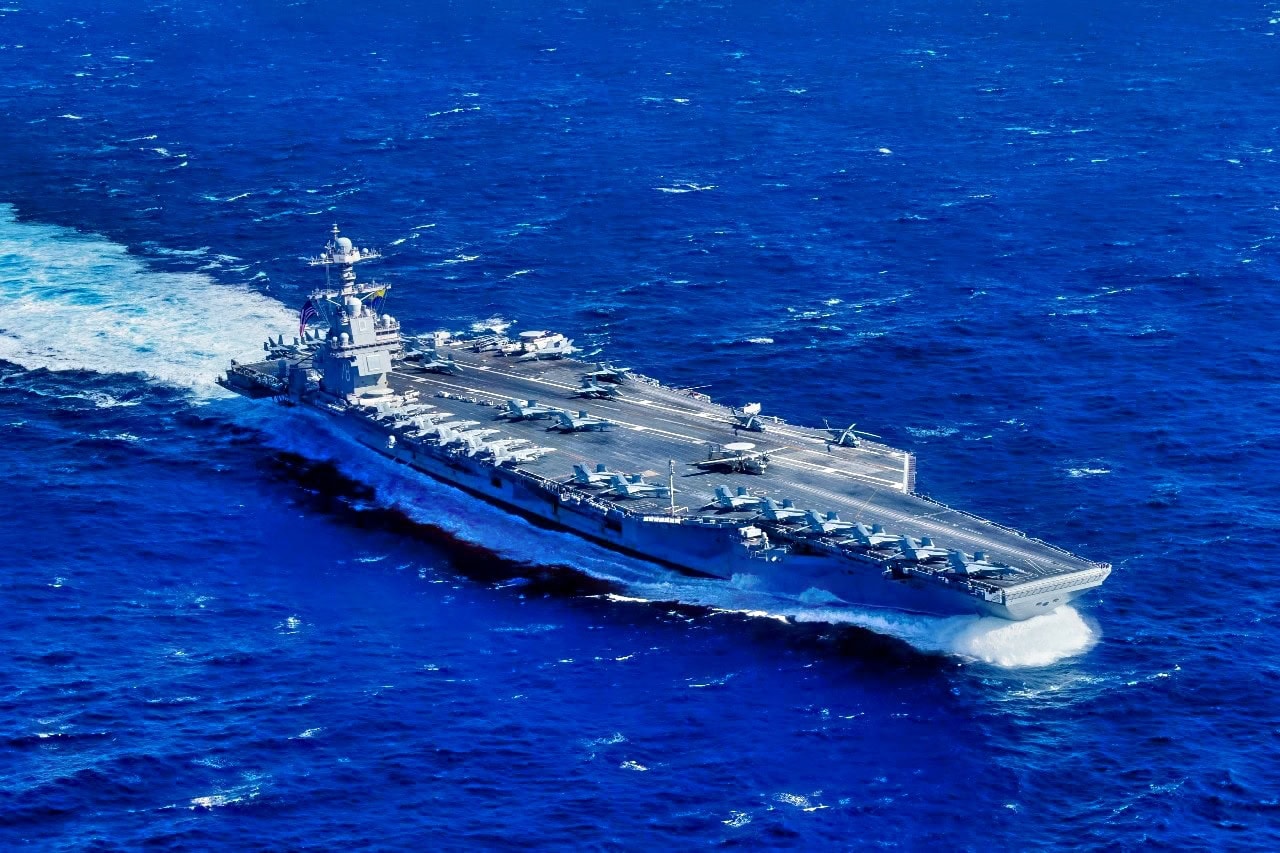
ATLANTIC OCEAN (Oct. 29, 2019) USS Gerald R. Ford (CVN 78) conducts high-speed turns in the Atlantic Ocean. Ford is at sea conducting sea trials following the in port portion of its 15 month post-shakedown availability. (U.S. Navy photo by Mass Communication Specialist 3rd Class Connor Loessin)
The crew did their jobs, but that doesn’t mean all carriers are safe from fires.
Crew members must stay alert at all times because a fire can start unexpectedly, and they should rehearse their response so often that fighting these emergencies becomes instinctive and efficient.
More: Trump Could Leave NATO But The Alliance Would Survive
About the Author: Brent M. Eastwood
Author of now over 3,000 articles on defense issues, Brent M. Eastwood, PhD, is the author of Don’t Turn Your Back On the World: A Conservative Foreign Policy and Humans, Machines, and Data: Future Trends in Warfare, plus two other books. Brent was the founder and CEO of a tech firm that predicted world events using artificial intelligence. He served as a legislative fellow for US Senator Tim Scott and advised the senator on defense and foreign policy issues. He has taught at American University, George Washington University, and George Mason University. Brent is a former US Army Infantry officer. He can be followed on X @BMEastwood.