
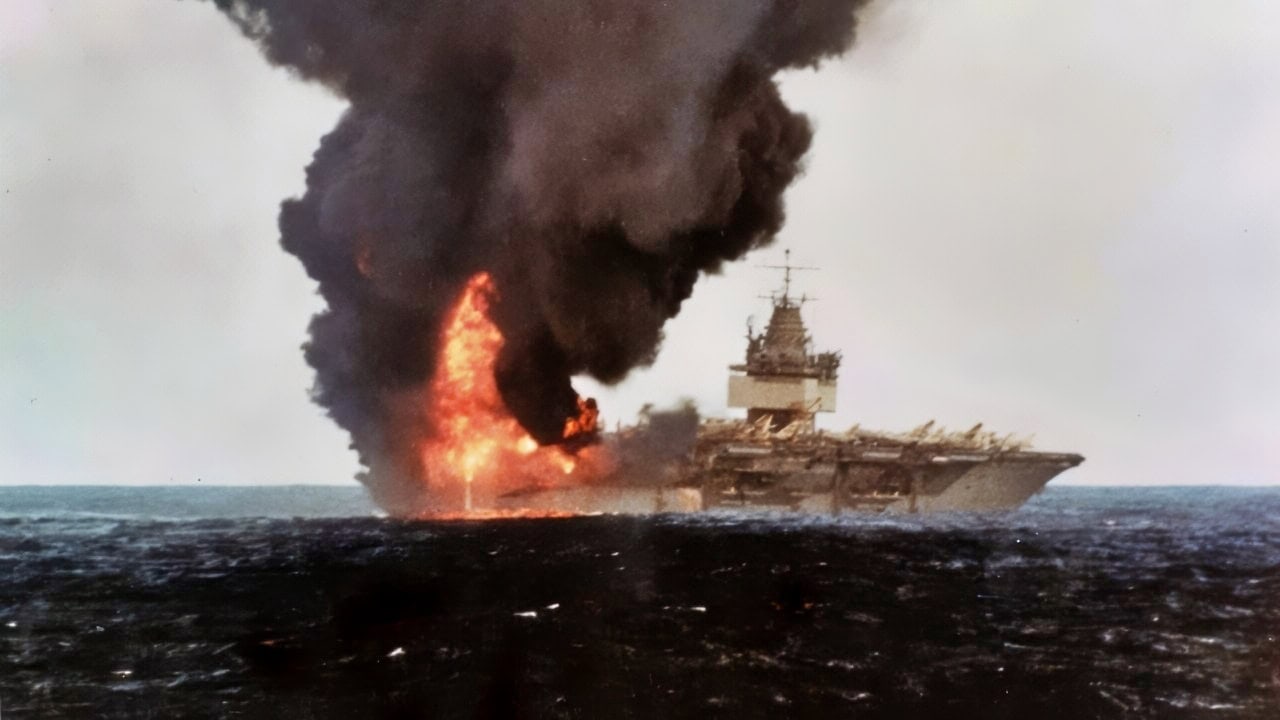
The U.S. Navy’s USS Enterprise Aircraft Carrier Was Hit with a Historic Fire. And Onboard a Nuclear Warship, That Is a Crisis
Besides being the name of the heroic starship (registration number NCC-1701) in the blockbuster Star Trek franchise, USS Enterprise is the most time-honored name for U.S. Navy aircraft carriers (yes, even more so than USS Yorktown).
In World War II, CV-6, nicknamed “Big E,” was the most decorated USN vessel of the war, as her air wing shot down over 900 enemy aircraft and helped sink or damage over 260 ships (including during the pivotal Battle of Midway).
More recently, there was CVN-65–also affectionately nicknamed “Big E”—which was the first nuclear-powered aircraft carrier in the world (laid down in 1958, launched in 1960, and commissioned in 1960). Just like her WWII predecessor, she was never sunk. However, she can dangerously close to doing so, thanks to a shipboard fire in 1969.
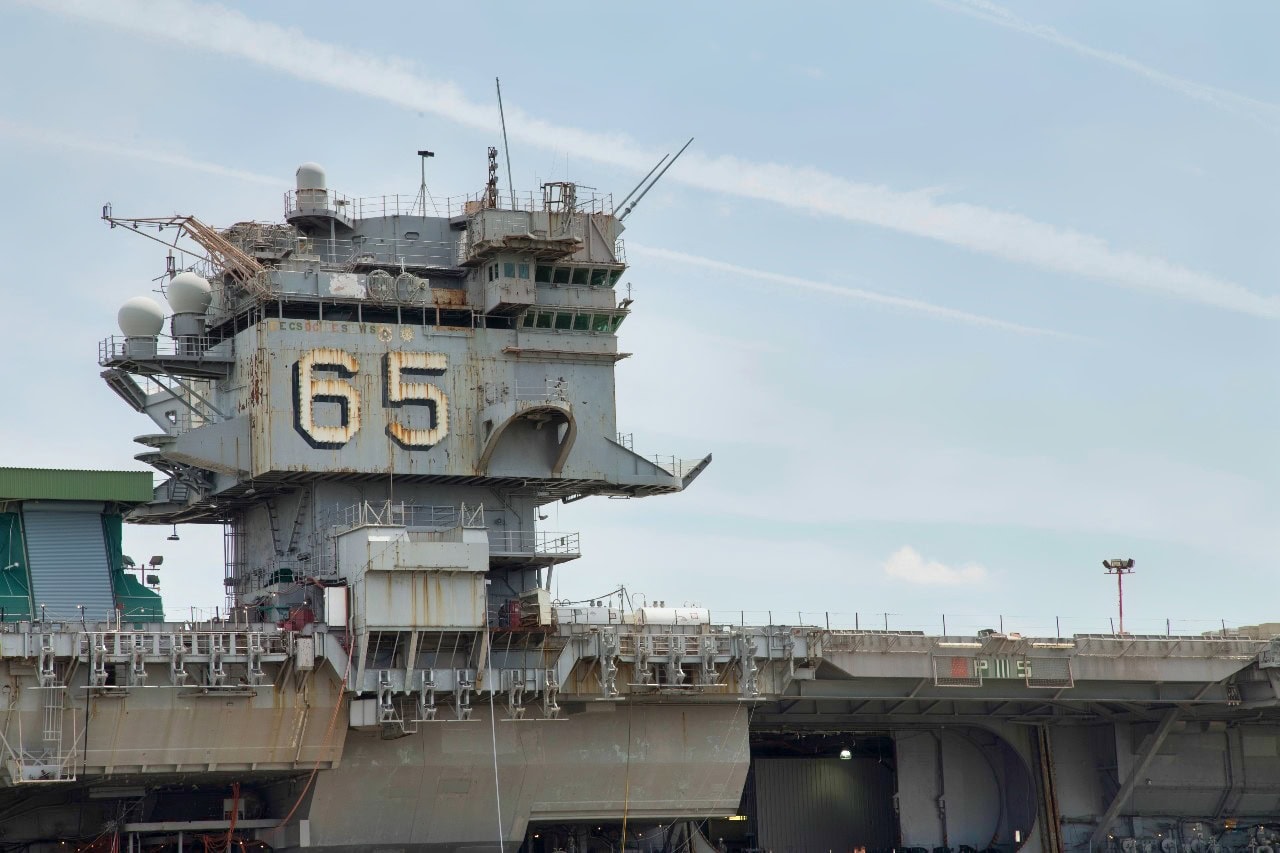
NEWPORT NEWS, Va. (July 15, 2018) — USS Enterprise (CVN 65) sits pierside at Newport News Shipbuilding following its decommissioning in February 2017. (U.S. Navy photo by Mass Communication Specialist 2nd Class Cat Campbell/RELEASED)
Prelude to Pyro on an Aircraft Carrier
The tragedy occurred against the backdrop of the Vietnam War. “Big E” had already done three deployments in support of that controversial war.
On January 14, 1969 (six days before Richard Milhous Nixon replaced Lyndon Baines Johnson as President of the United States and ended up coming much closer to leading America to victory in Nam than most mainstream media and ivory tower academicians are willing to admit), the warship and her crew were prepping for a fourth such deployment.
More specifically, the Enterprise was operating about 70 nautical miles southwest of Pearl Harbor, Hawaii, conducting a final battle drill and Operational Readiness Inspection (ORI) before heading back to the waters of Southeast Asia.
At 0830 Local Time (1830 UTC AKA “Zulu Time”) on that day, she was getting ready to launch six F-4 Phantom II fighters, seven A-7 Corsair II (AKA the “SLUF”) light attack jets, one RA-5C Vigilante photo-reconnaissance aircraft, one EKA-3B Skywarrior tanker, and one E-2A Hawkeyeairborne early warning aircraft of Air Wing NINE (CVW-9).
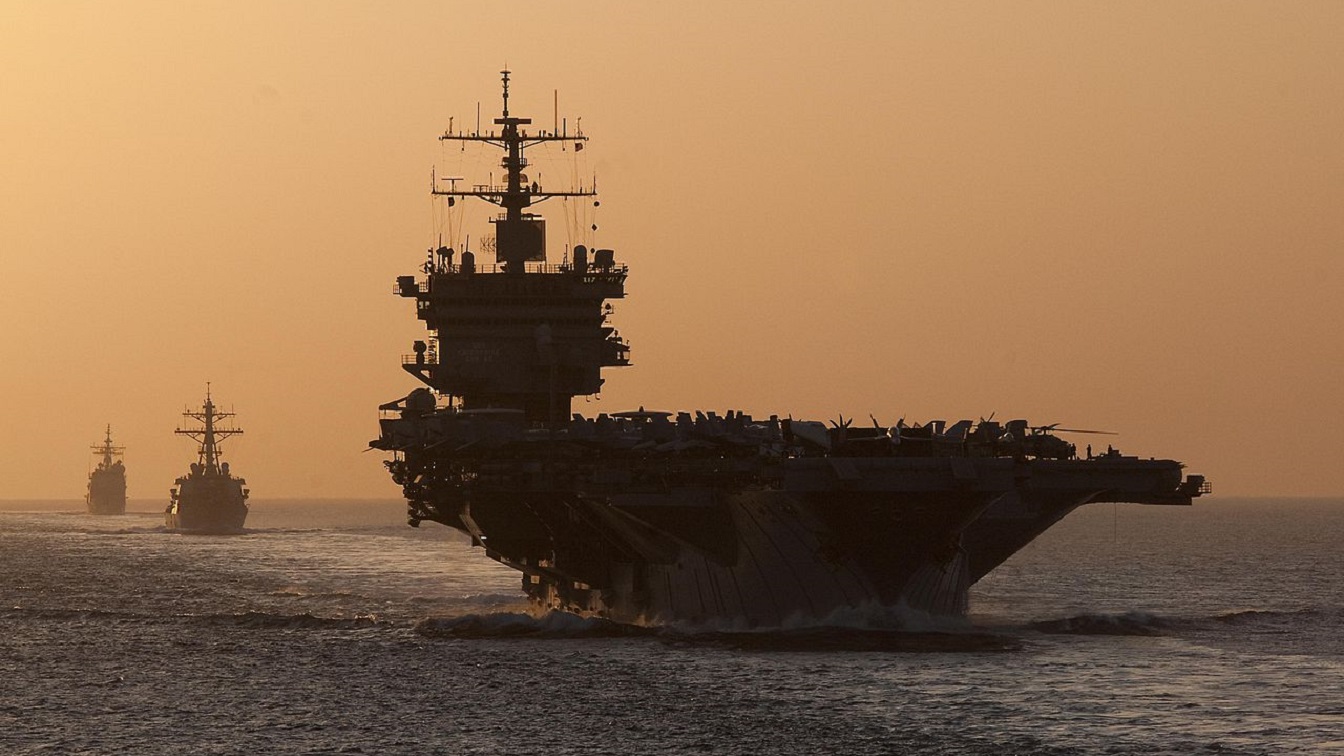
The aircraft carrier USS Enterprise, right, the guided-missile destroyer USS Porter (DDG 78) and the guided-missile cruiser USS Vicksburg (CG 69) transit back to their homeport of Norfolk, Va. Enterprise, Porter and Vicksburg are returning from a deployment to the U.S. 5th Fleet area of responsibility, where the ship conducting maritime security operations, theater security cooperation efforts and support missions for Operation Enduring Freedom. (U.S. Navy photo by Mass Communication Specialist 3rd Class Jeff Atherton/Released).
The Tragedy Flares Up
At 0818L, the ship was commencing a turn to port into the wind when suddenly, an explosion transpired on the port quarter of the flight deck outside the landing area.
The culprit was a carelessly positioned MD-3A aircraft starter unit (“huffer”) that blew hot exhaust onto the warhead of a MK-32 5-inch Zuni rocket.
That Zuni rocket warhead contained 15 lbs. (6.8 kg) of Composition B explosive (which consists of a castable mixture of RDX [ Royal Demolition eXplosive; also known as cyclonite or hexogen]
and TNT) and contains 2000 one-quarter-inch (6.35mm) square fragments that could damage light vehicles within a 70-foot (21.3-meter) radius.
It was mounted in a pod of four rockets on the starboard wing (No. 8 station) of an F-4J belonging to Fighter Squadron 96 (FITRON or VF-96; nicknamed the “Fighting Falcons” years before the U.S. Air Force’s F-16 fighter jet came along).
The huffer’s exhaust temperature could reach 590 degrees Fahrenheit (310 degrees Celsius) at a two-foot distance.
And a mere 358 degrees Fahrenheit (181.11 degrees Celsius) was sufficient to cook off the warhead in about 78 seconds (per the subsequent investigation).
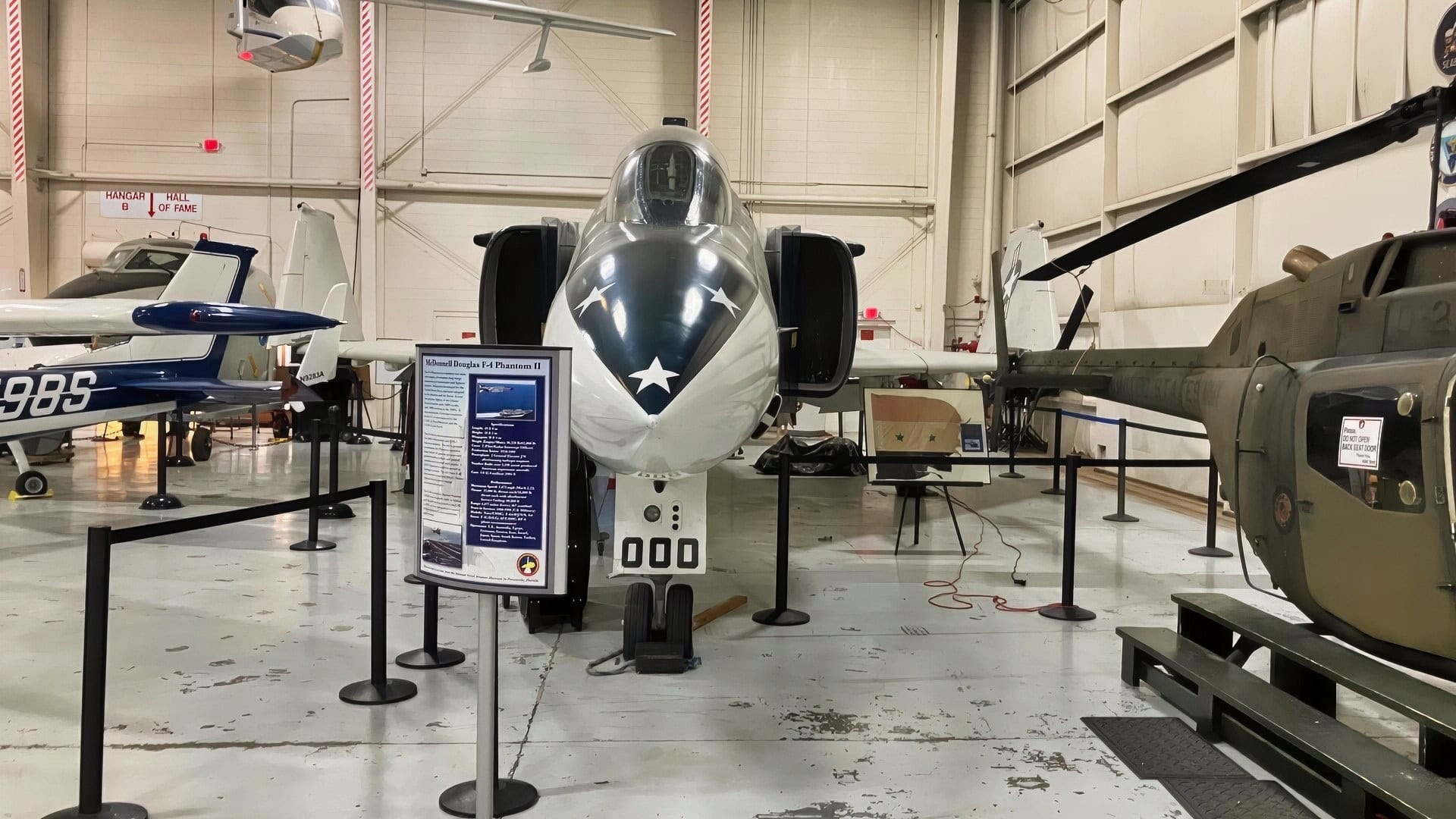
F-4 Phantom Fighter Aviation Museum of Kentucky. Taken by 19FortyFive.com on March 1, 2026.
In other words, a highly volatile pairing.
The F-4J in question was also carrying two wing fuel tanks (one on the starboard wing outboard of the Zuni rockets) and six MK 82 500-lb. free-fall general purpose bombs.
A junior airman apprentice (AA; not to be confused with the USAF rank of Airman) attempted to sound the alarm about the pending danger. Alas, his warning was either not understood or was stifled in the din of jet noise. The subsequent investigation determined that the warning was likely too late anyway.
The Zuni warhead’s explosion sent shrapnel flying, perforating the external fuel tanks and igniting a JP-5 fuel fire. A minute later, the other three Zuni rockets on that star-crossed Phantom fighter jet also blew up, punching holes in the flight deck down and sending burning JP-5 flowing into the O-3 level.
The Big E’s skipper, then-Captain Kent Lee (future Vice Admiral and Commander of Naval Air Systems Command), promptly steered the ship so that the wind blew smoke and flames off the flight deck.
However, despite Capt. Lee’s swift reaction set in motion a catastrophic chain reaction of ordnance and fuel, resulting in 18 explosions that blew five large holes in the flight deck and destroyed eight Phantoms, six Corsairs, and the Skywarrior tanker.
Even worse, 28 of the Enterprise’s crew members perished, and an additional 314 were injured.
As truly tragic as that was, the death toll could’ve been even worse, as was the case with the USS Forrestal (CVA-59) fire of July 29, 1967, that killed 134 men, injured 161, and destroyed 21 aircraft (amongst the sailors who endured that particular tragedy was then-LCDR [and future United States Senator and GOP presidential nominee] John S. McCain III).
Luckily (though obviously not luckily enough for the 28 dead sailors and their surviving loved ones), 96 percent of the Enterprise’s ship’s company and 86 percent of her air wing personnel had received formal firefighting training. Contrast this with the Forrestal, with a mere 50 percent of the ship’s company—and **none** of her air wing(!!)—had been trained.
One Survivor Tells His Story
One sailor aboard “Big E” who recounted the events of that fateful day was Danny Noe. Danny had been asleep in the room directly beneath the initial Zuni explosion, which gave him a rude awakening and threw him into a bulkhead.
As soon as he came to his senses, his first instinct was to run, an instinct shared by two of his friends who were in that same room.
Sadly, those two friends ran to the right and didn’t live to tell their tales, whilst Noe ran to the left and is still with us today.
In Danny’s own words, “That’s the good thing, I guess, and unfortunately they didn’t make it… They were doing what they did to protect everyone, and I just happened to get out alive.” As a testament to both his training and his mental & physical toughness, Noe recovered his wits from his near-death experience quickly enough to grab a hose and do his part to help fight the flames.
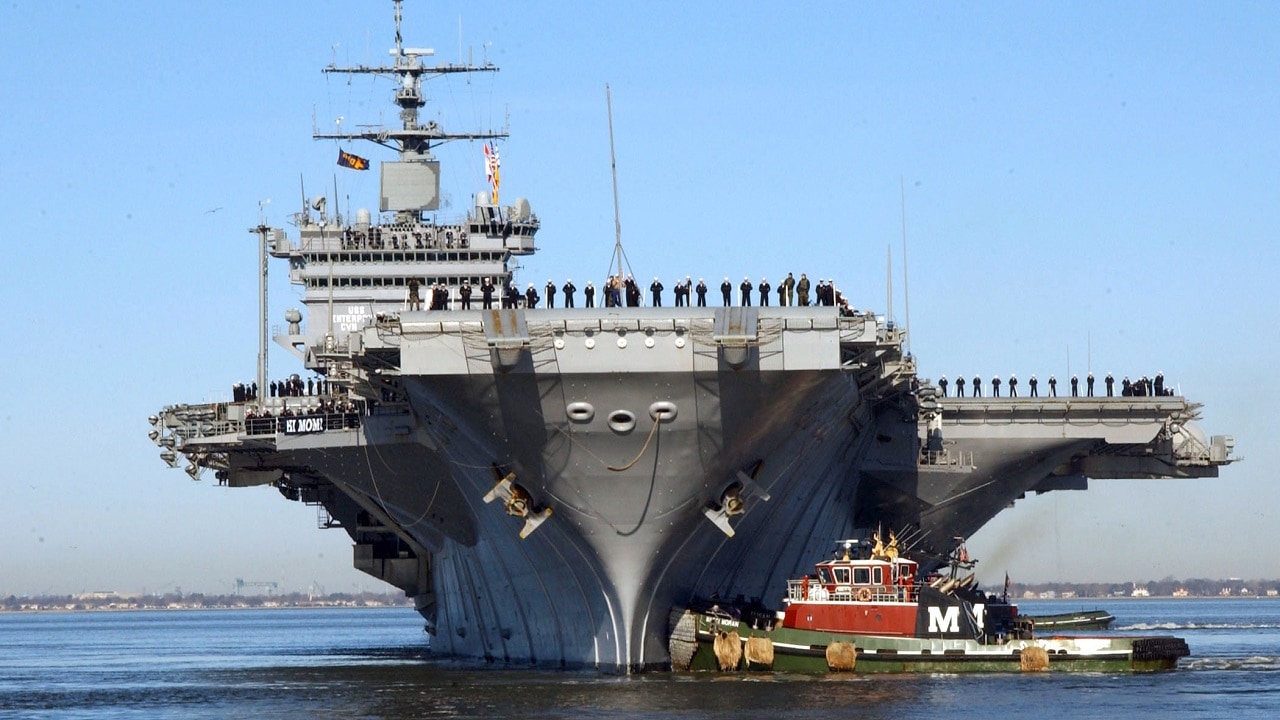
Naval Station Norfolk, Va. (Feb. 29, 2004) – Sailors aboard the nuclear powered aircraft carrier USS Enterprise (CVN 65) “man the rails” as the carrier approaches its pier at her homeport of Naval Station Norfolk, Va. The carrier and its strike group are returning after completing a six-month deployment in support of the global war of terrorism, including Operations Iraqi Freedom and Enduring Freedom. U.S. Navy photo by Photographer’s Mate 3rd Class Sondra Howett. (RELEASED)
However, Noe would receive a further shock shortly thereafter (as if the mental and emotional trauma of losing his shipmates wasn’t enough of an ordeal already): he learned that he had been listed as missing in action! “I went up and gave them my name a couple of days later, and they said you are MIA, and I said, ‘As you can see, I’m here.’”
Danny was given back his dog tags, which had gotten knocked off during the explosion. He’s had them ever since, as a memento to his own survival and to his shipmates who didn’t make it.
MORE – China Will Be ‘Surrounded’ By A New Fleet of F-35A, F-35C, and New F-15EX Eagle II Fighters
MORE – The F-22 Raptor Mistake: 750 Ordered, 189 Built
About the Author: Christian D. Orr
Christian D. Orr is a Senior Defense Editor. He is a former Air Force Security Forces officer, Federal law enforcement officer, and private military contractor (with assignments worked in Iraq, the United Arab Emirates, Kosovo, Japan, Germany, and the Pentagon). Chris holds a B.A. in International Relations from the University of Southern California (USC) and an M.A. in Intelligence Studies (with a concentration in Terrorism Studies) from American Military University (AMU). He is also the author of the book “Five Decades of a Fabulous Firearm: Celebrating the 50th Anniversary of the Beretta 92 Pistol Series, the second edition of which was recently published.