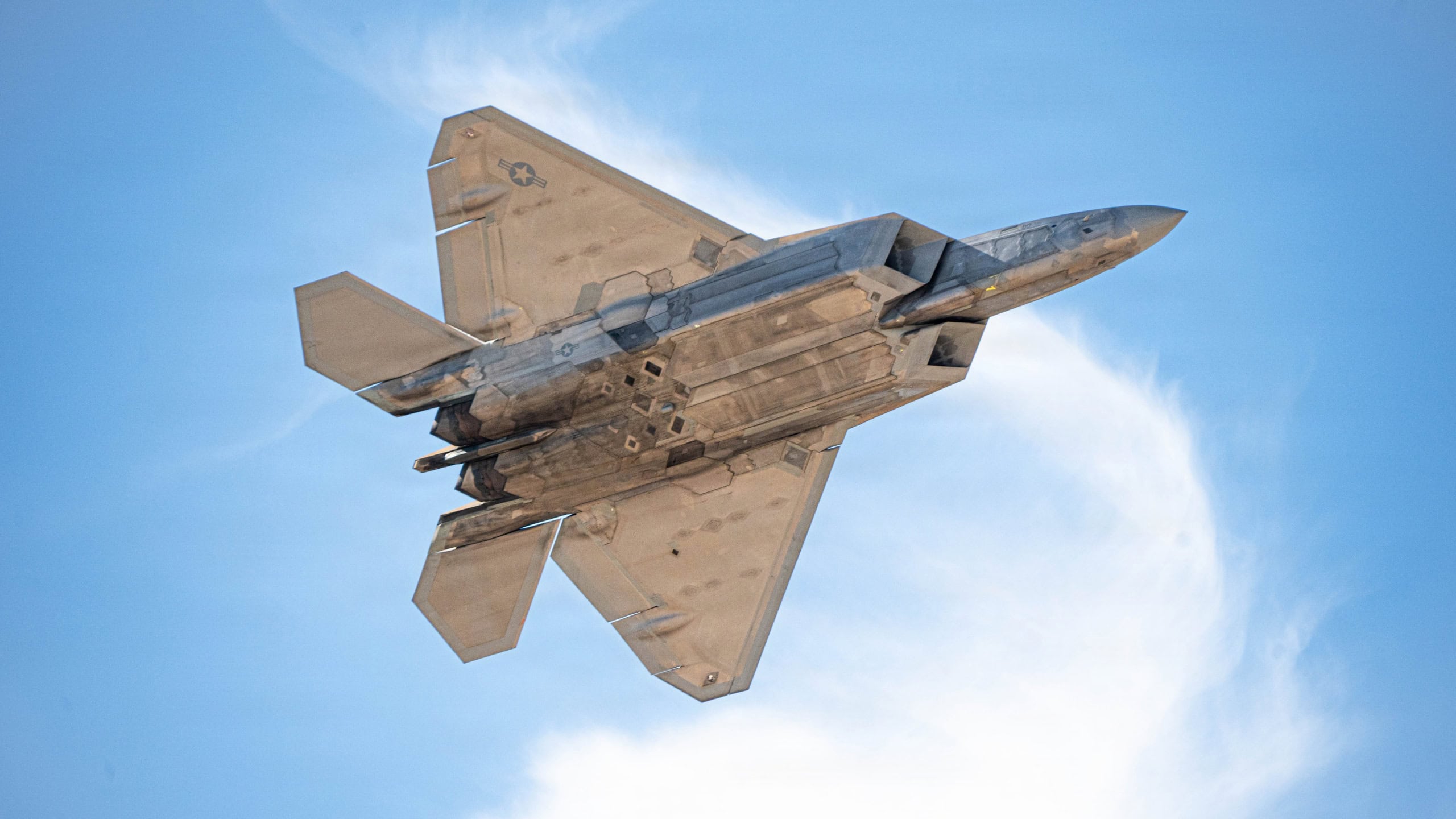
Years ago, there was a decided and passionate push to “restart” the F-22 production line, an effort which was ultimately abandoned due to what was cited as cost concerns.
The interest in restarting stemmed from the recognition that the program was simply cut way too early and too short.
The US Air Force operates 185 F-22s, a number which is merely a fraction of what was originally planned.
That number: 750.
The end of the Cold War seems to have generated a fair amount of short-term thinking, leading to the cancellation of several critical and promising programs, such as the B-2 bomber, the F-22, and the Seawolf-class submarine.
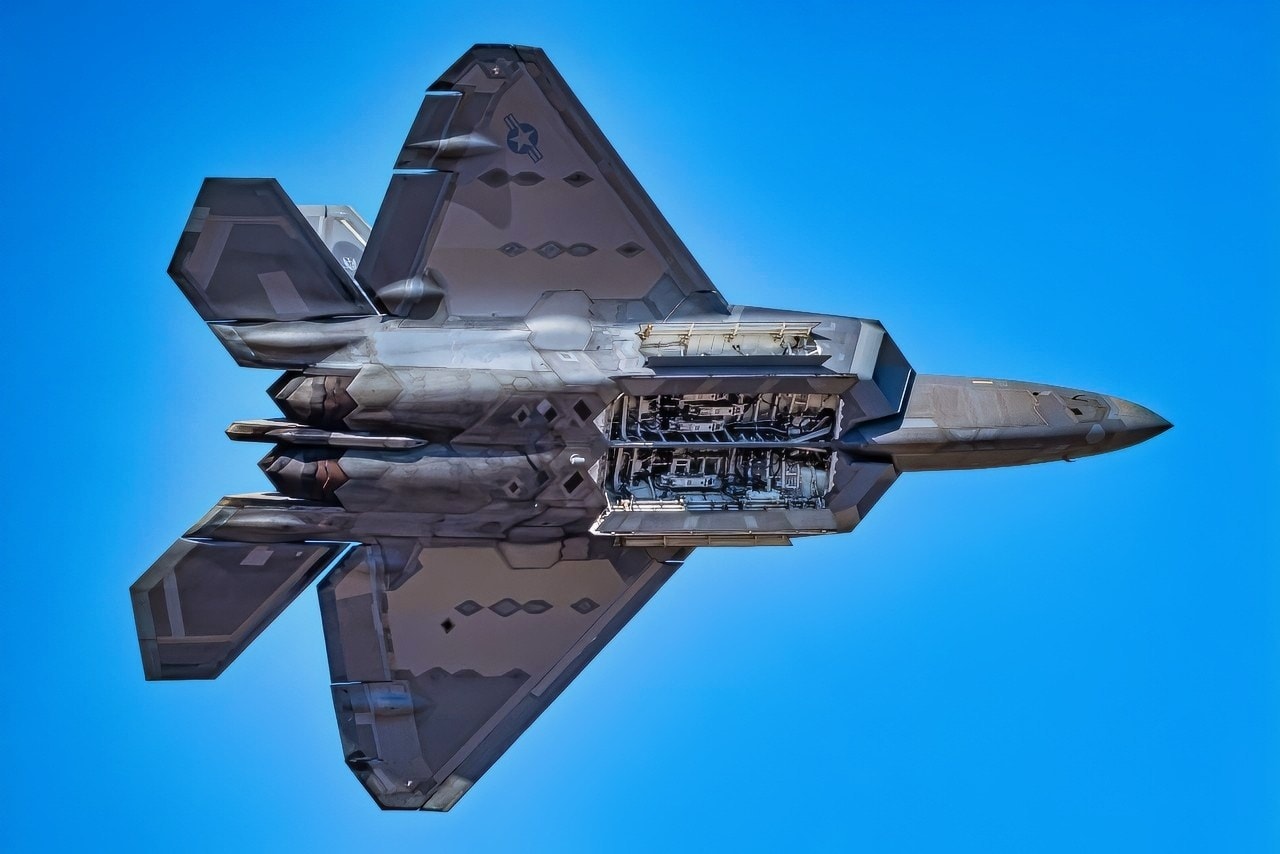
U.S. Air Force Maj. Joshua “Cabo” Gunderson, F-22 Raptor Demonstration Team commander and pilot, preforms the weapons bay door pass during rehearsal for the 2022 FIDAE Air & Trade Show, April 3, 2022 in Santiago, Chile. The F-22 Raptor is a multi-role air dominance stealth fighter that can carry of combination of air-to-air missiles and GPS guided bombs. (U.S. Air Force photo by Staff Sgt. Don Hudson)
The B-2 fleet size was reduced to just 20 airframes, and, of course, F-22 production was cancelled after only a small portion of the anticipated fleet was built.
The US Navy Seawolf-class was entirely abandoned after three boats.
Wrong F-22 Decision
In recent years, many Pentagon weapons developers and defense experts have come to lament these prior decisions, wondering whether those responsible live with both concern and regret.
Clearly, the Cold War had ended, and Russia was much less of a threat, yet the threat equation at that time is a mere snapshot in time, a brief window when the US did not appear to have a great-power threat.
However, any student of history or geopolitical expert could easily have embraced a much more accurate, long-term worldview grounded in trends and future predictions.
The F-22 circumstance inevitably introduces the key question as to what the U.S. military, or perhaps even the world, might look like now if the Pentagon had stayed with the original plan to acquire hundreds of F-22s.
In an era of great power rivalry, one cannot underestimate the importance of pursuing “mass,” and the ability to deploy a large fleet of F-22s would undoubtedly change the global balance of power.
Consider, for example, the pace at which China is adding J-20s to its fleet of 5th-generation aircraft. What if the U.S. Air Force operated 700 or more F-22s?
That is something the PLA AF would not be able to match for years.
In any large-scale confrontation, an ability to “widen” an attack envelope, particularly with modern networking, would enable the larger Air Force to potentially out-flank or “encircle” an enemy force.
F-22 Superiority
F-22 specs state the Raptor can hit Mach 2.25, a speed placing the aircraft in a very small, elite group of high-speed fighters, including the US F-15 Eagle, F-14 Tomcat, and several Russian aircraft such as the Su-27, Su-35, MiG-31, and MiG-25.

F-22 Raptor Fighter. Image Credit: Creative Commons.
Both the MiG-31 and MiG-25 are listed as capable of Mach 2.83; they are not stealthy and are potentially less agile.
It is easier to generate thrust without incorporating stealth properties, and the Russian MiGs are heavier planes that are likely to be much less agile than an F-22.
Apart from speed, arguably the largest F-22 advantage may pertain to its amazing thrust-to-weight ratio, meaning its speed, propulsion, and engine “thrust” is extremely high and effective due to the F-22s lighter weight.
Simply put, this means the F-22 Raptor operates with unparalleled aerial maneuverability and dogfighting capability, making it perhaps the only air-to-air combat platform in the world.
Unlike the F-35, which has now reached 19-countries, the F-22 has gone nowhere.
If the F-22 had been made available for foreign sales, would the program have had a vastly different outcome?
The answer is likely yes, as allied participation in the F-22 program would undoubtedly have massively expanded production of the aircraft and likely have inspired the US to build more Raptors.
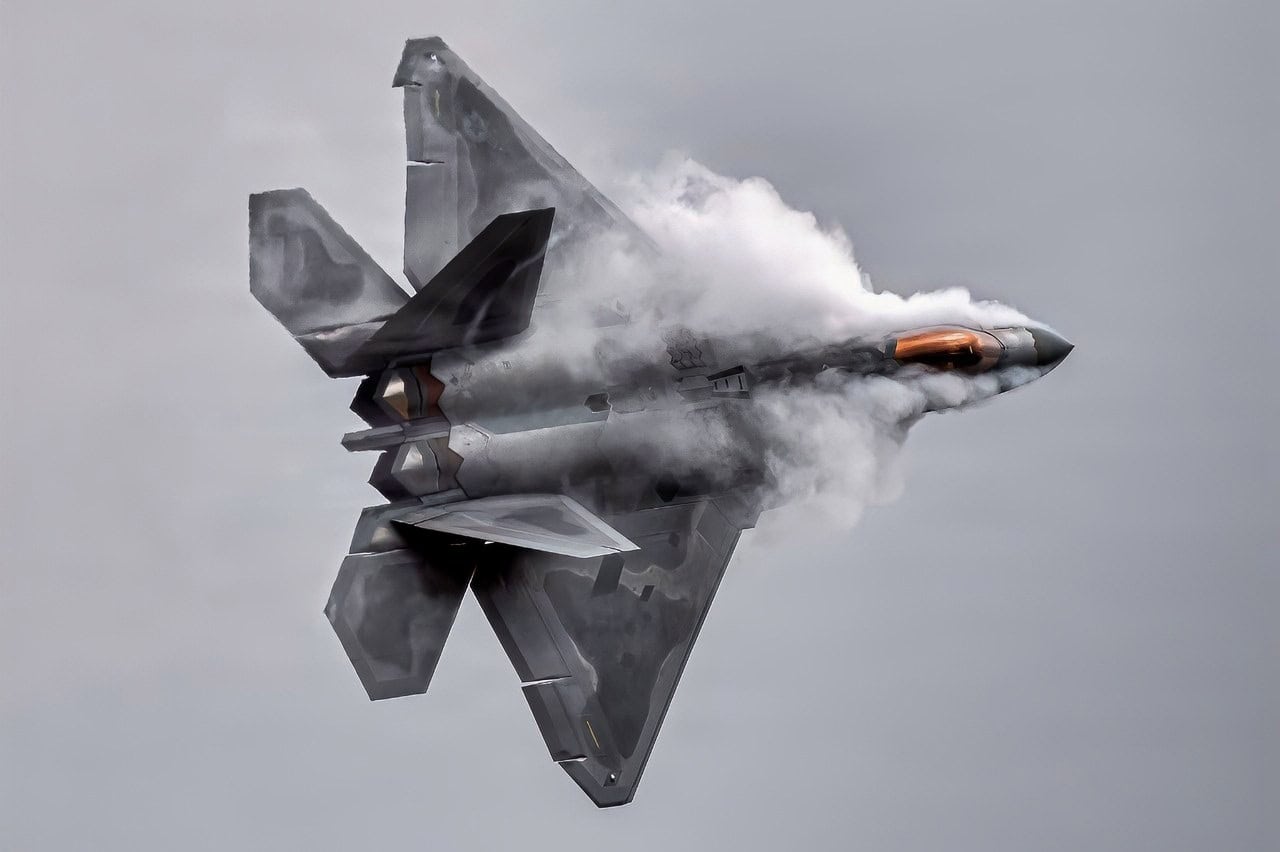
U.S. Air Force Capt. Samuel “RaZZ” Larson, F-22 Raptor Aerial Demonstration Team pilot and commander, performs at the United States Air Force Academy, Colorado Springs, CO, April 14th, 2023. The F-22 Raptor Aerial Demonstration showcases the unmatched maneuverability of the airframe by executing a series of combat maneuvers to inspire Americans and their allies, and deter foreign adversaries. (U.S. Air Force video by Staff Sgt. Michael Bowman)
It would likely have had an experience similar to the F-35, meaning it could spread like wildfire across the free world once pilots and allied militaries had a chance to fly it.
The other aspect of “scaling” production is that it massively lowers costs, so it may have enabled US and allied customers to order larger numbers of the aircraft through “lot” or “block” buys.
About the Author: Kris Osborn, Warrior Maven President
Kris Osborn is the President of Warrior Maven – Center for Military Modernization. Osborn previously served at the Pentagon as a highly qualified expert in the Office of the Assistant Secretary of the Army—Acquisition, Logistics & Technology. Osborn has also worked as an anchor and on-air military specialist at national TV networks. He has appeared as a guest military expert on Fox News, MSNBC, The Military Channel, and The History Channel. He also has a Master’s Degree in Comparative Literature from Columbia University.