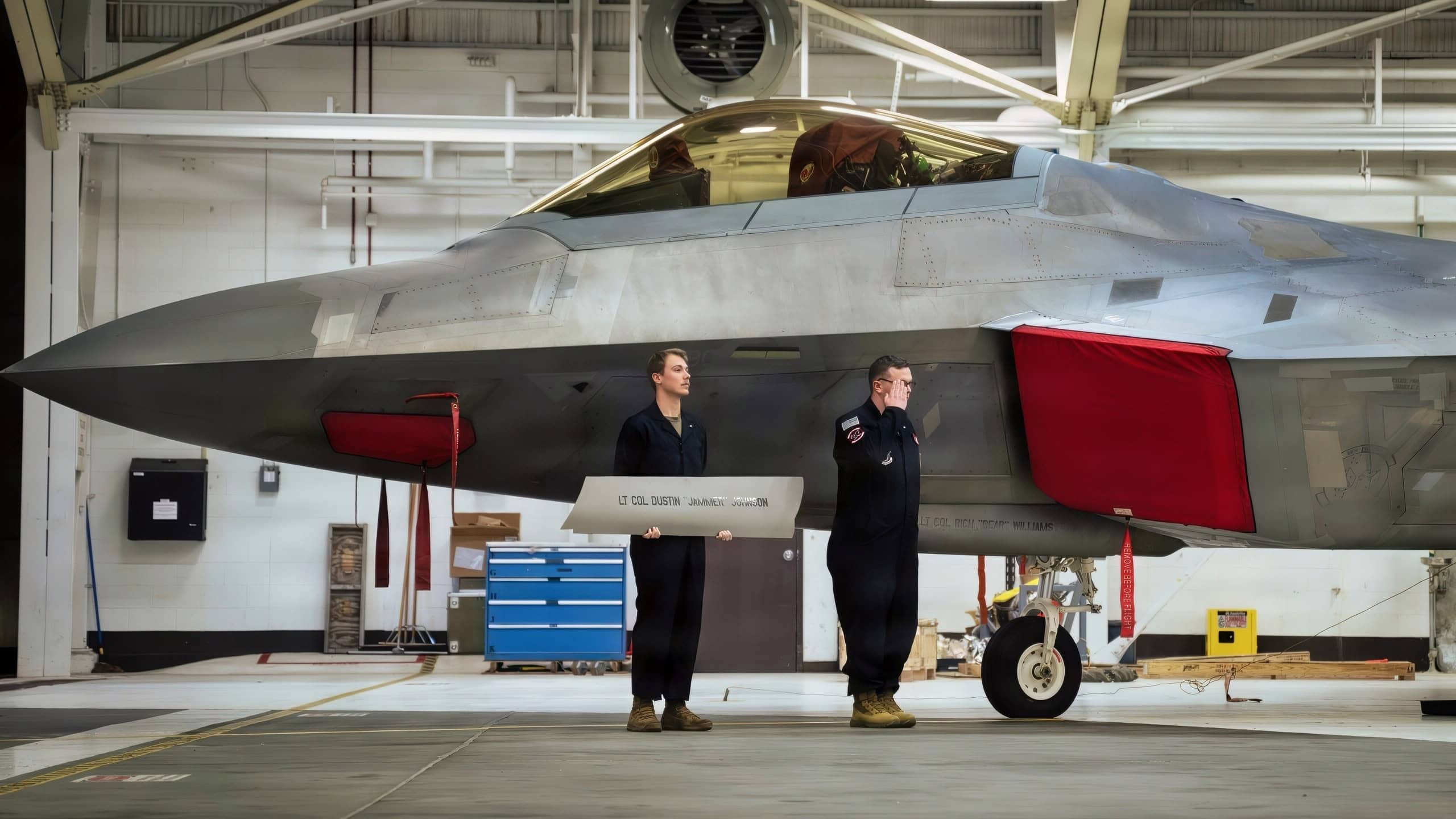
The F-22 Raptor Is Now Going to Go Into 2.0 Mode: The Best Fighter on Earth Gets Better
We are reminded once again that technology evolves and that weapons platforms are almost always upgradeable. At least, that’s what the ‘new’ version of the F-22 Raptor is teaching us.
The shortcoming of the US military, on many occasions, is that just because a major platform, like a fighter aircraft, is capable of being upgraded does not mean it will be.
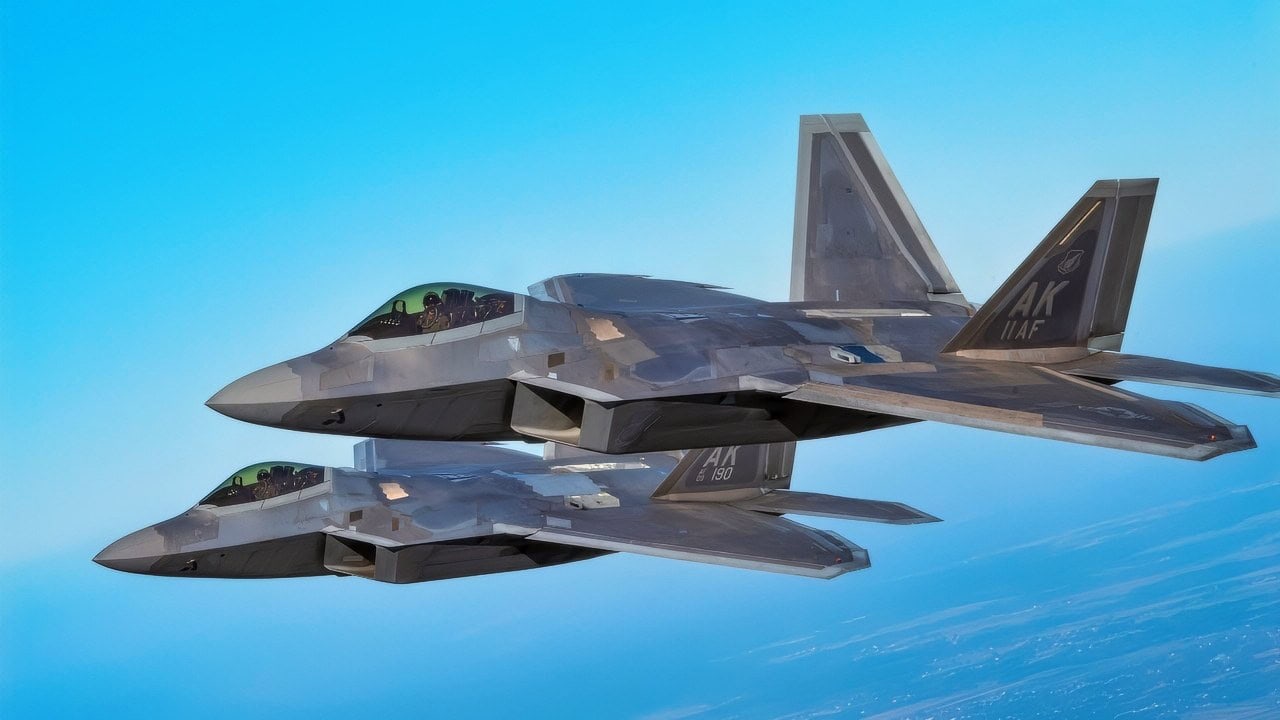
Two U.S. Air Force F-22 Raptors assigned to the 90th Expeditionary Fighter Squadron conduct a two-ship formation during the NATO Air Shielding media day, Oct. 12, 2022 at Łask Air Base, Poland. The Raptors uphold the Air Shielding mission alongside Polish F-16s and Italian Eurofighter Typhoons. The event showcased the importance of NATO’s Air Shielding mission and the interoperability among the U.S. and NATO Allies to international media through trilateral aerial demonstrations and interviews with service members. The U.S. remains dedicated to our security commitments with our NATO Alliance and postured to defend NATO territory. (U.S. Air Force photo by Staff Sergeant Danielle Sukhlall)
More often than not, the proposed improvements end up collecting dust on a shelf or at the bottom of a burn bag, lest anyone ever learn that there are actually cost-effective ideas inside the procurement system.
In a career of more than 37 years, I have seen more proposed upgrades for a combat aircraft than I can count that would have made all kinds of sense – and definitely would have delivered real value for money to the warfighter – but that in the end never saw the light of day.
Thankfully, two recent concepts for improving both the mission profile and the range of the F-22A survived the process that usually sees upgrades binned before they get started.
This is part of the traditional penny-wise and pound-foolish approach that many default to during a weapon system’s service life.
If the photographic evidence obtained in the past few days is being accurately interpreted, then the aircraft is about to become the “Raptor on Steroids”, as one analyst we spoke to described it.
Capabilities that have been discussed for years and were first captured in photographs two years ago are now apparently being validated in a series of test flights, along with other improvements to the aircraft’s range capacity, both over the Mojave Desert.
One of the most visible modifications to the aircraft is the addition of two external, stealthy, 600-gallon fuel tanks.
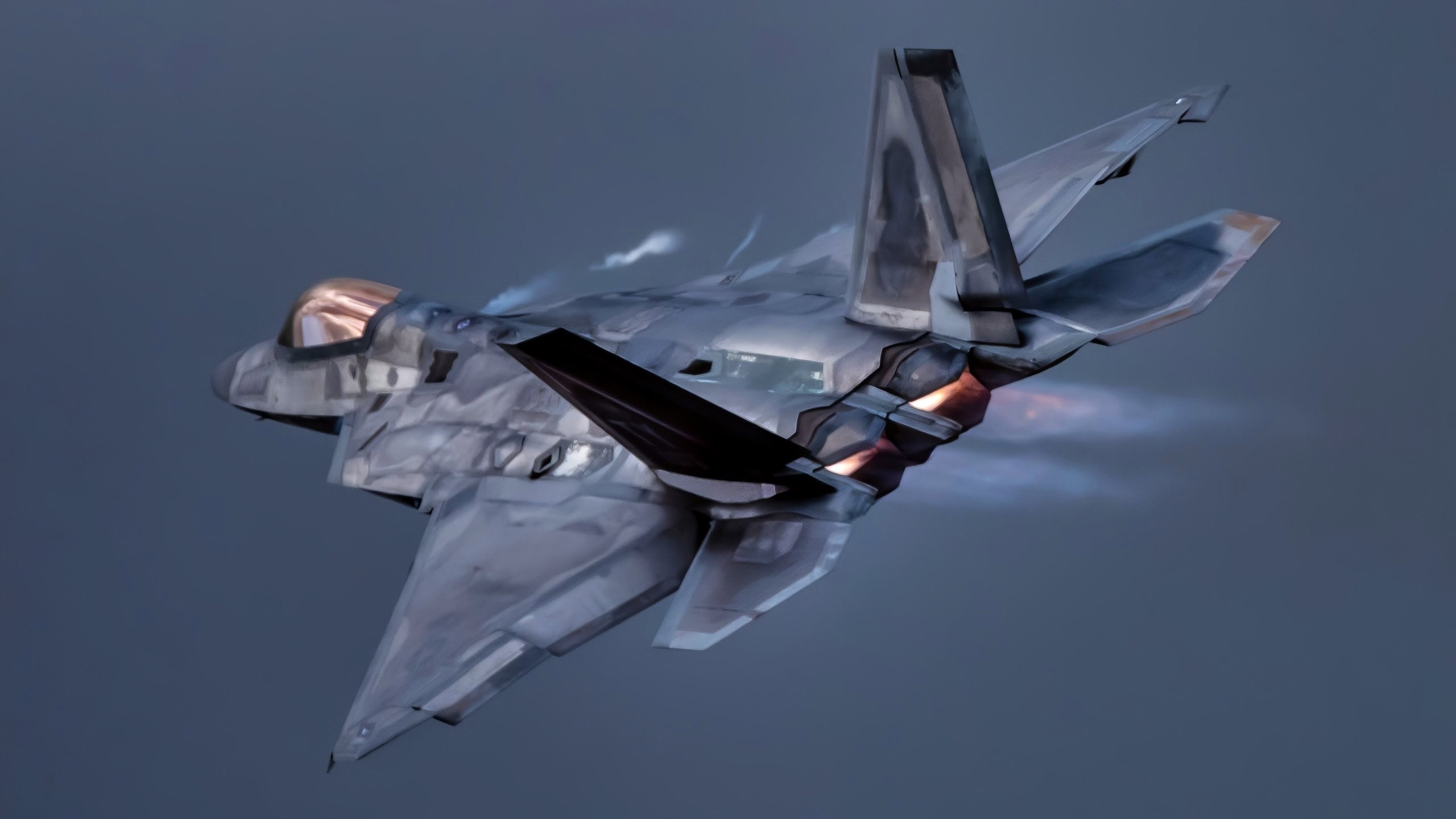
U.S. Air Force Maj. Josh Gunderson, F-22 Raptor Demonstration Team commander and pilot, flies a practice demo at Joint Base Langley-Eustis, Va., Dec. 6, 2019. Representing Air Combat Command, the F-22 Demo Team travels to air shows all across the world showcase the performance and capabilities of the world’s premier 5th-generation fighter. (U.S. Air Force photo by 2nd Lt. Sam Eckholm)
The standard load-out for these tanks is two per aircraft if required for a long-range mission.
However, reportedly, the aircraft can actually carry four of these if the fuel is needed for a long ferry mission.
This is not an unimportant improvement, as it would significantly reduce the F-22 fleet’s dependence on air-to-air refuelling tankers.
New F-22: Design For Combat Scenarios
Close examination of the photos reveals that these fuel tanks are of a non-traditional, angular, low-observable design.
Their shaping is consistent with the basic concepts of designing for stealth: ensuring that the surface reflects back a minimum or scattered radar signal, and that what is reflected is not within the antenna’s field of reception of the original radar pulse.
Reducing the shape of these tanks in this manner, which is a complete departure from the traditional design for external stores, is purposeful so as to extend the aircraft’s operational range all the way into the target area and then also during egress.
Conventional drop tanks are designed to be jettisoned before entering the combat zone, but these new tanks are intended to remain attached even during high-threat operations.
“That tells two important facts about these tanks,” said a US aviation specialist who has written extensively about stealth programs.
“One is that the material that these tanks are coated with must be capable of absorbing radar signals even at short ranges and without any appreciable increase in the aircraft’s radar cross section (RCS).”
“What is also tells us is that low RCS was not the only detail that was paid attention to in designing them,” he continued.
“Obviously, if they are intended to remain attached to the aircraft for the duration of a mission then they also must not be the cause for any excessive degradation in aerodynamic performance due to drag.”
Enhanced Mission Profiles For Raptor Stealth Fighter
A stealth aircraft that is capable of carrying additional fuel without compromising survivability also does more than just add to its effective range.
It also provides command authorities with numerous additional options in planning mission routes and patrol areas, as well as extending the time the aircraft can remain on station.
The second major observable aspect of the aircraft’s upgrade will be “music to the ears for those of us in the fighter community who have long been calling for a passive detection capability to be added to the F-22,” said a retired USAF flag rank officer who has been a long-time advocate for this technology and also took part in the program’s original requirements’ definition phase.
This is believed to be a function of a pair of mission pods mounted under the wings as well.
According to a report on The Aviationist, both pods appear to have a similar stealthy shape, though with minor variations.
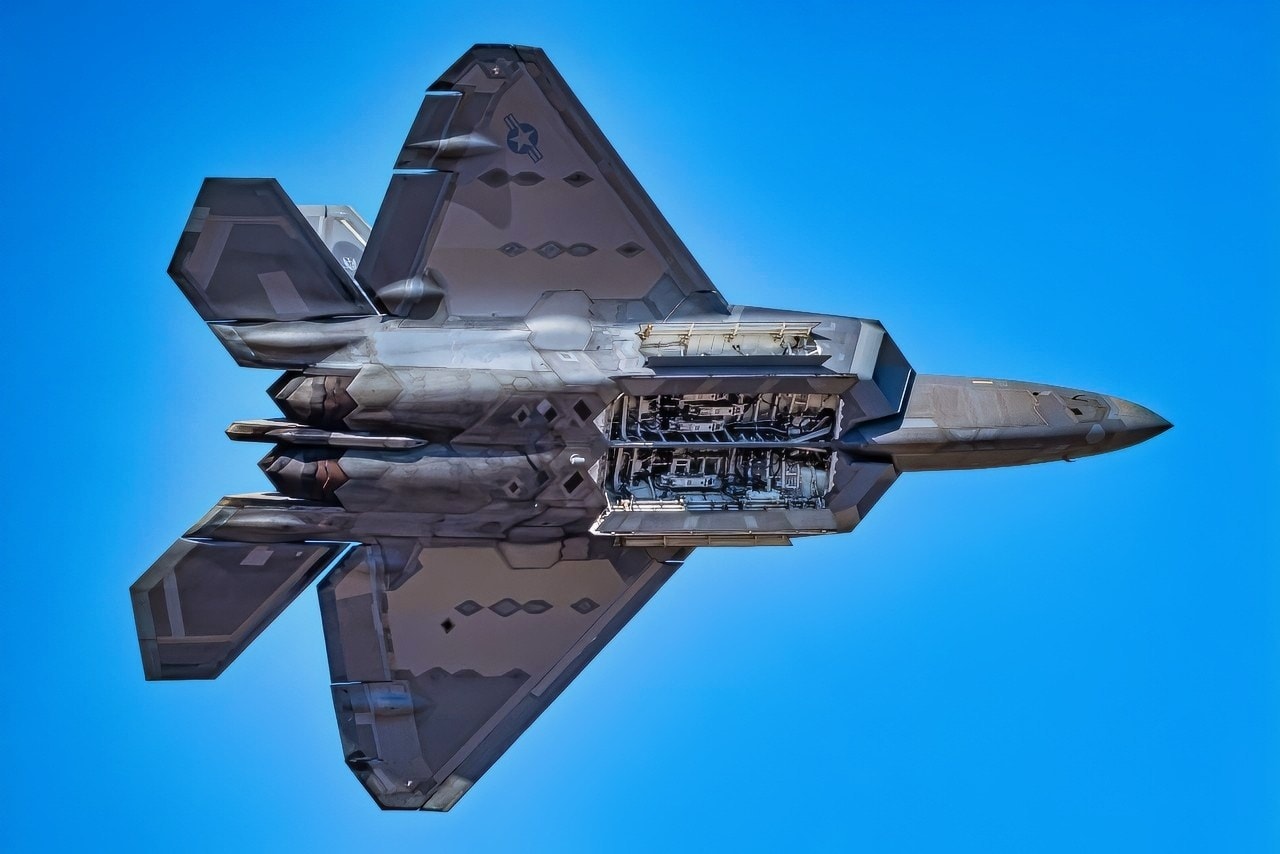
U.S. Air Force Maj. Joshua “Cabo” Gunderson, F-22 Raptor Demonstration Team commander and pilot, preforms the weapons bay door pass during rehearsal for the 2022 FIDAE Air & Trade Show, April 3, 2022 in Santiago, Chile. The F-22 Raptor is a multi-role air dominance stealth fighter that can carry of combination of air-to-air missiles and GPS guided bombs. (U.S. Air Force photo by Staff Sgt. Don Hudson)
One of the two appears to have a transparent window in the forward position.
That pod is believed to contain an infrared search and track (IRST) sensor or another similar optical detection and tracking system.
An on-board IRST enables the aircraft to detect and track targets using heat signatures without transmitting radar signals, thereby reducing the risk of detection by an adversary.
Passive sensors that operate in this manner are becoming mission-critical in today’s environment, where electronic warfare and emissions control are increasingly affecting combat survivability.
Old Fighter, New Tech Means a Better F-22 Future
What will come as no surprise to those familiar with the services’ aircraft procurement processes is that, early in its configuration development, there was a plan for an internally integrated IRST, similar to the electro-optical targeting system that was later made part of the sensor suite on the F-35 Lightning II.
That feature was later removed during the program’s development due to what were blamed as budget constraints.
A U.S. Air Force F-22 Raptor takes off from a base in the Middle East during Operation Epic Fury. The Raptor is unmatched by any known or projected fighter aircraft. pic.twitter.com/aZd59BlP3h
— U.S. Central Command (@CENTCOM) March 29, 2026
Which takes us back to that reference above to penny-wise and pound-foolish procurement practices.
“It only took the powers-that-be more than three decades to realise the F-22 always needed this kind of a passive detection system,” said the same retired flag-rank USAF officer.
About the Author: Reuben F. Johnson
Reuben F. Johnson has thirty-seven years of experience analyzing and reporting on foreign weapons systems, defense technologies, and international arms export policy. Johnson is the Director of Research at the Casimir Pulaski Foundation. He is also a survivor of the Russian invasion of Ukraine in February 2022. He worked for years in the American defense industry as a foreign technology analyst and later as a consultant for the U.S. Department of Defense, the Departments of the Navy and Air Force, and the governments of the United Kingdom and Australia. In 2022-2023, he won two awards in a row for his defense reporting. He holds a bachelor’s degree from DePauw University and a master’s degree from Miami University in Ohio, specializing in Soviet and Russian studies. He lives in Warsaw.