

Deployment After Deployment: The U.S. Navy’s Aircraft Carrier USS Gerald R. Ford Is Being Tested
The USS Gerald R. Ford Has Been All Over the World: All deployed sailors face tough missions, especially on aircraft carriers that stay at sea for long months.
Those in aircraft squadrons are constantly active. Pilots are briefed, spend plenty of time at the controls, and are then debriefed. This cycle repeats regularly.
Flight deck personnel work hard and are known for their skill, specialization, and stamina in a hazardous job.
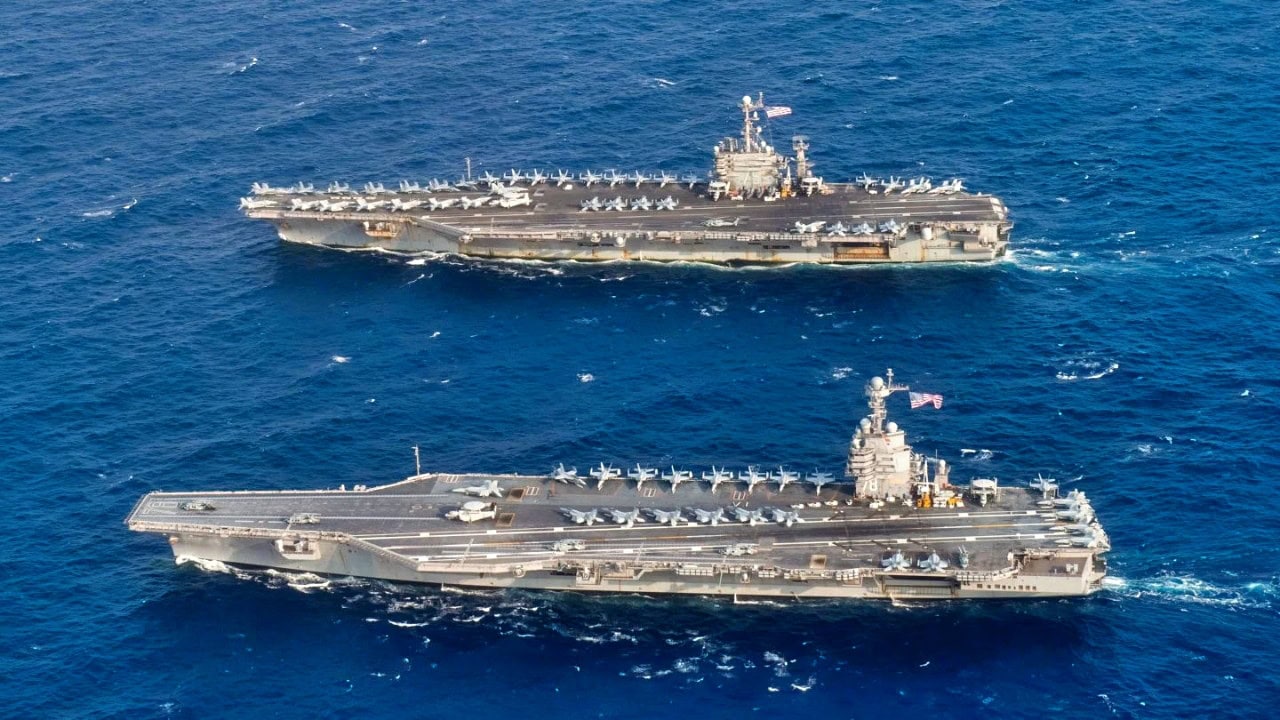
Ford-Class Aircraft Carrier U.S. Navy. Image Credit: Creative Commons.
The USS Gerald Ford Could Be Deployed for as Long as 11 Months
This high operational tempo has some wondering whether the USS Gerald R. Ford should have changed course from its deployment to the Caribbean to conduct a counter-narcotics mission in the Southern Command Area of Responsibility, then redeploy to the Middle East, potentially extending its deployment to 11 months, which is much longer than usual.
It left its homeport in Norfolk, Virginia, on June 24, 2025.
Chief of Naval Operations Worried About an Extended Deployment
Chief of Naval Operations Admiral Daryl Caudle was worried about extending the mission of the Gerald R. Ford.
He raised the alarm but then held back, not complaining further, when the Department of Defense ordered the carrier to respond to a call in the Middle East for Operation Epic Fury.
“I think the Ford, from its capability perspective, would be an invaluable option for any military thing the president wants to do,” Caudle explained. “But if it requires an extension, it’s going to get some pushback from the CNO. And I will see if there is something else I can do,” the admiral said to reporters at a naval conference. “It is the extensions that bother,” he added.
Hardship on the High Seas
There was concern that the extended deployment would lower morale and upset sailors who began to miss family events such as births, anniversaries, and other important occasions.
Shipmates in the surface fleet understand what they signed up for. They will be away from home for months. The sea can be lonely, and their jobs can be routine, with high-stress situations mixed in.
Bad Toilets and a Fire Onboard
Plus, the Ford faced several challenging situations, including sewage problems that backed up toilets, a hard-to-put-out fire in the aft laundry room, and injuries to three sailors, with 200 shipmates treated for smoke inhalation.
The fire destroyed mattresses, and some had to sleep on the floor or on tables.
Other Carriers Had Long Deployments During the Vietnam War
However, other carriers in history have endured long voyages. The USS Midway aircraft carrier deployed for 332 days during the Vietnam War. This 11-month deployment was a record for that conflict.
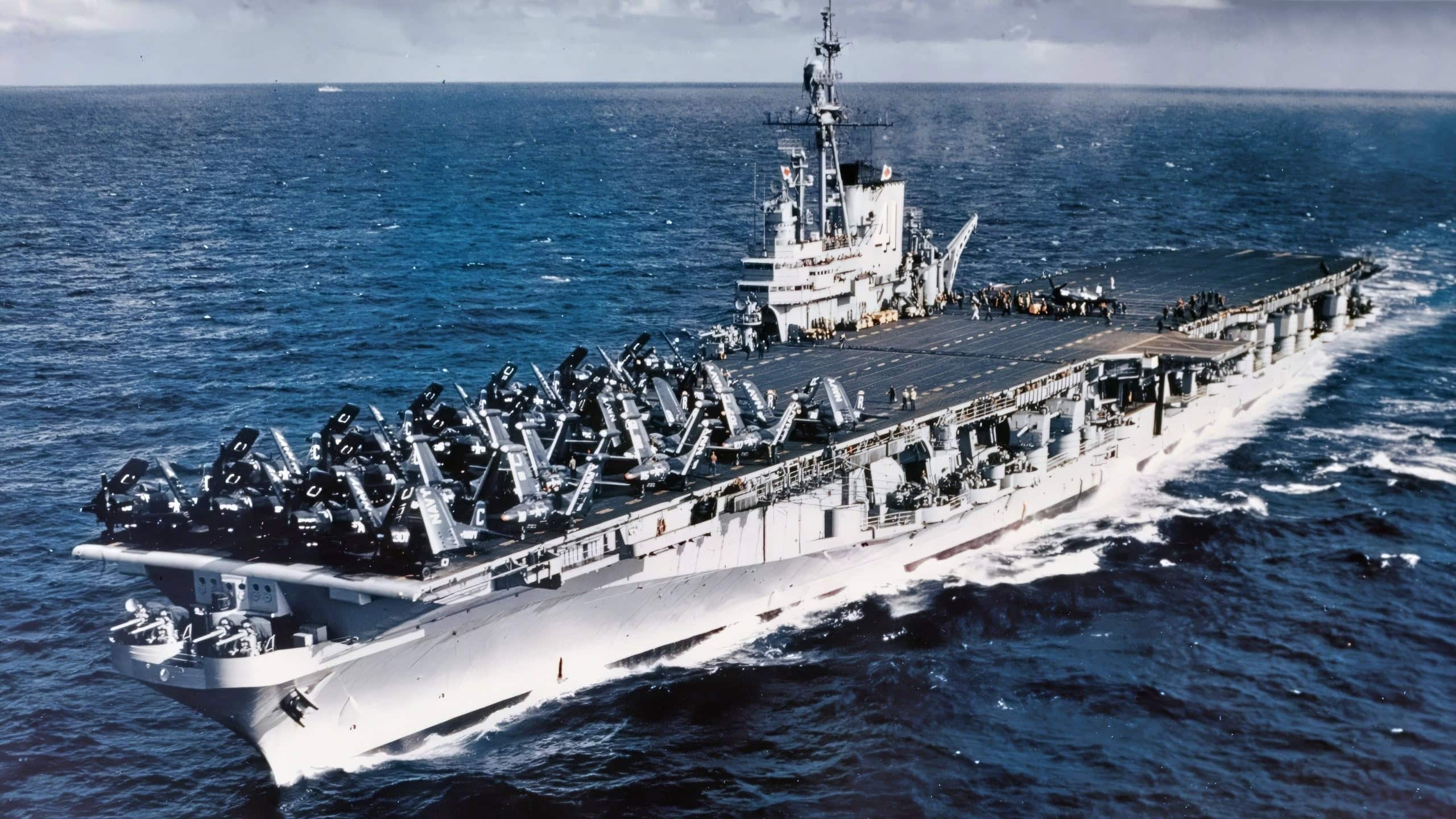
USS Midway Midway-Class Aircraft Carrier
The USS Coral Sea carrier nearly matched that record with 332 days at sea—just under an 11-month deployment. Carriers during the Vietnam War conducted intense aviation operations at high sortie rates. The flight deck crewmen often worked 48-hour shifts, according to my father-in-law, who served top-side on the USS Oriskany during Vietnam.
Don’t Forget the Long Duty Periods in World War Two
Sailors also pushed their limits during World War Two. The USS New Jersey battleship was deployed for an impressive 14 months. This was one of the longest continuous cruises during the war. The massive ship took part in the Marshall Islands campaign and the Battle of Leyte Gulf. New Jersey earned 19 battle stars.
New Jersey’s 16-inch guns fired 2,700-pound shells. It was 900 feet long and displaced 45,000 tons. There were 2,000 sailors on board, and after being at sea for more than a year, you can bet they were eager to come home. But they did not stop until the enemy was defeated.
The New Jersey Took It to the Limit
The New Jersey shipmates were often at battle stations for days on end. The battleship was sent to “Saipan, Tinian, and Guam. And we bombarded those three islands for 30 days, day and night,” according to New Jersey sailor Charles Owen.
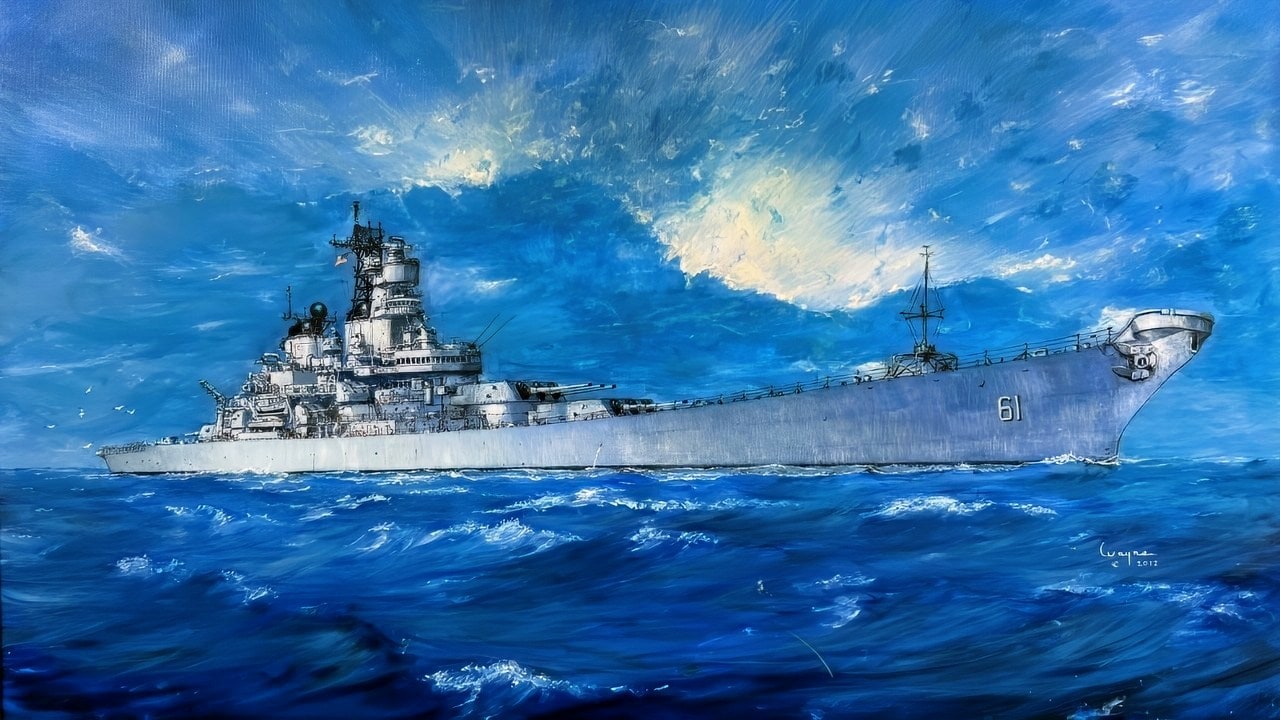
Image taken by Harry J. Kazianis aboard the USS Iowa on August 15, 2025. Image is of a painting of the USS Iowa of the Iowa-Class. USS New Jersey is also a Iowa-Class battleship.
New Jersey also had to deal with enemy fighter planes trying to destroy the battleship. Owen manned the anti-aircraft guns, and these attacks occurred daily. You can imagine how exhausted the crew became from the constant battle stress.
Which day would a Japanese submarine or airplane drop the torpedoes that could sink the mighty ship? Sailors could not dwell on these thoughts as they manned the guns and bombarded the shorelines to help the Marines.
Let the Ford Sailors Know They Are Not Alone
The crew on the Ford can draw inspiration from sailors during the Vietnam War and World War II. All personnel on the advanced carrier are highly professional and well-trained for their jobs.
The toilet situation is terrible, and the fire was frightening, but they got a needed break from combat duty in Crete, and now the supercarrier is in Split, Croatia. Soon, it will be time to get back to work on the high seas.
These sailors have been run ragged and probably miss home, but they should remember that shipmates in earlier wars also suffered and had to put aside fear and make a great effort during 11 to 14 months at sea.
Eventually, There Will Be ‘Fair Winds and Following Seas’
Let’s give credit to the sailors on the Ford. They served bravely in the Western Hemisphere and took the new orders to the Middle East with resolve. The officers aboard the carrier should note that sailors during Vietnam and World War II also faced challenges, and some served even longer in combat than personnel on the newer carrier.
It will take more effort to stay engaged after all that Ford has experienced, but they understand they are in rare company with this long deployment.
When all the repairs on the Ford are finished, the sailors will have fair winds and following seas ahead. I expect great things from the Gerald R. Ford and its crew.
About the Author: Brent M. Eastwood
Author of now over 3,000 articles on defense issues, Brent M. Eastwood, PhD, is the author of Don’t Turn Your Back On the World: a Conservative Foreign Policy and Humans, Machines, and Data: Future Trends in Warfare, plus two other books. Brent was the founder and CEO of a tech firm that predicted world events using artificial intelligence. He served as a legislative fellow for US Senator Tim Scott and advised the senator on defense and foreign policy issues. He has taught at American University, George Washington University, and George Mason University. Brent is a former US Army Infantry officer. He can be followed on X @BMEastwood.