
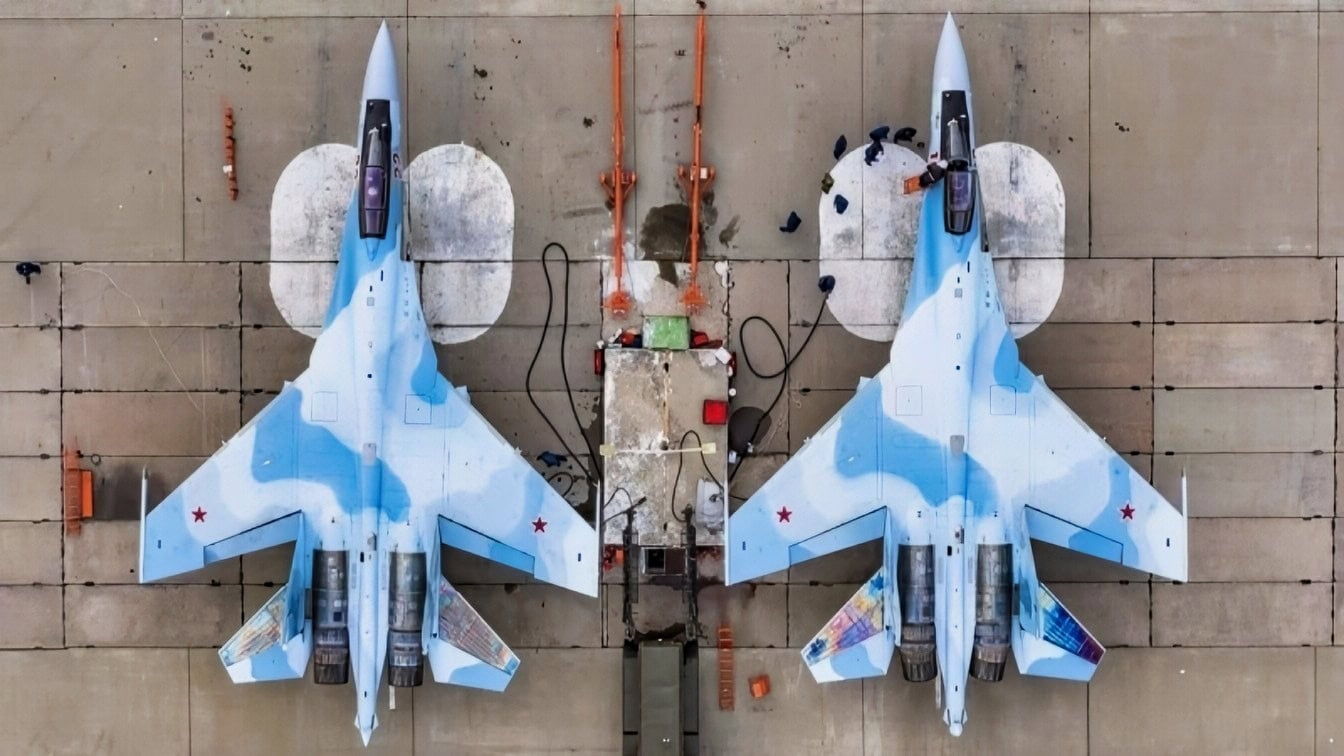
Russia has just delivered its third batch of Su-35S fighters this year, and it will not say how many aircraft are in it. Rostec announced the handover on Thursday, August 27, 2026, four months after the first batch and three months after the second. Roughly 114 Su-35s are already in Russian service, with another 30 on order. Sanctions, wartime spending and heavy combat losses were all supposed to make this impossible. The line at Komsomolsk-on-Amur is still moving.
More Su-35S Fighters for Russia
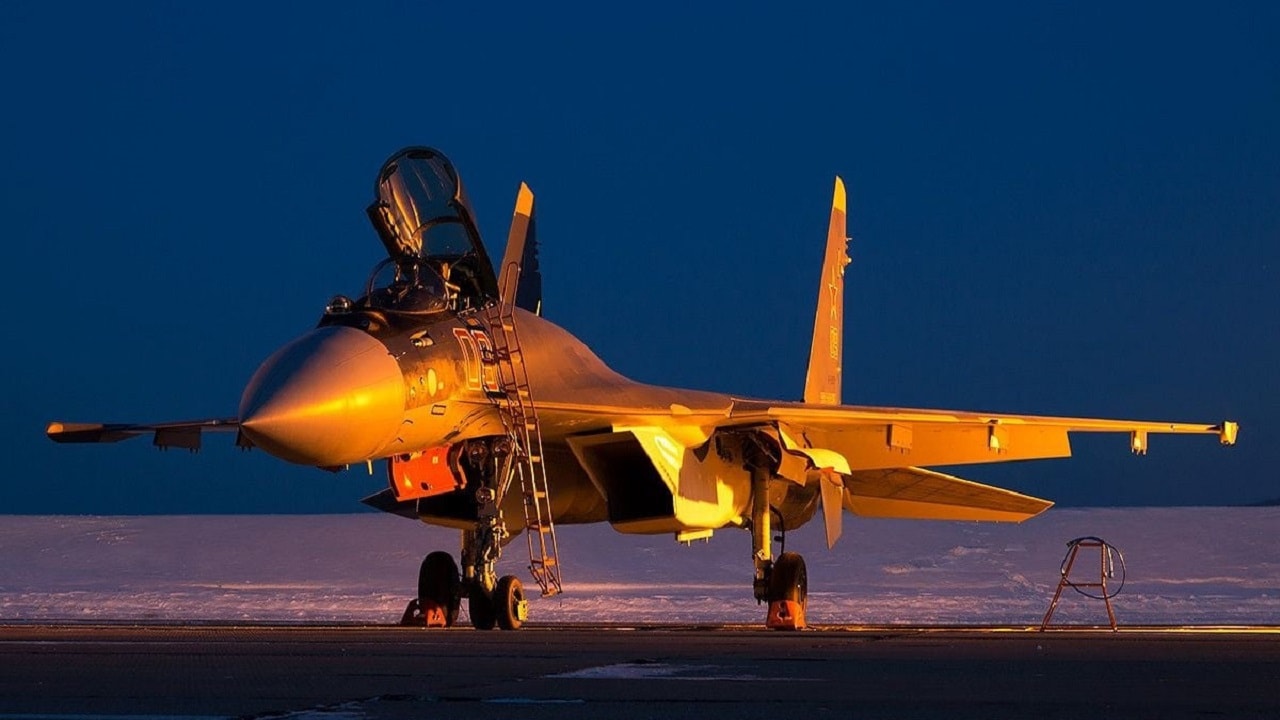
Russian Air Force Su-35. Image Credit: Creative Commons.
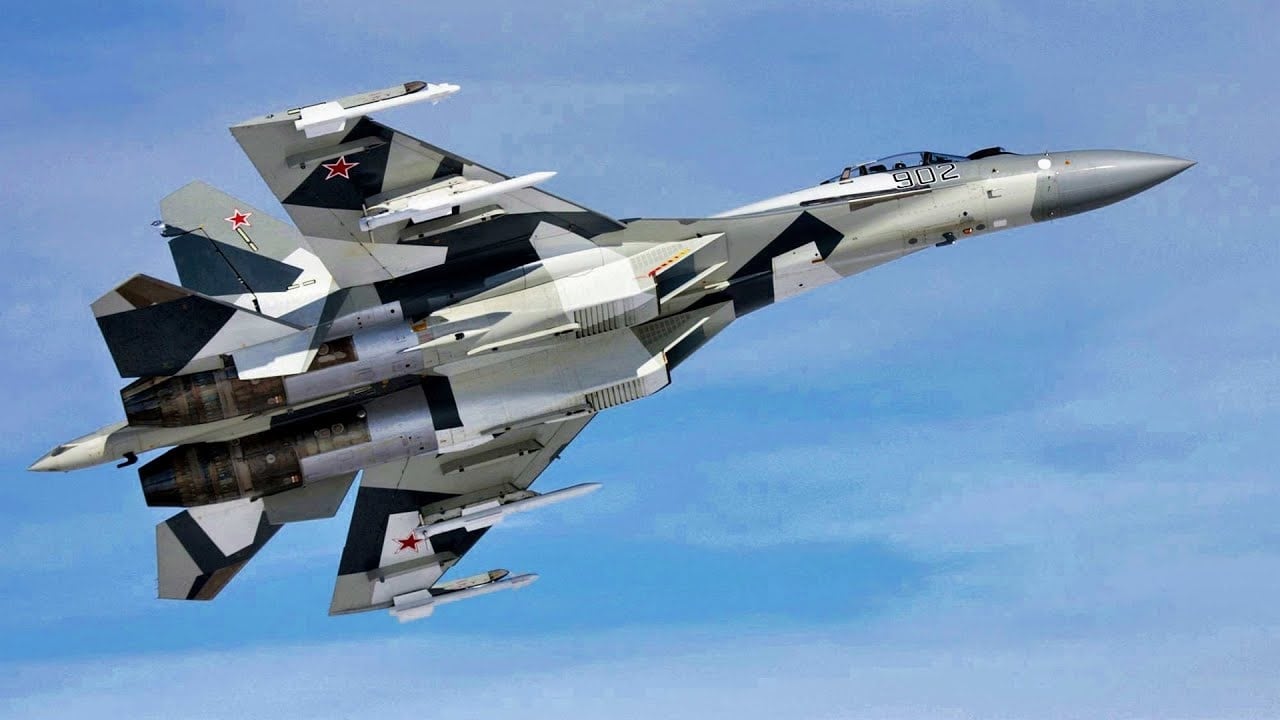
Russian Su-35 fighter jet. Image Credit: Creative Commons.
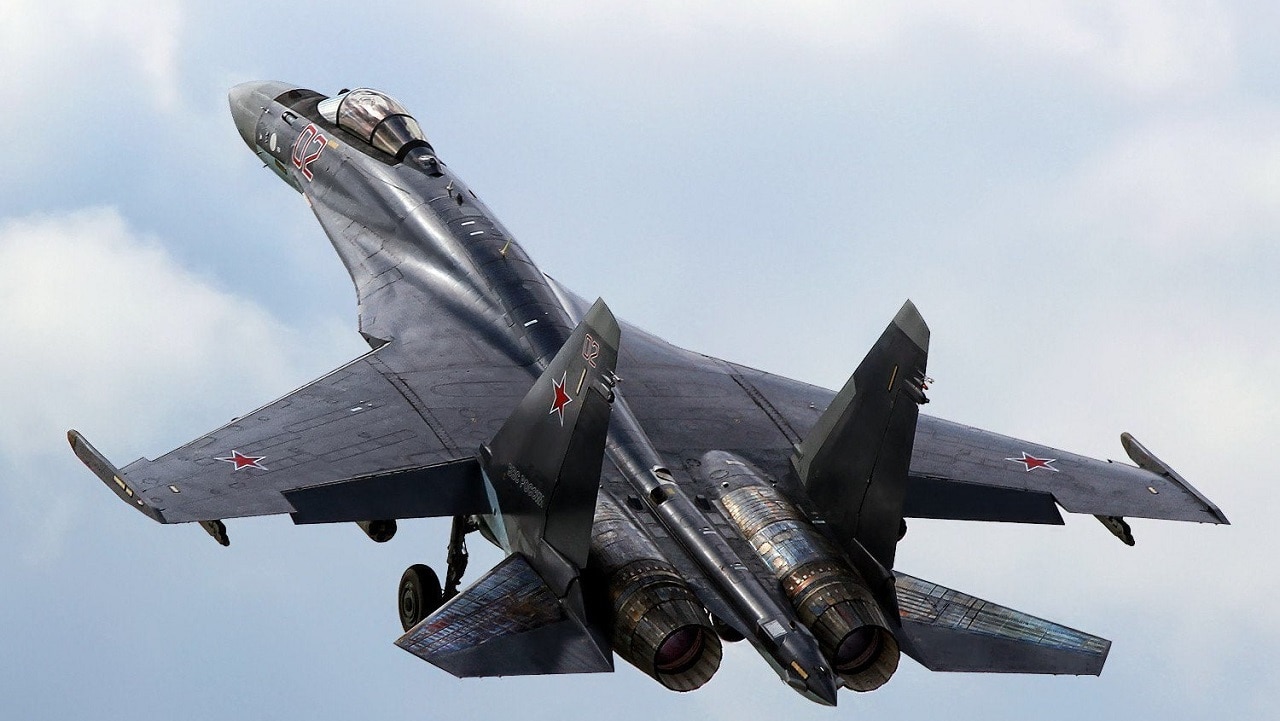
Su-35 fighter. Image Credit: Creative Commons.
According to a report we just received, Russia’s state defense conglomerate Rostec announced on Thursday, 27 August 2026, that their aviation subsidiary, United Aircraft Corporation (UAC)v, delivered its third Su-35S batch of the calendar year to Russia’s beleaguered air forces.
The spokesperson(s) also noted that the jets completed a full cycle of factory testing across various operating modes before flying to their home airbase. However, they didn’t specify the exact number of airframes being delivered or the specific beneficiary unit of the Aerospace Forces.
The warbirds are produced at UAC’s Yuri Gagarin Aviation Plant in Komsomolsk-on-Amur. The ever-handy World Directory of Modern Military Aircraft (WDMMA) estimates that Russia currently has 114 SU-35S’s in service and 30 more on order. The first contract, which called for 48 of the aircraft, was signed in 2009 and fulfilled by the end of 2015, followed by a second contract for 50 additional airframes inked that December.
An Expert Elaborates
Defense analyst Guy Plopsky observed on his X page that “The number of aircraft in this batch is not specified; photos and video released by UAC show two or more. UAC announced the delivery of the first and second batches of new-production Su-35S multirole fighters in April and May 2026, respectively. Those two batches likewise comprised aircraft with blue bort numbers.”
NOTE: Bort numbers are large, prominent numerical markings painted on the fuselage, wings, or tail of Russian military aircraft; unlike tail codes on U.S. military warplanes, bort numbers are used primarily for unit-level identification rather than unique aircraft specimen registration.
What the “Super Flanker” Brings to the Table
Although a 4.5 Generation fighter jet and therefore not a true stealth fighter like Sukhoi’s Su-57 “Felon,” the Su-35S is arguably Russia’s best fighter jet. Indeed, the unofficial NATO nickname for the beast is “Super Flanker”—although the more formal and official NATO reporting name is “Flanker-E/M—and as that “Super” appellation suggests, the plane was designed as a mega-modernization upon the original “Flanker,” the Su-27.
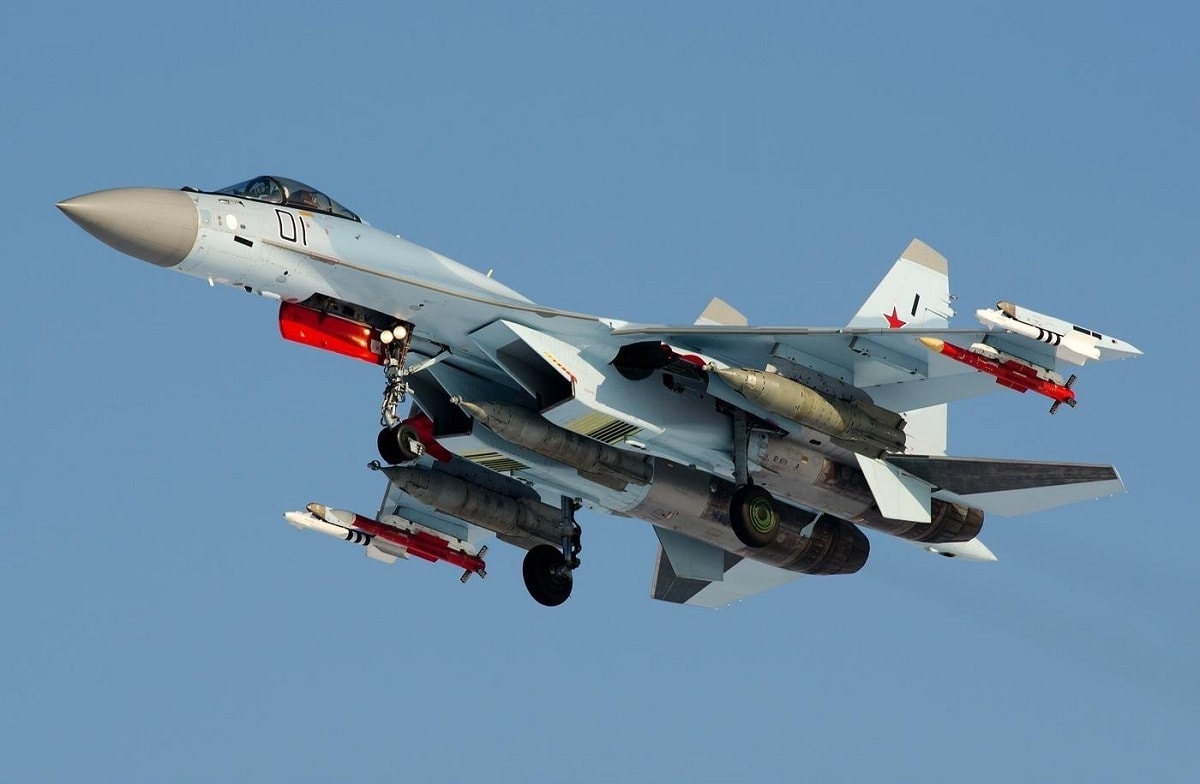
Su-35. Image: Creative Commons.
Indeed, the Flanker-E/M began life as the designation of Su-27M, making its maiden flight in prototype form in the skies of the Soviet Union in June 1988, during the waning years of the Cold War. The Su-35S designation wasn’t applied until 2007, 16 years after the Soviet collapse.
Improvements upon the original Flanker include:
-A canard, for better agility and takeoff/landing performance
-An enforced chassis to compensate for the increased takeoff and landing weight of the aircraft
-A quadruple-redundant digital-analog remote control system to assure the required stability and controllability characteristics
-A newly developed wing featuring an increased relative thickness
-The nose leg is replaced with a reinforced two-wheel strut
The Super Flanker has a max airspeed of Mach 2.25. Its armament package consists of a 30 mm Gryazev-Shipunov GSh-30-1 autocannon with 150 rounds of ammo and a cyclic rate of fire of 1,500 to 1,800 rounds per minute, as well as 12 hardpoints with a carrying capacity of 17,630 lb., potentially comprised of:
-RW-AE, R-27R1, R-27ER1. R-27T1, R-27ET1, and R-73E air-to-air missiles;
-Kh-31A, Kh-31P, Kh-29L, Kh-29T, and Kh-59M air-to- surface missiles;
-unguided and guided aerial bombs of various sizes and purposes
One anonymous Su-27 Flanker driver was quoted thusly in the Rostec report: “This equipment works without complaints; the crew finds it comfortable to fly.
We carry out various tasks on this aircraft: intercepting air targets at long range, covering strike groups and ground targets, destroying unmanned aerial vehicles, and delivering precision strikes against ground and surface targets with high-precision weapons. We also conduct reconnaissance, uncovering enemy positions at significant depth from the line of contact.”
The Su-35S experienced its first combat deployment in January of 2016, when four of the warbirds were sent to Syria as part of Moscow’s intervention in the Syrian Civil War.
Fast forward to the current Ukraine war, and Russian Super Flanker pilots have reportedly attained seven confirmed air-to-air kills against Ukraine’s fighter jets along with one Ukrainian Naval Aviation Mil Mi-14 “Haze” helicopter.
In return, there were at least two *confirmed* shootdowns of Su-35S’s by Ukrainian forces as of 2024, with multiple additional kills claimed by Ukrainian MIM-104 Patriot missile operators since then.
In addition, in late September 2023, Russia lost one of its prized Super Flankers to friendly fire, most likely from an S-300 surface-to-air missile (SAM).
About the Author: Christian D. Orr
Christian D. Orr is a Senior Defense Editor. He is a former Air Force Security Forces officer, Federal law enforcement officer, and private military contractor (with assignments worked in Iraq, the United Arab Emirates, Kosovo, Japan, Germany, and the Pentagon). Chris holds a B.A. in International Relations from the University of Southern California (USC) and an M.A. in Intelligence Studies (with a concentration in Terrorism Studies) from American Military University (AMU). He is also the author of the book “Five Decades of a Fabulous Firearm: Celebrating the 50th Anniversary of the Beretta 92 Pistol Series,” the second edition of which was recently published.