

Next Generation Electronic Warfare – The US Air Force’s new EA-37B Compass Call has reportedly been flying missions near Russia’s Kaliningrad exclave, alongside a NATO E-3 Sentry AWACS and a US Army ARTEMIS II intelligence aircraft.
The combination of aircraft here is notable.
The E-3 builds the broader airborne radar picture, while the ARTEMIS II is capable of collecting information on the activity below.
The EA-37B, meanwhile, is designed not merely to listen to the electromagnetic spectrum, but, when needed, to attack an adversary’s ability to use the electromagnetic spectrum.
Combined, these three aircraft create a formidable presence.
Of course, flight activity alone does not establish what the three aircraft were doing near Kaliningrad.
Just because the EA-37B was involved does not confirm that Russian systems were being targeted. Still, Kaliningrad is an excellent venue for testing out a new electromagnetic device like the EA-37B.
Why Kaliningrad Matters
Kaliningrad is a small Russian exclave between Poland and Lithuania, physically separated from mainland Russia—an odd curiosity on the map of Eastern Europe.
From a military perspective, however, Kaliningrad carries outsized strategic value.
In the small exclave, Russia has concentrated S-400 surface-to-air missile systems, along with short-range air defenses, electronic warfare capabilities, a variety of missile forces, naval assets, and the infrastructure for sophisticated surveillance and communications.
Kaliningrad’s location gives Moscow a forward position that essentially overlooks portions of the Baltic and NATO territory.
Kaliningrad also sits near the Suwalki Gap, the narrow strip of land between Poland and the Baltic states, widely understood as one of NATO’s most pronounced geographic vulnerabilities.
Should war ever erupt, NATO would be incentivized to suppress Kaliningrad’s sensors and air defenses immediately.
Russia, similarly, would be incentivized to preserve Kaliningrad’s capabilities, making the territory a likely early contest in any NATO-Russia conflict.
The EA-37B Upgrade
The EA-37B replaces the aging EC-130H Compass Call, which performed electronic attack from a C-130-derived platform for decades. While venerable, the EA-37B is an upgrade.

C-130 Image: Creative Commons.
The major difference is that the EA-37B is a modified version of a Gulfstream G550 business jet—only with electromagnetic spectrum equipment now added.
The basic advantages of the new platform are kinetic: the EA-37B is faster than the EC-130H, capable of operating at higher altitudes, with longer range, better endurance, and a smaller physical footprint.
The aircraft is visually distinct, with prominent conformal fairings and antenna arrays along the fuselage. The EA-37B combines the G550 with the BAE Systems electronic attack suite, which is central to the Compass Call mission. L3Harris oversaw the integration of the various systems.
The Modern Mission
Modern integrated air defenses aren’t individual missile batteries operating independently.
It’s more of a network, including long-range surveillance radar to detect, command nodes to interpret, and then communication links to pass the information along to the appropriate fire-control radar and battery.
Then, based on the preceding sequence, an interceptor is launched—the last link in a sophisticated chain. The system’s strength relies on connectivity and coordination—exactly what the EA-37B targets.
If electronic attack can degrade the communications or information flow of the IADS chain, the dangerous part of the chain, the S-400 launcher, may be degraded because the wider network within which it operates has been disrupted.
This approach is a cheaper, more effective way to degrade IADS than physically destroying every radar and missile launcher.
No Magic Bullet
But the EA-37B isn’t a magic bullet.
Russia has spent decades preparing to operate in contested electromagnetic environments.
In an actual encounter, Russia wouldn’t just sit by passively; they would rely on frequency hopping, redundant communications, hardened or directional links, decentralized operations, passive sensors, or shutting down emitters.
And unlike the F-35 or F-22, the EA-37B isn’t a stealth aircraft. Survival will depend on stand-off employment—that is, staying beyond the reach of Russian defense systems.
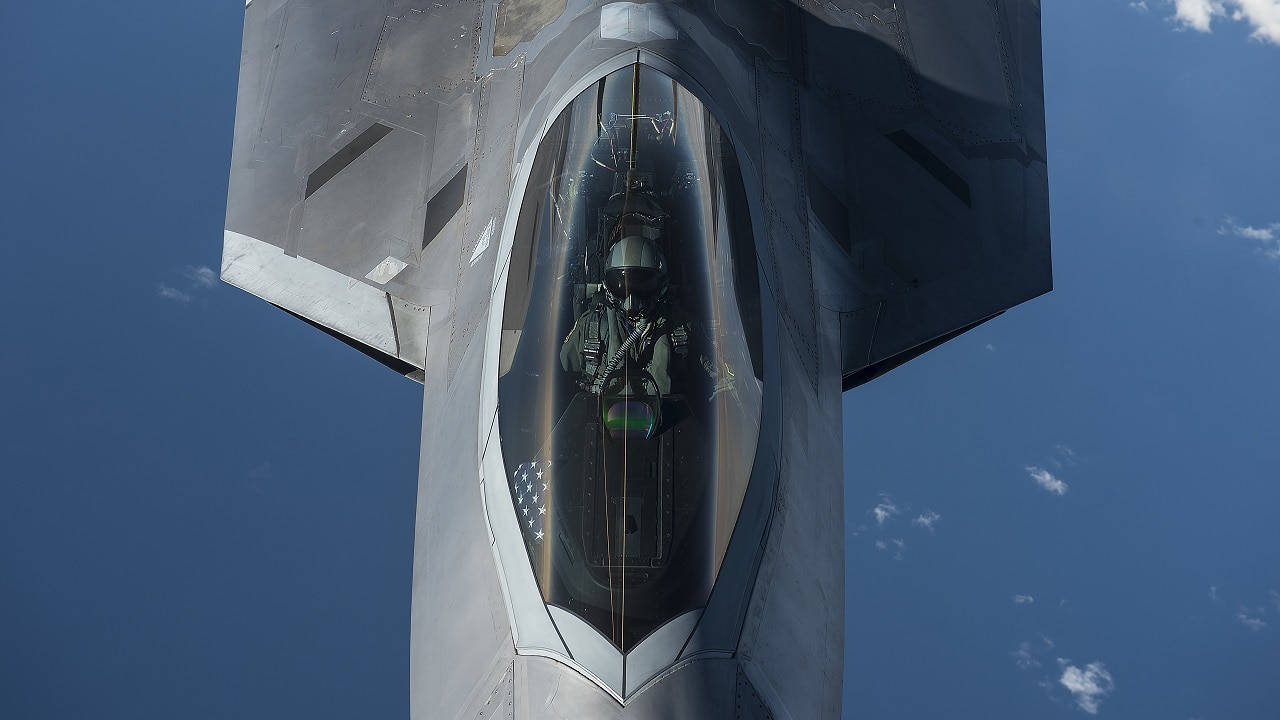
A U.S. Air Force F-22 Raptor pilot from the 95th Fighter Squadron, Tyndall Air Force Base, Fla., flies over the Baltic Sea Sept. 4, 2015. The U.S. Air Force has deployed four F-22 Raptors, one C-17 Globemaster III, approximately 60 Airmen and associated equipment to Spangdahlem Air Base, Germany. While these aircraft and Airmen are in Europe, they will conduct air training with other Europe-based aircraft. (U.S. Air Force photo by Tech. Sgt. Jason Robertson/Released)
But given the long range of Russian air defenses and fighters, this might mean the EA-37B has to operate beyond its effective range.
Still, the EA-37B is an important upgrade in the NATO toolkit, a sign of shifts in the approach to countering air defense systems.
About the Author: Harrison Kass
Harrison Kass is a writer and attorney focused on national security, technology, and political culture. His work has appeared in Tablet, City Journal, The Hill, The Spectator, and The Cipher Brief. He holds a JD from the University of Oregon and a master’s in Global & Joint Program Studies from NYU. More at harrisonkass.com.