

In the last week of April 1945, with the war in Europe days from ending, a colonel of the US 2nd Cavalry Group radioed the Third Army with the strangest request George Patton ever received. Hundreds of irreplaceable horses, including the white Lipizzaner breeding stock of Vienna’s Spanish Riding School, were sitting at a German stud farm called Hostau, across the Czechoslovak border, in territory the Red Army would reach within days. Colonel Charles Hancock Reed wanted permission to go get them. Patton’s answer, as the story has come down, was five words: get them, make it fast. What followed became known as Operation Cowboy, and it produced one of the rarest scenes of the Second World War: American GIs and surrendered German soldiers fighting side by side against the Waffen-SS to save more than 1,200 horses.
This is the plain account of what happened and why.
The Horses at Hostau
The horses were at Hostau because the Third Reich had put them there.
The German state had gathered the finest breeding stock in occupied Europe at the Bohemian stud farm as part of a wartime breeding program: the Lipizzaner mares and foals evacuated from Austria, Arabians, Thoroughbreds, and hundreds of Russian horses, tended in part by Allied prisoners of war and Cossack defectors held at the site.
The Lipizzaners were the treasure.
The breed behind the Spanish Riding School traces its bloodlines back four centuries to the Habsburg court, and the mares at Hostau were its future; lose them, and the performing stallions in Austria would be the last of their line.
By late April 1945, the farm sat directly in the path of the advancing Soviets, and everyone involved understood what that likely meant for the animals: an army that had been living off the land, and a starving continent behind it, did not preserve rare horses.
The Ask
The Americans learned about Hostau when a German intelligence officer surrendered to the 2nd Cavalry carrying photographs of the horses.
He had picked his unit well.
Reed was a lifelong horseman, and the general above him was the most famous cavalry officer America ever produced, a man who had ridden in the 1912 Olympics, had served early in his career on horseback, and knew Reed from the prewar horse world.
The approval came fast, in the five words the tradition preserves, with the understanding that Reed’s neck was on the line if it went wrong.
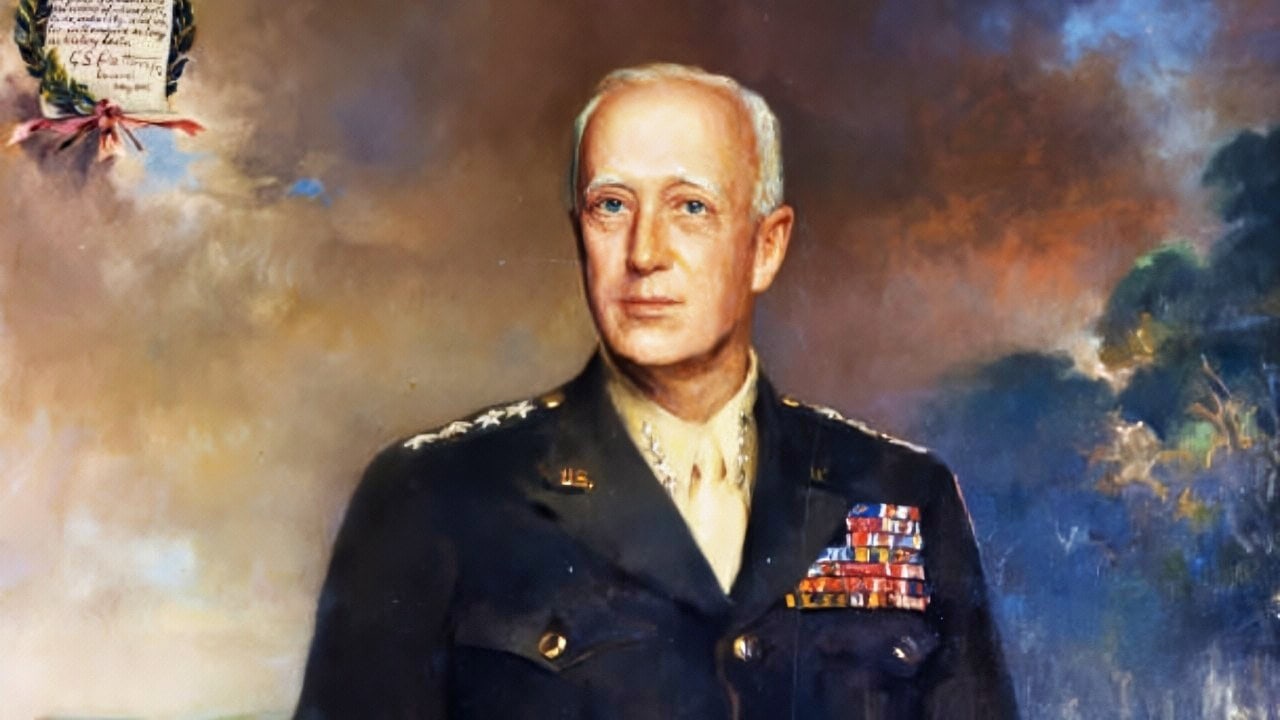
Portrait of Army General Patton. Image Credit: Creative Commons.
The mechanics were stranger than the permission.
A German veterinary officer at the farm, Captain Rudolf Lessing, rode out through the lines to meet the Americans and agreed to help arrange a surrender; Reed sent Captain Thomas Stewart, a 29-year-old Tennessee horseman and intelligence officer who spoke some German, back through enemy territory with Lessing to negotiate.
The Hostau garrison agreed to hand over the farm, asking only that the Americans arrive with tanks so the surrender would look honorable. On April 28, 1945, a small task force, one cavalry troop with light tanks and assault guns, fought its way roughly twenty miles through the frontier defenses that had not gotten the message, and took the farm.
The Fight and the Drive
Then came the part nobody planned. Waffen-SS units in the area, surrendering to no one, attacked the farm to take it back, and the defense that repelled them was a formation with no precedent: American cavalrymen, the German soldiers who had surrendered hours earlier, rearmed for the purpose, and Cossack horsemen, fighting together and twice throwing the SS back.
The men called the composite force Stewart’s Foreign Legion.
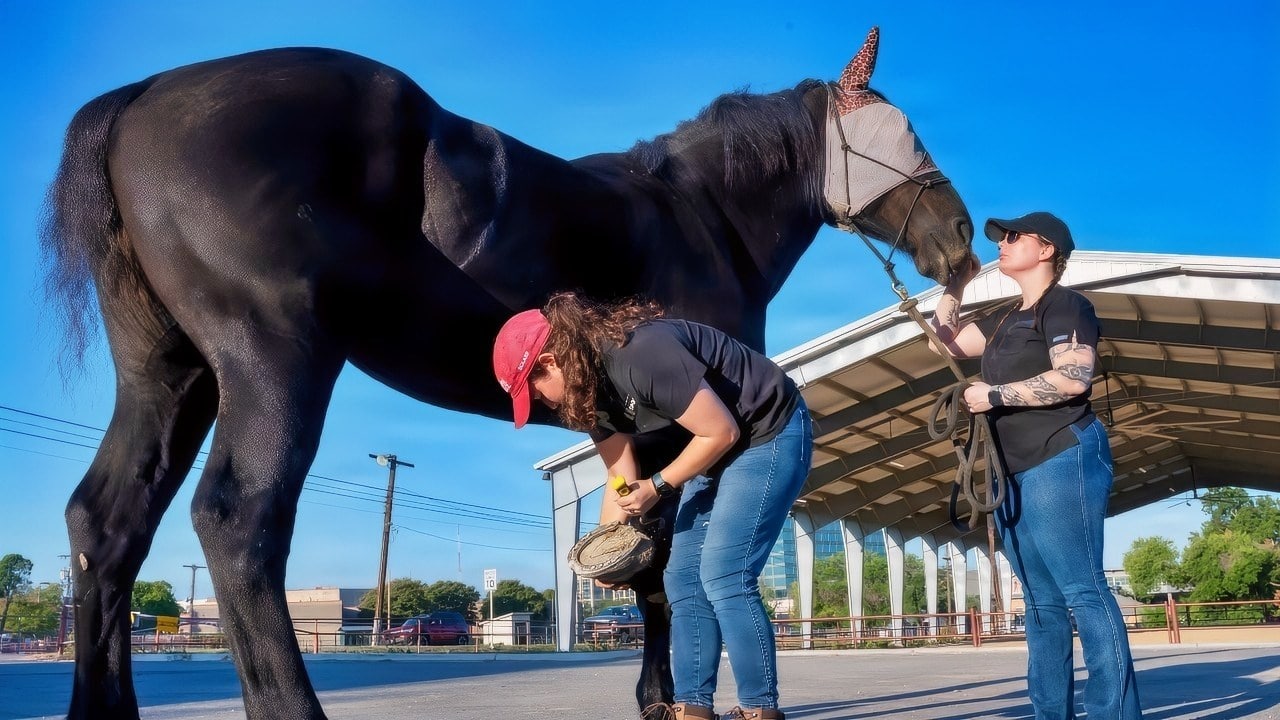
U.S. Army Capt. Sabrina Dagher-Arevalo, veterinarian, left, and Sgt. Erin Loya, animal care specialist with Public Health Command-West, performs hoof care to a caisson horse during its annual exam at Joint Base San Antonio-Fort Sam Houston on Sept. 26, 2025. This care helps detect issues like lameness, cracks, and abscesses early on, ensuring the horse can move and perform without pain or injury. (U.S. Air Force photo by Melissa Hydrick)
With the farm held, the evacuation became a cattle drive out of another century: officers of three nations rode the stallions west, the herds were driven on foot, and the pregnant mares and newborn foals traveled together in American and German trucks, some 35 miles into Bavaria.
Soviet tanks reached the edge of Hostau as the last of the column moved out.
The final count ran past 1,200 horses, including about 375 Lipizzaners, plus roughly 400 liberated Allied prisoners of war.
Stewart received the Bronze Star, and Patton, in his own gesture, gave him a fine German shotgun.
Why It Was Not Strange to Him
The rescue’s coda came on May 7, when the Spanish Riding School’s director, Colonel Alois Podhajsky, performed with his stallions at St. Martin in Austria for Patton himself and asked the US Army to protect the school; Patton agreed on the spot, and the school that dances in Vienna today descends from both decisions, the protection and the rescue.
The operation stands in the record as one of only two occasions in the entire war when American and German soldiers fought on the same side, and the horses returned to Austria to rebuild the oldest riding tradition in Europe.
As for the five words, they were the least surprising thing about the whole affair.
Patton was a cavalryman before anything else, the Army’s onetime Master of the Sword, an Olympic rider, a man who believed a good solution applied with vigor now beat a perfect one applied ten minutes later.
About the Author: Harry J. Kazianis
Harry J. Kazianis (@Grecianformula) was the former Senior Director of National Security Affairs at the Center for the National Interest (CFTNI), a foreign policy think tank founded by Richard Nixon based in Washington, DC. Harry has over a decade of experience in think tanks and national security publishing. His ideas have been published in the NY Times, The Washington Post, The Wall Street Journal, CNN, and many other outlets. He has held positions at CSIS, the Heritage Foundation, the University of Nottingham, and several other institutions related to national security research and studies. He is the former Executive Editor of the National Interest and the Diplomat. He holds a Master’s degree focusing on international affairs from Harvard University.

