
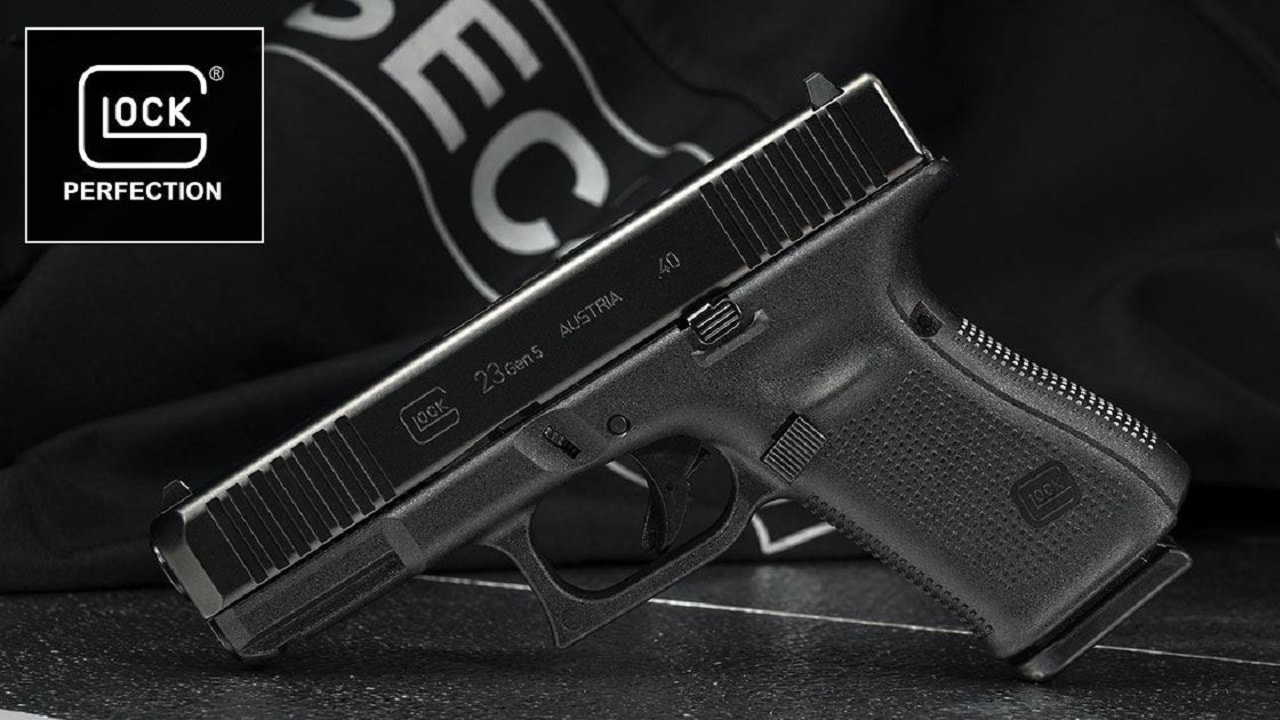
Summary and Key Points: The Glock 23 has been a fixture in the compact pistol market since its introduction in 1990, offering shooters a .40 S&W option in the same size frame as the popular 9mm Glock 19. Over three and a half decades later, it remains a common choice among law enforcement officers, concealed-carry permit holders, and home-defense shoppers. Like any firearm, though, it comes with trade-offs worth understanding before you buy.
Making A Case For the Glock 23
Reliability. Glock built its reputation on pistols that run consistently across a wide range of conditions, ammunition types, and maintenance schedules, and the 23 is no exception.
Its simple design uses relatively few moving parts, which reduces the number of potential failure points. Many owners report tens of thousands of rounds fired with minimal cleaning (though not recommended) and few, if any, malfunctions.
Compact size with meaningful power. The Glock 23 is built on the same compact frame as the Glock 19, making it easy to conceal for everyday carry while chambering the .40 S&W cartridge, which produces more muzzle energy than 9mm in most factory loadings, but it isn’t quite as snappy as a .45.
For shooters who prioritize a harder-hitting round without stepping up to a full-size duty pistol, the 23 offers a middle ground.
Capacity. Standard magazines hold 13+1 rounds of .40 S&W, which is respectable for a compact pistol. This gives shooters a reasonable balance between firepower and a grip size that remains manageable for most hand sizes.
Widespread parts and holster support. Because the Glock 23 has been in continuous production for decades and shares a footprint with other Glock models, aftermarket support is extensive.
Holsters, sights, magazines, triggers, and other accessories are easy to find and often less expensive than for less common pistols.
Simplicity of operation. Glocks use a striker-fired design without an external manual safety lever, relying instead on internal safeties and consistent trigger pull.
For many shooters, this reduces the number of steps and decisions under stress, though it places greater emphasis on trigger discipline and proper holster selection.
Proven law enforcement track record. Many police departments have carried .40-caliber Glocks, including the 23, for years.
That kind of institutional adoption typically reflects extensive vetting for durability and performance under demanding conditions.
Making The Case Against the Glock 23
Recoil and controllability. The .40 S&W cartridge generates noticeably sharper recoil than 9mm, especially in a compact frame like the 23’s.
Some shooters find this slows follow-up shots and makes practice sessions more fatiguing, which can be a real drawback for newer shooters or anyone who shoots infrequently.
Ammunition cost and availability. In recent years, 9mm has become both cheaper and more widely available than .40 S&W at most retailers.
This matters for anyone who plans to train regularly, since ammunition costs add up quickly.
Industry trend away from .40 S&W. Several major police agencies, including the FBI, have shifted back to 9mm over the past decade, citing comparable terminal performance with modern bullet designs, easier controllability, and higher magazine capacity.
This shift has influenced the broader market, and some shooters view .40 S&W as a cartridge in decline rather than growth.
Trigger feel. Glock triggers are functional and consistent, but many shooters find them less refined out of the box than those of some competitor pistols.
Aftermarket trigger upgrades are common, which adds to the total cost of ownership for those seeking a lighter or crisper pull.
No external manual safety. While many shooters see the lack of a manual thumb safety as a feature, others see it as a drawback, particularly those trained on pistols with a traditional external safety or who want an additional manual step before the gun can fire.
Grip angle and ergonomics. Glock’s grip angle is distinctive and doesn’t suit every shooter. Those transitioning from 1911-style pistols or revolvers sometimes need time to adjust their point of aim, with shooters often finding that a Glock initially points high when raised instinctively.
Also, the boxy grip shape isn’t universally comfortable for smaller hands, despite interchangeable backstraps on newer generations.
The Glock 23 Is An Excellent Weapon Despite The Caliber
The Glock 23 remains a solid, well-supported option for shooters who specifically want a .40-caliber pistol in a concealable size, backed by a long track record of reliability and an enormous aftermarket.
Its main drawbacks stem from the characteristics of the .40 S&W cartridge itself: sharper recoil and a shrinking market share compared to 9mm.
And many critics argue (I’m not a fan of the .40 S&W) that if you want more power than a 9mm, why not go to a .45 or even a 10mm?
As with any firearm, hands-on time at a range and proper training matter more than any single feature comparison, and prospective buyers should always keep that fact in mind.
About the Author: Steve Balestrieri
Steve Balestrieri is a National Security Columnist. He served as a US Army Special Forces NCO and Warrant Officer. In addition to writing on defense, he covers the NFL for PatsFans.com and is a member of the Pro Football Writers of America (PFWA). His work was regularly featured in many military publications.