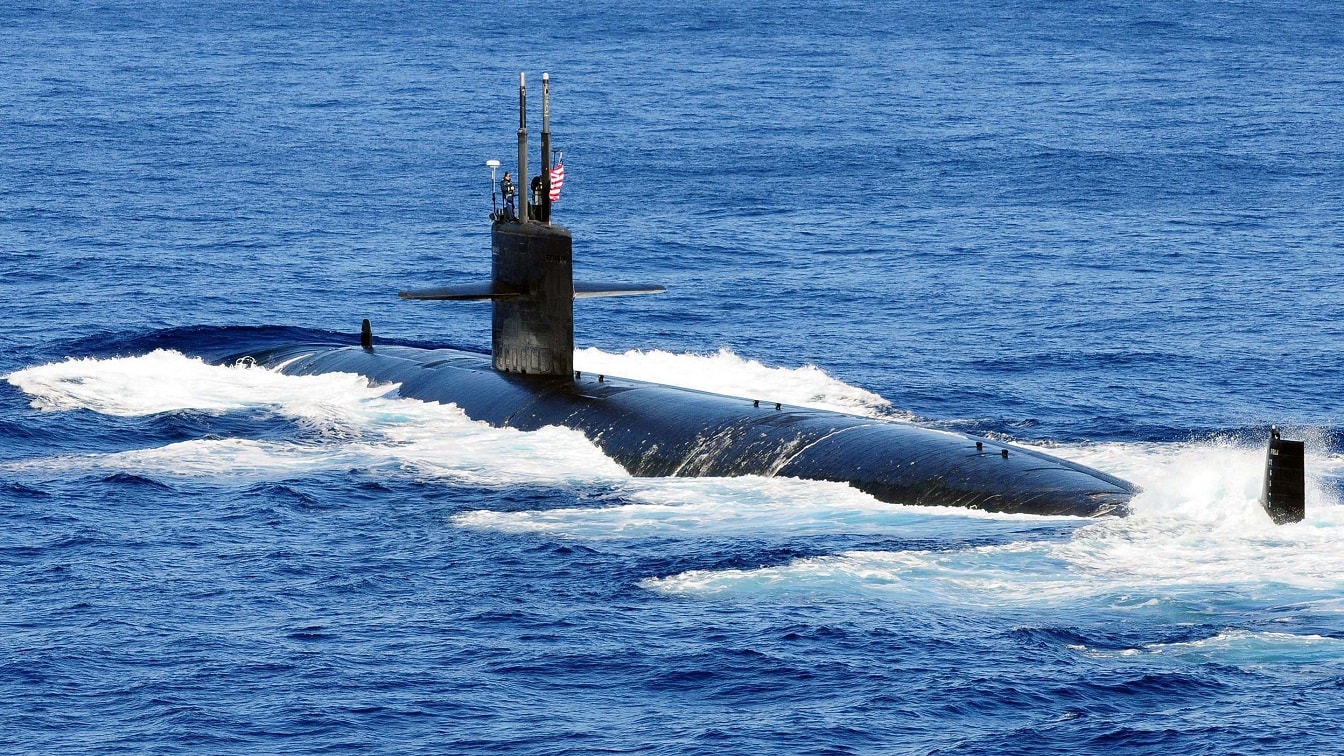
The Los Angeles-class submarine is the most successful fast-attack submarine class in the US Navy’s history, thanks to its longevity. For fifty years, this nuclear fast-attack submarine class has formed the core of the submarine fleet’s primary mission: seeking out and destroying enemy ships and submarines. Eventually, the Los Angeles-class expanded its mission to attack land targets.
Los Angeles-class submarine: US Navy Nuclear History
During the height of the Cold War, the Los Angeles-class was developed to counter increasingly sophisticated Soviet attack submarines and ballistic missile submarines.
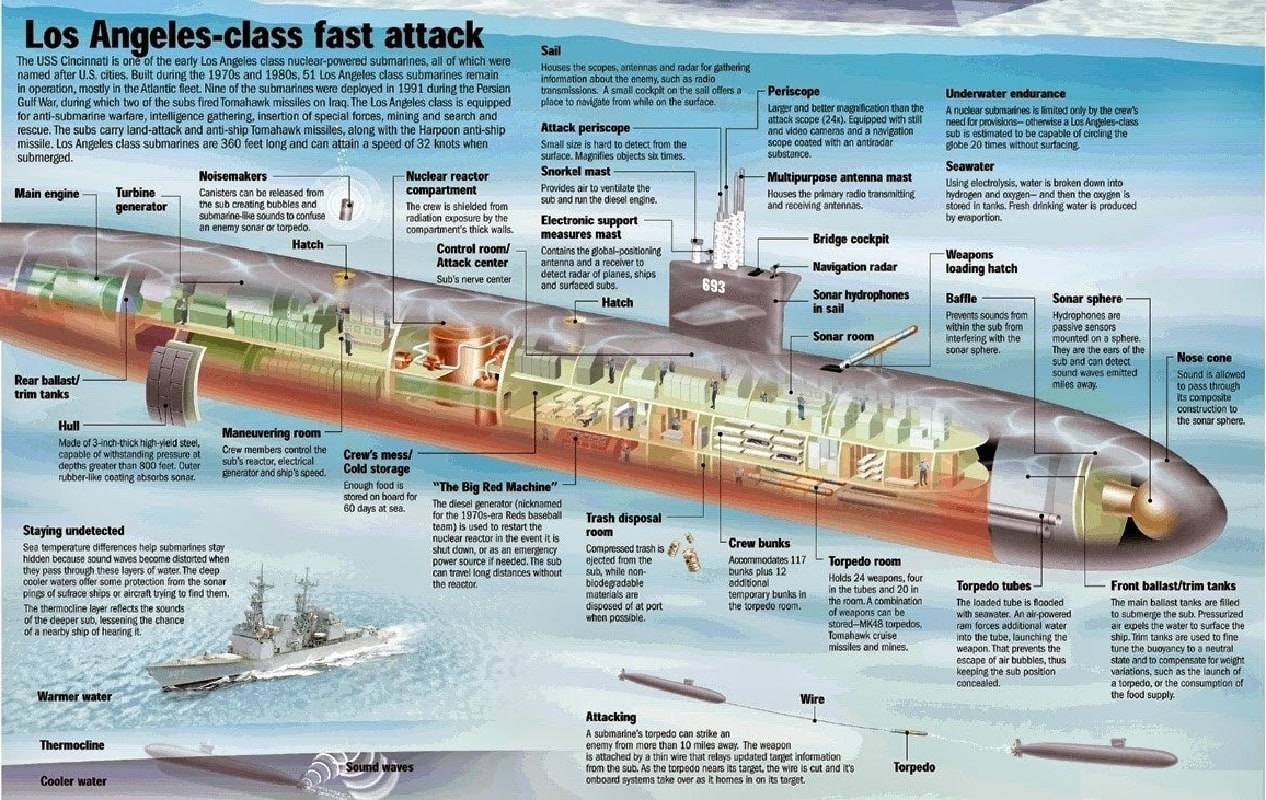
Los Angeles-Class diagram. Image Credit: US Navy.
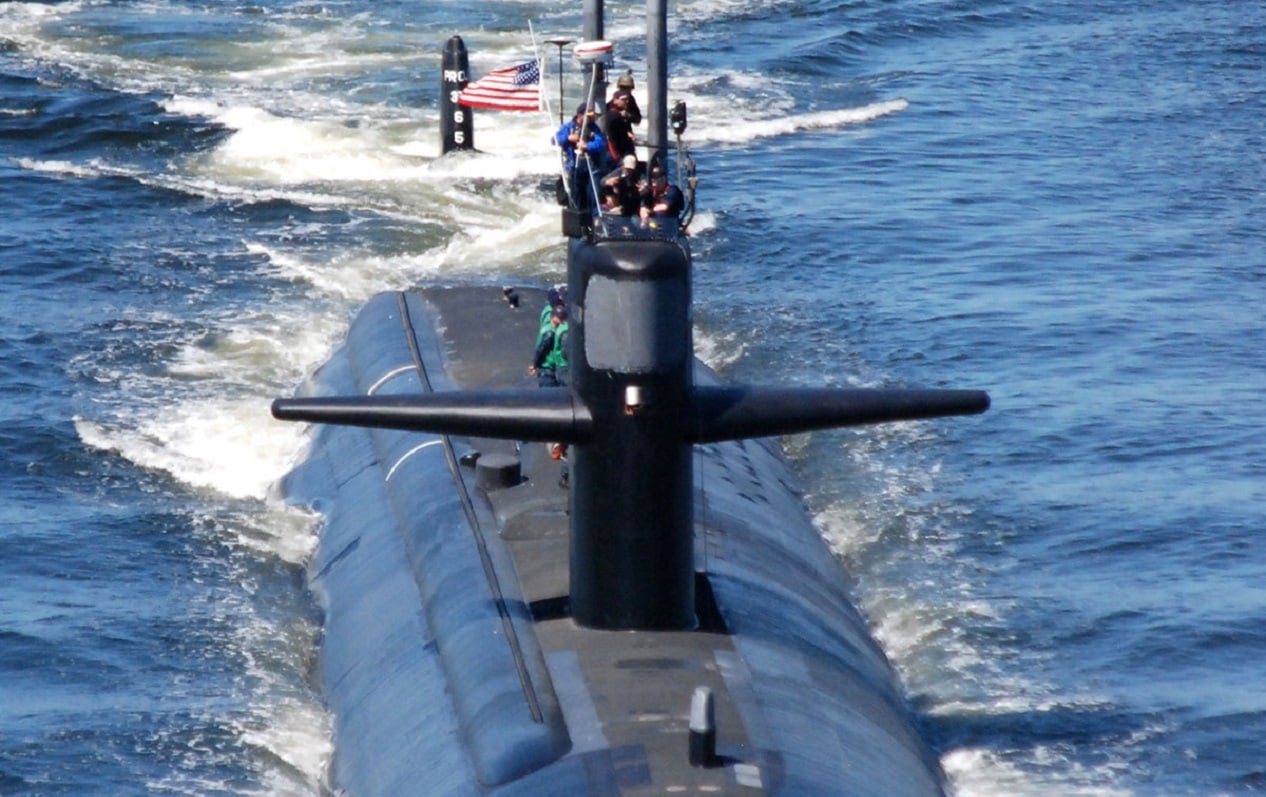
Los Angeles-Class Attack Submarine. Image Credit: Creative Commons.
Sixty-two of what came to be known as 688 Attack Boats were built between 1972 and 1996 by Newport News Shipbuilding and General Dynamics Electric Boat.
Dimensions:
Los Angeles-class general technical specifications:
Length: 360-362 feet (110 meters)
Beam: 33 feet (10 meters)
Displacement: 6,900 tons submerged.
Propulsion: One General Electric S6G pressurized water nuclear reactor driving a single propeller shaft.
Speed: Submerged speeds could exceed 25-37 knots.
Complement: Between 127-143 enlisted and 16 officers.
The Evolution Of The Los Angeles-class Hunter-Killer
Changes in strategic and tactical conditions over its long service life led to the Los Angeles-Class being built in three distinct versions, or “Flights.”
Flight I started with hull number SSN-688 and ran through SSN-716.
Flight I Submarines were configured with four midships-positioned torpedo tubes.
These were angled outward from the sides of the hull rather than straight forward.
Flight II, built in 1984 (hull numbers SSN-719 to SSN-750), incorporated 12 Vertical Launch System (VLS) cells to launch conventional or nuclear-tipped Tomahawk cruise missiles.
Flight III / 688i Improved, beginning in1986 for hulls SSN-751 through SSN-773.
Improvements included bow-mounted dive planes to improve submerged maneuvering, reinforced sails to allow operations in and under Arctic ice, and the advanced BSY-1 Combat/Sonar system.
By 1986, the Soviet Union’s gigantic Typhoon-class ballistic missile submarines operated almost exclusively under the ice in the far northern Atlantic to avoid detection.
These new sails allowed the Los Angeles-class submarines to shadow them continuously under the ice.
Torpedoes, Missiles And Even Mines Armed The Los Angeles-class
The combat systems and armament remained constant during the Los Angeles-class’s service period, with incremental improvements to its core weapons and combat systems.
Torpedoes: 533mm Mark 48 ADCAP wire-guided torpedoes with four launch tubes.
Mines: The Mark 60 CAPTOR Mine was a torpedo encapsulated in an aluminum tube anchored to the seabed. When its microphones detected the specific sound signature of Soviet submarines, the torpedo activated and launched from its tube in pursuit.
The Mark 67 Mine was launched from the submarine’s torpedo tubes into a designated spot in relatively shallow water.
Once it came to rest on the bottom, it performed its traditional magnetic mine role, waiting for surface ships to approach.
Sensing the seismic, magnetic, and water-pressure changes created by a nearby ship, the mine would detonate its 333-pound charge beneath it, breaking its back at the keel.
The Combat Control Systems of a Hunter-Killer
The Los Angeles-class combat sensor suites used a continuously updated Raytheon combat control system, including the AN/BQQ-5 or later AN/BSY-1 sonar suite.
Where an ordinary fire control system might simply set up a firing solution to a target, these systems on the Los Angeles-class were designed to detect, classify, track, and then help guide the torpedo to the target.
They were the brain analyzing the acoustic information the submarine was receiving while the human crew looked over its shoulder, so to speak.
The Long and Evolving Operational History For The Los Angeles-class
During the Cold War, the most common missions for the Los Angeles-class were to escort Carrier Strike Groups, conduct surveillance of Soviet surface fleets, and to locate and closely follow the Soviet Union’s fleet of ballistic missile submarines on their patrols.
If the US and the USSR had gone to war during this period, Los Angeles-class submarines would have fought some of the first battles, already within a mile or two of Soviet ships and submarines around the globe.
Following the collapse of the Soviet Union and the presumed end of the Cold War, Los Angeles-class submarines found themselves providing surveillance of littoral waters, conducting Special Operations missions, and firing their Tomahawk missiles at targets in the Middle East conflicts in Iraq.
In the Indo-Pacific and Arctic, the Los Angeles-class were tasked with freedom-of-navigation patrols in waters that Communist China claimed control over, as well as icebreaking operations.
Worn Out Reactors and Hulls Retire Los Angeles-class
As of this writing, some twenty-four Los Angeles-class submarines of the Flight II and Flight III types remain in service.
Their nuclear reactors are nearing the end of their useful service life, and replacing them would require removing and replacing the submarine’s rear section.
Additionally, hundreds of dive and surface cycles slowly degrade the pressure hull’s strength.
With these factors in mind, the remaining Los Angeles-class subs have been retiring as their replacement, the newer Virginia-class submarines, entered service in 2000.
An Amazing Safety Record For The Los Angeles-class
The Los Angeles-class will leave behind a stellar safety record after its fifty years of service.
Of the sixty-two hulls in service, none suffered a catastrophic reactor casualty or loss at sea. Only one crew member died aboard these submarines.
In 2005, the USS San Francisco SNN-711 struck a seamount off the Caroline Islands in the Pacific.
The submarine was 535 ft deep and traveling at 25 kts.
The forward ballast tanks and sonar dome were destroyed, 93 of the crew were injured, and one was killed.
The submarine’s pressure hull remained intact, and the San Francisco safely surfaced and proceeded under its own power to Guam for repairs.
The complete history of the Los Angeles-class can’t be written while twenty-four still remain in service, but someday historians may recall the Los Angeles-class as the best submarines ever to serve in the United States Navy.
About the Author: Sean Spoonts
Sean Spoonts is the former Editor-In-Chief of SOFREP.com. He is a military analyst, writer, and commentator whose work has appeared in Newsweek, CNS News, Ukrinform, and various military/veteran media networks and professional publications, including the Military Intelligence Professional Bulletin. He is a U.S. Navy veteran, having served as an Aviation Anti-Submarine Warfare Operator and Search and Rescue Helicopter Aircrewman.