

The Pentagon cannot reliably track millions of spare parts supporting the Lockheed Martin F-35 Lightning II, according to a new Government Accountability Office report.
The problem persists despite repeated federal audits dating back to 2019.
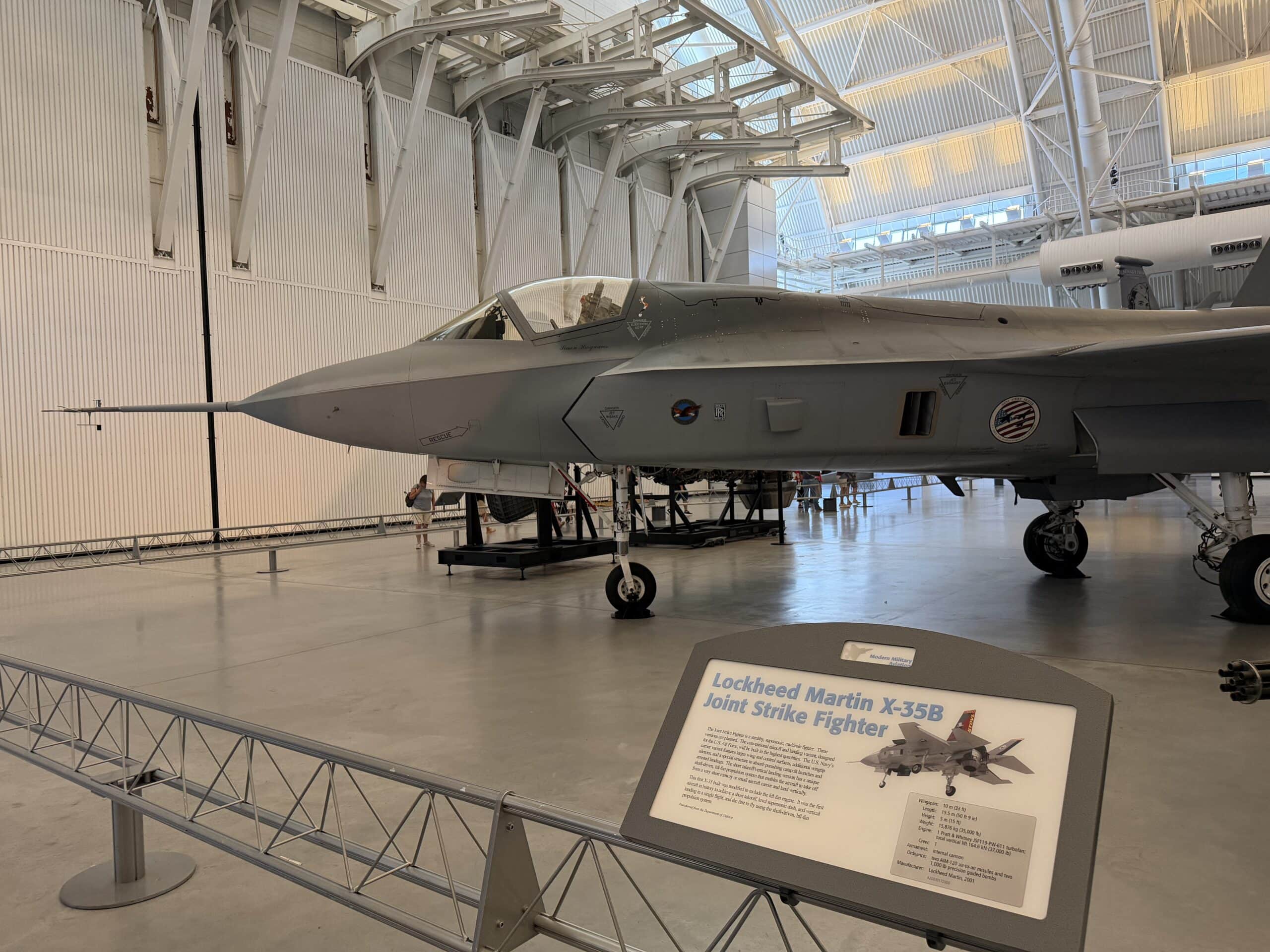
F-35 at the Smithsonian 19FortyFive Photo
As of March 2026, the F-35 program’s shared inventory contained approximately 26 million parts valued at $31 billion, yet government records remain outdated, inaccurate, and incomplete.
The GAO found that the Pentagon has made “minimal progress” in improving accountability.
This suggests the military cannot reliably account for its entire F-35 inventory—not necessarily that all 26 million parts are physically missing—but it’s still not ideal.
The GAO Findings
The November 2026 report GAO-27-108713 identified persistent deficiencies in the F-35 Joint Program Office’s inventory management.
Approximately 17,000 spare parts, valued at up to $2.5 billion, were not recorded in the Pentagon’s Enterprise Logistics Management Software (ELMS).
It’s important to recognize that those parts are not necessarily lost; their absence from the system means, most directly, that the government lacks an adequate centralized record system.

F-35 at the Smithsonian. 19FortyFive Original Photo.
But the problem also suggests that inventory information is not updated in real time, that records may contain incorrect locations and valuations, and that some contractor-held parts are not adequately reflected in government records.
Also worth noting is that nearly 6% of the parts records in December 2025 contractor data submission listed an acquisition cost of one cent or less, suggesting valuation errors were rampant.
GAO concluded that neither ELMS records nor the program’s inventory results are reliable for financial reporting.
How The System Works…and Fails
Unlike many military aircraft programs, the F-35 uses a shared pool of spare parts serving the US Air Force, Navy, and Marine Corps, as well as international customers.
The inventory includes components ranging from tires to engines and everything in between. The F-35’s principal contractors are Lockheed Martin, the prime aircraft contractor, and Pratt & Whitney, the prime engine contractor.
ELMS does not directly interface with the contractors’ property management systems; instead, the Joint Program Office receives inventory information from contractors quarterly.

F-35 at the Smithsonian. Image taken on 7/8/2026 by 19FortyFive Staff.
As a result, government records can be more than three months out of date. Contractors also may lack complete visibility into inventory maintained by subcontractors.
The problem is that the Pentagon depends on private companies for information about government-owned property and lacks an independently reliable, continuously updated inventory.
One Million Parts
The new findings follow an earlier GAO investigation published in 2023.
That investigation found that one F-35 prime contractor reported losing more than 1 million spare parts worth over $85 million between 2018 and 2022.
As of March 2026, the F-35 Joint Program Office still has not established the status of those items.
The Pentagon also lacks effective procedures for systematically monitoring losses.
GAO financial management director Asif Khan explained that the government cannot independently identify missing components unless a contractor-managed or government-managed facility reports it.

F-35C at Lakeland, Florida Airshow. Image Credit: 19FortyFive.com
Khan also said that investigators could not calculate the total number of missing parts because the program’s loss-monitoring procedures are inadequate.
F-35 Readiness Implications
The F-35 is the Pentagon’s most expensive weapons program, making inventory management a substantial financial and operational concern.
Spare parts availability directly affects maintenance schedules, aircraft availability, and the ability to sustain deployed fighter units.
In July 2026, the Air Force awarded Lockheed Martin a $1.6 billion contract for additional F-35 spare parts. Poor records make it harder to determine whether existing inventory is sufficient before purchasing additional components.
International customers also want greater transparency to plan maintenance and allocate resources.
Khan warned that without understanding the parts it owns and how contractors manage them, the Pentagon cannot establish whether it is receiving adequate readiness at a reasonable cost.

F-35C at Lakeland, Florida Airshow. Image Credit: 19FortyFive.com
GAO recommended stronger procedures for identifying, recording, and analyzing lost spare parts.
The Joint Program Office should conduct trend analysis to identify recurring losses and reduce future incidents. GAO also recommended better use of accountable property officers—the officials responsible for maintaining government property records.
Those officers should receive training specifically tailored to the F-35 program. Better inventory tracking is essential because contractor submissions and government records currently do not provide a dependable accounting picture.
Editor’s Note: All interior photos of the F-35 in this article were taken over the last twelve months as we do all we can to provide original photography while taking our readers close to the things we write about daily.
About the Author: Harrison Kass
Harrison Kass is a writer and attorney focused on national security, technology, and political culture. His work has appeared in Tablet, City Journal, The Hill, The Spectator, and The Cipher Brief. He holds a JD from the University of Oregon and a master’s in Global & Joint Program Studies from NYU—more at harrisonkass.com.