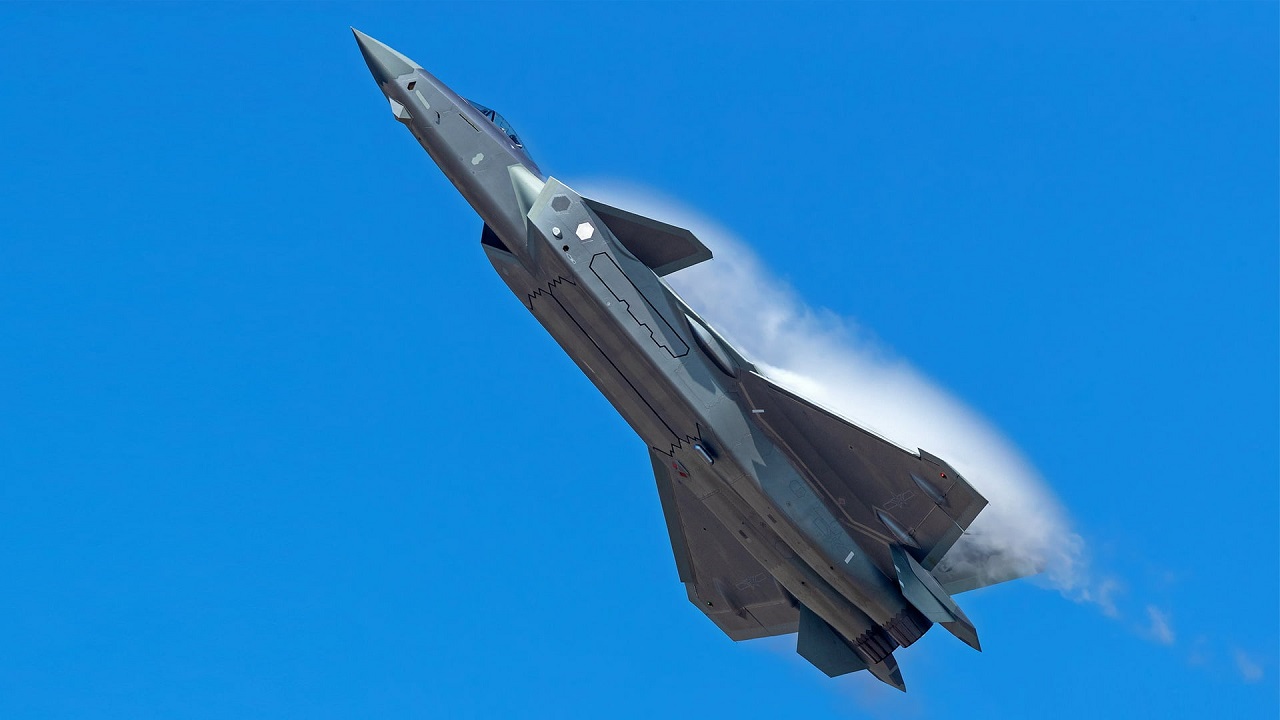
China hopes to make the J-20 a significantly more capable fighter by adding a second seat for a weapon systems officer. The plane is designed with one goal in mind: beat the F-22 and F-35 fighters in any contest.
China’s Chengdu J-20 made waves when the first images of the fighter leaked online, later officially revealed by Chinese state-owned media. The jet was a coup for the country — an indigenously built, notionally fifth-generation stealth fighter.
Not only is the J-20 stealthy—thanks to canards forward on the fuselage and a twin-engine design—but the jet also likely boasts a relatively high degree of maneuverability. This power is potentially at the cost of a more stealth-focused design. Still, the J-20 is a significant step forward in Beijing’s push to develop a stealth fighter and bring it into wider service within the People’s Liberation Army Air Force (PLAAF).
The most recent J-20 variant, notionally called the J-20S, appears poised to double down on the platform’s capabilities.
Chengdu J-20S Explained
This latest J-20 variant carries an extra letter designation, denoting the variant’s twin-seat configuration—onboard space within the elongated cockpit for a second seat, room for a weapon systems officer, and an effort to expand the baseline variant’s capabilities. Like the original J-20, the S two-seater retains its predecessor’s V-shaped, canted tail, the jet’s internal weapons bay, stealthily countered nosecone and fuselage, and the forward canards.
Though not verifiably guaranteed, one could guess that some of the J-20S’s electronics, perhaps its radar, are upgraded or modified. A more advanced suite of sensors and avionics would give a weapon systems officer better situational awareness and better leverage to perform tasks like finding and identifying enemy aircraft or other points of interest in the air or down below on the ground or at sea.
International Relations, Engines, and Stealth
Though the J-20 shares a wide range of characteristics consistent with fifth-generation aircraft, that particular jet’s radar cross-section, a measure of its detectability by radar, is thought to lag behind its American counterparts, the F-35 and the F-22.
One reason for this is the jet’s canards, which enhance maneuverability but also increase the number of surfaces that could reflect enemy radar. The other, perhaps more important, reason is the J-20’s engines.
No discussion of China’s aerospace industry is complete without mentioning the outsized assistance Beijing has received from Russia, particularly in the form of input on jet engines. China has historically relied on material help from Russia for its aerospace programs, particularly on extensive Russian engine experience.
Compare and Contrast: the United States versus China
The fighter is a significant step in a direction that the United States has not taken. The United States’ current in-service fifth-generation aircraft, the F-22 Raptor and the F-35 Lightning II, are single-seat aircraft, with no plans to modify either aircraft to accommodate a second airman in the cockpit. Furthermore, the F-35 is a single-engine aircraft, and while the F-22 does have two engines, its production line shut down years ago.
It will be interesting to see if the recently-announced F-47, the sixth-generation aircraft recently revealed by President Trump and Defense Secretary Hegseth from the Oval Office, will be a single- or two-seat platform.
The US Air Force has previously explained that it would like the Next-Generation Air Dominance fighter—the program that yielded the F-47—to perform missions in tandem with Collaborative Combat Aircraft, essentially loyal wingmen-type drones that expand the capabilities of a manned fighter.
The United States Navy is also expected to make an announcement about the upcoming F/A-XX fighter, a carrier-capable sixth-generation fighter, and what it is presumed will eventually make up the backbone of American naval aviation. Like its Air Force counterpart, that aircraft will be tasked with controlling CCAs.
It is conceivable, though not assured, that both aircraft could feature a pilot and a weapon systems officer, relieving the burden on just a pilot alone. It is also likely that both jets will be twin-engine platforms.
The Pressing Question of Range in the Indo-Pacific
The exact range of the J-20 and J-20S variants is not public knowledge. However, both aircraft are larger than the F-35 or F-22, which raises the question of range. Considering the size of the J-20 and J-20S, it is possible that both jets have considerable internal fuel storage, which would be of great importance in any environment, particularly the Indo-Pacific.
Interspersed with the occasional island chain and atoll, the Indo-Pacific is an enormous region, defined more by the vast wastes of ocean between land than the specs of land themselves. And while a single fighter jet’s range would not be enough to traverse the Indo-Pacific from any direction, combat radii in that theater are particularly important.
It’s something that the American fleet of F-35s and F-22s would have to contend with as well and one that they might not be well-equipped to do—both the F-22 and F-35 are thought to have less internal volume for fuel storage than either J-20 variant, an indication that they can spend less time in the air, and are more reliant on air-to-air refueling to say aloft.
What Happens Now for J-20 Fighter?
China’s Chengdu J-20S has the potential to augment the baseline J-20 platform considerably, freeing up the pilot’s limited mental bandwidth with the introduction of a second seat in the cockpit. When considering the potential for China also to field its version of collaborative combat aircraft, the J-20S’s potential as a capable aircraft jumps considerably.
Ample internal volume for fuel is another factor in the jet’s favor and one that American warplanes have likely taken note of, compared to the more limited onboard space for fuel on either the F-22 or the F-35.
About the Author: Caleb Larson
Caleb Larson is an American multiformat journalist based in Berlin, Germany. His work covers the intersection of conflict and society, focusing on American foreign policy and European security. He has reported from Germany, Russia, and the United States. Most recently, he covered the war in Ukraine, reporting extensively on the war’s shifting battle lines from Donbas and writing on the war’s civilian and humanitarian toll. Previously, he worked as a Defense Reporter for POLITICO Europe. You can follow his latest work on X.