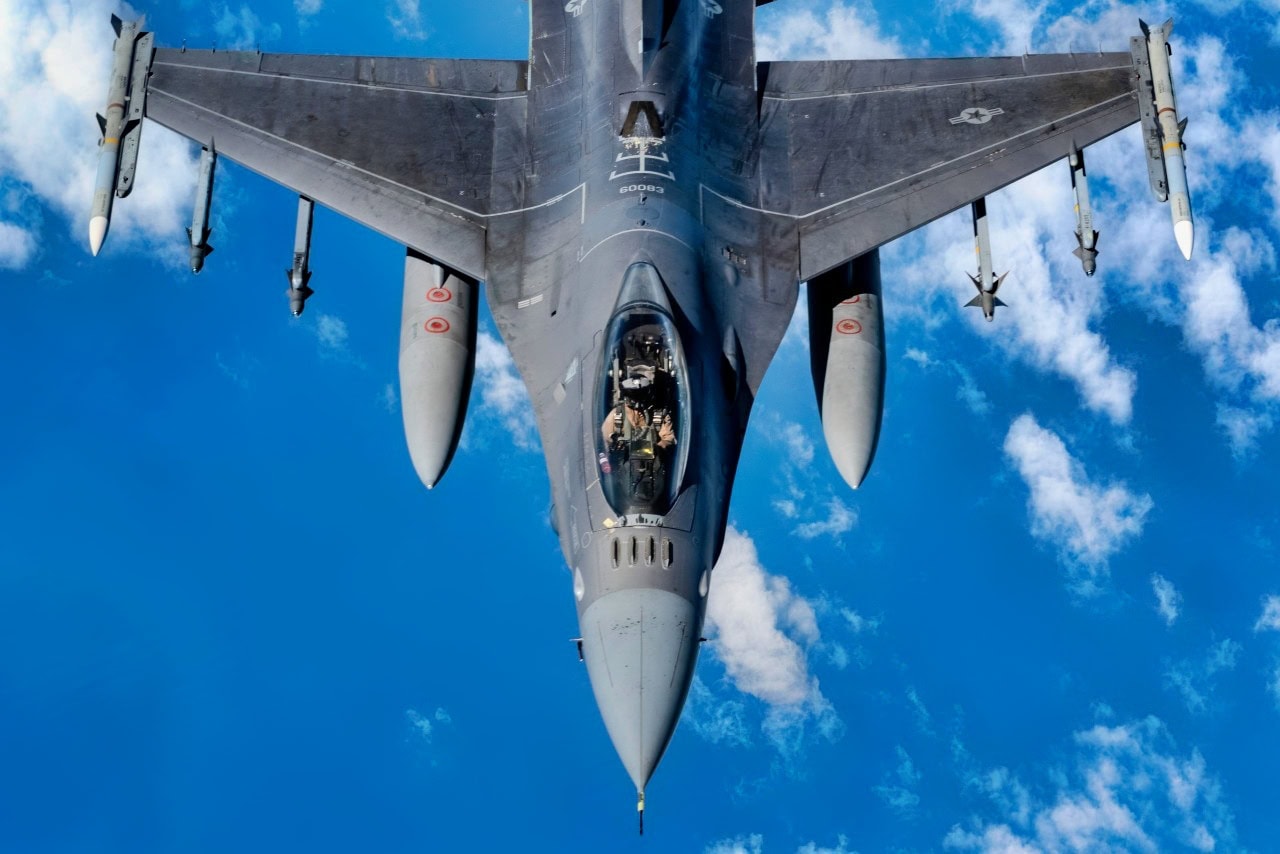
Summary and Key Points: Ukraine has lost another F-16 fighter jet, resulting in the death of skilled pilot Captain Pavlo Ivanov. The incident marks the second combat loss of an F-16 for Ukraine, likely downed by Russia’s advanced R-37 missile, which outranges Ukraine’s current missile capabilities.
-Ukrainian officials confirm their F-16 fighters have had critical components like Link 16 communication systems removed, drastically limiting their effectiveness.
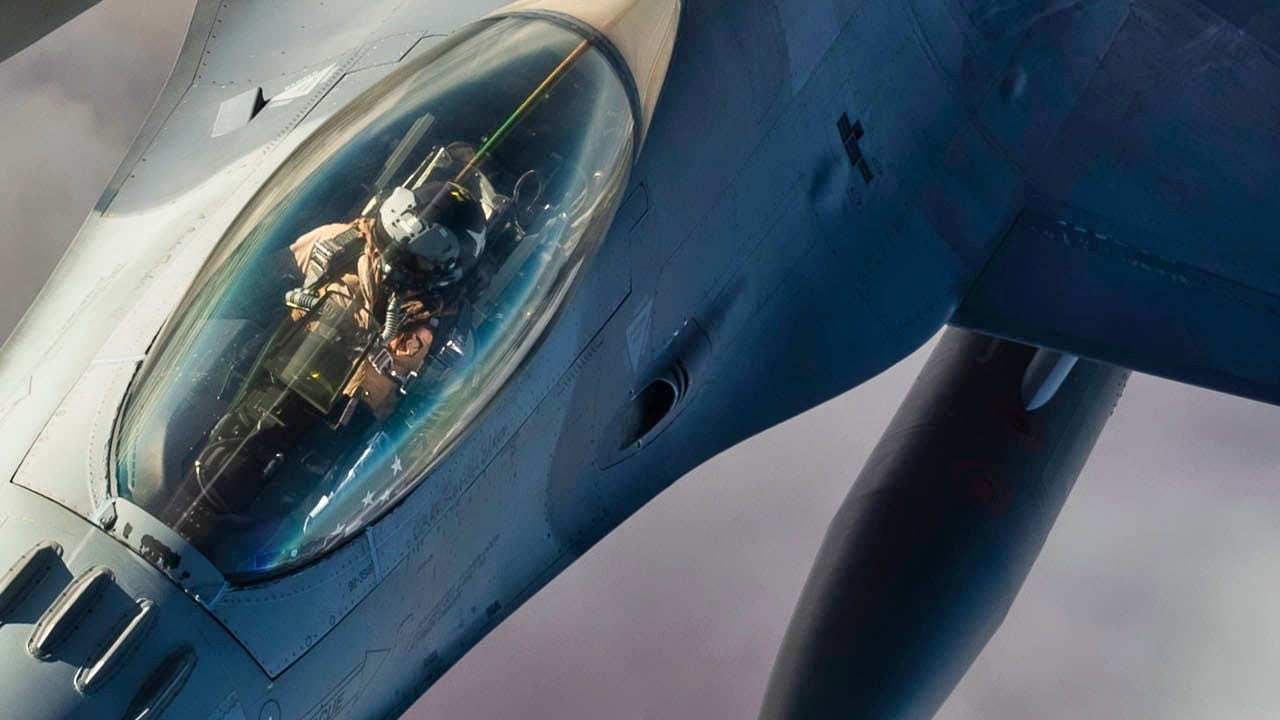
A U.S. Air Force F-16 Fighting Falcon is refueled over the U.S. Central Command area of responsibility Nov. 22, 2024. The F-16 avionics system includes highly accurate enhanced global positioning and inertial navigation systems in which computers provide steering information to the pilot. (U.S. Air Force photo by Staff Sgt. William Rio Rosado)
-Ivanov transitioned rapidly from the Soviet-era Su-25 to the advanced but handicapped F-16, underscoring challenges faced by Ukrainian pilots.
-His death highlights critical capability gaps and the intense pressures on Ukraine’s air force amid ongoing Russian aggression.
Ukraine Loses Another F-16 Fighter And One of Its Most Skilled Pilots
This past Saturday, Ukraine’s Ministry of Defense (MoD) announced that Captain Pavlo Ivanov had been killed while flying a combat mission while piloting one of the F-16 fighter aircraft that have been supplied to Ukraine by European NATO nation-states. This is the second F-16 to be lost in combat in Ukraine and the first this year.
Denmark and the Netherlands provided the F-16s flown by Ukraine’s Air Force (PSU) as these nations were preparing to retire their F-16s. NATO-nation air forces will soon take delivery of the stealthy F-35 to replace the older US fighters in their inventories.
Ukraine’s F-16 Fighters vs. Russian Missiles
Following the news of the pilot’s death in combat, Ukrainian President Volodymyr Zelensky posthumously awarded him the title of Hero of Ukraine. Unfortunately, this pilot’s death was pre-ordained due to the changes made to the F-16s before they were delivered to Ukraine.
The BBC’s Ukrainian Language Service had reported Ivanov’s aircraft may have been downed by a Russian missile. “In total, the Russians fired three missiles at the jet. It was either a guided surface-to-air missile from an S-400 system or an air-to-air Vympel R-37 missile,” the source, a Ukrainian official, told the BBC.
The R-37 is one of the latest-model air-to-air missiles (AAM) in the Russian armory. According to a prominent Ukrainian defense electronics firm intimately familiar with this AAM, it can be launched from any of the three Russian fighters employing a passive electronically scanning array radar.
According to one of the senior members of the design team, these are the Mikoyan MiG-31, which carries the N007 Zaslon radar; the Sukhoi Su-30SM, which has the N011 M, and the Su-35, which is equipped with the latest N035 Irbis radar set.
Ukrainian officials have said there is no possibility that Ukrainian forces shot the plane down in a friendly fire incident. The same MoD representatives also explained that no Ukrainian air defense systems were operating where Ivanov was flying.
A previous F-16 was also lost along with its pilot when the aircraft flew through a debris field created by the intercept of an incoming cruise missile by one of Ukraine’s air defense batteries.
Handicapped F-16 Fighters
The senior director of the same Ukraine defense electronics firm had previously lamented the fact that the Danish and Dutch F-16s onboard equipment was stripped from them before they were provided to Kyiv.
Specifically, as had been previously reported, “the Link 16 hardware has been deleted from these F-16s.”
“The radar in these F-16s is the older AN/APG-66 installed in the original ‘A/B’ models. It is less capable than the versions of the MiG-29’s Phazotron N019 radar that the Ukraine industry has upgraded. On top of this, all of the aircraft sent to Ukraine thus far have had their Link 16 hardware removed. This makes the effective ranges at which we are able to engage Russian aircraft about one-third of the range at which their fighter aircraft can fire on us.”
When he originally pointed out how this put the F-16s at a disadvantage compared to these latest Russian fighter aircraft, he specifically singled out the range of the R-37 missile.
“Without Link 16 and the ability to fire the US AIM-120 [AMRAAM] AAM, the R-37 is to launch against our aircraft more than 100 km before our pilots can fire on them.”
Given what happened in the recent F-16 shootdown, those words may have been more than fortuitous.
Pilots Overloaded
Ivanov’s loss comes after an incident on August 26, 2024, in which another F-16 pilot, Oleksii “Moonfish” Mes, was also killed in action. Both he and Ivanov had previously flown Russian-made aircraft.
Ivanov had transitioned from piloting the Soviet-designed Su-25 to the sophisticated F-16. The Su-25 is built for low-altitude air-to-ground strikes and is an aircraft that the designers call “the flying tank.” It starkly contrasts the F-16’s high-tech cockpit and multirole mission capability.
According to other reports, Ivanov had completed the F-16 training course in a much shorter time than is normal for that aircraft and, like other PSU pilots, was always flying a series of difficult missions.
Flying advanced fighters “against Russia’s layered air defenses requires split-second decision-making, a challenge compounded by fatigue and relentless sorties,” read one Central European publication on the tragedy. “The Ukrainian Air Force’s tribute to Ivanov emphasized his role in protecting strike groups and hitting enemy targets, a testament to the punishing workload shouldered by Ukraine’s pilots.”
About the Author: Reuben F. Johnson
Reuben F. Johnson is a survivor of the February 2022 Russian invasion of Ukraine and is an Expert on Foreign Military Affairs with the Fundacja im. Kazimierza Pułaskiego in Warsaw. He has been a consultant to the Pentagon, several NATO governments and the Australian government in the fields of defense technology and weapon systems design. Over the past 30 years he has resided in and reported from Russia, Ukraine, Poland, Brazil, the People’s Republic of China and Australia.