
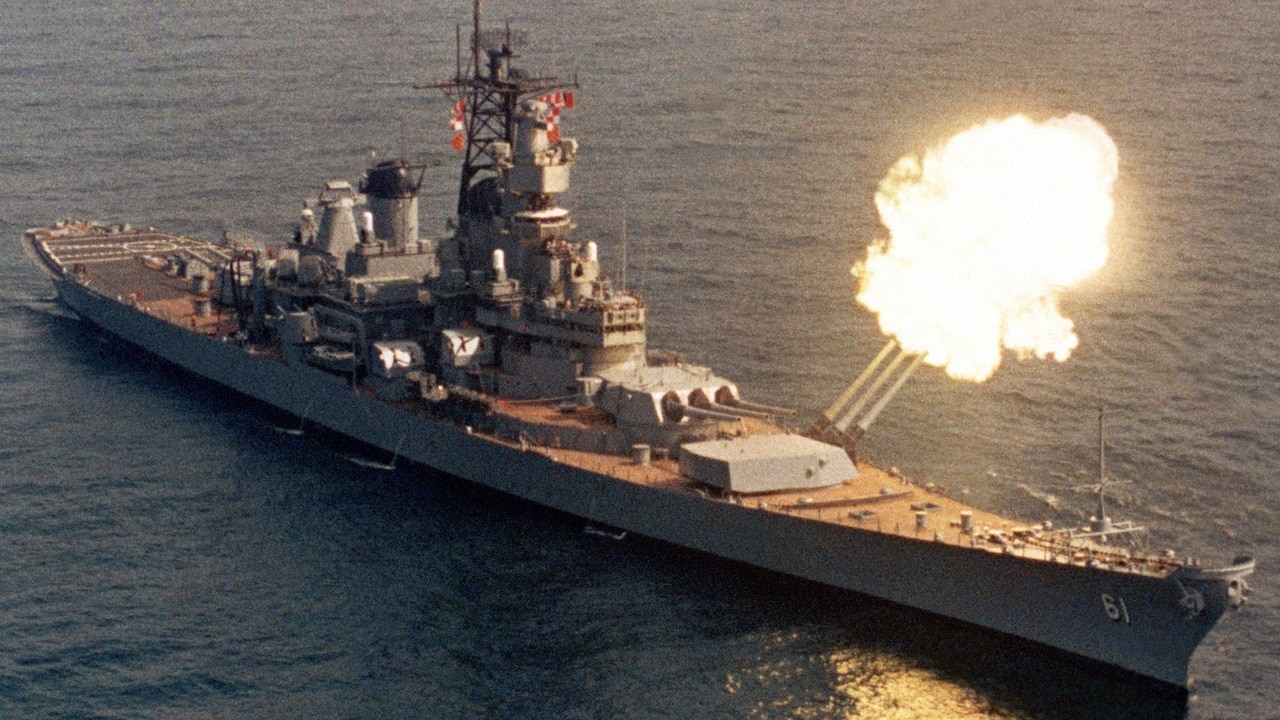
Article Summary and Key Points – The USS New Jersey (BB-62), America’s most decorated battleship, has completed a $10 million, 12-week dry-dock overhaul and is back at her Camden, New Jersey berth.
-The work focused on long-term preservation: her hull was cleaned, inspected, repaired, and repainted, with 1,300+ anodes replaced and 165 through-hull openings serviced.
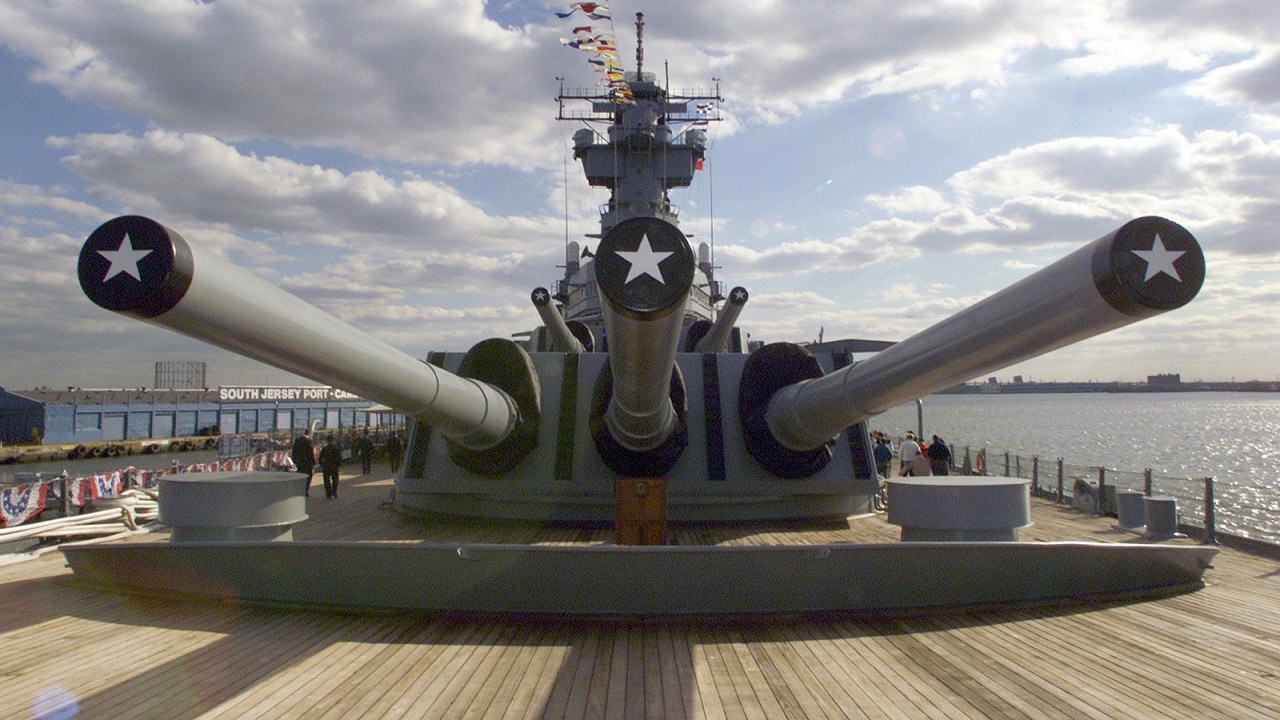
A head on view of the forward 16″ gun turrets on the USS NEW JERSEY (BB 62).
-Sections of the teak deck were renewed, parts of the superstructure repainted, and the radar tower and topmast temporarily removed to clear the Walt Whitman Bridge.
-After a combat career spanning World War II, Korea, Vietnam, and Lebanon, “Big J” is now set to serve for decades more as a museum and memorial.
How USS New Jersey’s Refit Can Be Summed Up in One Word: Preservation
The USS New Jersey (BB-62), the most decorated battleship in US Navy history, has been undergoing dry dock repairs.
It recently completed a $10 million, 12-week dry dock repair project at the marine terminal across the river from Philadelphia’s airport.
The project involved repairs, repainting, and upgrades to the historic battleship, which is now back on the Camden Waterfront and open for tours, according to NJ.com.
Last March, the big battlewagon, affectionately known to its crews as “The Big J,” left its berth in Camden, NJ, for the first time in a quarter-century and made its way down the Delaware River to the Paulsboro Marine Terminal for dry docking and repairs.
The $10 million modernization project will keep the ship in good condition for decades to come, allowing visitors to explore one of the Navy’s most iconic vessels.
What Was Done In Terms of Repairs To The Battleship?
Hull maintenance was needed to prevent the ship from rusting.
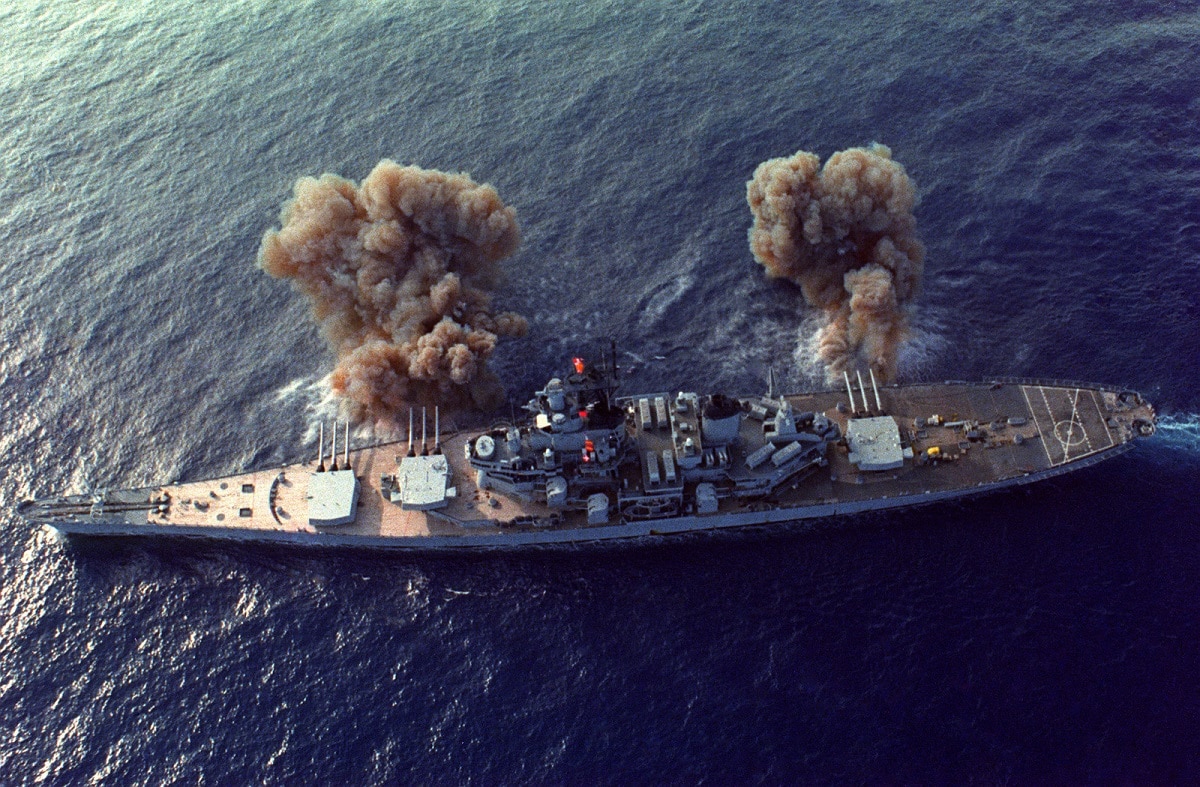
An overhead view of the battleship USS NEW JERSEY (BB 62) firing its Mark 7 16-inch/50-caliber guns to starboard.
The ship’s hull was cleaned, inspected, and repaired, with over 1,300 anodes replaced, according to Battleship New Jersey. One hundred sixty-five through-hull openings were inspected and repaired, with some requiring welding, according to Battleship New Jersey.
Zinc anodes were replaced with aluminum anodes to protect the hull from corrosion, and then the hull was repainted to prevent future rust from forming.
Some sections of the main deck were sanded and redecked, and the replaced teak decking was sold to visitors as keepsakes from the famous battleship.
Areas of the superstructure were also repainted.
The radar tower and part of the topmast were removed to allow the ship to pass under the Walt Whitman Bridge during its move to the repair dry dock.
The Battleship New Jersey (BB-62) History
The USS New Jersey, a 45,000-ton Iowa-class battleship, was built at the Philadelphia Navy Yard, Pennsylvania. Commissioned in May 1943, she spent the rest of that year in the western Atlantic and Caribbean area.
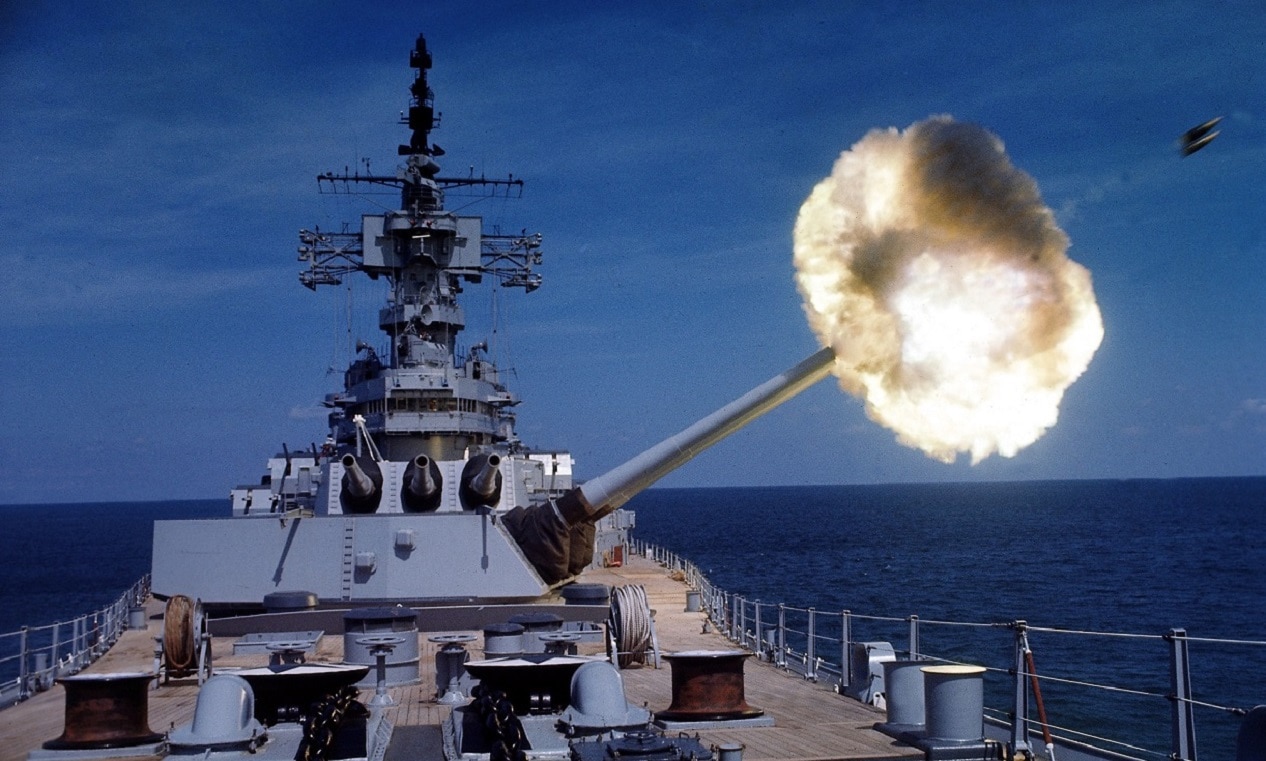
USS New Jersey Iowa-Class Battleship. Image Credit: US Navy.
New Jersey departed for the Pacific in early 1944 and conducted her first combat operations in support of the Marshall Islands invasion. She was the Fifth Fleet flagship and took part in the Marianas invasion, the Battle of the Philippine Sea, the Battle of Leyte Gulf, and operations against the Philippines.
From August 1944, she was the flagship of Admiral William F. Halsey’s Third Fleet.
In 1945, the battleship supported the invasions of Iwo Jima and the Ryukyus (Okinawa). Following an overhaul, she again became Fifth Fleet flagship during the final days of the war and remained in the Far East until early 1946. She went back to the Atlantic in 1947 and made one midshipmen’s training cruise to Europe before decommissioning in June 1948.
Called Back For Korea and Then Vietnam
The Korean War brought New Jersey back into commission in November 1950—a European cruise in the Summer of 1952 punctuated two Korean combat tours in 1951 and 1953.
After returning home from the western Pacific in late 1953, New Jersey operated in the Atlantic. She deployed to Mediterranean and European waters twice in 1955-56 and was retired again in August 1957.
USS New Jersey was the only battleship recalled to duty during the Vietnam War. She recommissioned in April 1968 and arrived in Southeast Asia in September.
From then until April 1969, she conducted frequent bombardments along the South Vietnamese coast. While preparing for a second Vietnam tour, she was ordered inactivated and decommissioned for a third time in December 1969.
The Reagan Administration Calls Back The Big Battleships
The early 1980s defense buildup produced a fourth and final active period for New Jersey, beginning with her recommissioning in December 1982.
She fired her big guns in combat for the last time during the Lebanon crisis of 1983-84 and deployed to the western Pacific in 1986 and 1989-90, with the latter cruise extending to the Persian Gulf area.
Decommissioned again in February 1991, the USS New Jersey was towed from the Pacific to the Atlantic in 1999. She is still alive, however, as a museum ship.
The ship’s return to Camden was celebrated with a welcome party after its journey from the marine terminal and a stop in Paulsboro. The repairs were deemed necessary to preserve the historic vessel and ensure it can continue to function as a museum and memorial.
About the Author:
Steve Balestrieri is a National Security Columnist. He served as a US Army Special Forces NCO and Warrant Officer. In addition to writing on defense, he covers the NFL for PatsFans.com and is a member of the Pro Football Writers of America (PFWA). His work was regularly featured in many military publications.