Key Points and Summary – U.S. submarines still own the acoustic fight, but a wave of non-acoustic sensors is narrowing the gap.
-A Naval Submarine League analysis spotlights magnetic anomaly detection (MAD), bioluminescent “boundary layer” wakes, surface and internal wave signatures, thermal trails seen by IR, and blue-green laser lidar that can ping through seawater.
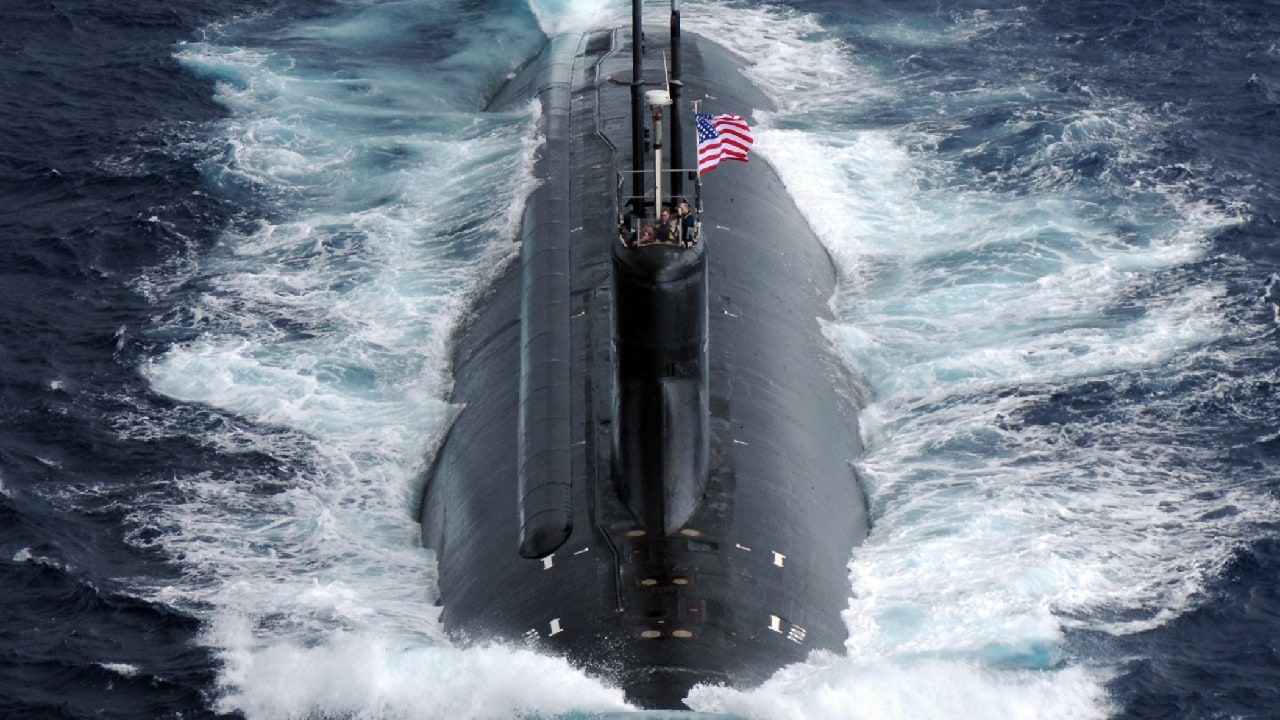
The Seawolf-class fast-attack submarine USS Connecticut transits the Pacific Ocean during Annual Exercise. ANNUALEX is a yearly bilateral exercise with the U.S. Navy and the Japan Maritime Self-Defense Force.

The first of a revolutionary new class of fast attack submarine, the Seawolf (SSN-21). Shown during construction at the Electric Boat Division of General Dynamics Corporation in Groton, Conn. She was christened by Margaret Dalton, wife of Secretary of the Navy John H. Dalton, on June 24, 1995.
-Each has limits—short ranges, clutter, false alarms, weather, and whale look-alikes—but fused with satellites, UAVs and UUVs they complicate stealth.
-The takeaway: the “silent service” isn’t going silent; it’s evolving. Expect more degaussing, signature management, deeper ops, decoys, and tighter manned-unmanned networks to preserve America’s undersea edge for decades ahead.
The End of the Stealth Submarine?
Acoustic systems have driven detection, innovation, and new generations of quieting technologies in the undersea warfare realm for decades, as they have become more precise, better networked, and extended range.
In recent years, the US Navy has made significant progress in developing emerging technologies capable of capturing higher-resolution images and connecting manned submarines to drones and unmanned underwater vehicles.
Innovations in this area are a key part of why the US Navy has continued to operate with what many regard as undersea superiority, a tactical and strategic advantage too large and significant to calculate.
Unlike surface ships or aircraft, more easily detected by satellite surveillance, enemy radar, and line-of-sight detection technologies, submarines can quietly and secretly lurk in high-threat areas to hold enemies at risk without being easily detected.
No More Stealth Submarines?
Sonar systems and acoustic detection will likely be here for decades into the future, yet a series of non-acoustic detection technologies may be changing this equation.
A significant essay from the Navy Submarine League called “Non-Acoustic Means of Submarine Detection” analyzes several key non-acoustic detection measures that are improving rapidly and are likely to be implemented by potential adversaries.
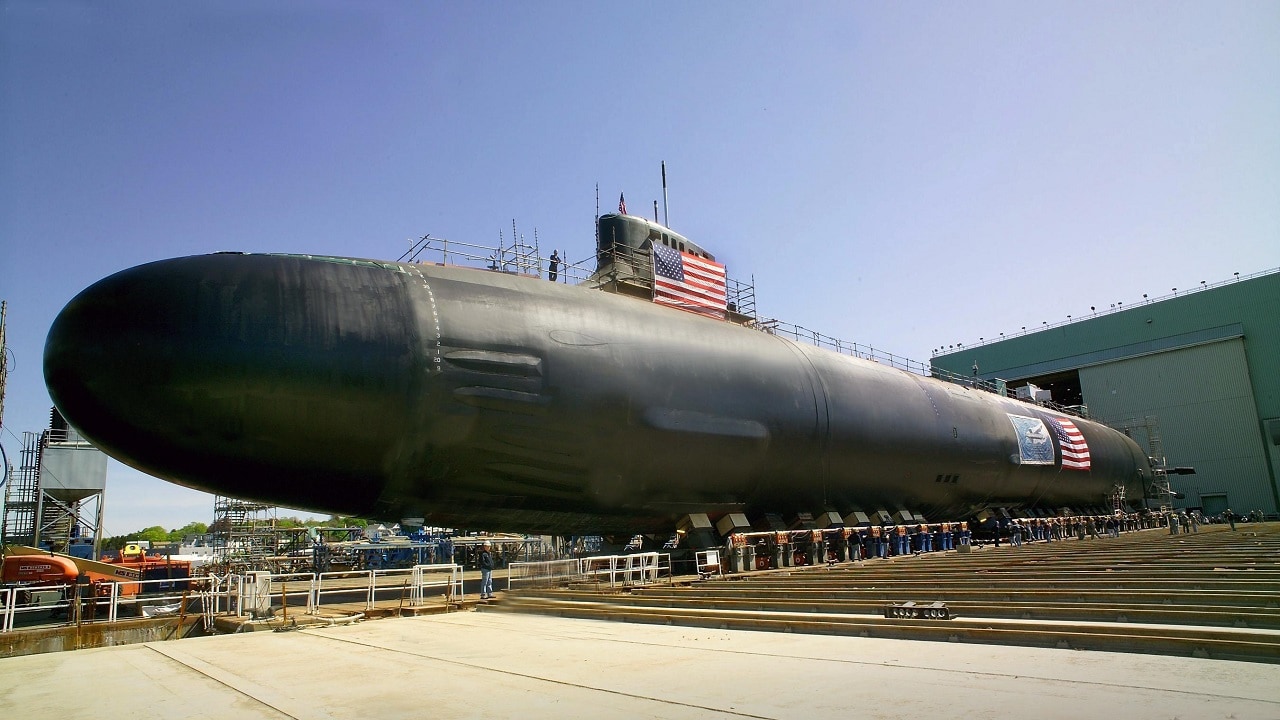
Seawolf-class Submarine. Image Credit: Creative Commons.
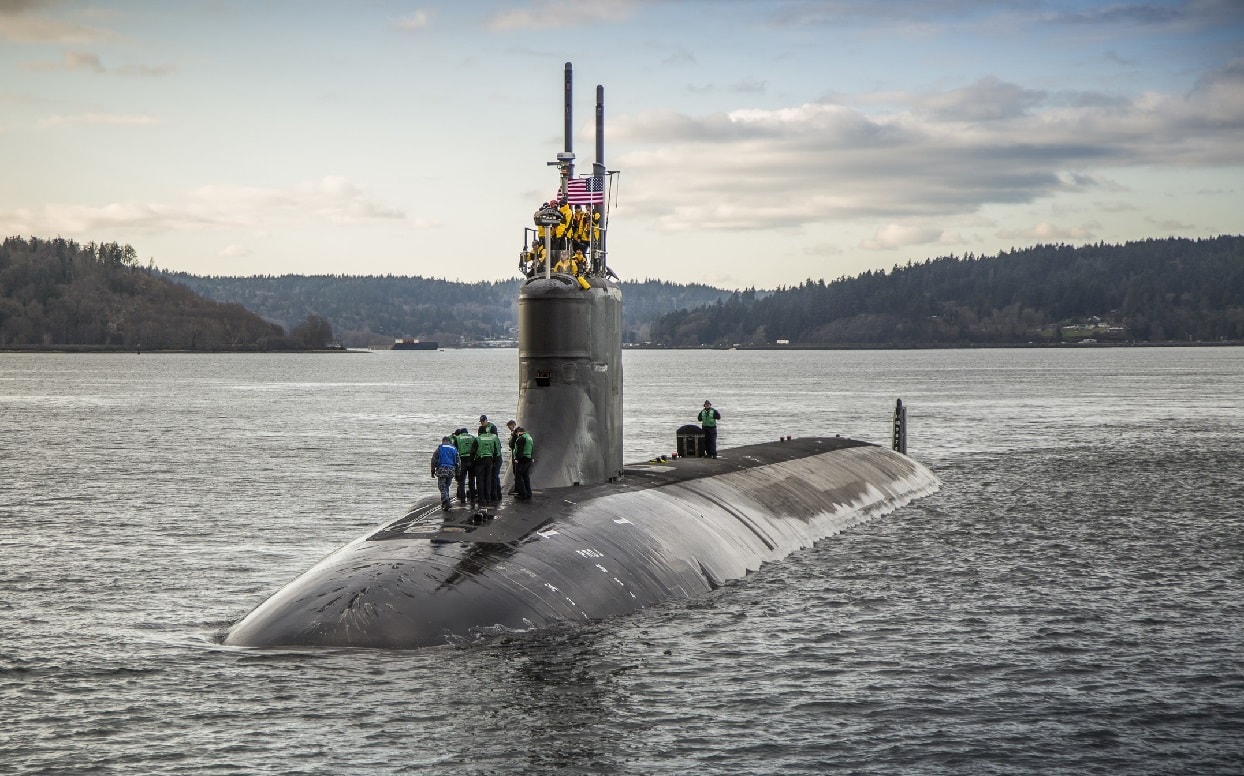
BREMERTON, Wash. (Dec. 15, 2016) – The Seawolf-class fast-attack submarine USS Connecticut (SSN 22) departs Puget Sound Naval Shipyard for sea trials following a maintenance availability. (U.S. Navy photo by Thiep Van Nguyen II/released)
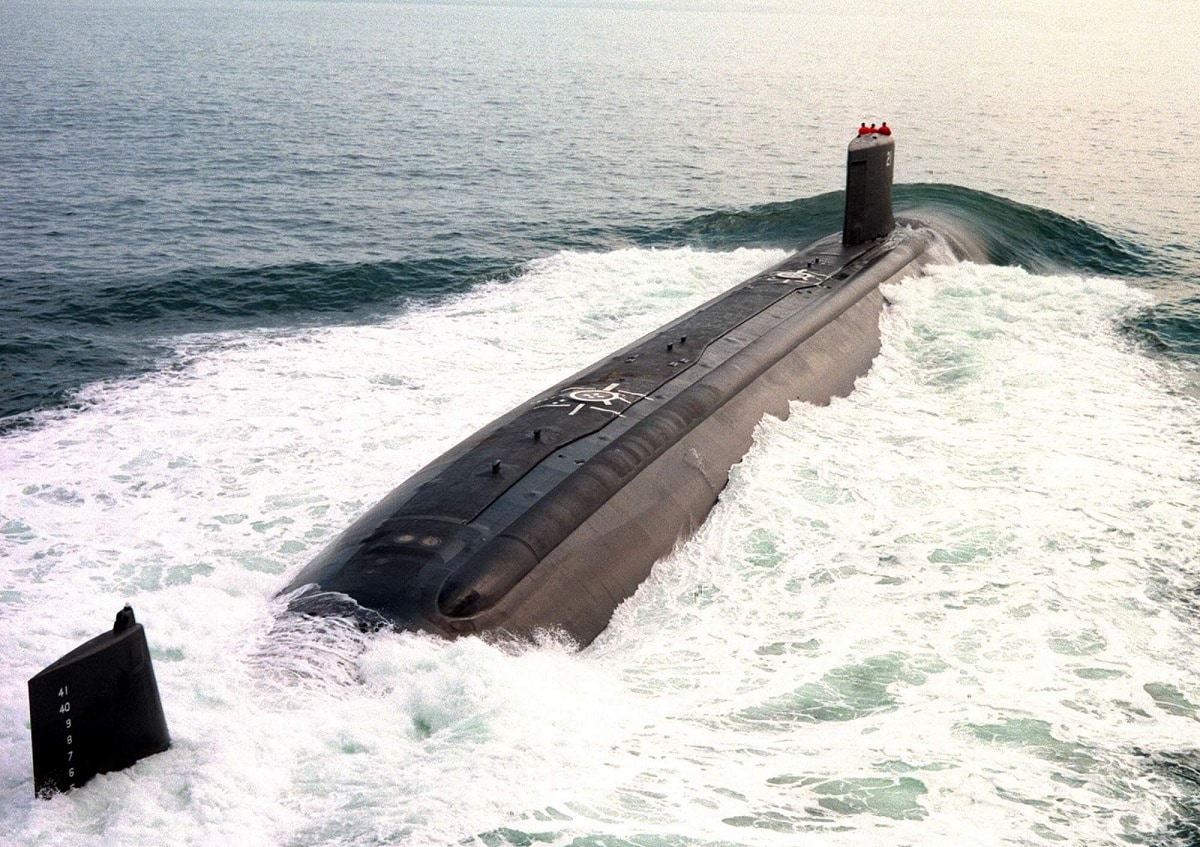
Seawolf-class. Image: U.S. Navy.
One central area of exploration relates to detecting disturbances in the earth’s magnetic field, something devices can measure.
“As a large piece of ferrous metal, the steel-hulled submarine causes a local disturbance in the earth’s magnetic field,” the essay explains.
Significantly, the essay explains that if a submarine is built with “non-magnetic” materials, its signature is decreased but not eliminated entirely.
“Submarines contain a large amount of metal that becomes magnetized in the course of normal operations. The permanent magnetic field associated with the submarine remains until active measures are used to demagnetize it,” the Naval Submarine League essay explains.
The U.S. currently deploys two types of MAD equipment on its ASW aircraft. The essay says these systems can detect the submarine magnetic field at no more than a few thousand feet.
Boundary Layer Water Flow
But other threats to the submarine are also possible. There are “bioluminescent” organisms beneath the sea that generate a natural “light,” something submarines can detect. This detection possibility is caused by “boundary layer” phenomenology, referring to the water flow surrounding a moving submarine. This water movement generated as the submarine transits the undersea realm can also generate movement of undersea organisms, including ones that create detectable light.
“These organisms can generate light when they are physically stimulated in the boundary layer of a submarine or in its wake. This phenomenon has been studied as a method for detecting submarines from the air or space,” the essay explains.
Wave Submarine Detection?
Another method of non-acoustic detection pertains to somewhat self-evident or easily observable variables such as “submarine-generated waves on the surface of the Ocean.”
When submarines move at shallow depths or travel at high speeds, they generate detectable surface waves. However, larger wind-generated surface waves can obscure or hide these waves.
Internal waves of great significance generate surface signatures that are not visible to the human eye. Radar systems, however, can detect some changes in moving surface water generated by undersea oscillations and water movements caused by submarines.
However, much like surface wind, there are many reasons why water can move beneath the surface, so there are also some limitations to this kind of detection method.
Temperature Submarine Detection?
Also, not surprisingly, thermal sensors can detect small changes in the water temperature caused by submarine movements.
Like how an infrared sensor would detect a heat signature emitting from an enemy fighter or engine vehicle, temperature-detecting technology can quickly discern differences likely to indicate the presence of a submarine.
“A moving submarine may also change the temperature of the sea surface by mixing lower cooler water with upper water, thereby leaving a trail of cool surface water that could be detected with infrared (heat) sensors,” the essay says.
Laser Detection
The Navy Submarine League essay further explains that “laser detection” may emerge as the most promising area of non-acoustic submarine detection.
Overall, electromagnetic signals have little ability to travel underwater except in some “ultra-low-frequency” waveforms.
Yet, the sea is “transparent” to blue-green light, which electromagnetic light “pings” from a laser can detect.
“The sea is relatively transparent to blue-green light. A burst of blue-green laser light could penetrate the sea, reflect off an object, and return to the sensor. The round-trip travel time of the laser burst indicates the depth of the object, but cannot discriminate, for example, between a large whale and a submarine,” the essay says.
Since the speed of light is a known or fixed quantity, and the length of travel time can be determined, algorithms can then discern the exact distance of an object. The travel time can be determined like a laser rangefinder on land.
Once the exact travel speed and time are known, an algorithm can quickly calculate the distance. In these cases, a blue-green laser light might be able to “see” or “find” a submarine at specific depths.
About the Author: Kris Osborn
Kris Osborn is the Military Technology Editor and President of Warrior Maven – Center for Military Modernization. Osborn previously served at the Pentagon as a highly qualified expert in the Office of the Assistant Secretary of the Army—Acquisition, Logistics & Technology. Osborn has also worked as an anchor and on-air military specialist at national TV networks. He has appeared as a guest military expert on Fox News, MSNBC, The Military Channel, and The History Channel. He also has a Masters Degree in Comparative Literature from Columbia University.