
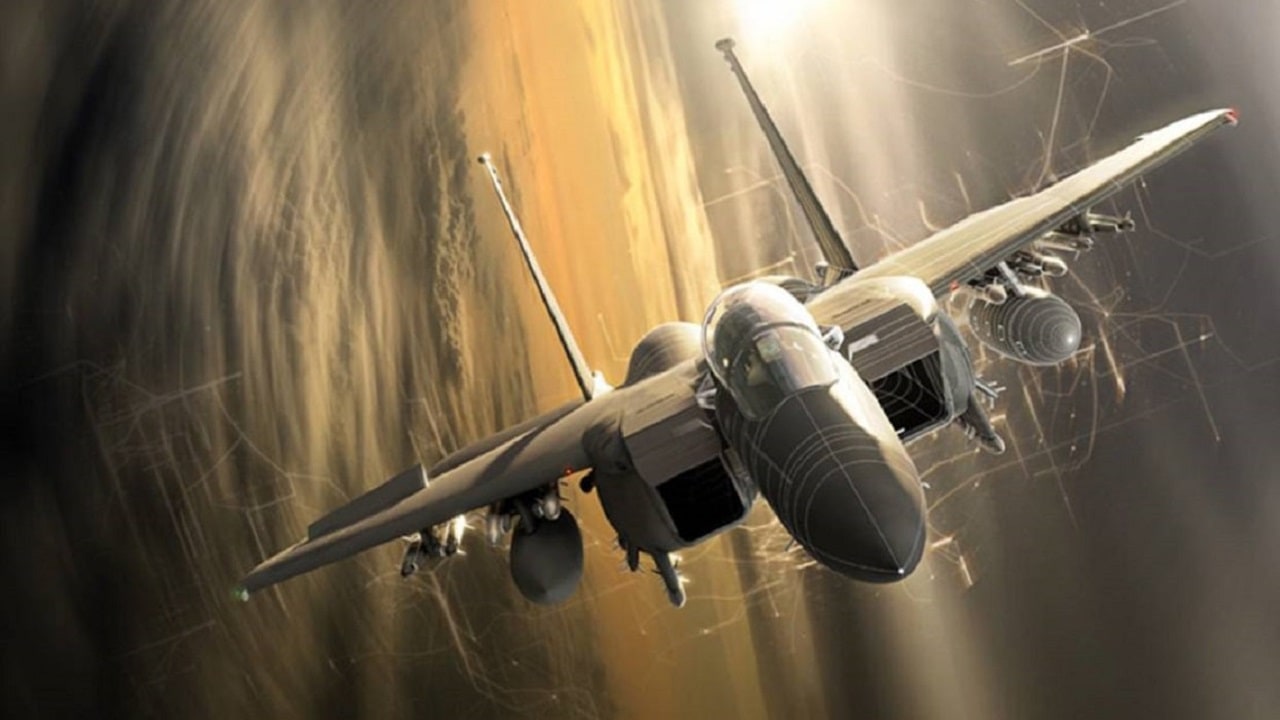
Key Points and Summary – More than fifty years after the F-15 first took to the air, the new F-15EX Eagle II is proving that “4.5-generation” does not mean obsolete.
-Building on the Eagle’s legendary 104–0 air-to-air record, the EX adds digital fly-by-wire controls, an all-glass cockpit, the APG-82 AESA radar, and the EPAWSS electronic-warfare suite, while retaining raw performance the F-35 can’t match.
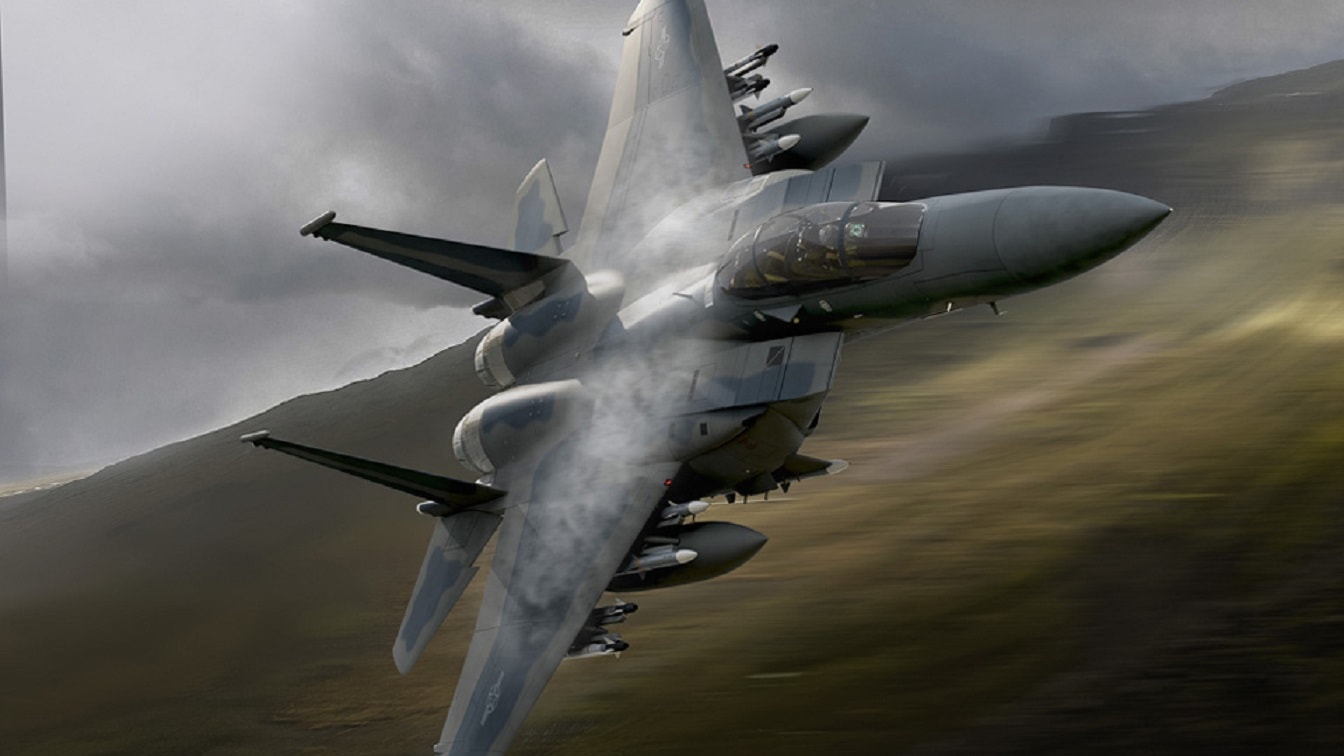
F-15EX Eagle II artist rendition. Image Credit: Boeing.
-It flies faster (Mach 2.5), farther, and carries far more weapons—up to 29,500 pounds, including 12 AMRAAMs—with a projected 20,000-hour airframe life. Rather than competing with the F-35, the F-15EX is best seen as its high-speed, heavy-hitting complement.
Faster Than Lightning: Why the F-15EX Still Matters in a Stealth World
Hard to believe as it may seem, the McDonnell Douglas (now Boeing) F-15 Eagle fighter jet has been around since 1972. (Vietnam War fighter pilot turned professional singer, Dick Jonas [Lt. Col., USAF, Ret.] was off by one year during the 1:15 mark in his F-15 dedication song.)
Although that still makes this warbird 20 years younger than the B-52 bomber, the Eagle is most definitely no spring chicken.
Over 53 years of faithful service to the air forces of the United States of America, Israel, Japan, Qatar, Saudi Arabia, South Korea, and Singapore, the F-15 has established a legendary reputation. And deservedly so, especially when you consider it’s mind-blowing 104:0 air-to-air kill ratio!
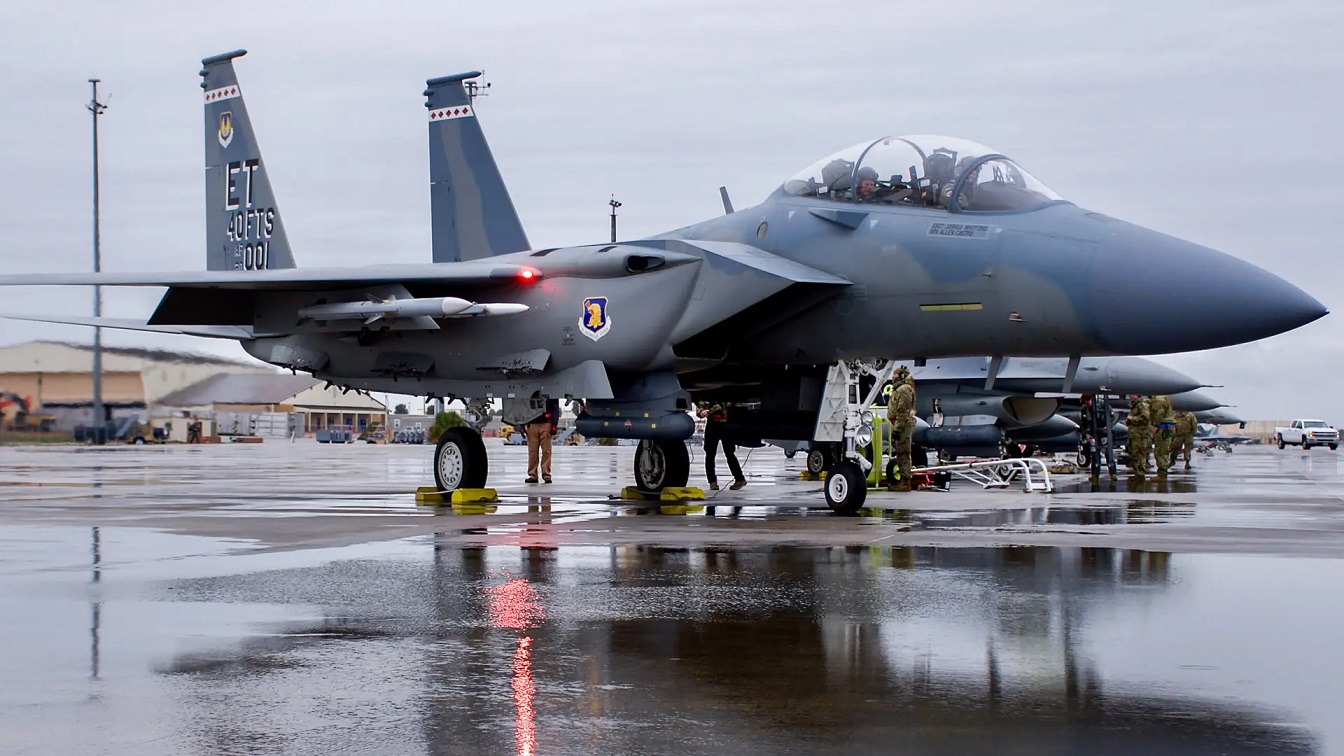
F-15EX. Image Credit: U.S. Air Force.
Meanwhile, the Eagle jet certainly hasn’t remained frozen in time. While earlier versions of the plane were considered pure 4th-generation fighters, the latest and greatest iteration is regarded as a 4.5-generation fighter, namely the F-15EX Eagle II.
However, even with its upgrades, one cannot help but ask: Is the Eagle II still relevant in the age of 5th-generation stealth fighters?
Or is it the aeronautical equivalent of a battleship, i.e., powerful and heavily armed, yet still old and obsolete?
4.5 Generation Fighters Explained
In essence, they bridge the gap between the 4th and 5th generations, embodying the phrase “meet you halfway” in both literal and figurative senses.
They blend legacy reliability and advanced capabilities without the exorbitant price tag of developing 5th Generation fighters from scratch. Though definitely not bona fide stealth aircraft, they do incorporate features that make them less easily detectable and trackable, including the masking of the turbine blades and using advanced materials with less distinctive, low-observable features (which reduce the size of the radar signature).
F-15EX Eagle II Premise and Prospectus
Having its roots in the so-called Advanced Eagle, which first flew in 2013, and making its maiden flight on 2 February 202, the Eagle II attained official operational status on 5 June 2024, with the Oregon Air National Guard’s 142nd Wing in Portland being the beneficiary.
Boeing’s official information page touts the F-15EX thusly: “Delivering best-in-class payload, range and speed, the F-15EX will serve as a backbone for any tactical fighter fleet – today and into the future…Building upon a legacy of air dominance, the F-15EX provides digital fly-by-wire flight controls, an all-glass digital cockpit, the latest mission systems and software capabilities, and the ability to carry hypersonic weapons. It can leverage existing and future technologies to meet warfighter needs and defeat future threats—head on.”
Advanced radar systems and state-of-the-art avionics also bolster the F-15EX. Chief amongst these are the Raytheon AN/APG-82(V)1 radar and the BAE Systems AN/ALQ-250 Eagle Passive/Active Warning and Survivability System (EPAWSS). EPAWSS is new top-of-the-line, all-digital electronic warfare (EW) suite that is smaller and lighter than the EW systems of the earlier Eagle variants, equipped with advanced radio frequency (RF) electronic countermeasures (ECM), which in turn enable deeper penetration against modern integrated air defense systems (IADS) and providing rapid response capabilities designed to protect the aircrew through increased situational awareness (SA) capabilities.
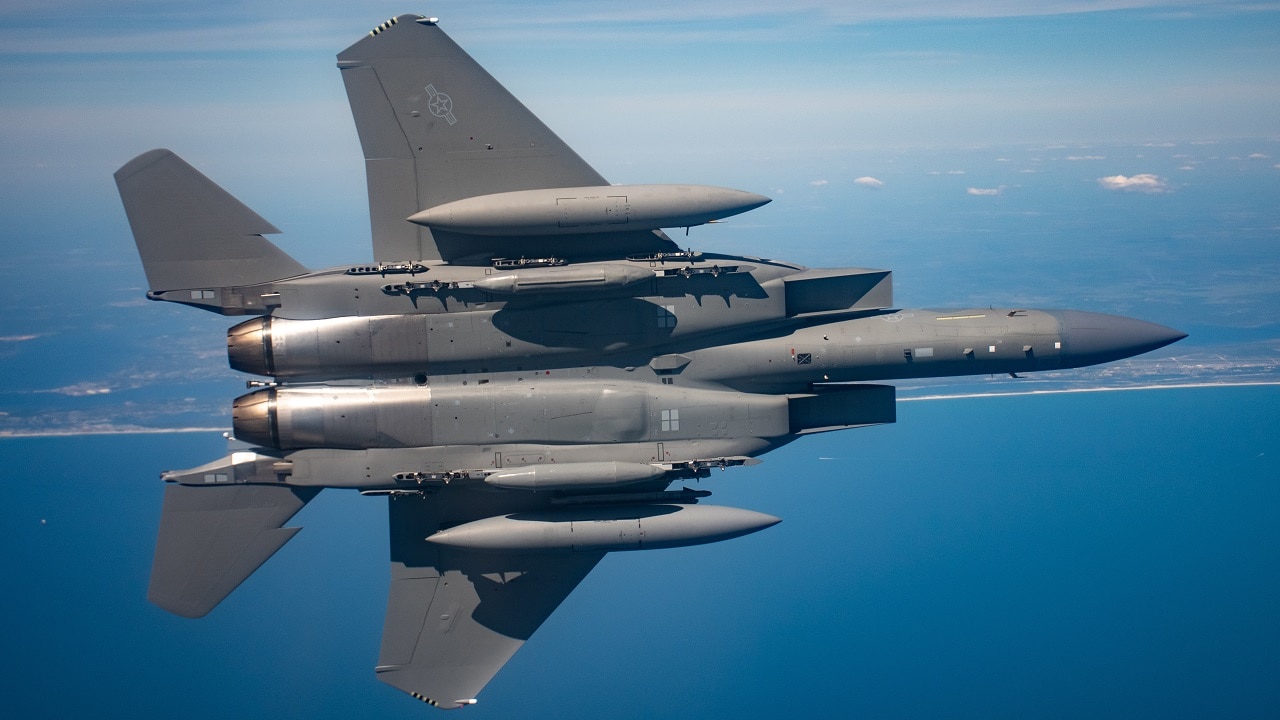
An F-15EX Eagle II from the 85th Test and Evaluation Squadron, 53rd Wing, takes flight for the first time out of Eglin Air Force Base, Fla., April 26, 2021, prior to departure for Northern Edge 2021. The F-15EX brings next-generation combat technology to a highly successful fighter airframe that is capable of projecting power across multiple domains for the Joint Force. (U.S Air Force photo by 1st Lt Savanah Bray)
All well and good, but aren’t 5th Generation fighters like the Lockheed Martin F-35 Lightning II still just plain better in every aspect?
F-15EX Advantages
Believe it or not, the Boeing bird confers certain advantages over the Skunk Works product.
Speed: The Eagle II rips through the sky at Mach 2.5 (1,918 mph, 3,087 km/h, 1,666 knots), compared with the comparatively plodding Mach 1.6 (1,227 mph, 1,975 km/h, 1,066 knots) of the Lightning II. To put a new spin on an old metaphor in a mechanical context, this Eagle is literally “faster than lightning.” As fighter pilots are fond of saying, “Speed is life.”
Range: 2,100 nautical miles (2,400 statute miles, 3,900 kilometers) for the F-15EX vs. 1,500 nautical miles (1,700 statute miles, 2,800 kilometers) for the F-35. Moreover, as the Boeing literature states, “The F-15EX can shoot from a significantly increased range – farther than any other fighter in the U.S. Air Force arsenal.” In other words, greater standoff attack and beyond visual range (BVR) capability, which is an additional boon to aircrew survivability.
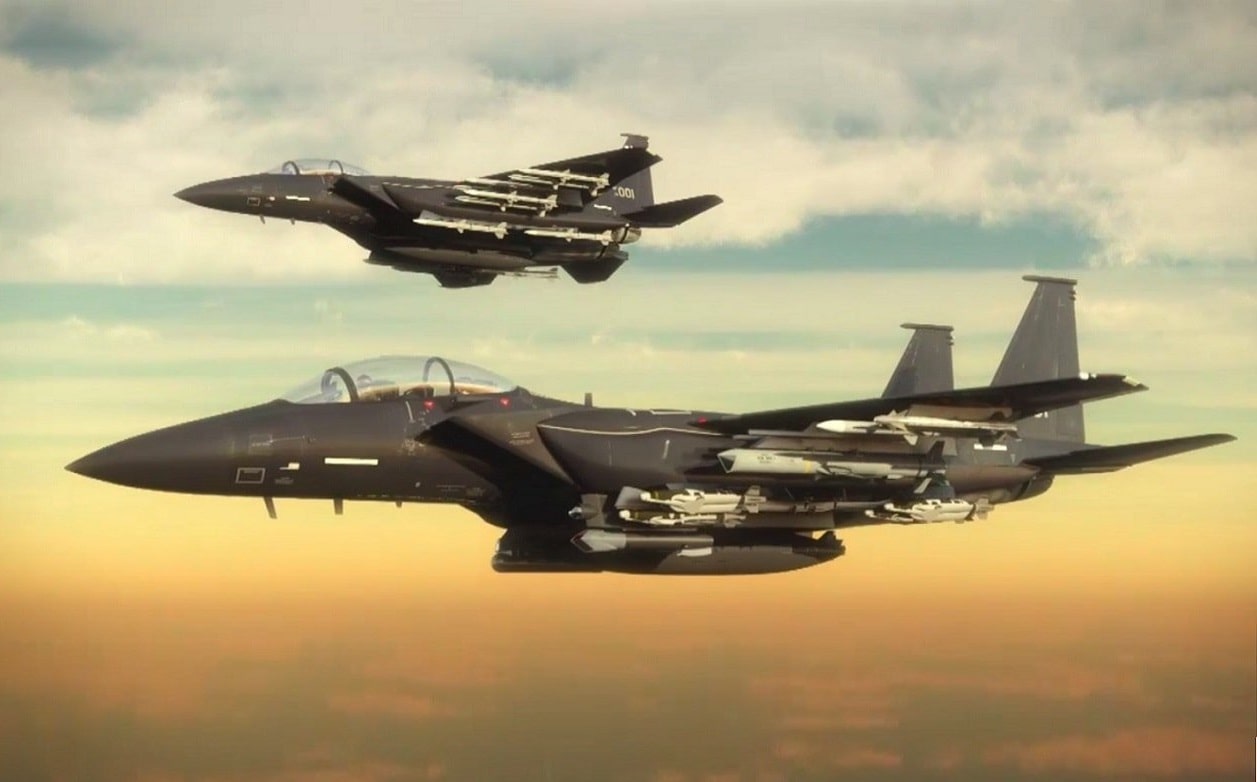
F-15EX Eagle II. Image Credit: Boeing.
Maneuverability: The F-15EX has a higher thrust-to-weight ratio than the F-35—0.93 vs. 0.87—and the ability to sustain higher G-forces during extreme maneuvers. This makes the 4.5 Generation fighter more capable in aerial dogfights and close-range engagements where agility and raw performance are crucial.
Weapons Payload Capacity: 29,500 lbs. (13,380 kg) for the Eagle II (including 12 AMRAAM missiles) vs. 18,000 lbs. (13,380 kg) for the Lightning II. The latter plane’s stealth capabilities limit its payload due to the necessity for internal weapons storage.
Lifespan: The R-15EX has two-and-a-half times the service life of the F-35, to the tune of 20,000 hours versus a mere 8,000 hours. “A bird in the hand is worth two in the bush,” and likewise, an airworthy Eagle II that’s still in the fight beats a Lightning II idled in the maintenance hangar.
More of a Complement than a Competitor?
Instead of being viewed as a mere competitor, perhaps the Eagle II should be seen as a complement and a potential force multiplier for the F-35; in other words, the two warbirds shouldn’t be seen as mutually exclusive concepts.
Aaron Spray of Simple Flying provides a useful strategic bomber analogy: “The F-35 can conduct penetration and surgical strikes and pave the way for the F-15EX to come in with greater payloads and range after reducing the threat environment … Whatever the B-21 is (cutting-edge, stealthy, etc.), the B-52 is not. However, the low cost, high payloads, and other advantages give the B-52 a place in the 2040s alongside the B-21s. Still, the contrast is not nearly as stark between the F-35 and F-15EX, and the F-15EX is a formidable fighting machine in its own right.”
About the Author: Christian D. Orr, Defense Expert
Christian D. Orr is a Senior Defense Editor. He is a former Air Force Security Forces officer, Federal law enforcement officer, and private military contractor (with assignments worked in Iraq, the United Arab Emirates, Kosovo, Japan, Germany, and the Pentagon). Chris holds a B.A. in International Relations from the University of Southern California (USC) and an M.A. in Intelligence Studies (concentration in Terrorism Studies) from American Military University (AMU).