
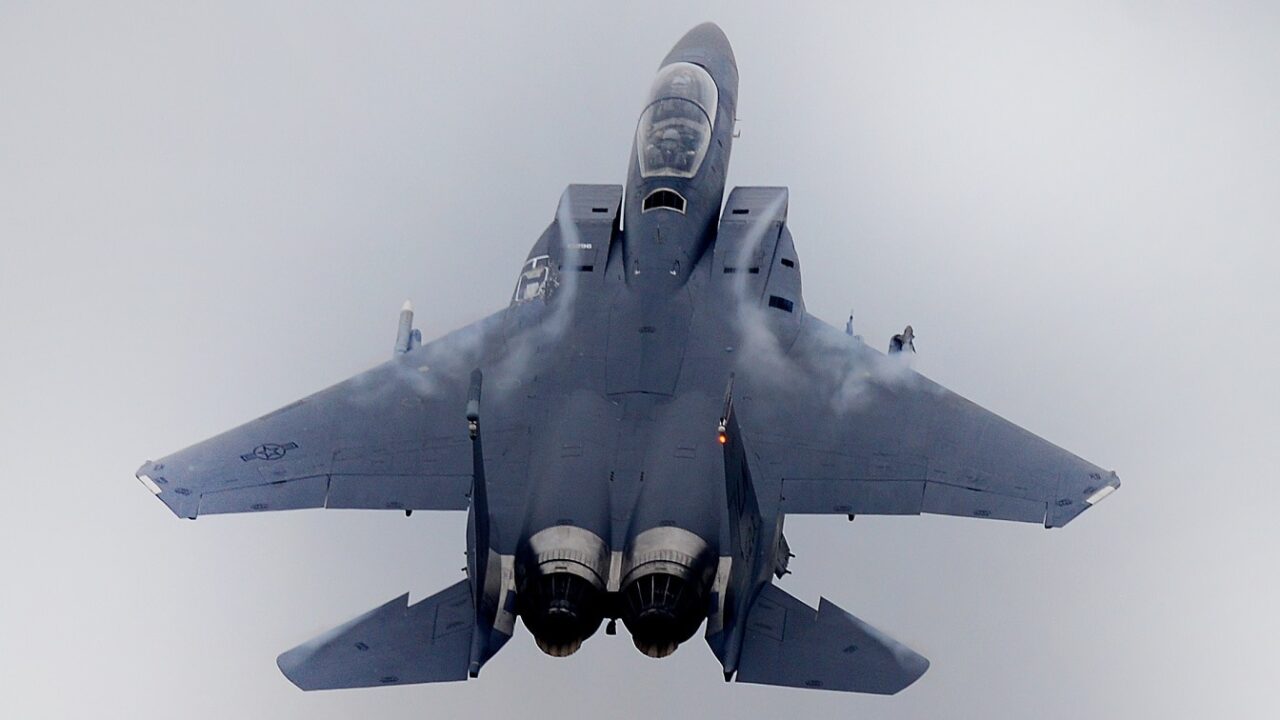
Key Points and Summary – The F-15C “Charlie” Eagle is the definitive single-seat air-superiority variant of America’s iconic F-15, refining the original F-15A with more fuel, higher takeoff weight, improved radar, and the ability to fire AIM-120 AMRAAMs.
-First fielded in 1979, the F-15C helped build the Eagle’s unmatched 104–0 air-to-air record, scoring kills in Desert Storm, no-fly zone patrols over Iraq, and the Kosovo air war.
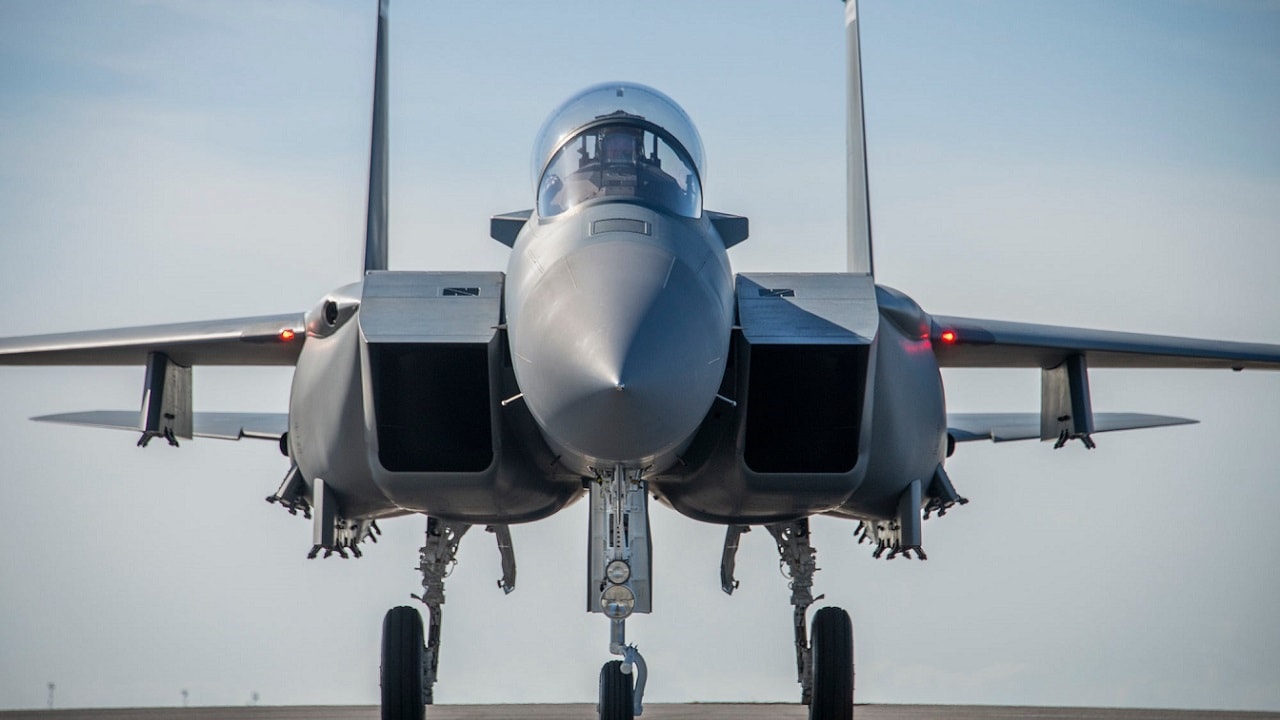
F-15EX Eagle II. Image Credit: Boeing.
-Saudi F-15Cs added their own victories, including the only Desert Storm double-kill.
-Now being phased out in favor of the F-15EX, many combat-veteran F-15Cs are headed to museums, cementing the jet’s place in aviation history.
F-15C Fighter Explained
“Oh, I wish I had 8 AMRAAMs like the Eagle/I’d be having so much fun, it’d be illegal/Like a guy who ain’t been laid for months/I’d shoot those f***ers all at once/I wish I had 8 AMRAAMs like the Eagle.”
Thus goes the second verse of “I Wish I Had a Gun Just Like the A-10,” a song by Dos Gringos, a rock band formed by two former U.S. Air Force F-16 pilots, Chris “Snooze” Kurek and Rob “Trip” Raymond. The plane they’re singing about in that verse is, of course, the F-15 Eagle.
In that same song, Snooze and Trip sing a verse about the two-seater “bomb truck” variant of the Eagle series, the F-15E Strike Eagle (AKA the “Mud Hen”). To be sure, they are personally biased in favor of the beloved Viper, as they make abundantly clear in the closing verse. However, the fact that these two proud F-16 jocks extol the virtues of two different iterations of the Eagle jet in one song ought to tell you something.
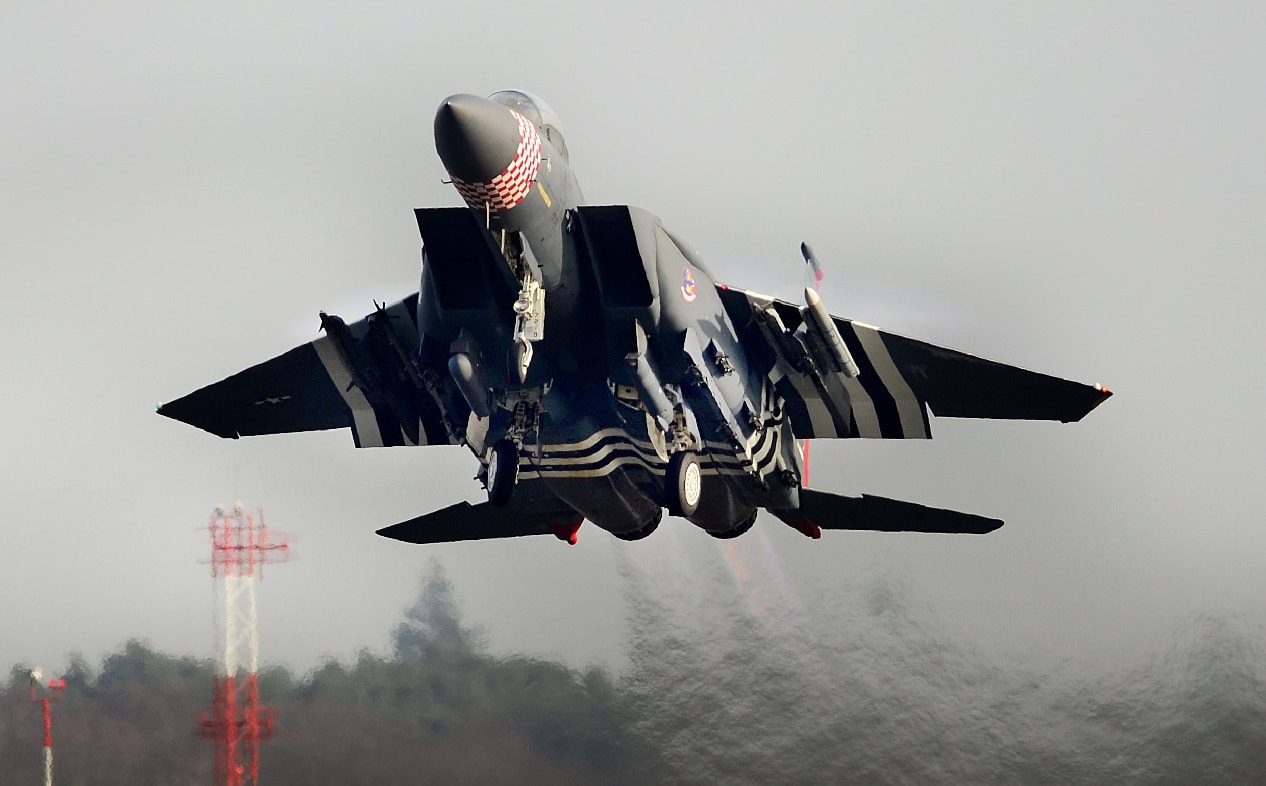
An F-15E Strike Eagle painted in the heritage colors of it’s P-47 Thunderbolt predecessor takes off from Royal Air Force Lakenheath, England Feb 6. The 48th Fighter Wing officially unveiled the aircraft publicly during a ceremony on Jan 31. (U.S. Air Force photo/Tech. Sgt. Matthew Plew)
With that in mind, 19FortyFive now turns its attention to the the single-seat F-15C variant of the Eagle.
F-15C Basics (Initial History and Differences from Earlier Variants)
The original Eagle jet, the F-15A, made its maiden flight on July 27, 1972. The F-15C came along six years later, with the Air Force unit at Kadena Air Base, Japan, becoming the first beneficiary in September 1979. A total of 483 of the “Charlie” models were built between 1979 and 1985.
As noted by Global Security, “Externally, the differences between the F-15A and F-15C are so slight as to make identification difficult; the only reliable indicator is the aircraft serial number. All F-15As have tail numbers starting with 73- through 77-, while F-15Cs have tail numbers beginning with 78- through 86-.” Scratching beneath the surface of the cosmetic differences reveals the following improvements over the F-15A:
-Upgraded avionics
-2,000 pounds of additional internal fuel
-The possibility of carrying exterior conformal fuel tanks
-Increased maximum takeoff weight of up to 68,000 pounds
-Accommodation of the AIM-120 Advanced Medium-Range Air-to-Air Missile (AMRAAM).

An F-15EX fighter jet taxis to its parking spot at Wright-Patterson Air Force Base, Ohio, Nov. 8, 2021. The jet visited Wright-Patt to give the Air Force Life Cycle Management Center’s F-15EX program office the opportunity to see the aircraft up close. (U.S. Air Force photo by Jaima Fogg)
In addition, the last 43 F-15Cs were upgraded with AN/APG-70 radar, and later the AN/APG-63(V)1 radar.
F-15C Combat Performance
Much has been said about the F-15 Eagle’s unmatched 104:0 air-to-air kill ratio. As far as this writer can ascertain, at least 41 of those aerial victories were attained by the “Charlie” variant, most of them with U.S. Air Force pilots at the controls during the 1991 Persian Gulf War, Operations Northern Watch and Southern Watch, and the 1999 Kosovo air campaign.
However, Royal Saudi Air Force (RSAF) F-15C drivers got their fair share of aerial combat glory as well:
–In June 1984, Saudi F-15s intercepted and shot down at least one, and possibly two, Islamic Republic of Iran Air Force F-4 Phantoms that had overflown Saudi Arabia’s territorial waters.
-On Jan. 24, 1991, during Desert Storm, Capt. Ayehid Salah al-Shamrani of the RSAF’s No 13 Squadron downed two Iraqi Air Force Mirage F1EQs. It was the only double-kill scored by any coalition aviator during that conflict. The Aviation Geek Club reports there was a good bit of controversy surrounding these shootdowns, but, long story short, Naqib al-Shamrani became an instant national hero.
Where Are They Now?
All good things must come to an end, including the run of a great fighter like the F-15C. In the ranks of the U.S. Air Force, it is being phased out for its 4.5-generation successor, the F-15EX Eagle II. Six F-15Cs have already been converted to museum displays, including:
-Tail No. 85-0114 at the Smithsonian National Air and Space Museum’s Steven F. Udvar-Hazy Center in Chantilly, Virginia. This plane scored two kills against Iraqi fighter jets during the Gulf War while flown by then-Capt. (now retired Col.) Cesar “Rico” Rodriguez. This writer has toured the Udvar-Hazy Center twice and can personally recommend it.
-Tail No. 86-0156 at the Cold War Gallery of the National Museum of the United States Air Force at Wright-Patterson Air Force Base, Ohio. This F-15 bagged two MiG-29 “Fulcrums” of the Yugoslavia Air Force during Operation Allied Force while flown by then-Capt. Jeff “Claw” Hwang (now a retired colonel). Our editor Harry Kazianis, got to pay a visit there earlier this year. (Lucky him!)
According to the World Directory of Modern Military Aircraft, the U.S. Air Force still flies 135 F-15C airframes. Meanwhile, the RSAF still has 43, and the Israeli Air Force has 17.
About the Author: Christian D. Orr, Defense Expert
Christian D. Orr is a Senior Defense Editor. He is a former Air Force Security Forces officer, Federal law enforcement officer, and private military contractor (with assignments worked in Iraq, the United Arab Emirates, Kosovo, Japan, Germany, and the Pentagon). Chris holds a B.A. in International Relations from the University of Southern California (USC) and an M.A. in Intelligence Studies (concentration in Terrorism Studies) from American Military University (AMU). He is also the author of the newly published book “Five Decades of a Fabulous Firearm: Celebrating the 50th Anniversary of the Beretta 92 Pistol Series.”