

Key Points and Summary – France’s Rafale F5, the “Super Rafale,” is a major modernization meant to keep France’s flagship fighter relevant into the 2040s while FCAS develops.
-F5 shifts Rafale from a single aircraft to a distributed combat node: it will control loyal-wingman drones for electronic warfare, reconnaissance, decoying, and SEAD/DEAD.
-Upgrades include improved AESA radar and optronics, 360-degree IR/optical coverage, stronger sensor fusion, and more capable SPECTRA-style EW.
-New weapons—especially the ASN4G nuclear missile—plus MICA NG and long-range A2A options expand deterrence and air dominance.
-With better datalinks and cooperative targeting, F5 becomes an airborne quarterback for joint forces and future combat-cloud links.
Super Dassault Rafale F5: The 1 Upgrade That Keeps France Competitive to 2040
The Dassault Rafale F5, or “Super Rafale,” represents the most significant modernization of France’s flagship fighter since its introduction.
Designed to keep France competitive into the 2040s, the Super Rafale is intended to bridge the gap between fourth-generation tech and Europe’s future sixth-generation FCAS fighter. France has already committed to buying 42 Super Rafales, with expected delivery in the early 2030s.
Historical Context for Dassault Rafale
The Rafale began as a technology demonstrator in the 1980s and has since evolved into a sophisticated fourth-generation-plus multirole fighter.
The earlier standards included the F1 early naval variant; F2 air-to-ground multirole; F3 with nuclear capabilities and AESA radar; and the current variant, the F4 with advanced datalinks and upgraded sensors.
The F5 represents a transformational jump, but is supposedly more of a generational half-step up than just a simple upgrade.
The new variant should be capable of serving as a frontline NATO fighter well into the mid-century.
The F5 will include several core upgrades.
Chief amongst them, perhaps, is the ability to control loyal wingman drones.
The drones will act as electronic warfare platforms, recon scouts, SEAD/DEAD platforms, decoy systems, and stand-off strike assets.
This transforms the Rafale from a single combat platform into a distributed combat node. The sensor suite is also being overhauled.
Specifically, the radar is being upgraded to the RBE2 AESA, which offers more extended range and more bandwidth.
Improved Front Sector Optronics (FSO) is being integrated to enhance passive detection.
Equipment is being added to enable 360-degree infrared and optical coverage.
And the aircraft’s sensor-fusion capabilities will be closer to the fifth-generation standard.
The F5 will also feature electronic warfare upgrades, i.e., stronger jammers, broader frequency coverage, more powerful threat geolocation, the ability to coordinate EW effects with drones, and the potential for cyber-electronic attack integration.
New weapons are being added, too, like the ASN4G hypersonic nuclear missile (France’s next strategic air-launched nuclear weapon), the MICA NG (next-generation short-medium missile), the new MBDA long-range A2A missile, and possibly new stand-off strike munitions for SEAD and maritime strike.
Major leaps will be made with respect to datalinks, with cloud-based mission systems and cooperative targeting.
Essentially, the F5 will act as an airborne quarterback, directing drones and coordinating with surface ships, satellites, and ground forces.
Technical Specs for Dassault Rafale F5 Fighter
The F5 will feature two Snecma M88-4E turbofans, each delivering 11,250 pounds of thrust, enabling a top speed of Mach 1.8.
The aircraft’s combat radius is expected to reach 1,000 miles. Fourteen hardpoints will allow the F5 to carry a 9.5 ton payload.
The stealth shaping is not consistent with a fifth-generation fighter, but it features lower observability than that of legacy fourth-generation fighters.
The platform’s multirole capabilities will enable a broad mission set, including air superiority, strike, nuclear delivery, electronic warfare, an,d with the M-variant, carrier operations.
The F5’s airframe will be the same as the previous variants—but the system architecture will be fundamentally more advanced.
The Missions
Operationally, France can deploy the F5 in various situations.
-Air superiority in high-threat environments.
-Deep strike and nuclear deterrence.
-SEAD/DEAD.
-Maritime strike.
-Airborne battle management.
Strategically, the F5 improves European defensive autonomy. Europe has been deeply reliant on US technologies and aid over the last generation; platforms like the F-35 have become integral to European defense. But the F5 allows Dassault and France to remain competitive internationally.
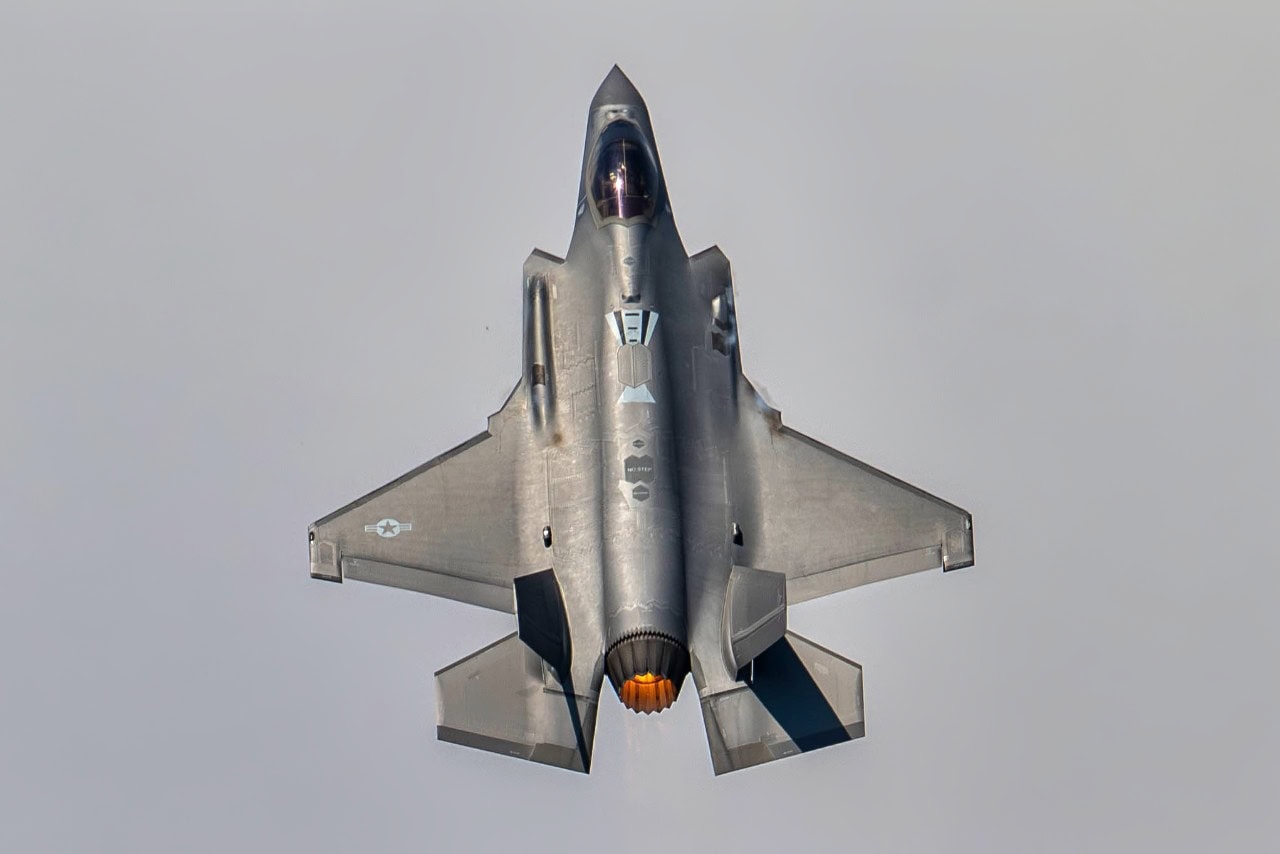
U.S. Air Force Maj. Kristin “BEO” Wolfe, F-35A Lightning II Demonstration Team commander, flies over Kennewick, Washington, during the Tri-Cities Water Follies Airshow Over the River, July 30, 2023. The F-35 Demonstration Team participated in the 2023 Tri-Cities Water Follies airshow and various other events in support of their mission to recruit, retain and inspire new and old generations of Airmen. (U.S. Air Force photo by Staff Sgt. Kaitlyn Ergish)
The F5 also serves as a bridge to fifth-generation technology. The F5’s drone control and sensor fusion architecture can serve as a testbed for technology that will ultimately be used in the sixth-generation FCAS, ensuring continuity before the FCAS arrives in the 2040s. The F5 also increases France’s export leverage.
The Rafale is already the top Western export after the F-35; the F5 will likely attract interest from Gulf states, India, Indonesia, and current Rafale users.
The F5 also allows France to keep pace with Russia and China, who have developed the Su-57 and J-20, respectively, and are currently working on new drone systems.

Su-57 Felon Fighter from Russian Air Force.
In sum, the Dassault Rafale F5 is more than an upgrade; it is the platform’s reinvention, reflecting how modern air power is shifting from aircraft vs aircraft to network vs network.
As a stepping stone to Europe’s sixth-generation FCAS, the F5 ensures France retains one of the world’s most advanced fighter systems through the 2030s and beyond.
About the Author: Harrison Kass
Harrison Kass is an attorney and journalist covering national security, technology, and politics. Previously, he was a political staffer, candidate, and a US Air Force pilot select. He holds a JD from the University of Oregon and a master’s in global journalism and international relations from NYU.