
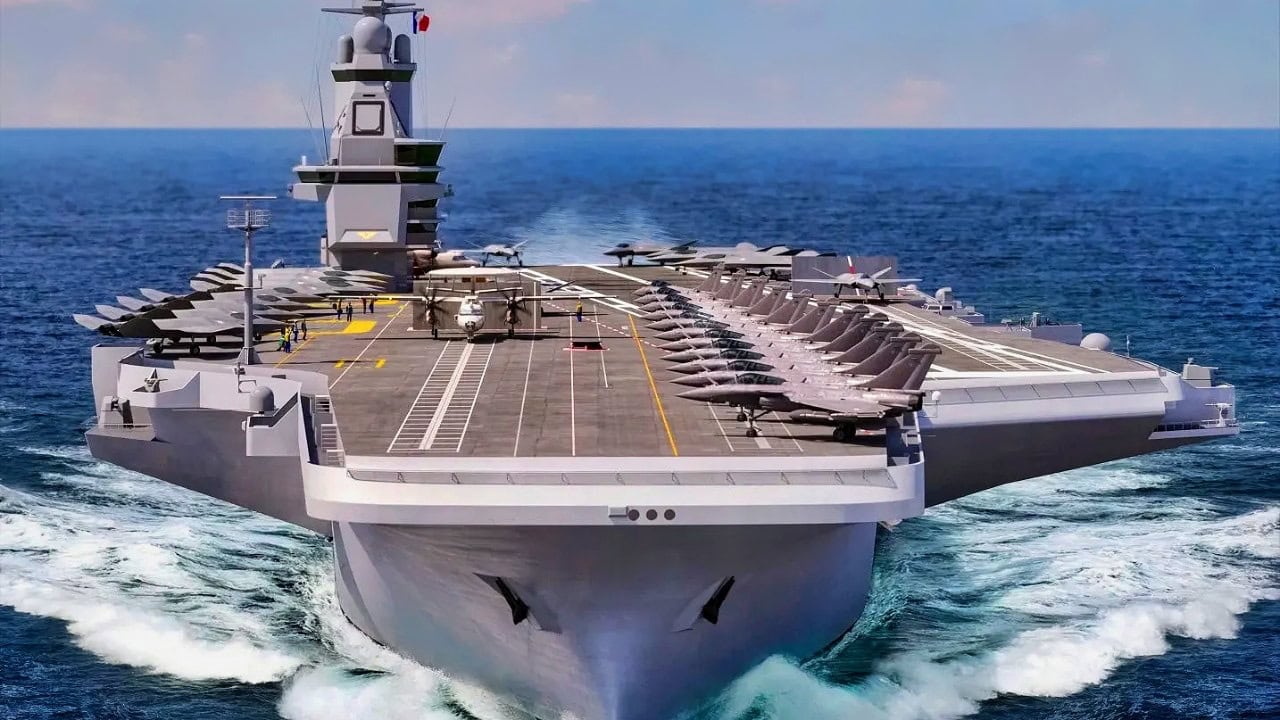
Synopsis: France has formally approved the Porte-Avions Nouvelle Generation (PANG), a nuclear-powered aircraft carrier meant to replace the Charles de Gaulle when it retires in 2038.
-Announced by President Emmanuel Macron during a December 21 visit to French troops in the UAE, the program is framed as a strategic necessity in an increasingly tense global environment.
-The 78,000-ton ship would be Europe’s largest warship, equipped with U.S.-made EMALS catapults and capable of operating around 30 fighters with a crew of roughly 2,000. The €10.25 billion project carries major industrial and political stakes—and domestic budget controversy.
France has formally committed to building a new nuclear-powered aircraft carrier, officially beginning one of Europe’s most ambitious naval procurement programs as President Emmanuel Macron seeks to strengthen French and European power projection amid rising geopolitical strain from multiple angles.
Speaking on December 21 to French troops stationed in the United Arab Emirates, Macron confirmed that the government had taken the final political decision “this week” to proceed with the Porte-Avions Nouvelle Generation (PANG) program. The new carrier is intended to replace the ageing Charles de Gaulle, France’s sole aircraft carrier, which is scheduled to retire in 2038 after nearly four decades of service.
The announcement came during Macron’s Christmas visit to French forces deployed near the Strait of Hormuz, a critical maritime chokepoint for global energy trade. Addressing the troops, Macron framed the carrier decision in strategic terms, arguing that France must be “strong in order to be feared” and particularly strong at sea.
“In an age of predators we must be strong in order to be feared, and especially strong at sea. THis is why, in line with the last two military programming laws, and after a thorough and careful review, I have decided to equip France with a new aircraft carrier,” Macron said. “The decision to launch the construction of this very large-scale program was taken this week.”
Europe’s Largest Warship
Under current plans, the PANG will displace roughly 78,000 tonnes and measure approximately 310 meters in length, making it the largest warship ever built in Europe. By comparison, the Charles de Gaulle displaces around 42,000 tonnes and is 261 meters long. The new carrier will be capable of embarking about 30 fighter aircraft and supporting a crew of roughly 2,000 sailors.
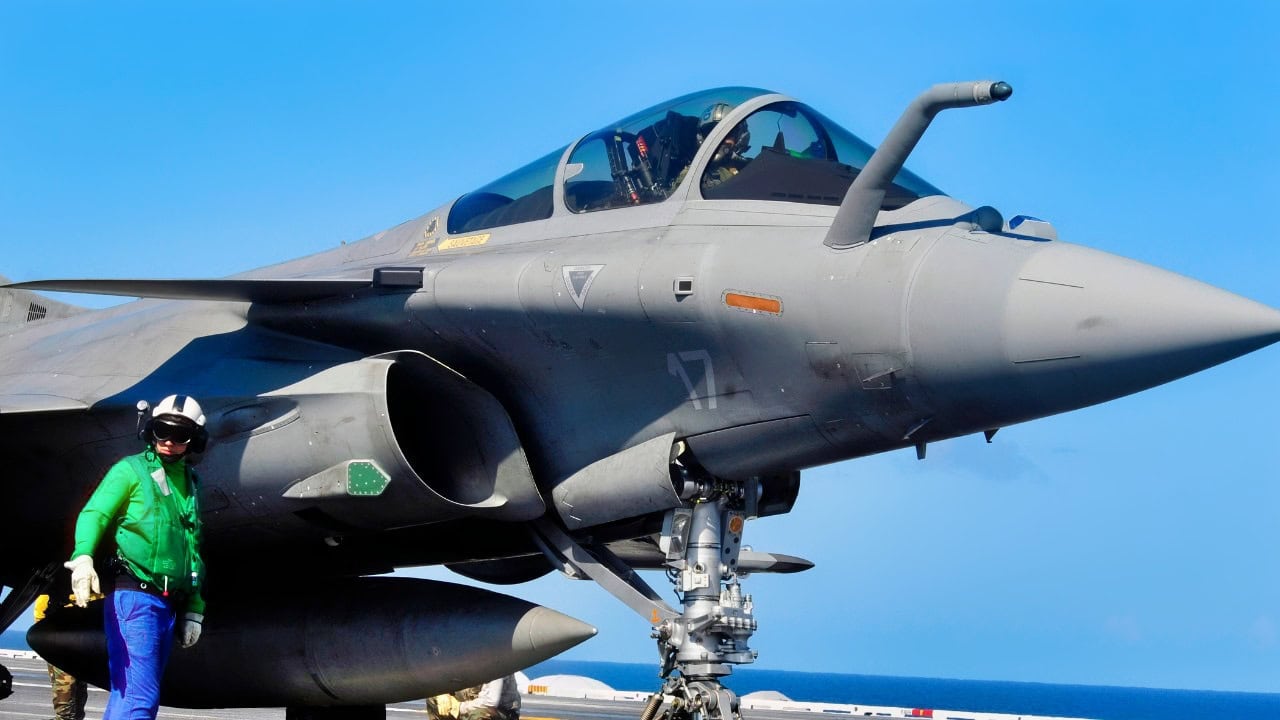
080719-N-3218H-011
ATLANTIC OCEAN (July 19, 2008) A French F-2 Rafale fighter prepares to launch during combined French and American carrier qualifications aboard the aircraft carrier USS Theodore Roosevelt (CVN 71). This event marks the first integrated U.S. and French carrier qualifications aboard a U.S. aircraft carrier. The Theodore Roosevelt Carrier Strike Group is participating in Joint Task Force Exercise “Operation Brimstone” off the Atlantic coast until the end of July. (U.S. Navy photo by Mass Communication Specialist 3rd Class Christopher Hall/Released)
Like its predecessor, the PANG will be nuclear-powered, allowing for extended deployments without the need for conventional refuelling. The ship is expected to operate the naval variant of France’s Rafale fighter and will be equipped with electromagnetic aircraft launch systems (EMALS), a technology currently fielded by the U.S. Navy. French military officials have confirmed that the catapult systems will be purchased from the United States, citing cost and schedule constraints that make domestic production impractical and unnecessary.
The program is expected to cost approximately 10.25 billion euros, according to figures cited by the French government and defense officials. Work on nuclear propulsion components began in 2024, and their final industrial order must be authorized under France’s 2025 defense budget to keep the project on schedule. If timelines hold, the carrier is expected to enter operational service in 2038, coinciding with the planned retirement of the Charles de Gaulle.
Industrial and Political Stakes
Beyond its military role, the carrier program is a major industrial undertaking. Macron said the project would involve hundreds of suppliers, the majority of them being small and medium-sized enterprises, and would provide a long-term boost to France’s defense-industrial base. Macron also pledged to visit the shipyard in early 2026 to show the government’s support for the companies involved with the project.
Meanwhile, the project was described as a the “centerpiece” of French military power by Army Minister Catherine Vautrin, promising that it would be capable of conducting heavily armed, long-range deployments at short notice and sustaining operations over extended periods. Capabilities like these are central to France’s doctrine of strategic autonomy – though it’s worth noting that, as with the days of the Charles de Gaulle, the country will still be relying on a single platform.
France is currently the only member of the European Union to operate a nuclear-powered aircraft carrier and is the bloc’s sole nuclear-armed state. Alongside the United Kingdom, Italy, and Spain, France is one of only a handful of European countries that field aircraft carriers at all. Even so, European carrier capabilities remain limited when compared with the United States’ fleet of 11 supercarriers and China’s three operational carriers.
Budget Pressures and Controversy on PANG Aircraft Carrier for France
While the project is inarguably a crucial next step for France’s military ambition, the decision to proceed with the carrier’s construction has not been without controversy at home. Some lawmakers from the political center and moderate left have argued that the carrier project should be delayed or scaled back due to France’s strained public finances. France is currently grappling with high debt levels and pressure to rein in spending, even as defense budgets rise across Europe.
Macron, however, doesn’t share that view. The French president has tied the carrier to a broader increase in military spending and pledged an additional 6.5 billion euros in defense funding over the next two years. Macron also said that France aims to spend 64 billion euros annually on defense by 2027 – double the level when he took office in 2017. The government has also set a goal of expanding the reserve force from about 40,000 personnel today to 80,000 by 2030.
If Paris can lock in the 2025 budget order and keep PANG on schedule, the next test will be whether France can sustain a credible, single-carrier deterrent deployment through the 2030s – while convincing voters that a 10 billion euro flagship is worth it.
About the Author:
Jack Buckby is a British author, counter-extremism researcher, and journalist based in New York who writes frequently for National Security Journal. Reporting on the U.K., Europe, and the U.S., he works to analyze and understand left-wing and right-wing radicalization, and reports on Western governments’ approaches to the pressing issues of today. His books and research papers explore these themes and propose pragmatic solutions to our increasingly polarized society. His latest book is The Truth Teller: RFK Jr. and the Case for a Post-Partisan Presidency.