
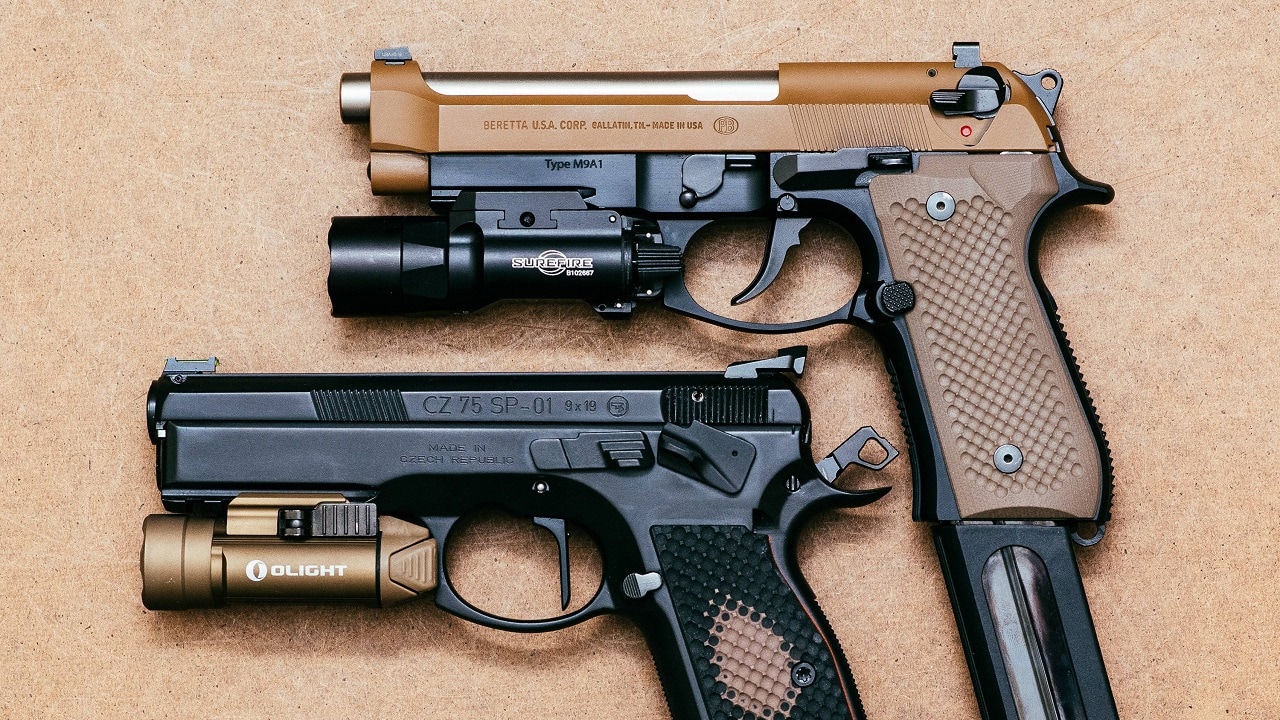
Key Points and Summary – Gun Expert Christian D. Orr revisits one of gun culture’s most stubborn arguments: revolver versus semi-auto for personal defense.
-He lays out why wheelguns still appeal—simple controls, ammo tolerance, and near-foolproof operation—while stressing that they can and do fail.
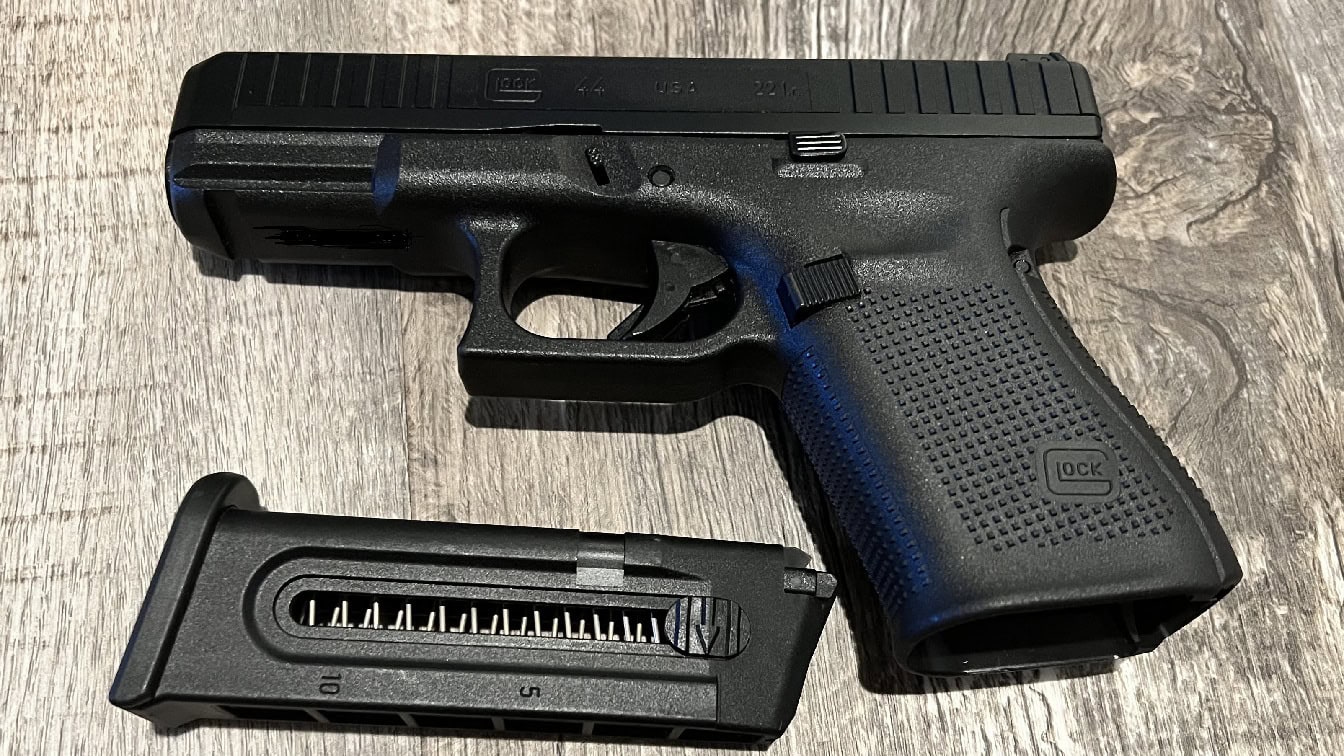
Glock 44. Image Credit: 19FortyFive Original Image.
-Semiautos, he argues, win where it counts in real gunfights: better hit probability with lighter triggers, much higher capacity, and faster reloads.
-Drawing on law-enforcement shooting data and his own experience, Orr concludes that while a quality revolver can still serve, a modern, reliable semi-auto is usually the smarter choice for concealed carry and sustained defensive fire.
Revolver vs. Semi-Automatic Pistol for Self-Defense: The Tired Old Debate Rages On
In the world of firearms, certain debates stubbornly refuse to die. There’s 9mm vs. .45 ACP, AK-47 vs. M16/AR-15/M-4, single-action (SA) vs. traditional double-action (TDA) vs. double-action only (DAO) vs. striker-fired, and so forth.
And then there’s the current debate at hand (no pun intended vis-à-vis handguns): the revolver (AKA the “wheelgun,” “wheelie,” sixgun”) vs. the semiautomatic pistol (AKA “semiauto,” “autopistol,” “autoloader,” and [incorrectly] “automatic”). So, to old-school shooters reading this, shaking their heads, and saying “Here we go again(!),” please bear with us…
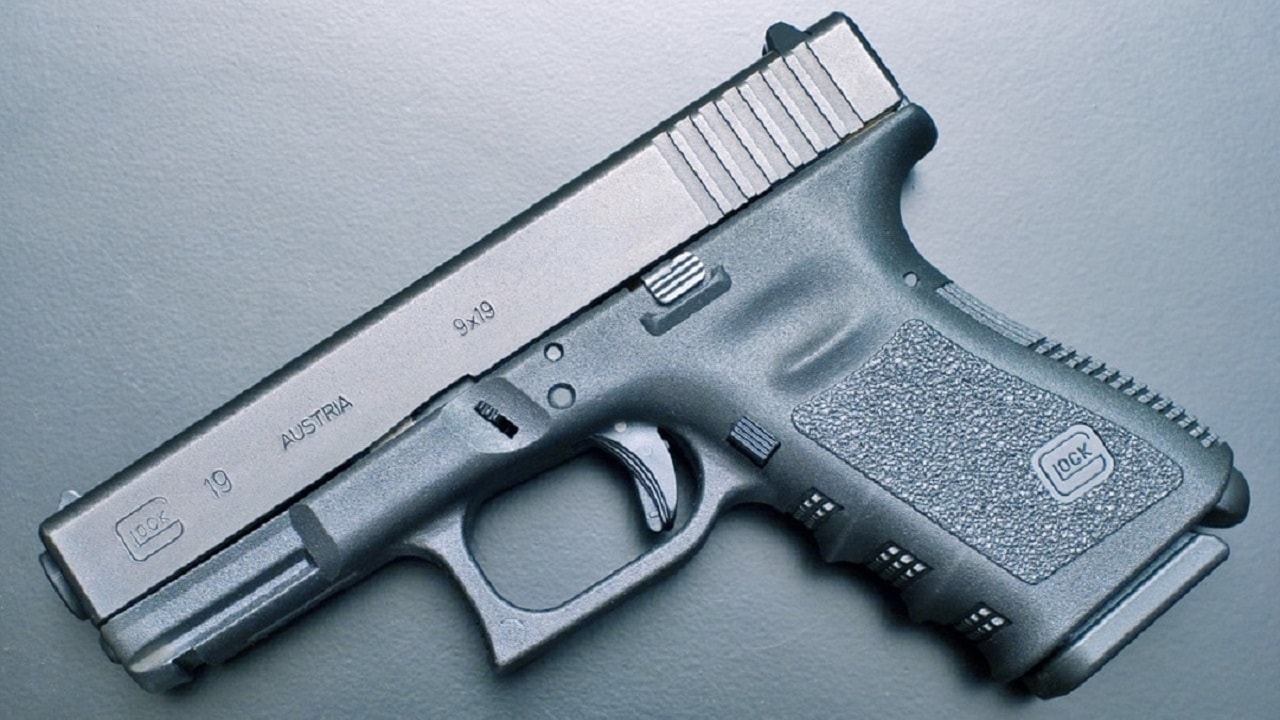
Glock 19 Gen4. Image: Creative Commons.
Revolver Primary Advantages
-Simplicity: As the one military acronym goes, “K.I.S.S. (Keep It Simple, Stupid)”. (Mind you, the US Army and Air Force haven’t made a wheelgun standard-issue in forever, but eh, why nitpick?). Revolvers have no manual safeties, mag release buttons, or slide stop levers to fumble with, and no slide to rack, making them far simpler for novices to operate.
-Reliability: “Six for Sure!” as revolver advocates are fond of saying, although one could be technically nitpicky, as not all wheelguns are “sixguns,” as quite a few snubnoses like the Smith & Wesson (S&W) J-frame series and the Ruger SP-101 are 5-shooters, and on the flip side, there is the occasional 7-shot revolver such the S&W 686 “Plus”.
In any event, revolvers have historically been more reliable than semiauto pistols. Now, mind you, this differential has been greatly exaggerated, as (1) revolvers can and do jam too, and (2) there are many super-reliable autopistols out there, such as the Glock 17 (10,000 jam-free rounds without a cleaning), Heckler & Koch (HK) P7 (4,500 jam-free rounds sans cleaning), and Beretta 90 series (that open-stop slide virtually eliminates stovepipe jams).
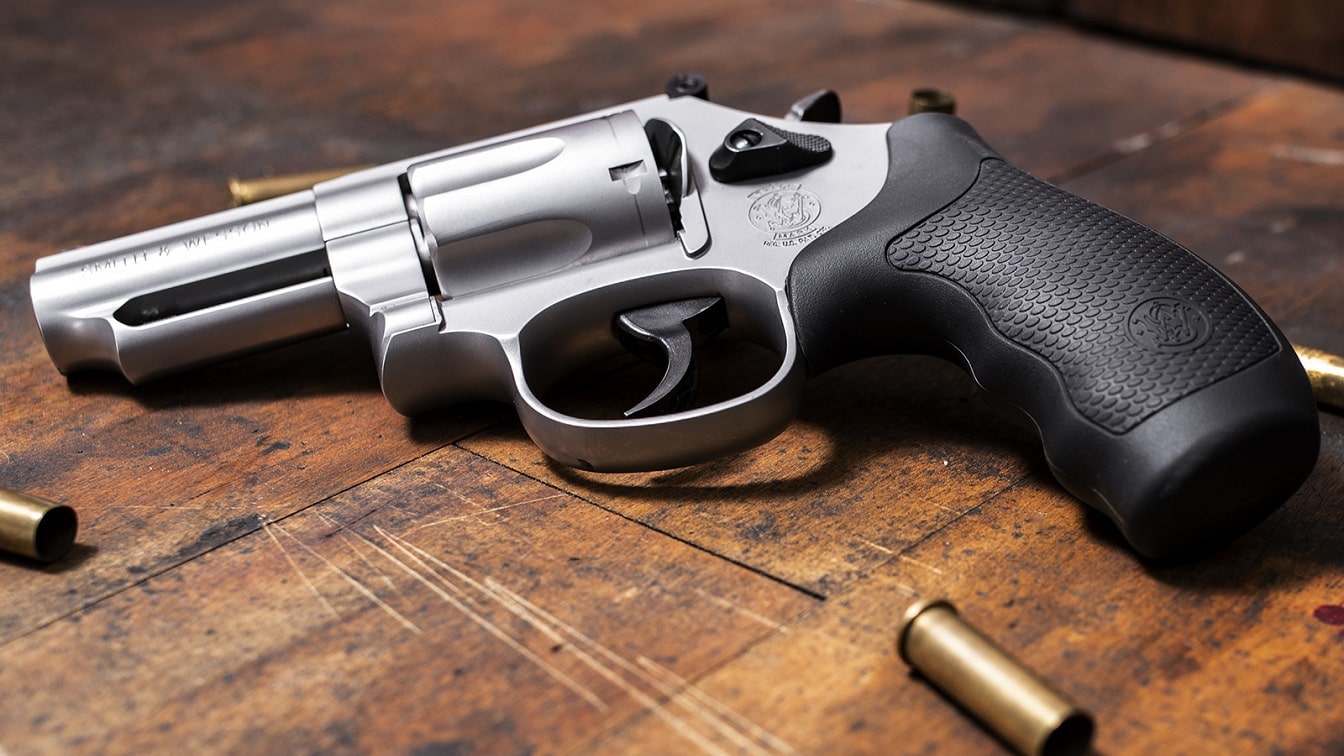
Smith & Wesson Revolver. Image Credit: Creative Commons.
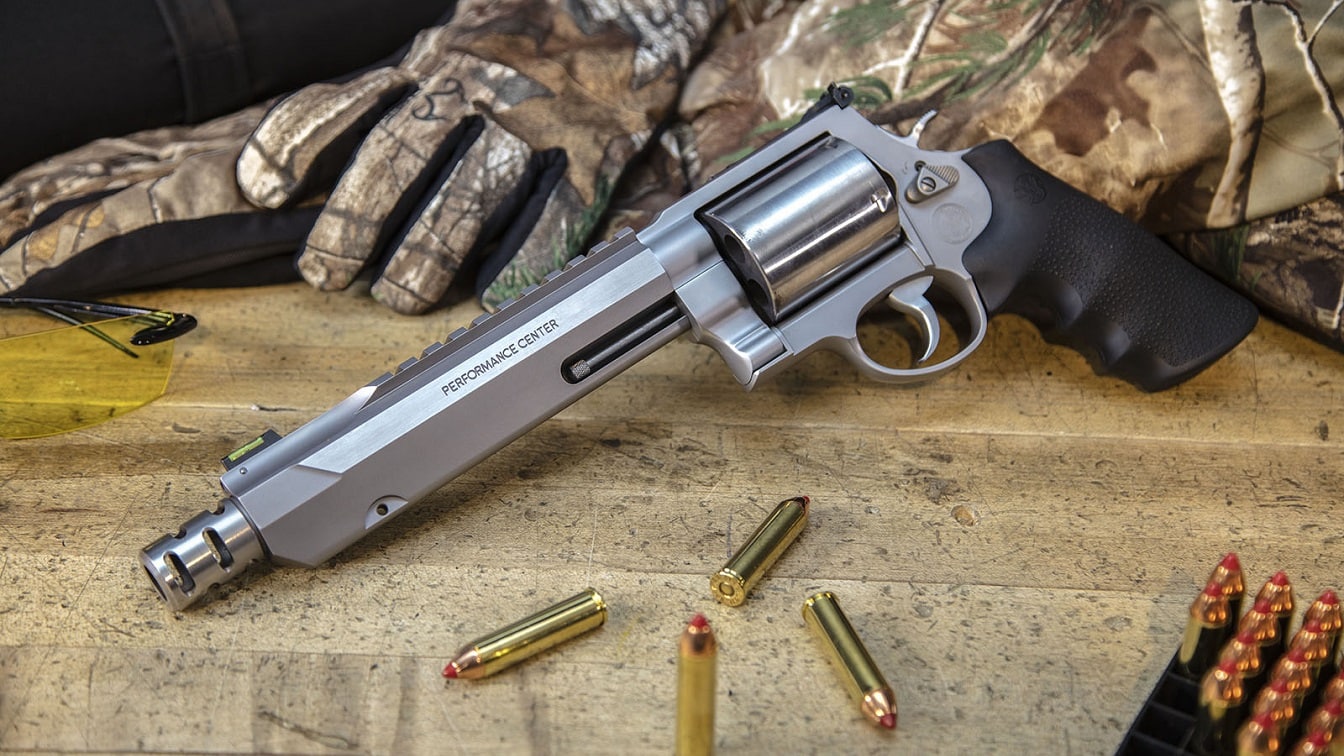
Smith and Wesson Model 500 Revolver. Image Credit: Creative Commons.
However, even the best autoloaders can be rendered unreliable with a faulty magazine; the “wheelie,” which is not magazine-dependent, has no such handicap. Revolvers are also less ammo-sensitive; e.g., you can reliably fire .38 Specials through a .357 Magnum revolver, but cannot do the same with the semiauto Desert Eagle .357 Mag.
-East of Maintenance: This factor goes along the lines of the first two disadvantages. With no disassembly or field-stripping required, a revolver is far easier to clean & lube than an autoloader. (Indeed, unless you’re a certified armorer or gunsmith, you are strongly discouraged from disassembling a revolver, with the possible occasional exception of removing the cylinder.)
Semiauto Pistol Primary Advantages
-Great Hit Potential Under Gunfighter Stress: As renowned self-defense guru Massad F. “Mas” Ayoob points out in his brilliant book “The Semiautomatic Pistol in Police Service and Self-Defense,” this, and not firepower, is actually the most significant advantage of the platform.
Mas cited studies that revolver-armed police had a rather distressing hit rate of 25 percent in real-world gunfights, thanks to that heavy DA trigger pull on every shot. By contrast, TDA-armed cops (such as the S&W Model 39) showed a 65 percent hit rate in deadly force situations, as the single-action trigger pull that followed the DA first shot facilitated combat accuracy. Cops carrying SA autos (such as the M1911 and Browning Hi-Power) showed an even higher hit rate than that (with many, though not all, getting 100 percent hit rates.
(Striker-fired pistols like the Glock series have pretty much the same advantage as an SA auto.)
-Proprietary Nature to the User: An Ayoob-ism for saying that the manual safety switches, which are roundly cursed by the revolver crowd as being overly complicated, can also be a lifesaver in the case of a gun grab.
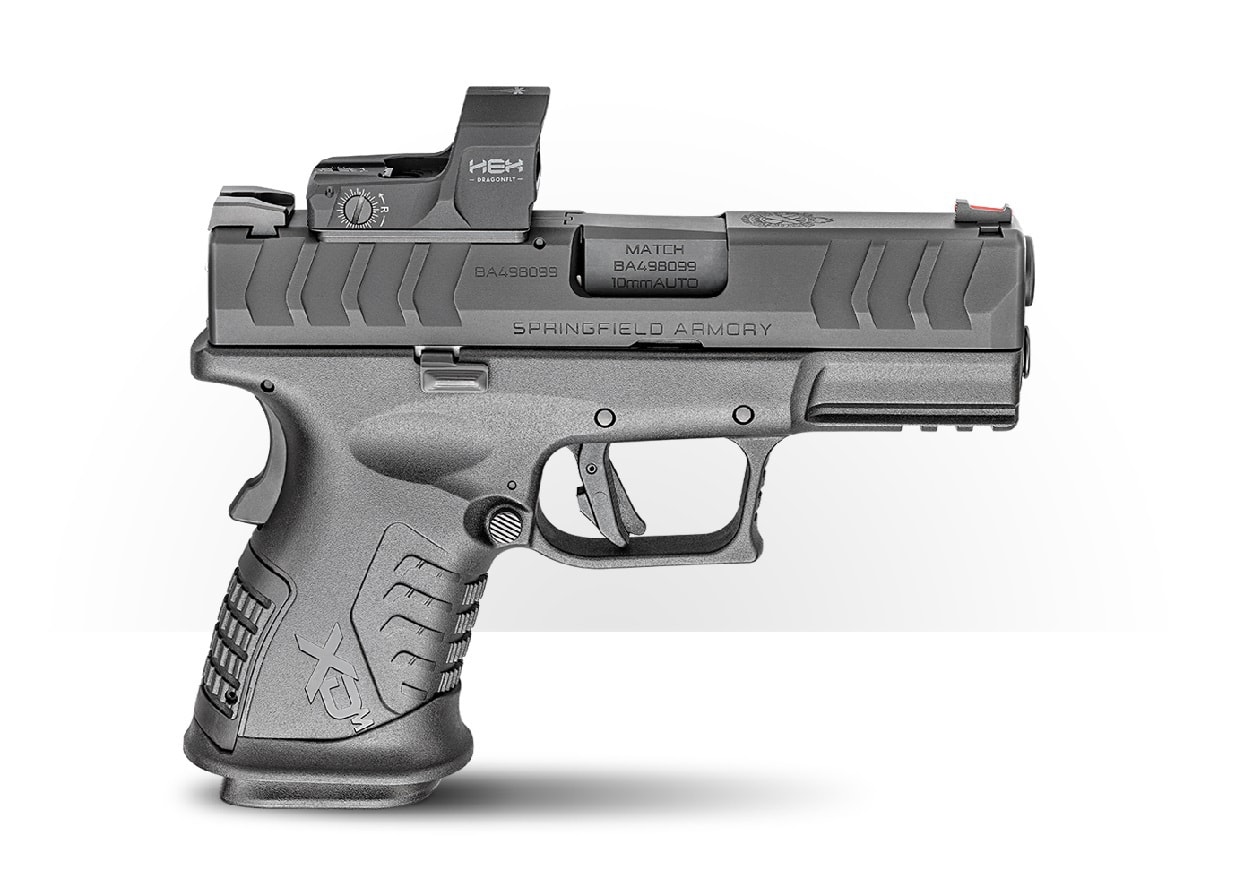
Image: Springfield Armory.
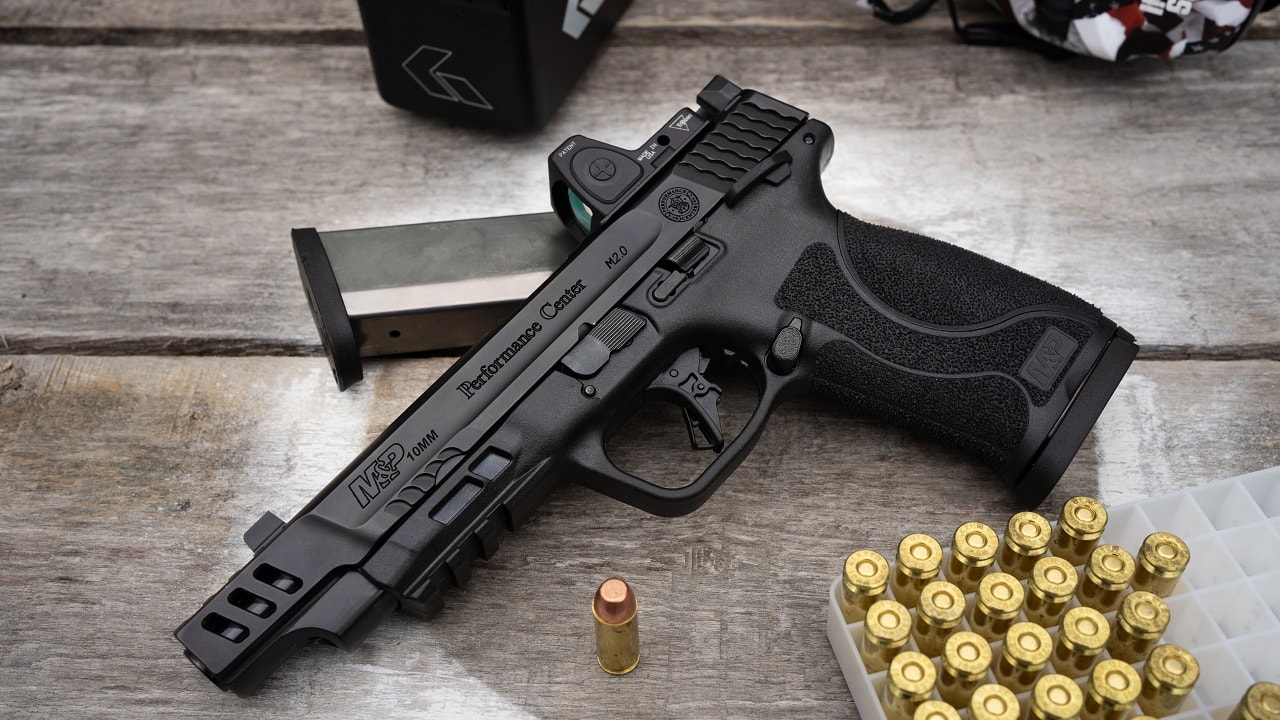
Smith and Wesson 10MM. Image: Industry Handout.
Back when the majority of American law enforcement carried wheelguns, roughly 20 percent of law enforcement officers (LEOs) who died in the line of duty were killed with their own sidearm when the bad guys snatched their guns away.
By contrast, on-safe carry has saved the life of many a autopistol-packing good guy when that carry mode slowed down the bad guy long enough to retake control of the situation and win the day. This phenomenon has been observed with SA autos, TDAs, and the “squeeze-cocking” HK P7.
-Firepower: As Mas Ayoob points out, this is actually third down the list of auto advantages.
Whether it’s the 7+1 standard capacity of the M1911, the 10+ capacity of the Glock 26, or the 17-round capacity of the Glock 17, the contrast in firepower between the semiauto and the wheelgun is like night & day. Mind you, the six shots of the revolver still do provide sufficient firepower for the majority of self-defense situations.
However, firepower is better to have and not need than to need and not have, and nobody ever lost a firefight because they carried too much ammo! (See the 1986 Miami Firefight and the 1997 North Hollywood Shootout.)
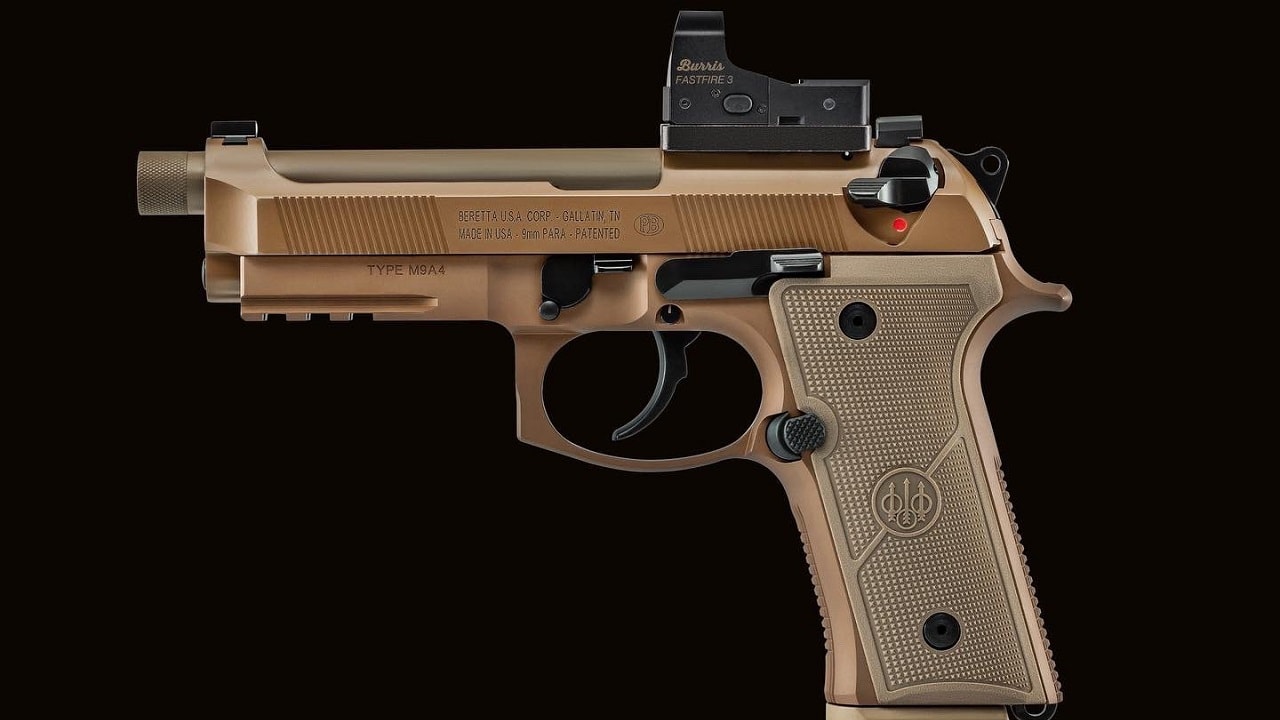
Beretta M9. Image Credit: Creative Commons.
-Faster Reloads: Whether using the push-button magazine release preferred by the overwhelming majority of American shooters, or the “European-style” butt-heel mag release (such as on the German-made Walther P38/P1 and the Russian-made Makarov), magazine-fed semiautos are quicker to get back into action via what the Federal Law Enforcement Training Center (FLETC) instructors term the Emergency Reload).
Yes, speedloaders do help to mitigate the revolver’s disadvantage in this arena. However, they’re still more awkward and fumble-prone under stress (as this writer and former cop discovered to his dismay during Police Pistol Combat [PPC] competitive matches).
And the Winner Is…?
Well, this is highly subjective, as One Size Does *Not* Fit All. I haven’t carried a revolver for self-defense in over 20 years (it was an SP101).
For CCW purposes, even “snubbies” are more challenging to take with the highly desirable combo of comfort & discreetness, as the bulkier bulging cylinder of the gun itself and the speedloaders dig into my pelvis whilst the butt tends to jab me in the short ribs.
By contrast, I can carry even a full-sized auto like my beloved Beretta 92FS/M9, along with backup mags, far more efficiently thanks to its flatter profile. And if I must engage past 7 yards, I definitely want that shorter, lighter trigger stroke.
About the Author: Christian D. Orr, Defense Expert
Christian D. Orr is a Senior Defense Editor. He is a former Air Force Security Forces officer, Federal law enforcement officer, and private military contractor (with assignments worked in Iraq, the United Arab Emirates, Kosovo, Japan, Germany, and the Pentagon). Chris holds a B.A. in International Relations from the University of Southern California (USC) and an M.A. in Intelligence Studies (concentration in Terrorism Studies) from American Military University (AMU). He is also the author of the newly published book “Five Decades of a Fabulous Firearm: Celebrating the 50th Anniversary of the Beretta 92 Pistol Series.”