
Key Points and Summary – The Army’s campus-style dining overhaul is expanding beyond five pilot installations and into the training pipeline, with plans to test private-sector dining at Basic Combat Training and Advanced Individual Training sites.
-The program—launched in early 2025—aims to boost usage of underutilized dining facilities through expanded menus, multiple service stations, and contractor staffing.
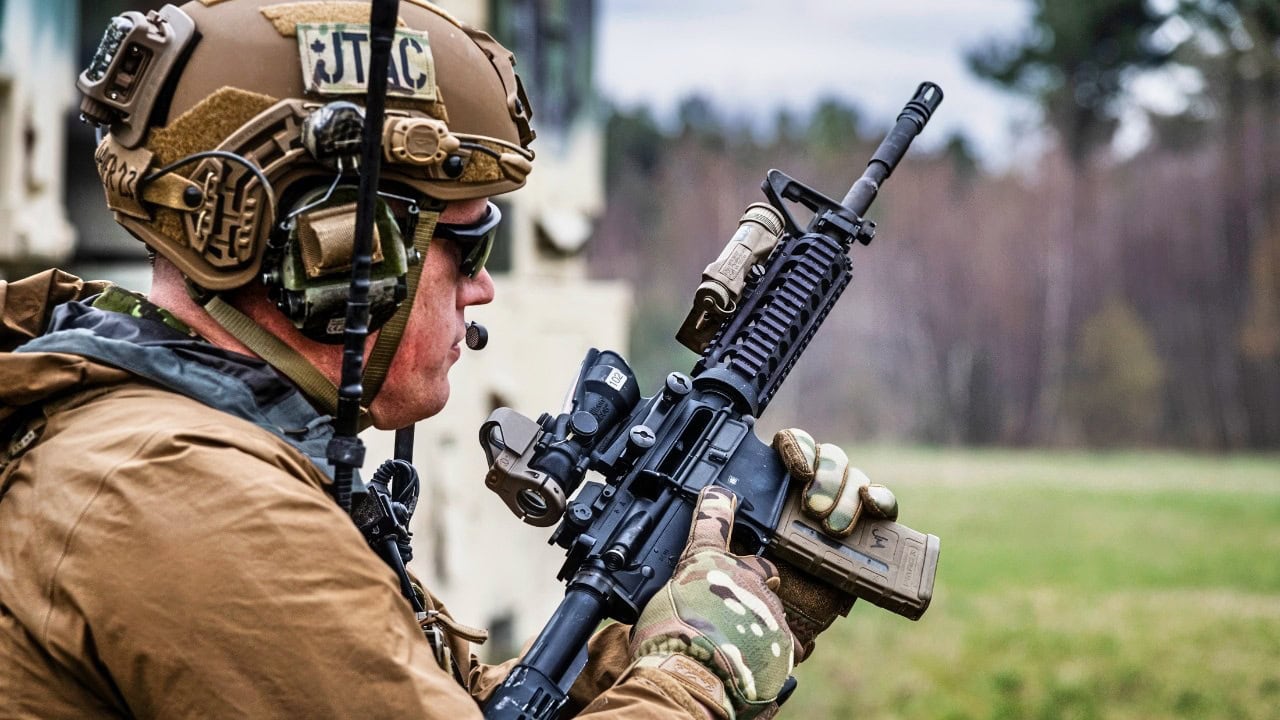
Sgt Mark Button, a Joint Terminal Attack Controller (JTAC) from the 1st Regiment, Royal Canadian Horse Artillery fires an American M4 assault rifle on a range while he participates in Exercise Hungry Horse in Fort Drum, New York State from April 29th to May 3rd 2024.
Photo Credit Petty Officer Second Class Dan Bard, Directorate Army Public Affairs.
Moving into training bases raises higher-stakes logistics: recruits eat on fixed schedules, in large numbers, under supervision, where speed and supply reliability matter.
-Leaders frame the shift as a force-wide redesign tied to fewer Army cooks and improved nutrition, with performance reviews and soldier feedback built in.
Army Expands Campus-Style Dining Overhaul Into Basic Training and Beyond
The US Army’s efforts to modernize—and increasingly privatize—how it feeds soldiers are moving beyond pilot “campus-style” dining halls at its major installations and into the force’s training pipeline, according to recent contracting documents, news reports, and public statements from Army leaders.
What began in early 2025 as an attempt to make underused dining facilities more attractive to soldiers – through expanded menus, restaurant-style service concepts, and contractor staffing – is now growing into a broader overhaul that includes plans to test private-sector dining solutions at Basic Combat Training (BCT) and Advanced Individual Training (AIT) sites.
The change matters because training bases operate differently than permanent garrisons: recruits are required to eat at fixed times, under supervision, and in large, concentrated numbers. That dynamic creates an environment in which speed, staffing, and supply chain reliability are all crucial. With that in mind, the Army is no longer treating dining reform as a quality-of-life add-on, but as a total redesign of the entire process that remains constant from the beginning of a soldier’s career to the time spent at major posts.
From Campus Dining to Privatization
The process of transforming how the US Army approaches dining began to take shape in January 2025, when the Army released a request for proposals for a new campus dining model intended to resemble college cafeterias. The concept was to offer broader dining options, multiple service stations, and greater flexibility in formats such as dine-in, takeout, and meal prep. The idea of delivery platforms was even proposed at the time.
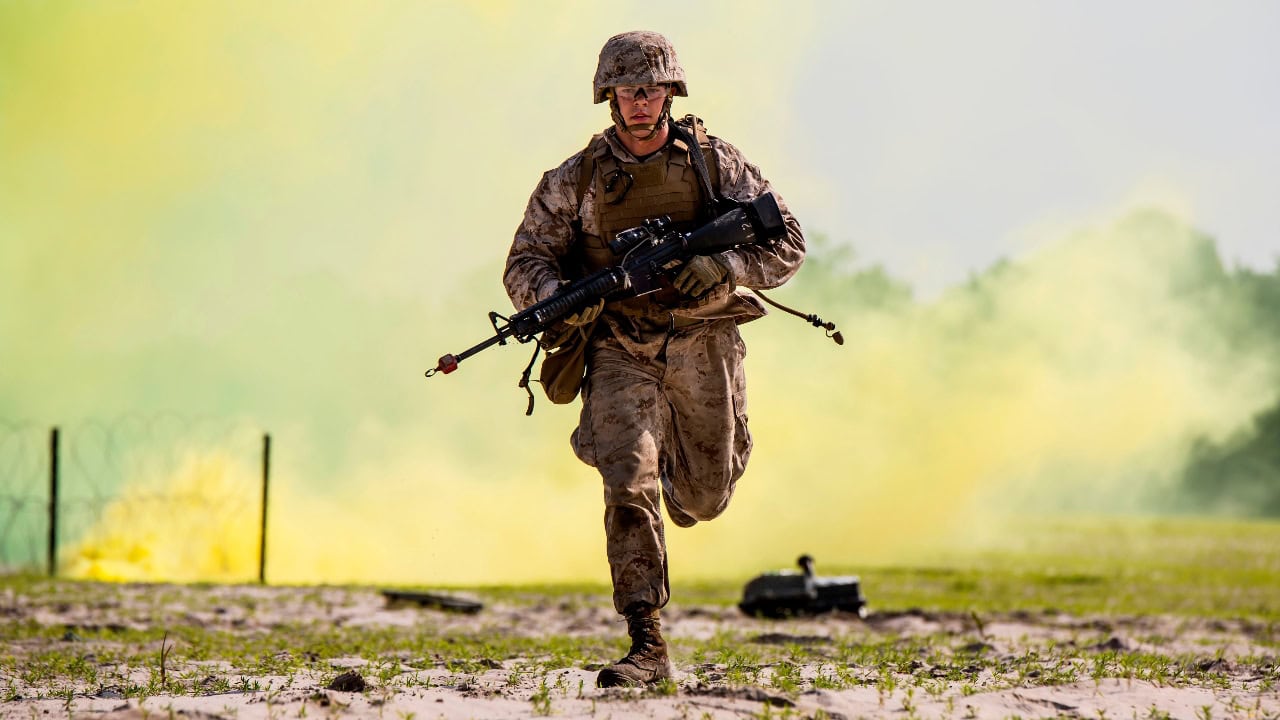
Lance Cpl. Alex Rowan, a combat engineer with 4th Combat Engineer Battalion, 4th Marine Division, stationed out of Bessemer, Ala., runs to take cover before the Anti-Personnel Obstacle Breaching System detonates during the SAPPER Leaders Course aboard Camp Lejeune, N.C., June 26, 2015. During the course, the Marines used assault and breaching techniques to clear a wire obstacle using line charges that utilized C4 explosives and their APOBS. (U.S. Marine Corps photo by Cpl. Krista James/Released)
The initial plan centered around renovating one dining facility at each of five large installations – Fort Liberty (Fort Bragg), Fort Stewart, Fort Cavazos (Fort Hood), Fort Drum, and Fort Carson – while moving day-to-day operations to private contractors rather than uniformed Army cooks.
By autumn, Army leaders were describing the concept as expandable, meaning it could be rolled out at eight to ten additional bases, including some overseas locations, as soon as the service reviews performance data from the first wave of changes. The Army also indicated that the process will be evaluated in a businesslike way, with officials considering an assessment after roughly 90 days of operations and a mechanism for soldiers to provide feedback via QR codes or Army apps.
The logic is this: not only could the ideas make dining more efficient (and standardized) for soldiers across the board, but it also eases the pressure as the Army faces a reduction in the number of Army cooks. Reports have described how the Army is slashing the number of cooks, with Sgt. Maj. of the Army, Michael Weimer, describing efforts to provide soldiers “the right nutrition for us in a large-scale combat operation.”
Discussing the plans, Weimer also said that the Army will seek direct feedback from soldiers at the first five locations and that the possibility of adding new bus routes to help soldiers get around the base and improve access to dining facilities is under consideration as the overall food ecosystem is completely transformed.
The dining overhauls are also unfolding alongside a broader push to reconsider how the military provides food more generally.
Earlier this year, the Pentagon said it was seeking commercial retailers to run commissaries on military bases as part of the food restructuring.
The Department of Defense sought to determine whether private grocery operators or investment firms could run 178 commissaries at military bases, according to information obtained from a Request for Information published on Sam.gov.
The move, however, has faced some questions. While the efforts are part of a broader plan to address historic shortfalls, some have questioned the logic of going so far as to privatize commissaries.

the Army’s goals are to train incoming civilians to become more than they once were — warfighters capable of managing the stresses of their role within the defense apparatus.
Rob Evans, the founder of Hots&Cots, an app used by troops to rate and review housing and dining facilities at military bases, questioned the plans in conversation with Task & Purpose.
“My understanding: you’re privatizing barracks and you’re privatizing dining facilities because there are these historical challenges. They did it with family housing because the military wanted to get out of that business and it was very challenging,” Evans said. “We’re seeing the same kind of pattern with barracks and one could probably argue the same with dining facilities. I don’t know what is the net gain here in privatizing commissaries.”
Will the Navy Follow Suit?
Meanwhile, the US Navy appears to be considering privatizing some of its shore-based dining facilities in response to the Army’s efforts. In a December 11 interview, Master Chief Petty Officer of the Navy John Perryman said it was an “open question” whether the Navy will continue to have sailors operate its galleys (dining facilities) or push ahead with reported plans to privatize them.
“I think we’re trying to work our way through, which is the best way to do that,” Perryman said.
While no plans are officially underway to privatize onboard facilities, Perryman said that the Navy is considering some changes to how onshore dining facilities work – but ultimately warned that full privatization would risk robbing the Navy of specialist cooks. With that in mind, Perryman argued that even if some privatization were to occur, it would likely – or, at least, it should – incorporate the talent of Navy culinary specialists.
“There’s probably some hybrid in there, depending on what galley you’re talking about, but I would like to maintain the ability for [chefs] to go ashore and hone their craft,” he said.
About the Author:
Jack Buckby is a British author, counter-extremism researcher, and journalist based in New York who writes frequently for National Security Journal. Reporting on the U.K., Europe, and the U.S., he works to analyze and understand left-wing and right-wing radicalization, and reports on Western governments’ approaches to the pressing issues of today. His books and research papers explore these themes and propose pragmatic solutions to our increasingly polarized society. His latest book is The Truth Teller: RFK Jr. and the Case for a Post-Partisan Presidency.