Key Points and Summary – The Russian Navy’s Kilo-class submarines, originally developed in the 1970s, remain a critical asset despite their age. Known as “Black Holes” for their stealth capabilities, these diesel-electric vessels were designed for littoral and anti-shipping operations.
-While newer variants like the Project 636.3 have been upgraded with Kalibr cruise missiles for land-attack capability, the class’s stealth reputation is debated, as it lacks Air Independent Propulsion (AIP).
-Although intended to be replaced by the modern Lada-class, the Kilo’s service life is being extended due to the Lada’s persistent production delays and technical failures.
BERLIN, GERMANY – The Russian Navy’s Kilo-class submarines were among the Soviets’ most successful exported conventionally powered submarines. Developed in the 1970s for the Soviet Navy, the Kilos superseded the Tango-class of submarines.
They were built for coastal operations in littoral waters and anti-shipping operations, and they are significantly smaller than many of their nuclear-powered counterparts. The Kilo-class’s first domains were the Black and Baltic seas.
The Kilo-class is a submarine hunter and an anti-ship asset, but it also gathers intelligence, a task it can carry out thanks to its relatively low acoustic signature, at least compared to earlier Soviet submarines. Because it was so quiet, the submarine was given the sobriquet Black Hole.
Misleading Moniker?
“During the Cold War the then-new submarine [the Kilo-class] gained a reputation for stealth, sometimes with the nickname ‘black hole’. The term is still used and much is made of its stealth even today,” naval affairs expert HI Sutton explains.
“But that was relative. Older Russian submarines, still widespread when the Kilo was introduced, were incredibly noisy. Although exact details are naturally not available, there os no reason to suppose that the Kilo family is any quieter than the latest western non-nuclear submarines. In fact, the lack of AIP (air independent power) will limit overall stealth. That’s not to say it’s noisy, Russia is experienced at noise reduction and has excellent anechoic tiles. But the ‘black hole’ label has become a bit of a myth.”
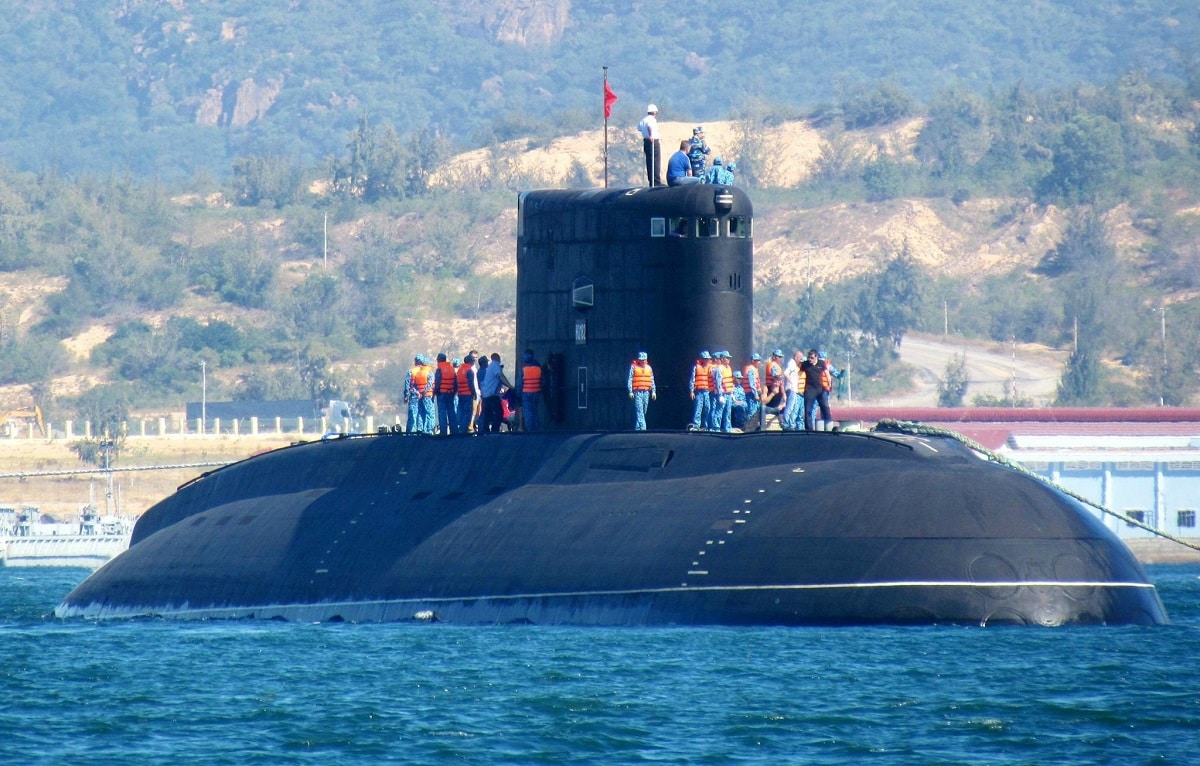
Russia-built Kilo-class Submarine. Image Credit: Creative Commons.
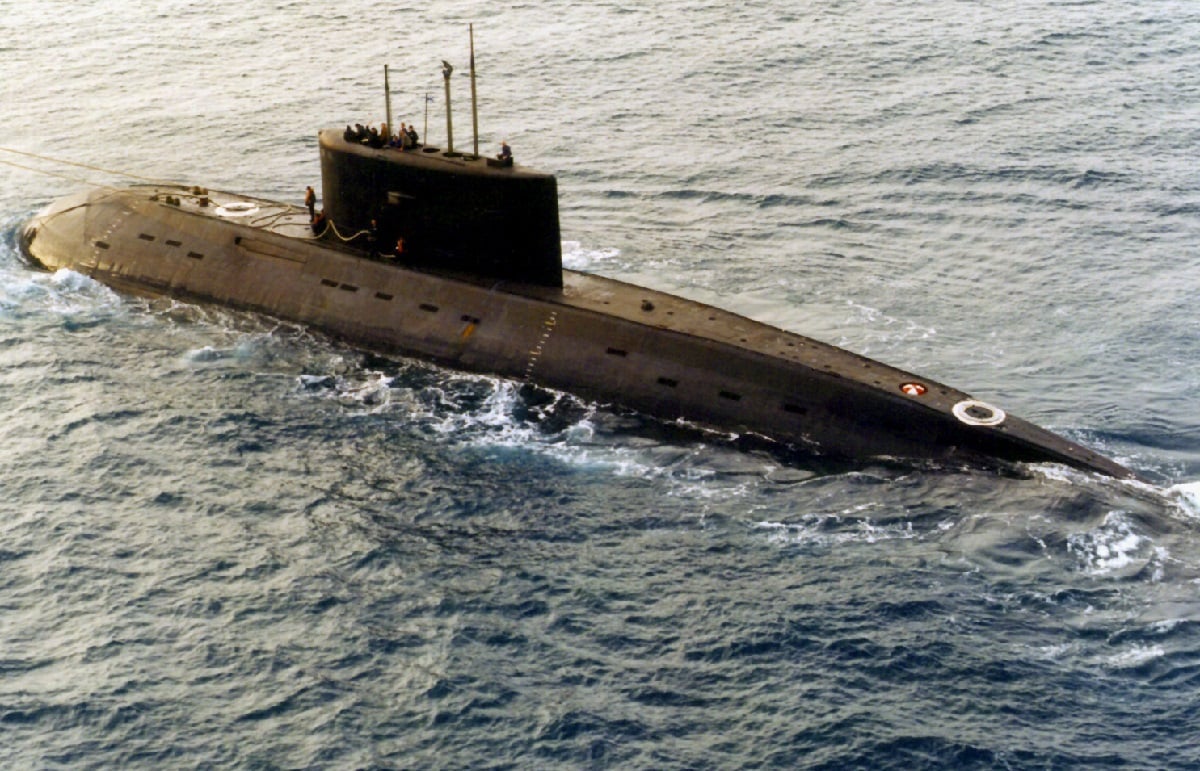
A Russian-built, Kilo-class diesel submarine recently purchased by Iran, is towed by a support vessel in this photograph taken in the central Mediterranean Sea during the week of December 23. The submarine and the support ship arrived at Port Said, Egypt, on Tuesday and were expected to begin transiting the Suez Canal today, Jan. 2, 1996. Ships and aircraft from the U.S. NavyÕs Sixth Fleet are tracking the submarine, which has been making the transit on the surface. This is the third Kilo-class submarine the Iranians have purchased from Moscow. DoD photo
The Kilo-class was a leap forward in technical capabilities. Crew living arrangements were improved for comfort, sonar arrays are more powerful than previous iterations, and it is, overall, more difficult to detect. The Kilo-class’s anechoic tiling—rubberized panels that absorb sonar—are streamlined and optimized for minimal sonar bounce-back.
Multiple Tranches of Kilo-Class
The Kilo-class has been continually refined since the submarine was introduced into Soviet naval service. Dubbed Project 877 in the original Soviet literature, the initial Kilo-class submarine was built for the Soviet Navy, though later variants were designed for export.
The most significant divergence from the original design was the last Kilo-class, dubbed Project 636.3. Sporting updated fire-control systems as well as a missile launch capability that integrated Kalibr cruise missiles, the last Kilo-class variant could engage targets on land. This variant gave Kilo-class submarines a power-projection dimension that diverged from their original littoral mission.
Perhaps one of the more noteworthy Kilo-class variants was a one-off experimental hull that the Soviets fitted with pumpjet propulsion: It was initialed the B-871 and called the Alrosa.
“This is unusual for a non-nuclear submarine since pump jets are generally optimal for higher underwater speeds,” HI Sutton explains.
“Possibly it was for testing since similar pumpjets are fitted to some Russian ballistic missile submarines. Although its use aboard Alrosa is questionable, it remains fitted after the submarine’s recent (and protracted) refit. It remains the only diesel-electric submarine with a pump jet.”
Out with the Old, in with the New
China also operates some Kilo-class submarines.
As the Department of Defense noted in 2022, “The PRC continues to increase its inventory of conventional submarines capable of firing advanced anti-ship cruise missiles (ASCM). Between the mid-1990s and mid-2000s, the PLAN purchased 12 Russian-built KILO class SS units, eight of which are capable of launching ASCMs.”
But, the Pentagon conceded, “in late 2021, the PLAN retired the first two KILO class submarines purchased from Russia in the 1990s,” and the Kilo’s future within the People’s Liberation Army Navy, may not be rosy.
Though the Kilo-class submarines are still in service with the Russian Navy and the navies of a few other countries, it will be replaced by the newer Lada-class of submarines.
That Lada is expected to offer a significant boost in capabilities compared to its Cold War-era predecessors: a conventionally powered next-generation submarine that integrates air-independent propulsion, as well as improved stealth, increased automation, and a smaller crew.
The Lada-class would offer performance broadly comparable to advanced Western submarine designs. But the class has faced stiff headwinds. The lead submarine of the class, the Sankt Peterburg, launched in 1997 but did not enter service until more than a decade later.
That submarine reportedly suffered from a raft of issues, including high operating costs, poor acoustics, and poor reliability. Cost overruns and production delays were detrimental.
The Black Hole Kilo-Class Won’t Go Away
The Russian Navy’s development of the Lada-class continues, at least in theory, but a seeming continued interest in Project 636.3 submarines lends credence to the idea that the Ladas continue to suffer production problems and may still be a relatively immature design.
Given the Ladas’ ongoing problems, the Kilo-class may enjoy a longer service life than its designers ever envisioned.
About the Author: Caleb Larson
Caleb Larson is an American multiformat journalist based in Berlin, Germany. His work covers the intersection of conflict and society, focusing on American foreign policy and European security. He has reported from Germany, Russia, and the United States. Most recently, he covered the war in Ukraine, reporting extensively on the war’s shifting battle lines from Donbas and writing on the war’s civilian and humanitarian toll. Previously, he worked as a Defense Reporter for POLITICO Europe. You can follow his latest work on X.