
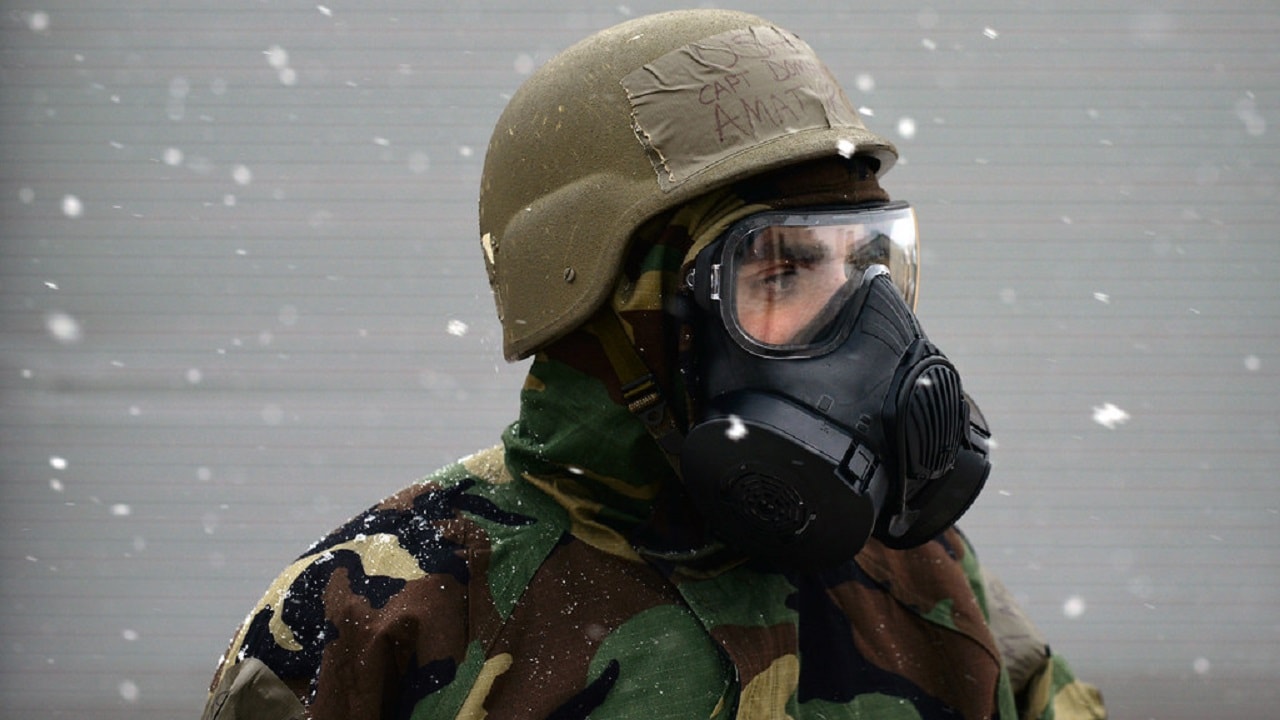
Minnesota National Guard’s Bright Vests Explained: Why Troops Must Stand Out Around ICE
With the massive ICE deployment to Minnesota, much of what is happening is unprecedented. One of those things is that the Minnesota National Guard may be deployed to areas where ICE agents are already present.
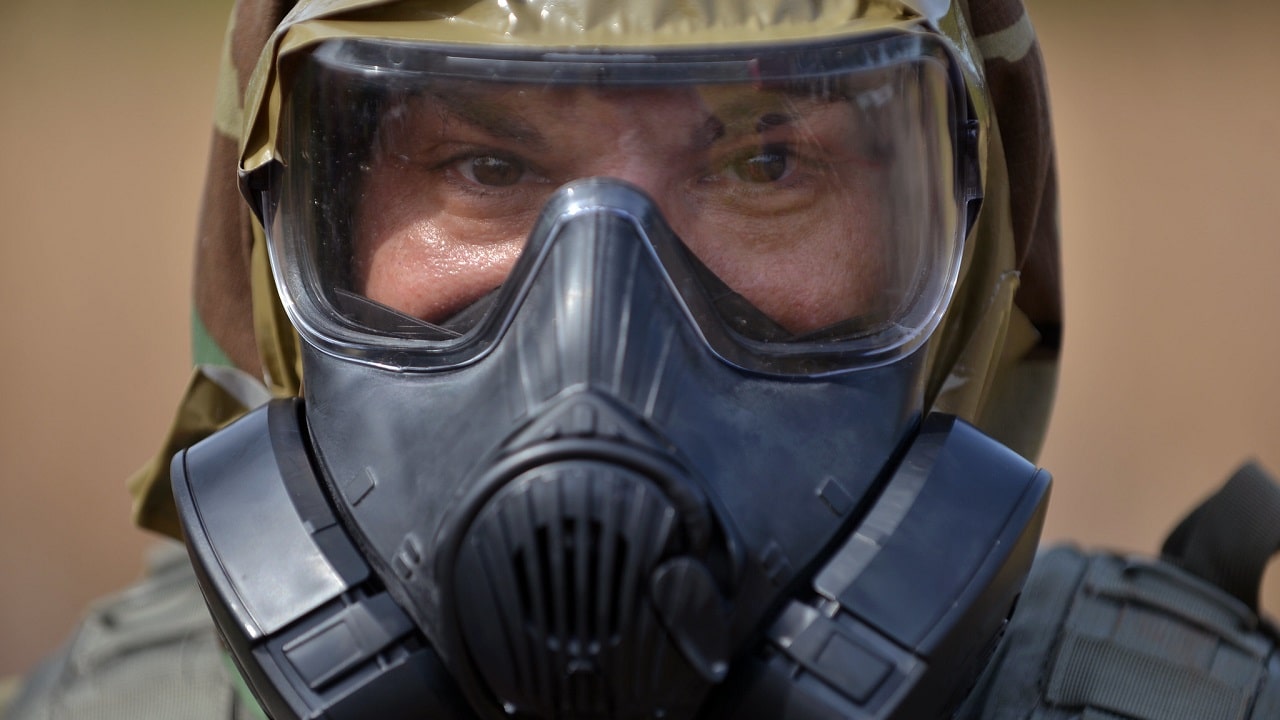
National Guard in WMD gear. Image Credit: Creative Commons.
And they’re going to have to wear distinguishing uniforms to stand out.
Task and Purpose reported on Wednesday that, in the event of deployment, National Guardsmen will wear bright, reflective vests “so they won’t be confused with law enforcement agencies that wear military-style camouflage.”
“Members of the Minnesota National Guard are serving in support of local law enforcement agencies and are not licensed peace officers,” Army Maj. Andrea Tsuchiya, a spokeswoman for the state’s National Guard, told Task and Purpose. “These vests are being used to distinguish our members from those of other agencies, due to similar uniforms being worn.”
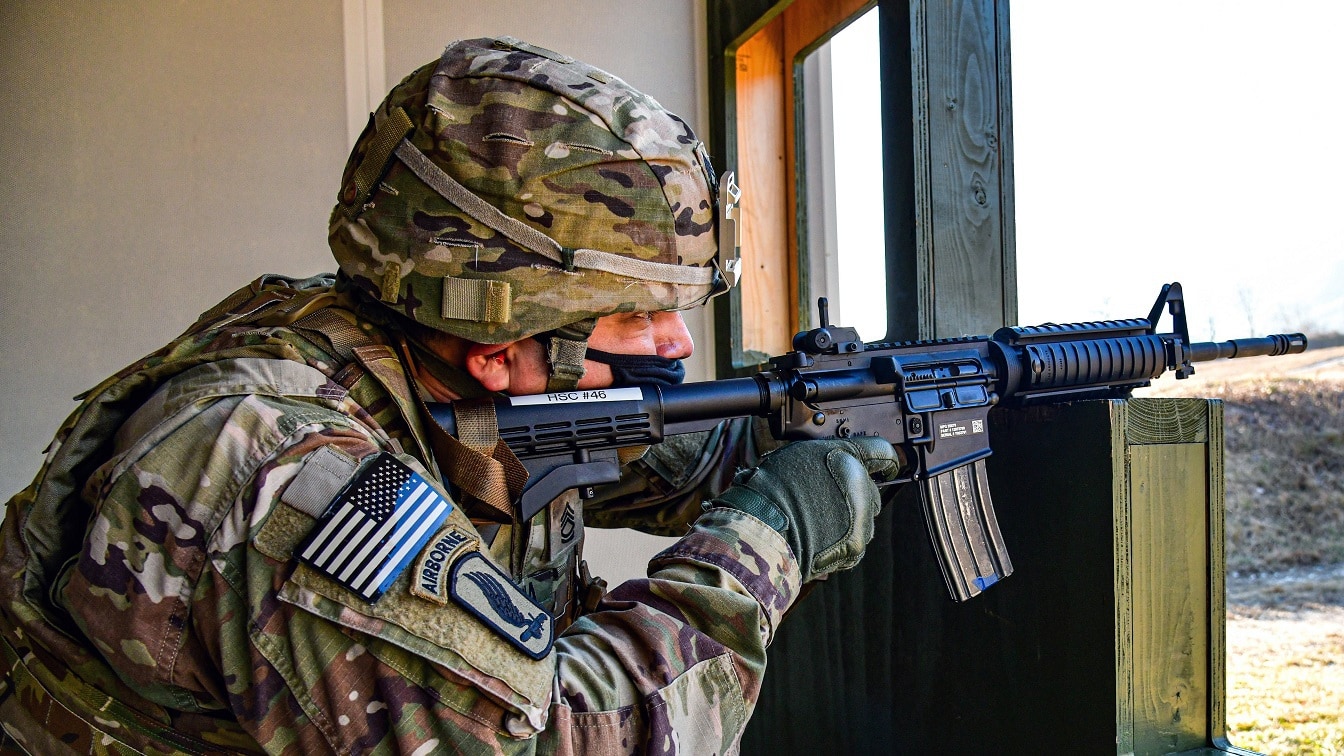
A Soldier assigned to U.S. Army Southern European Task Force, Africa engages pop-up targets with an M4 carbine during marksmanship training at Cao Malnisio Range in Pordenone, Italy, Jan. 26, 2021. (U.S. Army photo by Davide Dalla Massara)
On Standby
What’s the National Guard doing in Minnesota?
The agency laid out its mission in a Facebook post on January 17, illustrated with an image of two Guardsmen wearing those reflective vests.
“Members of the Minnesota National Guard are on standby, ready to assist local law enforcement and public safety agencies,” the Minnesota National Guard’s Facebook post says.
“If our members are activated, they will be wearing reflective vests, as pictured here, to help distinguish them from other agencies in similar uniforms. These Minnesota National Guardsmen live, work, and serve in our state, and are focused on protecting life, preserving property, and ensuring Minnesotans can safely exercise their First Amendment rights.”
As Task and Purpose noted, the National Guard statement does not specify an agency they hope to distinguish themselves from.
The Insurrection Act?
There’s been an ICE surge in Minnesota since early January, following a series of media reports about fraud scandals in that state. On January 5, Gov. Tim Walz announced that he would drop his bid for a third term.
Early on in the surge, on January 7, Renee Good was shot and killed by ICE agent Jonathan Ross in Minneapolis. The killing was caught on video from multiple angles and led to further protests throughout the Twin Cities area, with Minnesota, five and a half years after the killing of George Floyd, once again serving as a battleground of America’s culture wars and divides. Good died in South Minneapolis, about a mile away from where Floyd died in May of 2020.
While protests have taken place daily, there has been no rioting, looting, or other violent civil unrest in Minnesota like that that erupted there in the summer of 2020. However, President Trump has repeatedly threatened to invoke the Insurrection Act in that state.
The Washington Post reported on January 18 that the Pentagon had readied 1,500 active-duty soldiers to deploy to Minnesota. The soldiers in question are from two infantry battalions with the Army’s 11th Airborne Division, based in Alaska.
“We’re not going to give them an excuse to do the thing that clearly they’re trying to set up to do right now, which is these 1,500 troops,” Mayor Jacob Frey told CNN. “I never thought in a million years that our own federal government would invade us.”
Trump never invoked the Insurrection Act during any of the events of 2020 or at any point during his first term in office, even though he threatened to do so numerous times.
The last time a president invoked the Insurrection Act was George H.W. Bush, during the Los Angeles riots in 1992.
In another extraordinary measure, the Justice Department has issued grand jury subpoenas for Minnesota elected officials, including Gov. Walz and Mayor Frey, as well as Attorney General Keith Ellison and St. Paul Mayor Kaohly Her.
“We shouldn’t have to live in a country where people fear that federal law enforcement will be used to play politics or crack down on local voices they disagree with,” Frey said in a statement.
Who Supplies ICE?
Many have pointed out that ICE agents who showed up in Minnesota are wearing what appear to be military uniforms.
Back in December, Bloomberg News did a deep dive into who is supplying that agency with military equipment, following the massive surge in funding for ICE and other immigration enforcement agencies in last year’s One Big Beautiful Bill Act.
“In the final weeks of the 2025 fiscal year, the Trump administration’s immigration enforcement agencies went on a spending spree to outfit officers as they fanned out across American cities: $12.2 million for rifles, $11.3 million on tasers, and $3.7 million worth of chemical munitions and less lethal materiel,” the Bloomberg story said.
“Those were among a slew of weapons, ammunition, and protective equipment made or sold by companies that have seen a huge spike in revenue from the Department of Homeland Security, including several that usually sell their products to the military.”
One example, Bloomberg said, was Geissele Automatics, a Pennsylvania-based manufacturer. That company “agreed to sell $9.1 million of precision long guns and accessories to Immigration and Customs Enforcement and $3.1 million of rifles to Customs and Border Protection in September – two of the company’s biggest ever deals with the federal government.”
And the results of this have been obvious, quickly, in a way that government expenditures seldom are.
“The result has been on full view in Chicago’s neighborhoods and other cities across the country, where armed and masked officers from federal law enforcement agencies have been arresting immigrants and citizens alike, shooting protesters with pepper balls and tossing canisters of tear gas into crowds,” Bloomberg said, in something that’s very much true in Minnesota.
“ICE’s stock of military gear is usually reserved for major one-off raids,” Bloomberg wrote. “That it’s now a common sight on American streets is reflective of the fact that Congress has opened up its wallet,’ Ohio State law professor César Cuauhtémoc García Hernández told the outlet. ‘They’re popping tear gas canisters with abandon, which suggests they have every reason to believe they can replace those pretty quickly.'”
About the Author: Stephen Silver
Stephen Silver is an award-winning journalist, essayist, and film critic, and contributor to the Philadelphia Inquirer, the Jewish Telegraphic Agency, Broad Street Review, and Splice Today. The co-founder of the Philadelphia Film Critics Circle, Stephen lives in suburban Philadelphia with his wife and two sons. For over a decade, Stephen has authored thousands of articles that focus on politics, national security, technology, and the economy. Follow him on X (formerly Twitter) at @StephenSilver, and subscribe to his Substack newsletter.