
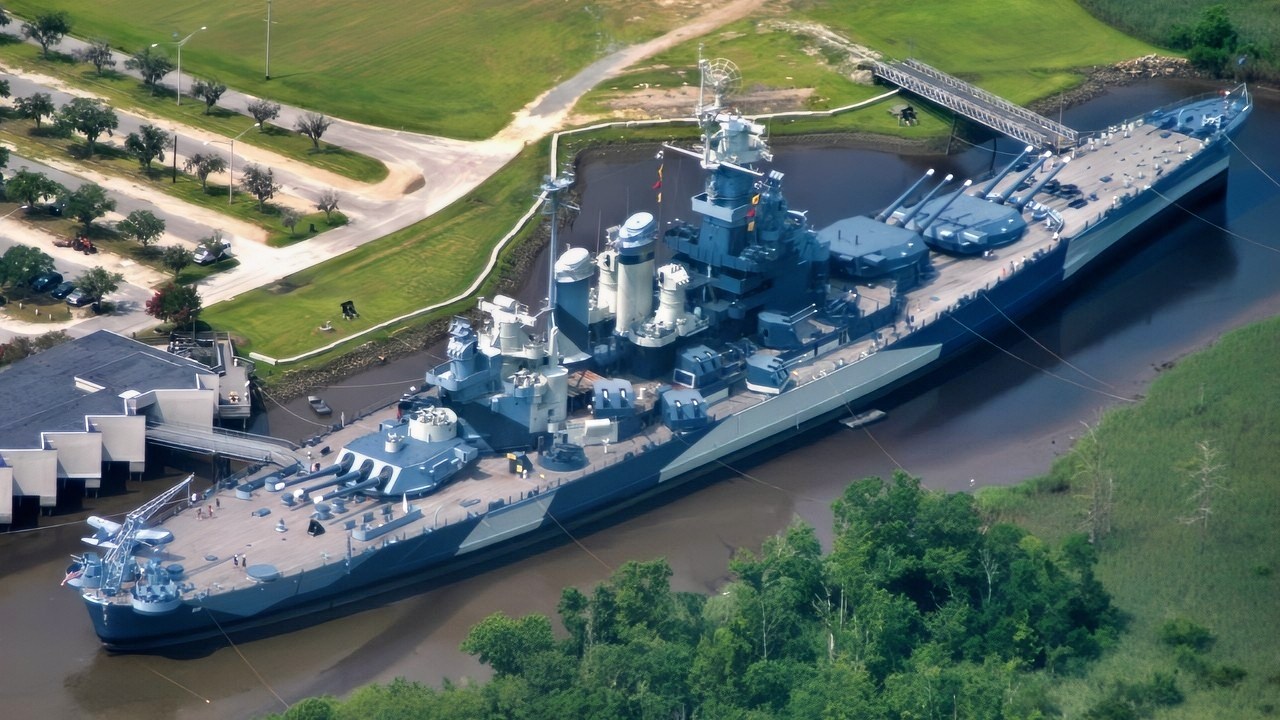
Key Points and Summary – The North Carolina-class produced just two fast battleships—USS North Carolina (BB-55) and USS Washington (BB-56)—built on the eve of World War II to deliver high-speed, big-gun sea power.
-Their nine 16-inch Mark 6 guns and heavy secondary batteries made them lethal escorts and surface fighters in the Pacific.
-Washington achieved the war’s most famous surface-gunnery moment by sinking IJN Kirishima during the Second Battle of Guadalcanal, hammering the enemy ship with 16-inch and 5-inch fire.
-North Carolina earned 15 battle stars. Both were decommissioned in 1947; Washington was scrapped, while North Carolina survives as a Wilmington museum.
North Carolina-Class Battleship Profile
Many experts consider the United States Navy’s Iowa-class battleships to be the crème de la crème of the battleship world, and quite understandably so. They were the last USN battlewagons to be fully assembled and commissioned—taking place in 1944, the penultimate year of World War II—and they certainly claimed the longevity crown as the last battleships from any country to fire their guns in anger, doing so during Operation Desert Storm in 1991. Especially noteworthy is the USS New Jersey (BB-62), AKA “The Big J,” which is the most decorated battleship in U.S. history.
Yet none of the Iowa-class battleships ever sank an enemy battleship (although the eponymous lead ship of the class, USS Iowa [BB-61], did sink the Imperial Japanese Navy cruiser Katori). The only one-on-one battleship kill of WWII was instead scored by a member of the battleship class we’re now going to discuss, the North Carolina-class battlewagons.
North Carolina-Class Battleship Initial History
Named for “The Old North State” (highly apropos vis-à-vis the official state name on the one hand, but kinda ironic on the other hand considering that North Carolina fought on the side of the South during the American Civil War), a total of two ships of the class were built; they were designated as “fast battleships,” just like with the Iowas and the South Dakota class.
The lead ship of the class was, appropriately enough, the USS North Carolina (BB-55), which was built at the New York (Brooklyn) Navy Yard (affectionately nicknamed the “Can-Do Shipyard”); her keel was laid on October 27, 1937, she was launched on June 13, 1940, and she was commissioned on April 9, 1941.
Next (and last) in line came the USS Washington (BB-56), which was built at Philadelphia Naval Shipyard; laid down on June 14, 1938, launched on June 1, 1940, and commissioned on May 15, 1941.
The timing of both ships’ commissioning would prove to be quite fortuitous in relation to the loss of the USN’s oldest battleships in the December 7, 1941, Pearl Harbor raid.
North Carolina-Class Tech Specs and Vital Stats
-Displacement: 44,800 long tons (45,519 short tons) fully laden
-Hull Length: 728 ft 8.625 in (222.113 m)
-Beam Width: 108 ft 3.875 in (33.017 m)
-Draft: 35 ft 6 in (10.820 m)
-Max Speed: 28 knots (52 km/h; 32 mph)
-Crew Complement: 108 commissioned officers and 1,772 enlisted seamen
-Primary Armament: 9 x 16-inch (406 mm)/45 caliber Mark 6 guns (two triple-gun turrets fore, one such turret aft)
-Secondary Armament: 20 × 5-inch (127 mm)/38 caliber Mark 12 guns (five twin-gun turrets to port, five such turrets to starboard)
-Tertiary Armament: Differing numbers of 1.1″-inch/75 caliber guns (AKA the “Chicago Piano”), .50 caliber machine guns, Bofors 40 mm and Oerlikon 20 mm antiaircraft guns.
Operational History
Might as well start with the most famous example, eh?
As we mentioned in the beginning segment of this article, it was a North Carolina-class battlewagon that scored the only one-one-one battleship kill of WWII. To be more specific. ‘twas the USS Washington that was the lucky half of the warship class’s “Dynamic Duo” (so to speak), and her victim was the IJN Kirishima.
The epic engagement took place during the Second Battle of Guadalcanal on 14-15 November 1942. Washington was skippered by Capt. Glenn B. Davis was also serving as the flagship of then-Rear Admiral (later Vice Admiral) Willis Augustus “Ching” Lee. (NOTE: For an excellent book on the life of Admiral “Ching” Lee, read “Battleship Commander: The Life of Vice Admiral Willis A. Lee Jr,” by Paul Stillwell, himself a former battleship officer on “The Big J.”)
Long story short, the Washington scored 20 hits from her 16-inch guns and 40+ hits by the 5-inch guns upon the Kirishima, utterly dooming the Japanese behemoth. For good measure, the Japanese destroyer Ayanami was also sent to Davy Jones’s locker by the mighty guns of the Washington. Over 200 IJN officers and enlisted seamen went down with their ships.
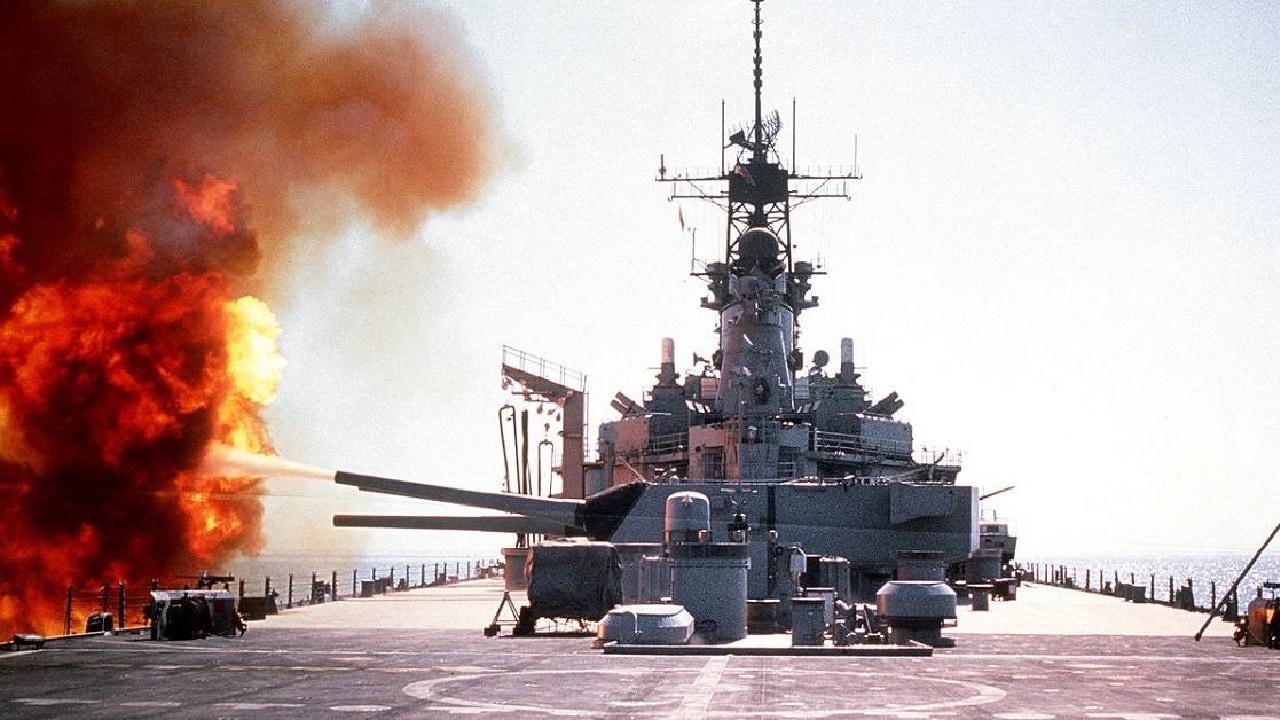
Image of Iowa-class battleships firing her 16-inch guns. Image Credit: Creative Commons.
The sinking of the Kirishima was a revenge factor for the U.S. Navy, as the Japanese battlewagon’s 14-inch guns had been directly responsible for the killing of RADM Daniel J. Callaghan aboard the cruiser USS San Francisco (CA-38) during the First Naval Battle of Guadalcanal the night before.
As for Washington’s sister ship, the North Carolina didn’t sink any enemy vessels, but she was certainly no slouch in the arena of combat experience either.
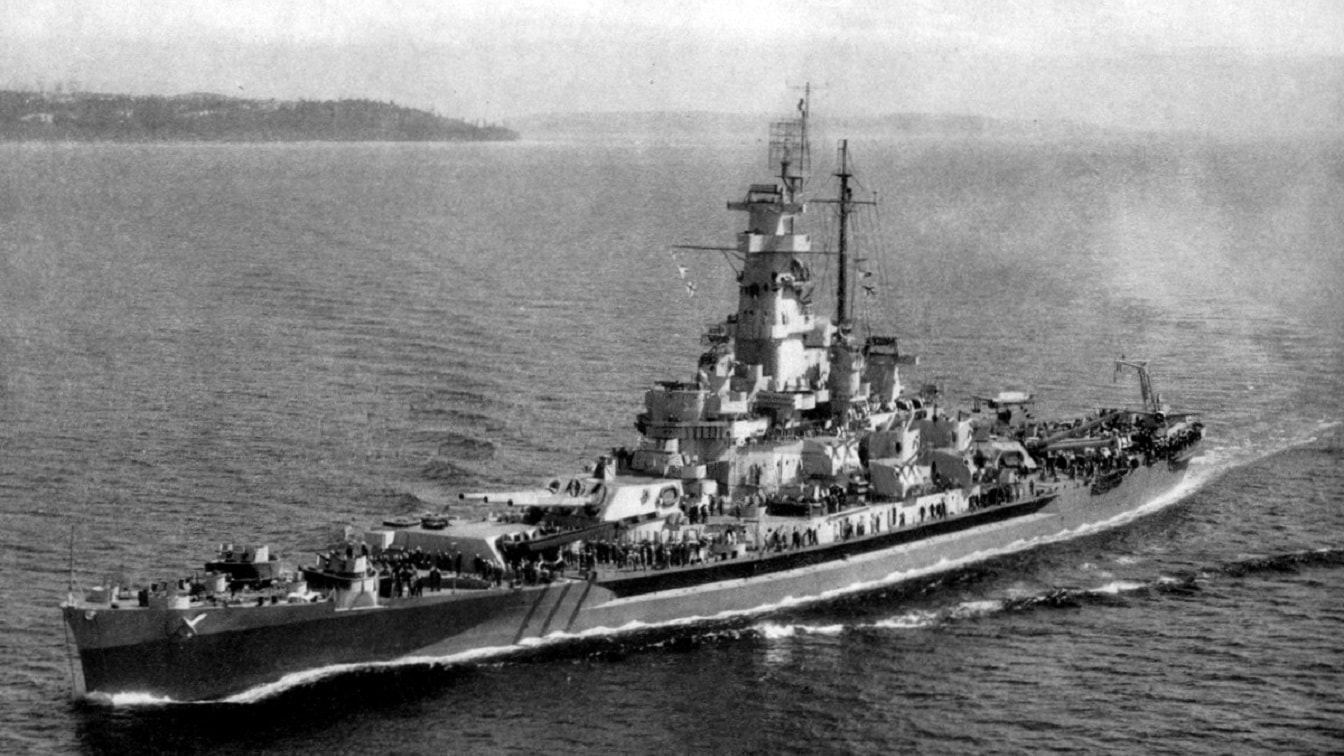
The U.S. Navy battleship USS Massachusetts (BB-59) underway, most probably after her refit at the Puget Sound Naval Shipyard, Washington (USA), circa in July 1944. She is painted in Camouflage Measure 22.
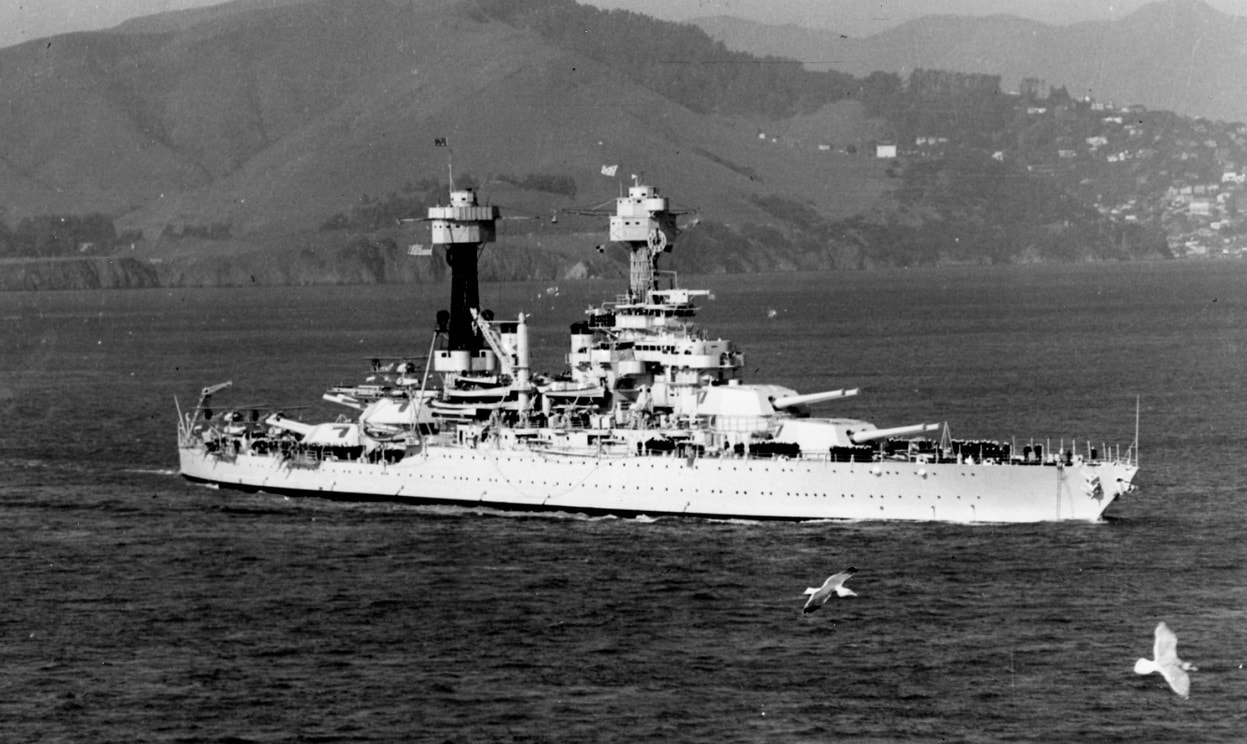
USS Washington of the North Carolina-Class. In San Francisco Bay, California, circa 1934. Official U.S. Navy Photograph, now in the collections of the National Archives.
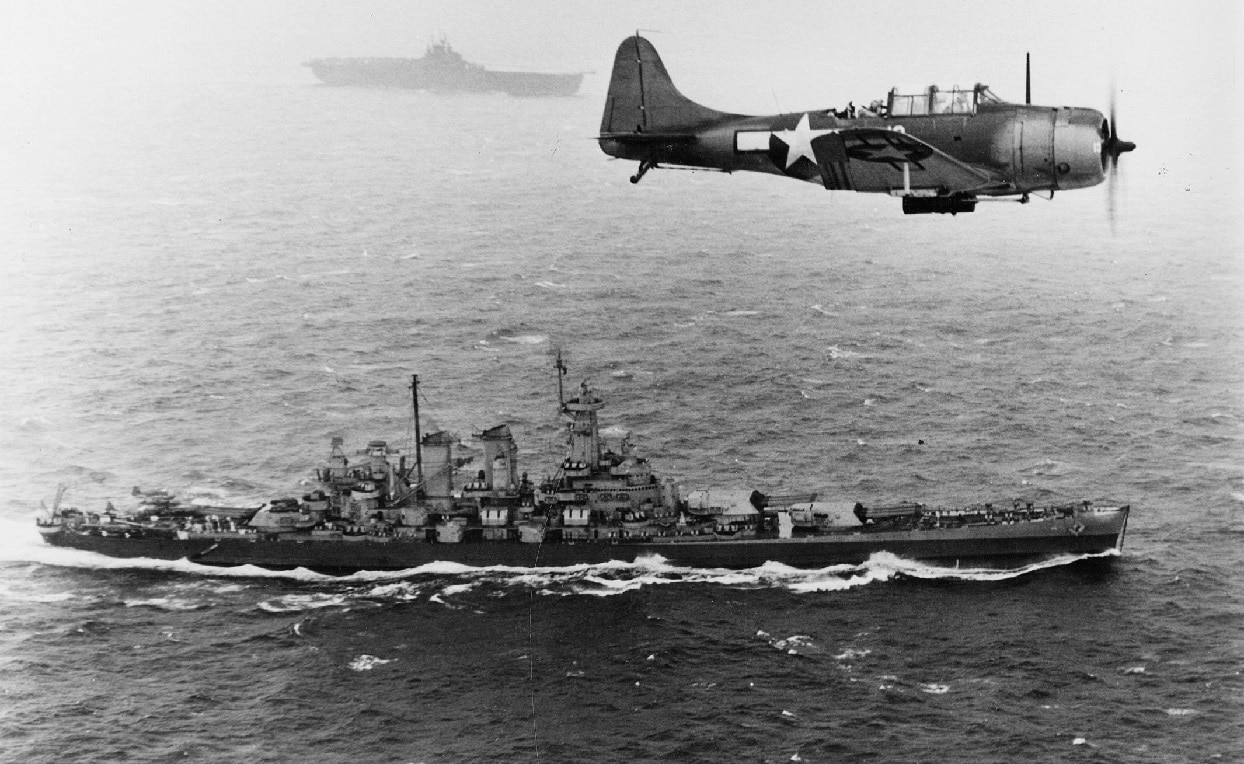
USS Washington of the North Carolina-class. Image: Creative Commons.
BB-55 served in every major naval offensive across the Pacific, earning 15 battle stars; though, as previously noted, the “Big J” (AKA “The Black Dragon,”) is the most decorated USN battleship overall (factoring in all of her post-WWII service), the North Carolina is the highest decorated American battleship specific to World War II.
Both vessels were decommissioned on June 27, 1947.
Where Are They Now?
With only two of these mighty warships being built, this concluding segment of the article can be pretty much summed up as “Half Good News, Half Bad News.”
We’ll get the bad news out of the way first: despite her smashingly unique historical achievement, USS Washington was not preserved for posterity.
Sadly, she was instead struck from the Naval Vessel Register on the 21st anniversary of her launching and sold for scrap on May 24, 1961.
Now for the good news: BB-55 *has* been preserved for posterity as a floating museum, docked in Wilmington, North Carolina (appropriately enough).
Ticket prices are $14.00 for adults, $10.00 for senior citizens and active-duty military with ID, $6.00 for children ages 6-11, and free of charge for children age 5 and below.
About the Author: Christian D. Orr, Defense Expert
Christian D. Orr is a Senior Defense Editor. He is a former Air Force Security Forces officer, Federal law enforcement officer, and private military contractor (with assignments worked in Iraq, the United Arab Emirates, Kosovo, Japan, Germany, and the Pentagon). Chris holds a B.A. in International Relations from the University of Southern California (USC) and an M.A. in Intelligence Studies (concentration in Terrorism Studies) from American Military University (AMU). He is also the author of the newly published book “Five Decades of a Fabulous Firearm: Celebrating the 50th Anniversary of the Beretta 92 Pistol Series.”