
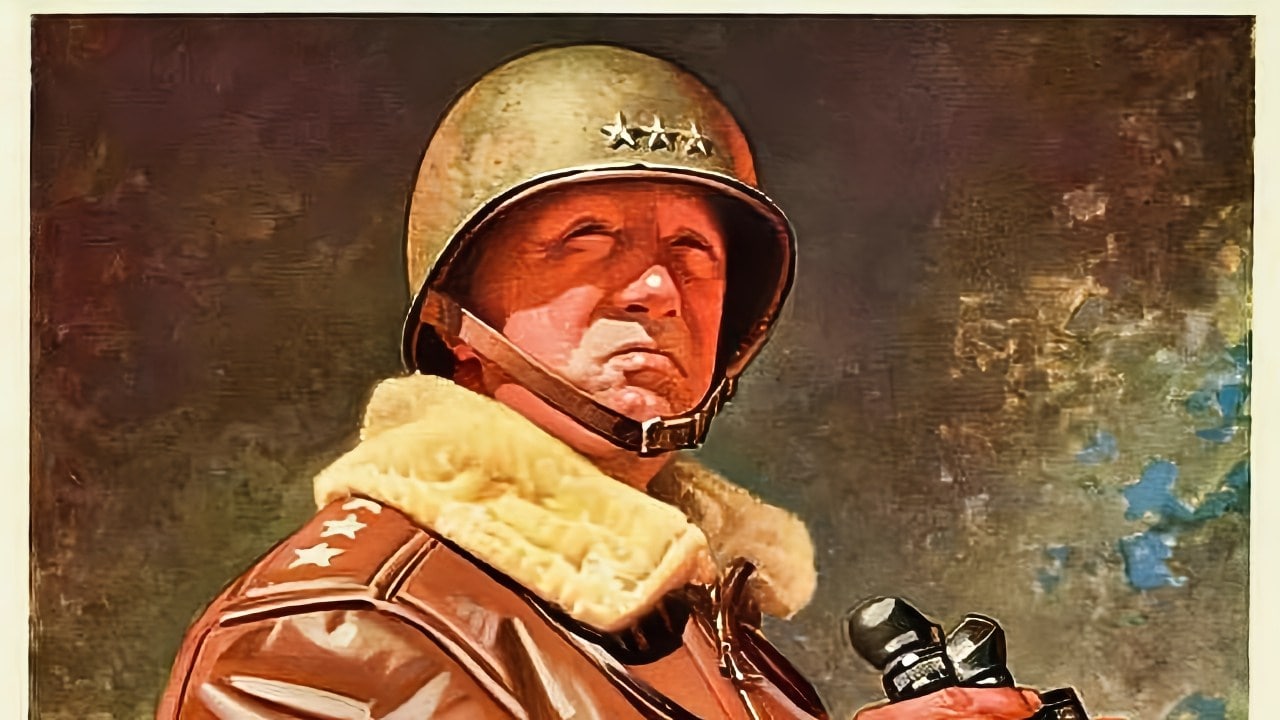
Summary and Key Points: George S. Patton Jr. is remembered for speed, aggression, and victory—but even Patton took hard losses.
-His clearest battlefield setback came at Fort Driant near Metz in late 1944, where American assaults bogged down against a fortified German position and ended with heavy casualties and no gain.
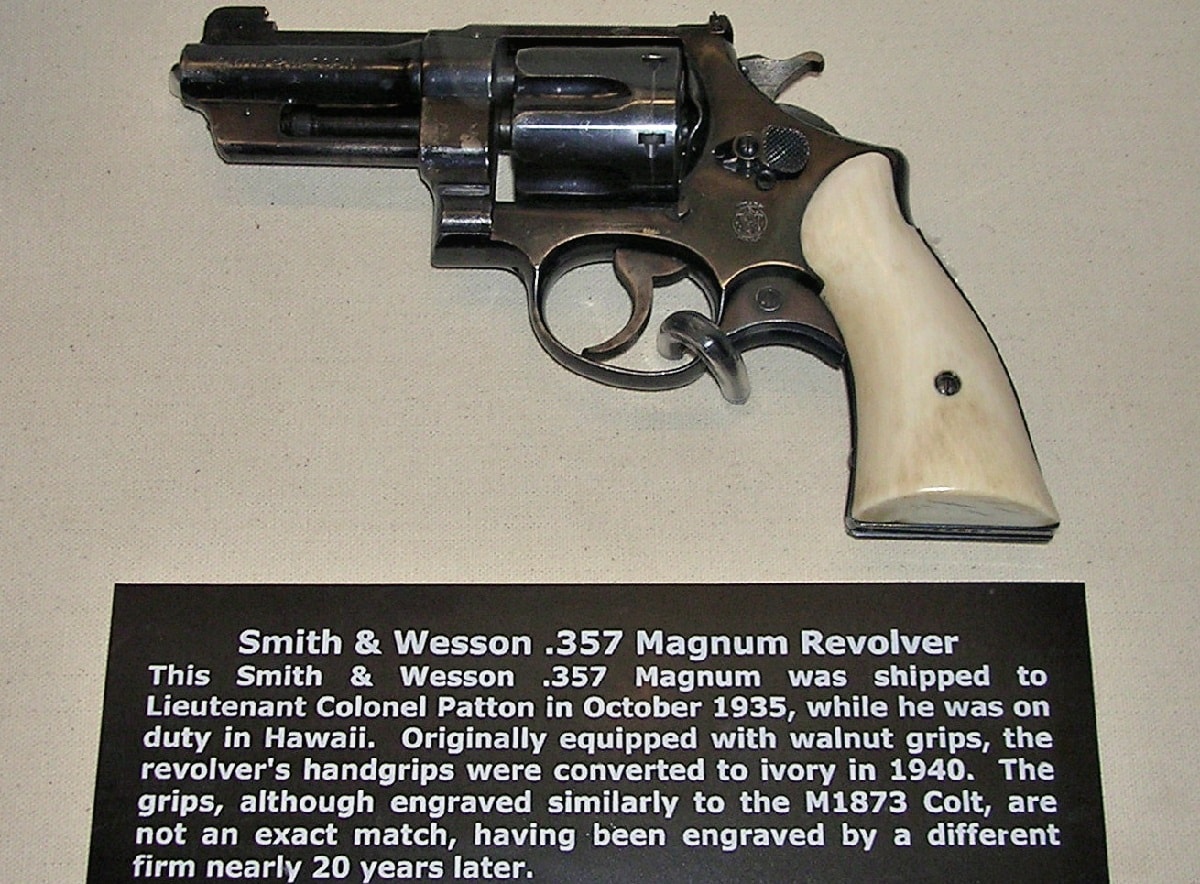
Patton’s well-known custom ivory-handled revolver.
-Patton also suffered a deeper strategic defeat after the war: his warnings about the long-term Soviet threat were brushed aside by senior leaders, even as Eastern Europe slid behind the Iron Curtain.
-His final and most personal defeat arrived in December 1945, when a vehicle collision left him paralyzed, and he died days later.
Quote of the Day: George Patton’s Biggest Defeat Wasn’t in Battle—It Was After the War
“You are not all going to die. Only 2% of you right here today would die in a major battle. Death must not be feared. Death, in time, comes to all men. Yes, every man is scared in his first battle. If he says he’s not, he’s a liar.” – George Patton
That quote is just one of many memorable ones uttered by U.S. Army General George Smith Patton Jr. in his immortal speech to the Third Army. The original raw, uncut, unplugged version of that speech was even more profane than the cinematic version rendered by George Campbell Scott in the 1970 Best Picture Oscar-winning “Patton” film (which was actually toned down and sanitized somewhat in order to get a “PG” rating from the MPAA).
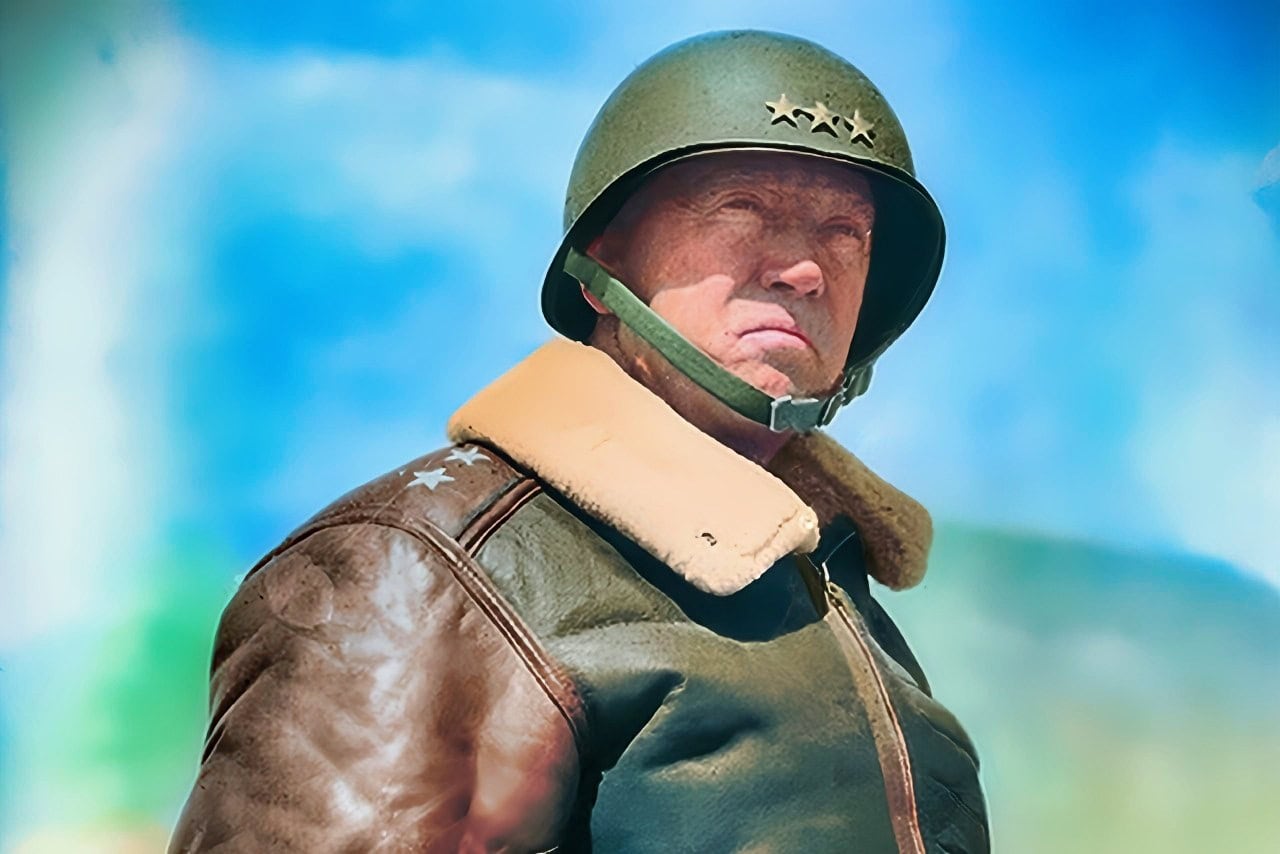
George Patton U.S. Army Photo
As great a military leader as Patton was, even he was a mere mortal human being who suffered his fair share of defeats and setbacks. (Indeed, of all the historic leaders we’ve profiled thus far, only Alexander the Great was undefeated in battle.) So then, what were Gen. Patton’s most significant defeats?
Military Defeat: Battle of Fort Driant
This was the only significant military defeat that can be attributed to Gen. Patton as a senior commander. (Yes, the Battle of Kasserine Pass was a humiliating American defeat, but Patton wasn’t in overall command of that fiasco.)
This battle took place from September 27 to October 13, 1944, pitting Patton’s Third Army against Nazi Germany’s 1st Army, at Fort Driant, a fortified installation located five miles southwest of Metz and west of the Moselle; it had been constructed in 1902 by the Germans, and was under French control when it was renamed after famed World War I veteran Col. Émile Driant in 1919.
As noted by Ryan McLachlan in an April 19, 2023, article for War History Online, “When they attempted to attack the Germans, the Third suffered heavy casualties, and it became exceedingly clear that, if they wanted to take the region, capturing Fort Driant needed to be a priority. Gen. George Patton believed the fortification to be an easy target and tasked the 5th Infantry Division with taking it.”
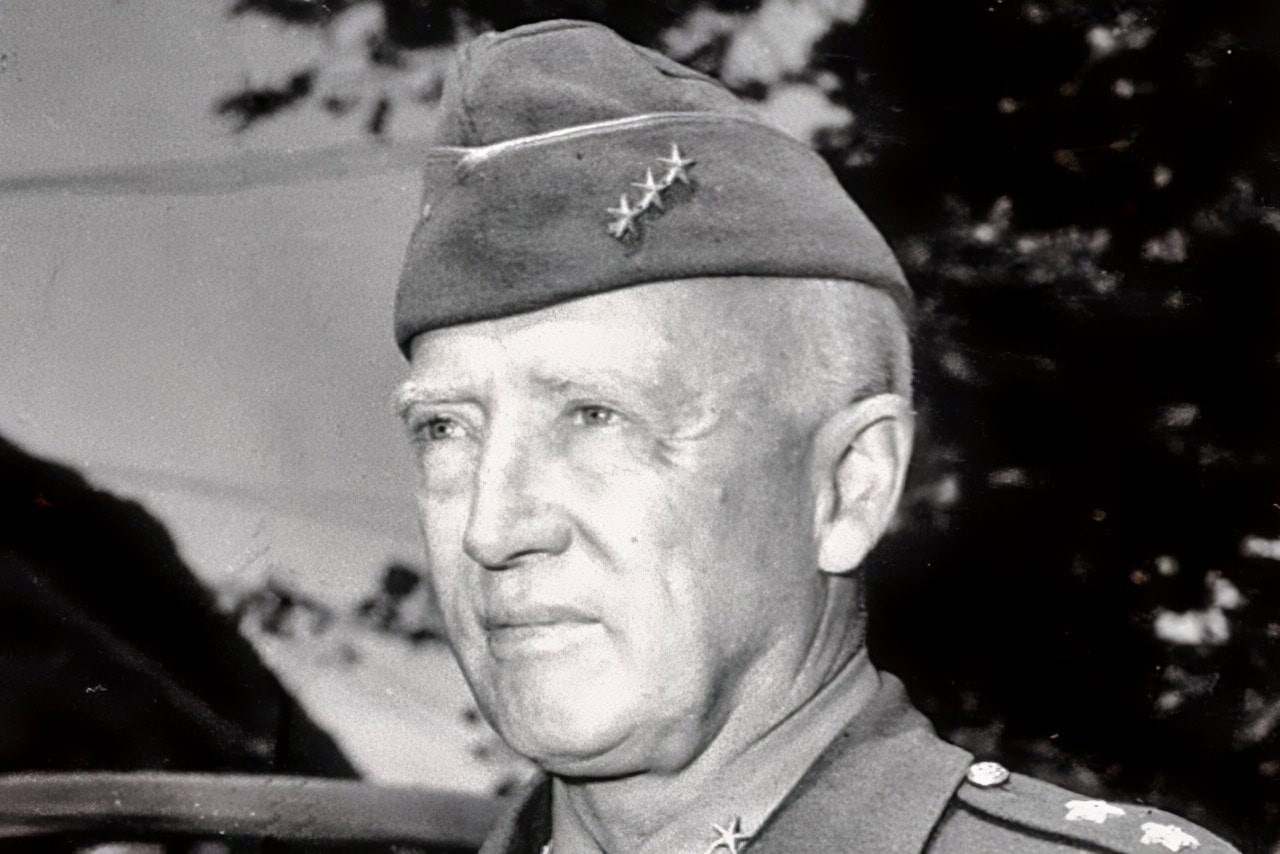
George S. Patton Quote of the Day. Creative Commons Image.
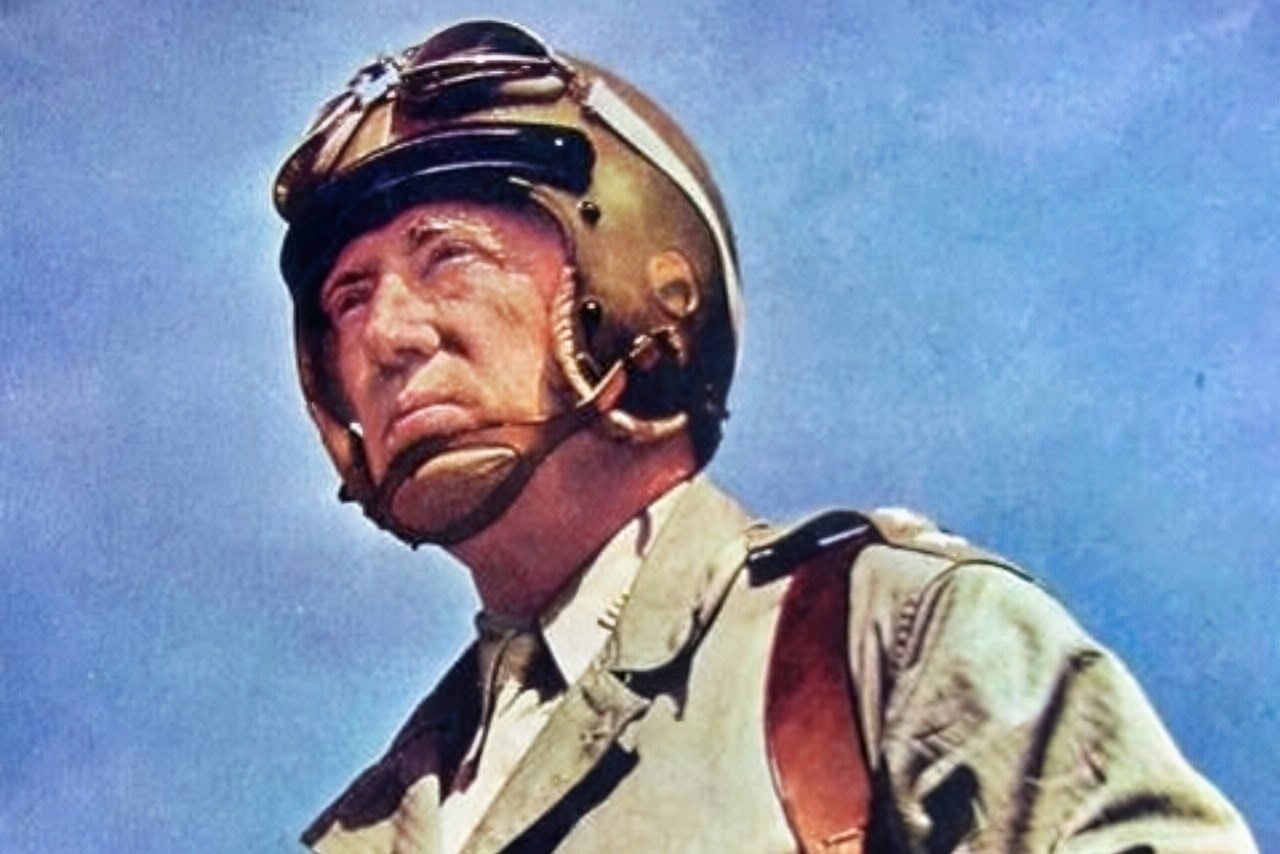
General George Patton of the U.S. Army. Image Credit: Creative Commons.
However, it wasn’t nearly as easy as the hard-charging General had assumed. Long story short: “It was believed the men participating in the fighting were becoming ‘battle fatigued.” It was also clear that engagements in other areas of the Metz were proving much more successful. [Gen. Hobart Raymond ] Gayv, with Patton’s agreement, therefore ordered the abandonment of the offensive…it was an evident loss for the United States and a success for German forces…The American forces suffered 798 casualties during the Battle of Fort Driant, including 64 dead, 547 wounded, and 187 missing or captured. German losses are unknown. At the conclusion of the engagement, the Americans stood exactly where they had at the start of the campaign. “
Political/Ideological Defeat: Ignored on the Soviet/Communist Threat
Gen. Patton’s most impactful defeat wasn’t on the battlefield, but rather in the political/ideological arena, and it wasn’t just impactful to him individually or even the U.S. Army, but for all the freedom-loving peoples of Eastern Europe.
Although Patton fought Nazi Germany’s forces with gusto, he soon came to see Communism—more specifically in the guise of America’s erstwhile ally, the Soviet Union—as the biggest long-term threat.
However, Gen. Dwight David Eisenhower, in his position as Supreme Commander of Allied Forces in Europe, patently refused to heed Gen. George Patton’s prophetic warnings about the Soviet menace; ditto for other top generals like Omar Bradley. (Of course. It didn’t help having a commander-in-chief, that being FDR, who genuinely saw Joseph Stalin as a friend.)
Patton was shunted aside, and then his warnings proved prescient when Eastern Europe languished for four-and-a-half decades under the jackboot of what Sir Winston Churchill famously dubbed “the Iron Curtain,” until the Soviet Union finally collapsed.
Final Personal Defeat for George Patton: His Fight for Life
George Patton’s final battle and defeat came at the most deeply personal and individual level: his fight to stay alive.
Some conspiracy theorists posit that there’s a direct connection between this defeat and the one we just described.
Patton never suffered a life-threatening wound or injury during wartime (although, during his World War I service, he was wounded by German machine gun fire during the Meuse-Argonne Offensive; depending on which account you read, he was wounded either in the leg or in “la derriere”).
But it was a peacetime injury—seven months after V-E Day and three months after WWII officially ended—that ended up cutting his life short.
On December 9, 1945, the General became the victim of a vehicle accident when his staff car collided with an American army truck driven by T/5 Robert L. Thompson.
The General suffered a broken neck and cervical spinal cord injury that rendered him paralyzed from the neck down; he lingered for 12 days before dying in his sleep of pulmonary edema and congestive heart failure at about 6:00 pm Local Time on December 21, 1945, at age 60.
To add tragic insult to injury, Patton was getting ready to take Christmas leave to spend quality time with his beloved wife, Bea, at the time of his accident. His ordeal is dramatized in heart-wrenching fashion in the 1987 made-for-TV movie “The Last Days of Patton” (wherein George C. Scott reprised his most famous role).
Three days later, he was laid to rest at the Luxembourg American Cemetery and Memorial in the Hamm district of Luxembourg City.
As for T/5 Thompson, as Bill O’Reilly notes in his bestselling book “Killing Patton,” this shadowy figure of a soldier was inexplicably never held accountable for his actions, never had his feet held to the fire in spite of being a junior enlisted troop causing the death of a general officer.
Instead, Thompson conveniently disappeared into the ether of history, which adds much grist to the conspiracy rumor mill.
About the Author: Christian D. Orr, Defense Expert
Christian D. Orr is a Senior Defense Editor. He is a former Air Force Security Forces officer, Federal law enforcement officer, and private military contractor (with assignments worked in Iraq, the United Arab Emirates, Kosovo, Japan, Germany, and the Pentagon). Chris holds a B.A. in International Relations from the University of Southern California (USC) and an M.A. in Intelligence Studies (concentration in Terrorism Studies) from American Military University (AMU). He is also the author of the newly published book “Five Decades of a Fabulous Firearm: Celebrating the 50th Anniversary of the Beretta 92 Pistol Series.”