
Summary and Key Points: Lt. Gen. Ulysses S. Grant emerged as the Union’s most aggressive leader, earning the nickname “Unconditional Surrender” after his decisive 1862 victory at Fort Donelson.
-His strategic brilliance was further cemented during the 1863 Siege of Vicksburg, where a unique interservice partnership with Admiral David Dixon Porter secured control of the Mississippi River.
-Grant’s relentless “fighting spirit” won the unwavering support of President Abraham Lincoln, who famously defended the general against critics.
-This perseverance culminated at Appomattox Court House in 1865, where Grant accepted Robert E. Lee’s surrender with profound humility, effectively ending the American Civil War and reunifying the nation.
The “S” Stands for Success: Ulysses S. Grant’s Rise from Failure to General-in-Chief
“The art of war is simple enough. Find out where your enemy is. Get to him as soon as you can. Strike him as hard as you can, and keep moving on.” – Ulysses S. Grant
That quote belongs to the greatest military hero of the American Civil War, Lt. Gen. Ulysses S. Grant, and the quote embodied Grant’s aggressive fighting spirit that won him the admiration and trust of President Abraham Lincoln, who, after tiring of previous Union generals’ hesitancy (particularly “the slows” of George Brinton McClellan in the wake of the Battle of Antietam), decided to place Grant in overall command of the Union Army.

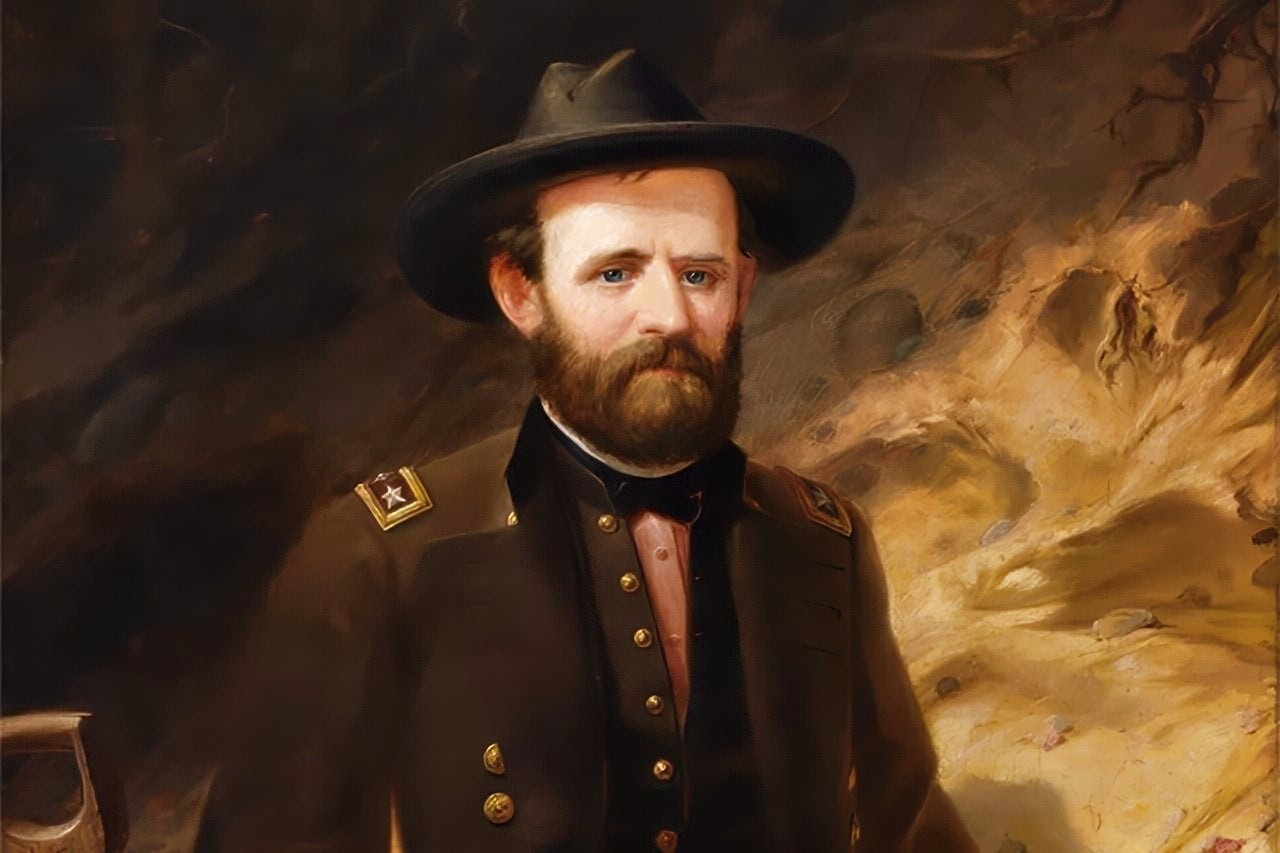
Ulysses S. Grant. Image: Creative Commons.
As Lincoln famously said of Grant, “I can’t spare this man. He fights.” Meanwhile, as former Secretary of the Navy and West Virginia Democratic Senator Jim Webb noted in his excellent bestselling 2004 book “Born Fighting: How the Scots-Irish Shaped America,” it took a Scots-Irishman like Grant to turn the tide in the Union’s favor after the North had suffered so many defeats at the hands of the South’s own Scots-Irish-descended generals.
Lincoln was undoubtedly a kindred spirit to Grant, as the two had both experienced multiple failures but persevered through those adversities en route to their eventual triumphs. Regarding Grant’s drinking problems that plagued him in between the Mexican War and the Civil War, “Honest Abe” is reported to have said, “Find me the brand, and I’ll send a barrel to each of my other generals!”
Earning the “Unconditional Surrender” Moniker: Battle of Fort Donelson
Poetically enough, Ulysses S. Grant’s first two initials were “U.S.” Besides being conveniently coincident to “United States” and “Uncle Sam,” those initials of his were soon equated with “Unconditional Surrender Grant.”
Cannon Firing. Image Credit: Creative Commons.
(NOMENCLATURE NOTE/SEMANTIC SIDEBAR: Although his mother Hannah had the maiden name Simpson, which also became the first name of one of his five siblings, Ulysses—”Sam” to his military friends and close confidantes—himself stated that the “S.” did not stand for anything. His original name was Hiram Ulysses Grant; by some accounts, he feared that reporting to West Point with a trunk bearing the initials H.U.G. would subject him to teasing and ridicule. Meanwhile, Rep. Thomas Lyon Hamer [D-PA]—who in his own right went on to become a major general during the Mexican War—had nominated young Hiram to West Point as “Ulysses S. Grant,” so that was the name that stuck for the long term.)
Though it wasn’t his first battlefield victory (that was during the capture of Paducah, Kentucky, in 1861), it was during the Battle of Fort Donelson (in present-day Stewart County, Tennessee) that he earned that “Unconditional Surrender” sobriquet. The battle took place February 11–16, 1862, and by the third day of the engagement, Grant’s 25,000 Federal troops had surrounded the fort, with additional naval support.
The commanding general of the Southern fort, Simon Bolivar Buckner, was an old friend, a former West Point classmate, and a Mexican War comrade-in-arms of “Sam.” Buckner relayed a message to his old friend on the opposite side of the battle line, asking about terms of surrender. To Gen. Buckner’s shock, “Uncle Sam” sent the following reply:
“Sir: Yours of this date proposing Armistice, and appointment of Commissioners, to settle terms of Capitulation, is just received. No terms except unconditional and immediate surrender can be accepted. I propose to move immediately upon your works.”
A legend was thusly spawned.
Victory at Vicksburg
Contrary to the misconception of some amateur Civil War buffs, it wasn’t Grant who led the epic victory at the Battle of Gettysburg; that honor belonged to Maj—Gen. George Gordon Meade (the “Damned Old Goggle Eyed Snapping Turtle“).
Whilst Meade was securing the victory at Gettysburg (in the northern state of Pennsylvania, thus signifying the “high water mark of the Confederacy“), Grant was busy winning an equally decisive and strategically significant engagement that took place farther west and south, namely in the Mississippi port city of Vicksburg.
In one of the finest examples of interservice cooperation (as opposed to interservice rivalries), Grant’s triumph at Vicksburg was hugely boosted by a flotilla of gunboats in the river commanded by Admiral David Dixon Porter. In his book Vicksburg 1863, published in 2010, historian Winston Groom (in turn quoted by Karen Stokes of Abbeville Institute Press) noted the following: “‘ From the river, Porter’s mortar boats kept up a regular bombardment of the city’s environs, while from landward Grant’s artillery relentlessly threw barrages of shells into the town.”
Coincidentally, the Gettysburg and Vicksburg victories were finalized on back-to-back days, July 3 and July 4, 1863. The fact of the latter taking place on the 77th anniversary of America’s independence was particularly poignant for the Union and particularly bitter for the Confederacy; from that year until 1945 (in the waning months of World War II), the City of Vicksburg refused to celebrate the 4th of July!
As Mr. Lincoln said of the Union victory, “The Father of Waters again goes unvexed to the sea.”
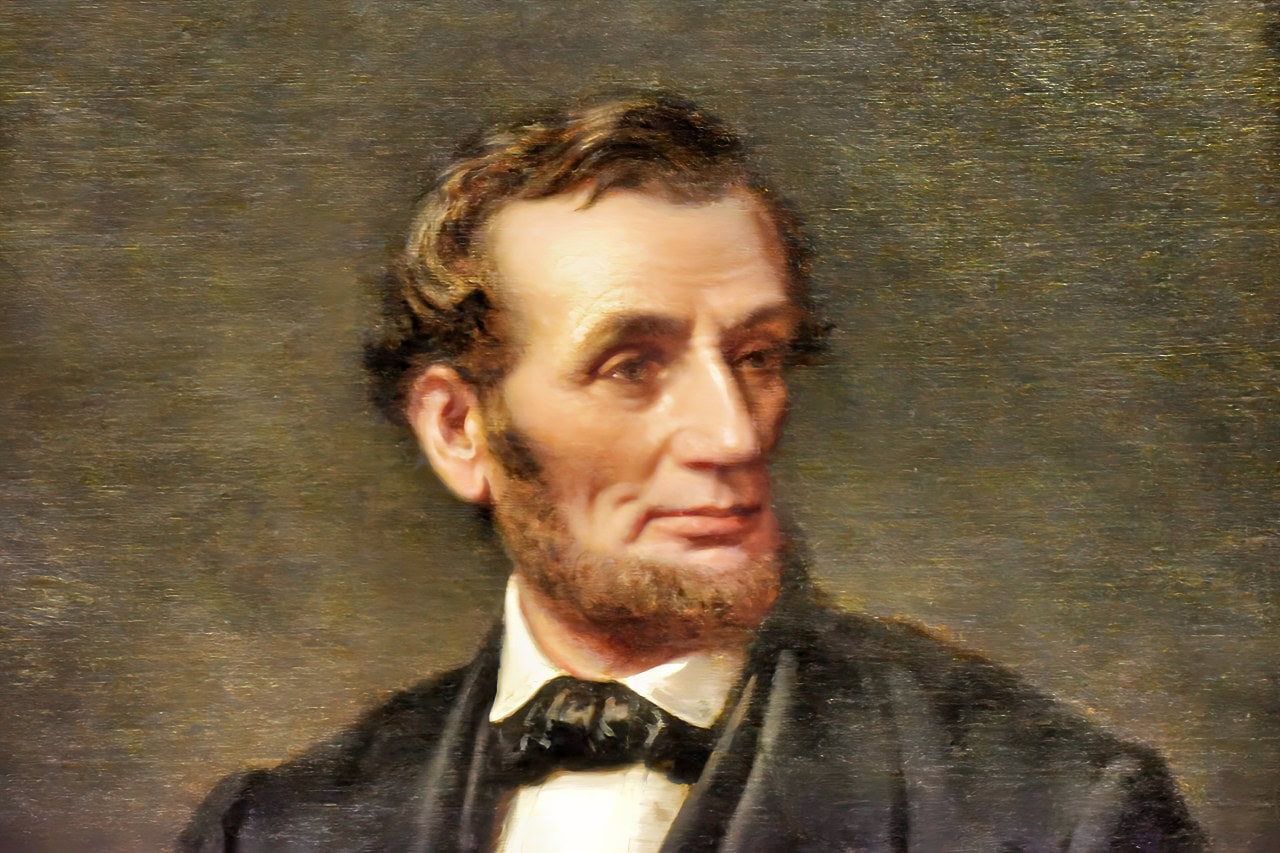
Abraham Lincoln 19FortyFive Image. Taken at the National Portrait Gallery in Washington, DC by Dr. Brent M. Eastwood on 1/23/2026.
(A “triple-A’ homage to the late Bruce Catton’s Pulitzer Prize-winning 1953 book “A Stillness at Appomattox.”)
After nearly two years of being accused of being a “butcher” for his high casualty-inducing brute force and full-frontal assault tactics against Robert E. Lee’s Army of Northern Virginia, it was at McLean House of Appomattox Court House that Grant was vindicated via Lee’s surrender on April 9, 1865, thus putting the finishing touches on Grant’s (and the Union Army’s) ultimate triumph.
As “Ultimate Surrender” Grant himself recounted in his bestselling memoirs, “I felt like anything rather than rejoicing at the downfall of a foe who had fought so long and valiantly, and had suffered so much . . .our men commenced firing a salute of a hundred guns in honor of the victory. I at once sent word, however, to have it stopped. The Confederates were now our prisoners, and we did not want to exult over their downfall.”
One of history’s finest examples of being humble in victory.
About the Author: Christian D. Orr, Defense Expert
Christian D. Orr is a Senior Defense Editor. He is a former Air Force Security Forces officer, Federal law enforcement officer, and private military contractor (with assignments worked in Iraq, the United Arab Emirates, Kosovo, Japan, Germany, and the Pentagon). Chris holds a B.A. in International Relations from the University of Southern California (USC) and an M.A. in Intelligence Studies (concentration in Terrorism Studies) from American Military University (AMU). He is also the author of the newly published book “Five Decades of a Fabulous Firearm: Celebrating the 50th Anniversary of the Beretta 92 Pistol Series.”