
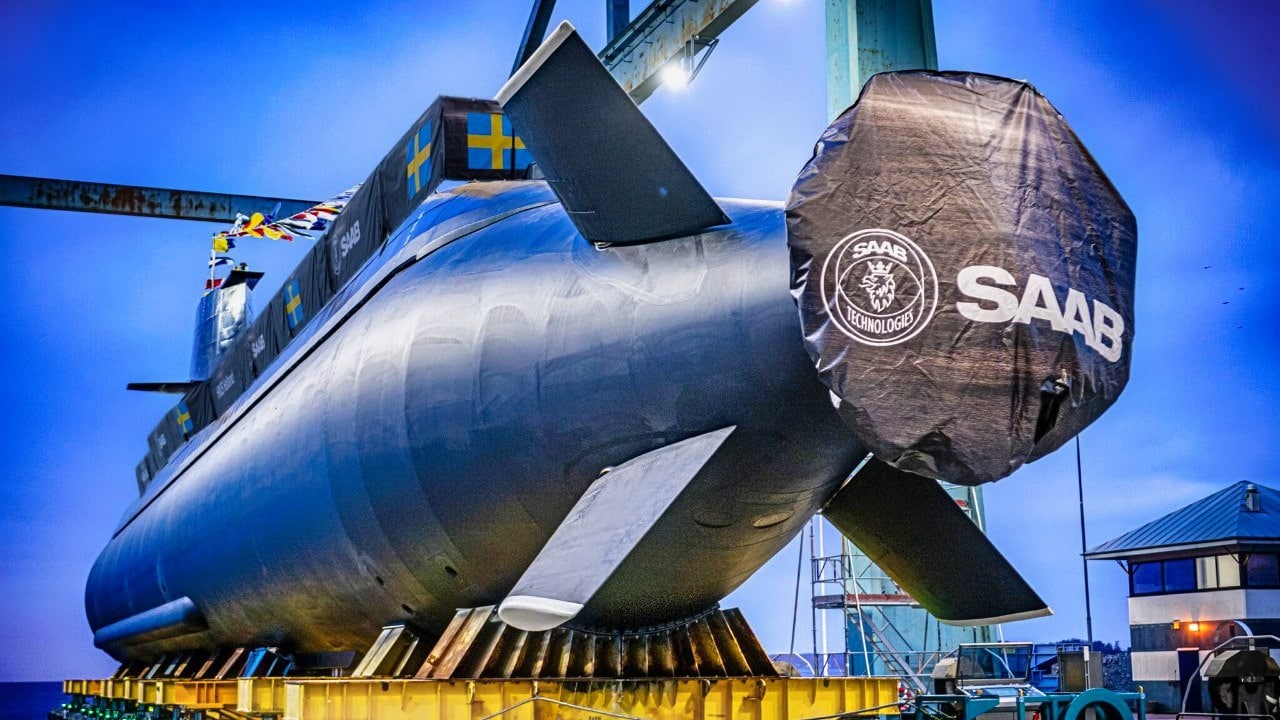
Summary and Key Points: Sweden’s Blekinge-class (A26) submarine represents the world’s first fifth-generation non-nuclear vessel, utilizing Genuine Holistic Stealth (GHOST) technology and Stirling Air-Independent Propulsion (AIP) to remain submerged for 18 days.
-Designed by Saab for the shallow Baltic Sea, the HMS Blekinge and HMS Skåne feature rubberized mounts and a unique bow portal for special operations divers and underwater drones.
-Despite a $1 billion budget increase and delivery delays until 2031, the A26 is a cornerstone of NATO’s “Baltic Lake” strategy, providing a critical deterrent against adversary naval movements along the alliance’s eastern flank.
The “GHOST” Submarine: Sweden’s Blekinge-Class A26 Summed Up in 2 Words
The Saab-produced Blekinge-class (A26) submarine uses Genuine Holistic Stealth (GHOST) technology, making it one of the world’s quietest non-nuclear submarines.
Designed for the shallow Baltic Sea, the class combines Stirling Air-Independent Propulsion (AIP) with advanced acoustic, magnetic, and hull-shaping technologies to remain undetected for weeks.
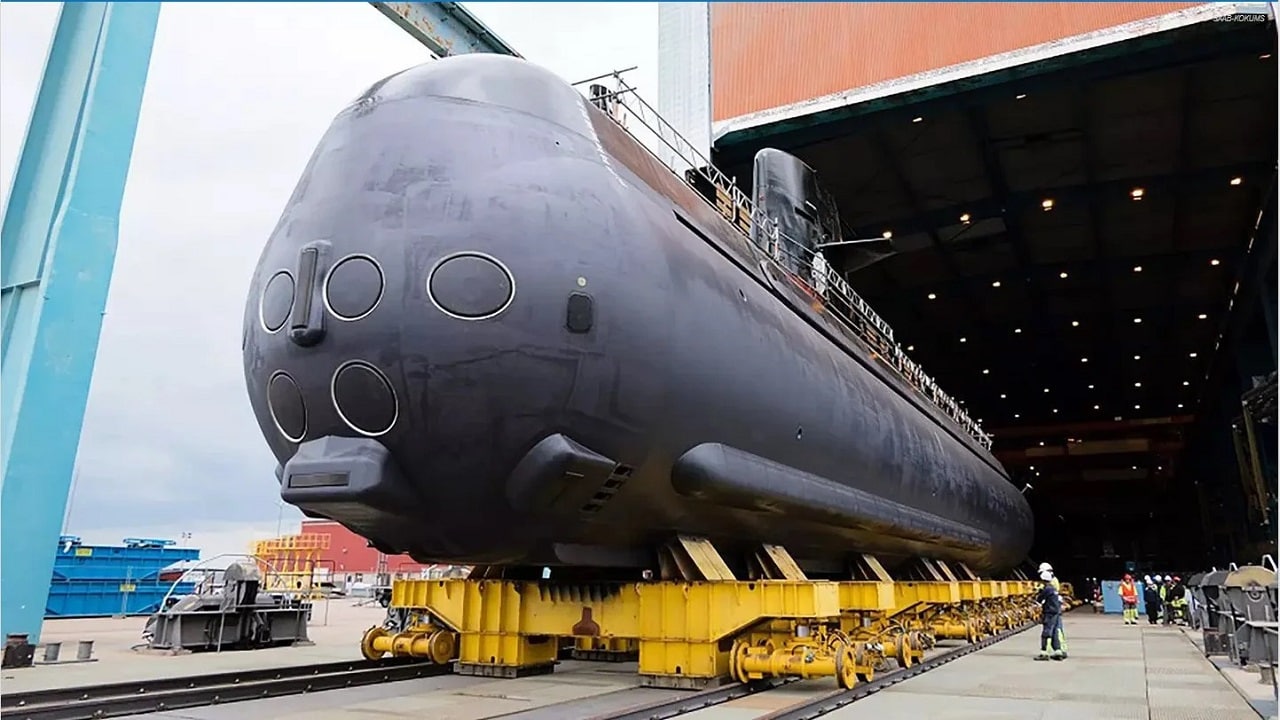
Gotland-Class. Image Credit: Creative Commons.
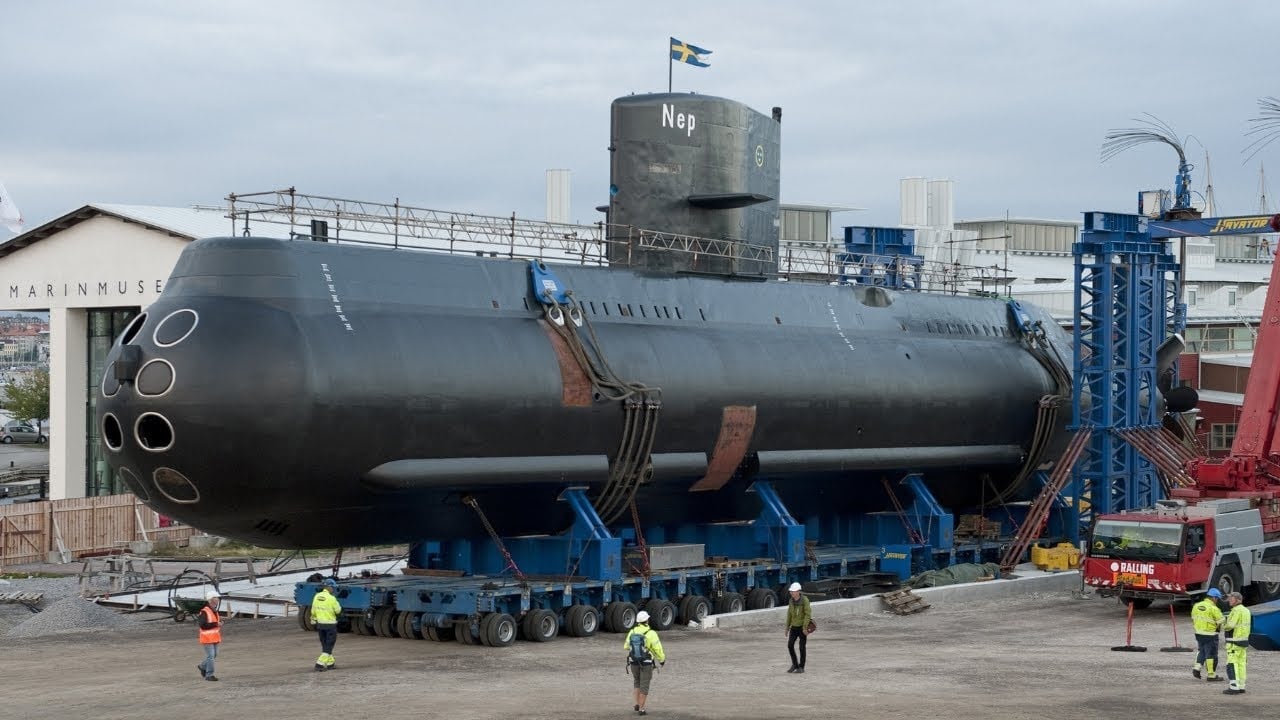
Gotland-class submarine. Image Credit: Creative Commons.
The A26 is billed as the world’s first fifth-generation submarine. It could become the world’s best non-nuclear boat, thanks to its outstanding design.
Sweden plans to add two A26s to its fleet, alongside its three upgraded A19 Gotland AIP boats.
The A26s and A19s will share common combat systems and sensors, but the A26 boats will boast improved endurance and offer a larger bow portal for special operations combat divers and unmanned drone vehicles.
The A-26 Is Delayed And Over Budget:
However, the submarine faces significant delays and cost increases, with the first boat now scheduled for delivery in 2031, and the second in 2035.
Key reasons for the delays include an unrealistically low original budget, a missed deadline to secure an export order to share costs, and renegotiations with the defense contractor, Saab.
The initial budget increase in 2021 and the latest contract renegotiation in October 2025 reflect these issues.
The Blekinge-Class GHOST Technology Features:
GHOST technology minimizes acoustic, magnetic, and electrical signatures. In short, the submarines are designed to be extremely quiet. They feature rubberized machinery mounts, noise-dampening plates between frames, and optimized interior surfaces to minimize internal noise.

San Diego (Oct. 1, 2005) The Swedish diesel-powered attack submarine HMS Gotland transits through San Diego Harbor with the Nimitz-class aircraft carrier USS Ronald Reagan (CVN 76) following close behind during the ÒSea and Air ParadeÓ held as part of Fleet Week San Diego 2005. Fleet Week San Diego is a three-week tribute to Southern California-area military members and their families. U.S. Navy photo by Photographer’s Mate 1st Class Michael Moriatis (RELEASED)
The submarine features a hydrodynamic design. The hull shape and fin design significantly reduce water-flow noise, making it incredibly quiet at low speeds.
The submarine can rest on the seabed for extended periods, avoiding active sonar detection by appearing as seabed clutter.
Stirling AIP allows the vessel to operate submerged for up to 18 days.
The A26 Is A Game Changer For Sweden and NATO:
The A26 will contribute to NATO’s multi-domain operations. The A26 meets NATO standards through secure and interoperable intelligence, surveillance, and Reconnaissance (ISR) capabilities, advanced data processing, long-range strike, and logistical capabilities.
The unique ability to employ special forces, unmanned underwater vehicles, and seabed interaction position the A26 for highly effective seabed warfare, especially in the shallow Baltic.
Factors Contributing To The Delays:
Sweden initially planned in 2010 to replace its two Södermanland-class submarines with the A26, with deliveries scheduled for 2018 and 2019. The order was placed in 2015, with a total program cost of approximately $750–765 million, and deliveries scheduled for 2022 to 2024.
The initial low budget was unrealistic. It relied on securing an export order by June 2019 to help cover costs—a goal that was not met.
The failure to find an international partner meant Sweden had to cover the full costs, necessitating budget adjustments. The total production of just two submarines significantly increased the overall cost.
One of the Södermanland-class submarines was mothballed in 2021, well past the 2018 deadline set for the first A26. The other older submarine is undergoing deep maintenance and upgrades to extend its service life to 2028.
Contract Renegotiations With Saab:
The delays and cost overruns have forced multiple renegotiations between Saab and the Swedish Defense Materiel Administration.
According to Janes, under the revised terms announced on October 13, delivery of the two boats, which will be named HMS Blekinge and HMS Skåne, has been pushed back to the early 2030s, and an additional $1 billion has been allocated to the program.
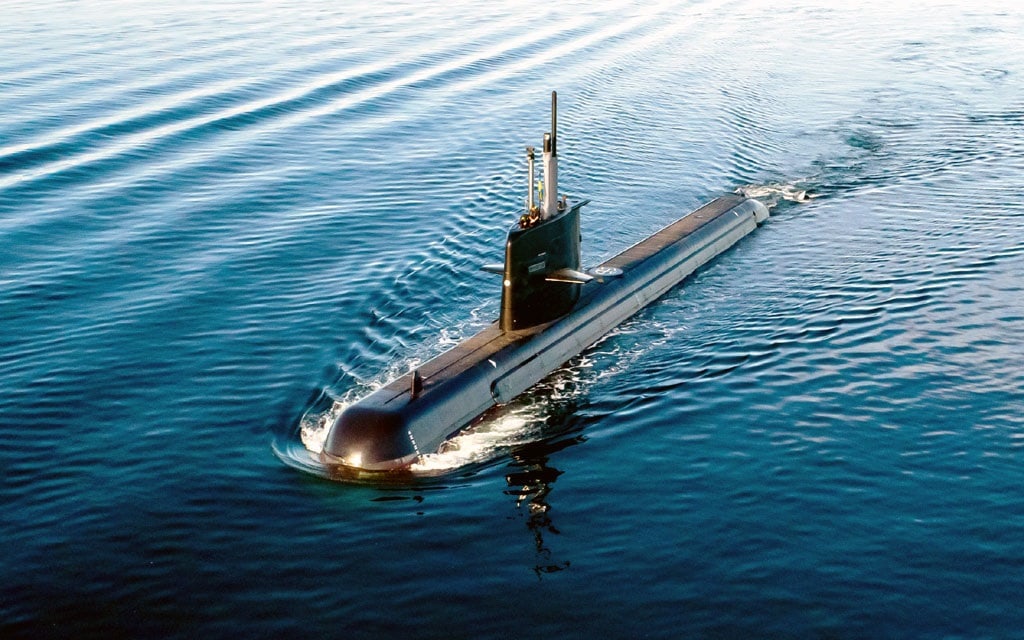
Gotland-class Submarine.
Production challenges are many, including the difficulties of resuming production of an entirely new submarine class after a long break. The poor state of the Kockums submarine yard, which has not built a new submarine since the Gotland-class was delivered in the mid-1990s, is definitely a factor.
Changes To Sweden’s Entire Naval Doctrine:
Sweden joined NATO in 2024, and it has dramatically shifted the nation’s naval doctrine. Sweden was a neutral, non-aligned country for centuries. Now, it is no longer just defending its own shores; the Swedish navy guards NATO’s eastern flank, with the “border” effectively set along Finland’s and the Baltic States’ coasts to the east.
As Swedish Navy Chief Rear Admiral Johan Norlén put it, “We are also defending our nations on the other sides. … The border is on the eastern shore right now.”
U.S. Rear Admiral Bret Grabbe, NATO’s top submarine commander, said, “With Sweden’s addition … that was our first opportunity to add another submarine nation to NATO. And now we have, basically, a Baltic lake full of NATO submarines.”
Currently, the alliance has a tremendous advantage in submarines. Right now, there’s a three- or four-to-one ratio of NATO ships to adversary ships around the area of responsibility, and “that’s quite an impressive deterrent feature that we have when we’re working together,” Grabbe said.
That is why Sweden’s updated A26 submarines are so crucial for the country and NATO.
Updated Timeline and Budget:
The revised work plan may depend on the shipyard. A new order in October 2025 includes additional funding and a revised schedule, with deliveries scheduled between 2026 and 2032. Poland has entered into an agreement with Saab to purchase three A-26s.
When it finally does arrive, the Blekinge-class may be one of the world’s best non-nuclear submarines—and it is perfectly designed for the shallow Baltic.
About the Author: Steve Balestrieri
Steve Balestrieri is a National Security Columnist. He served as a US Army Special Forces NCO and Warrant Officer. In addition to writing on defense, he covers the NFL for PatsFans.com and is a member of the Pro Football Writers of America (PFWA). His work was regularly featured in many military publications.