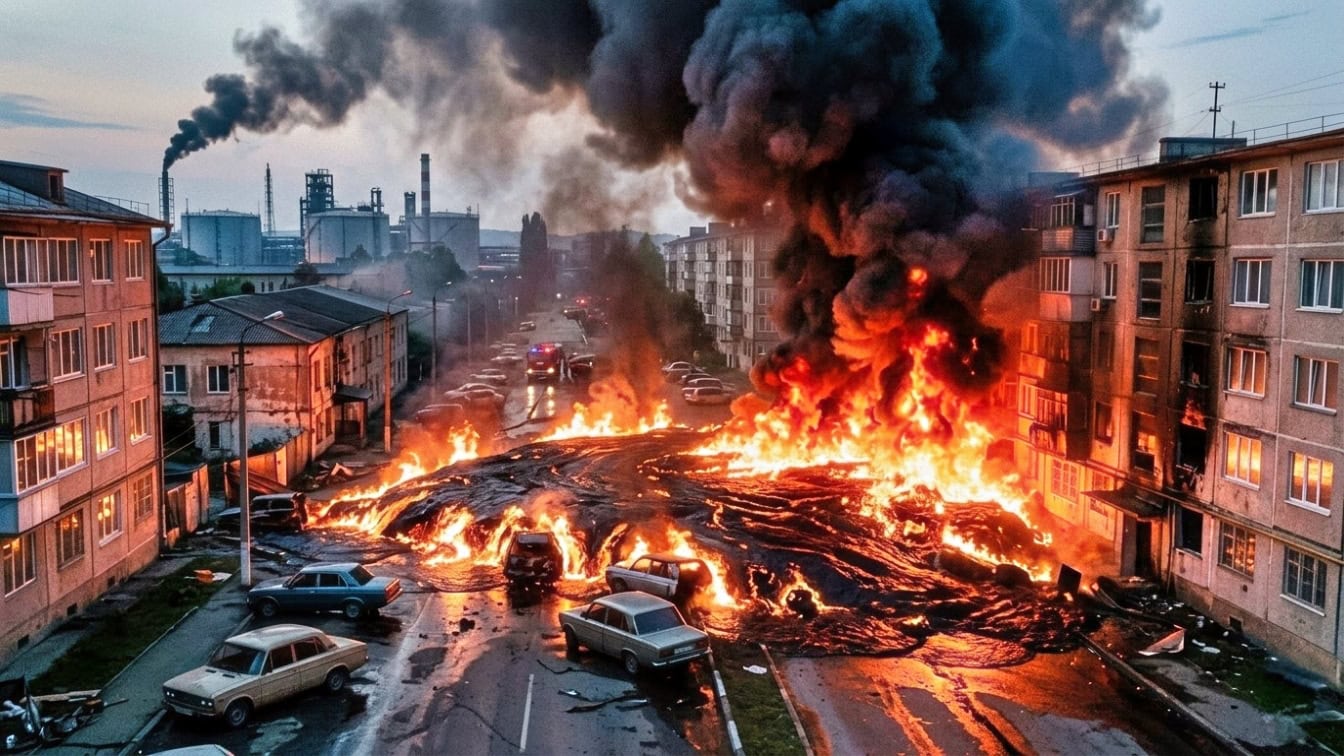
On 28 April, Ukraine’s drone forces conducted the third round of attacks in two weeks on Russia’s Tuapse Refinery in Krasnodar Krai, a facility that is owned by the Russian state energy behemoth Rosneft. This attack comes after previous strikes on 16 April and 20 April that both triggered major fires, damaged storage tanks, and forced the plant’s operations to go offline, and reportedly killed one person.
But this third round from last night has created levels of devastation that are being recorded with video footage of burning oil rolling down the streets in the adjoining areas that look almost like lava from a volcanic eruption, and have prompted near hysteria in the local population.
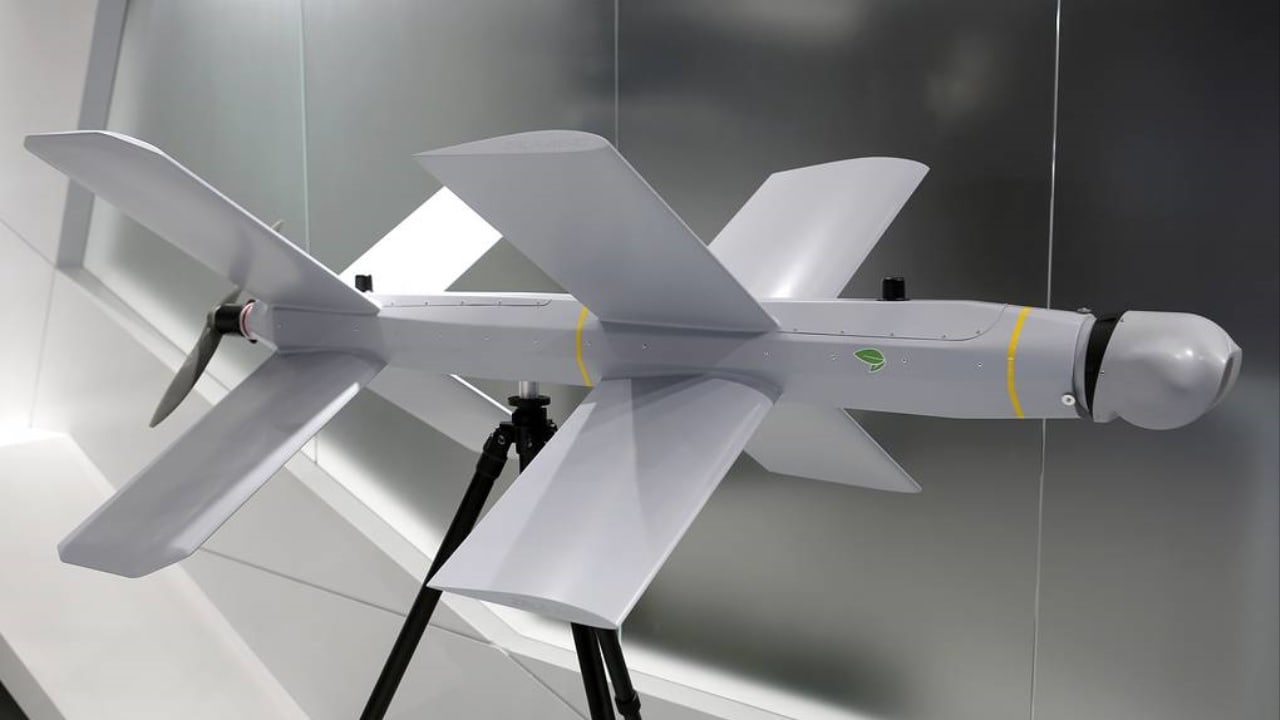
Lancet Drone. Image Credit: Russian State Media.
Reports that burning oil is flowing into nearby residential neighborhoods and causing fires to spread are also emerging from local news outlets.
The Russian service Astra reported that the spill stretched along Koshkina Street from the oil refinery site to building No. 30, after reviewing eyewitness footage.
According to that same report, fuel leaked from large domed tanks typically used to store heavy petroleum fractions such as fuel oil. Meaning that the volume of oil that could be sent streaming through the streets could turn out to be seemingly endless.
Russian officialdom has continued to downplay the ability of Ukraine’s military to hit these strategically important targets and evade all the air defense assets in the area.
But what is now becoming an almost formulaic, party-line response to any fires that break out after these strikes is to not give any credit to the Ukrainians being able to hit these targets and to instead to blame “falling drone debris.”
In other words, said a Ukrainian drone company director who spoke to 19FortyFive, “the Russian official message is ‘our valiant air defense forces continue to clear the skies, and none of their drones get through. The fires are just caused when some of the destroyed Ukrainian drones that are still on fire after being shot down fall to the earth below.”
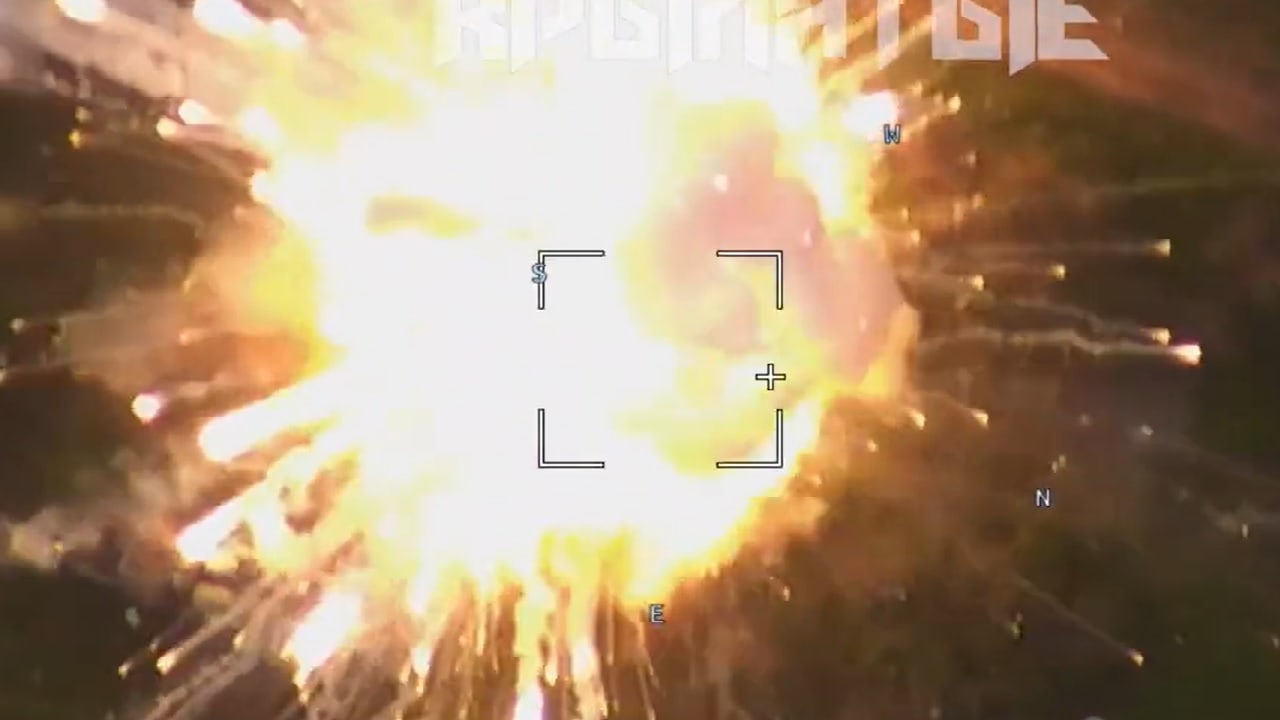
Lancet Drone Attack in Ukraine. Screenshot photo.
“If that’s true,” he said, “I want to ask why all the people nearby keep talking about hearing huge explosions on the ground – as you would when a drone hits its target – and not be hearing a loud boom 1000 feet or more up in the air where the Russians claim the drones are being intercepted.”
Wholescale Destruction
The Ukrainian General Staff noted that its analysts are still conducting battle damage assessments (BDA) for this most recent attack.
But geolocated satellite footage from 28 April shows multiple fires and smoke plumes at the Tuapse Oil depot and the adjacent refinery.
Ukrainian open-source intelligence (OSINT) analysis has assessed that the 27-28 April strikes damaged at least four oil storage tanks among other facilities.
“The fire and smoke plumes are so huge they can be seen from outer space – from photographic satellites,” said one panicked resident of the city. Tuapse is located on the far eastern coast of the Black Sea and north of the major Russian defense industrial city of Gelendzhik.
Speaking with several Ukrainian defense industrial contacts today, it is clear that there is no end to the negative implications for Russia, beginning with the impact of the attack on the facility itself.
The facility has been shut since it was hit in the first attack on 16 April, making it impossible to ship any oil from this site. This refinery’s daily production is about 240,000 barrels of oil products, including naphtha, diesel, fuel oil, and vacuum gas oil.
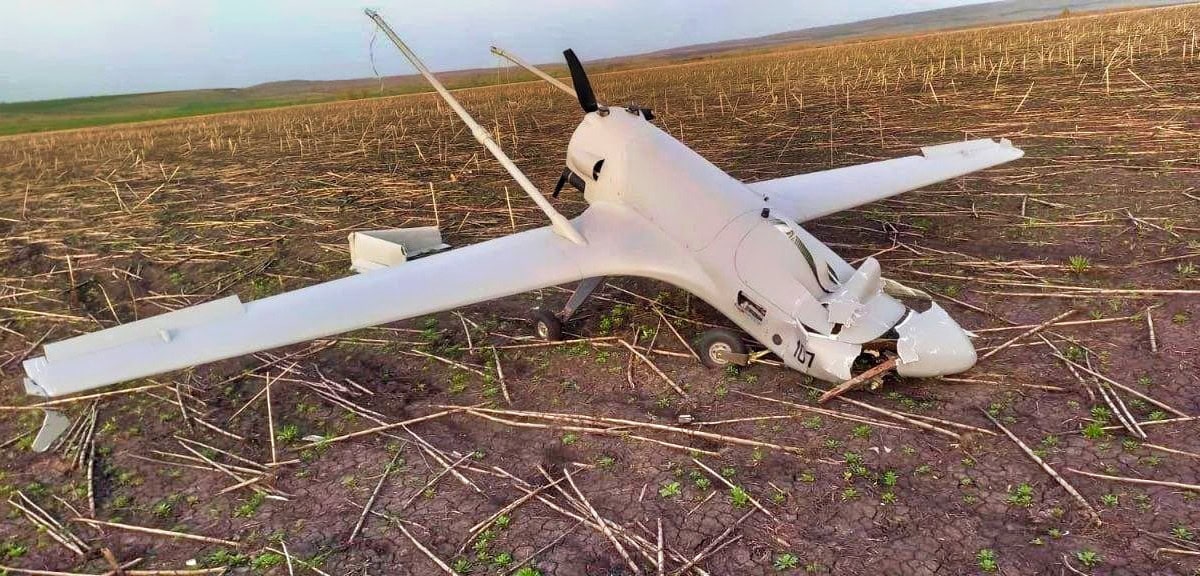
Lyutyi Drone from Ukraine Social Media.
“When the Russians have to shut down these shipments, this is another nail in [Russian President Vladimir] Putin’s war machine,” said the deputy director for a major Ukrainian company that designs some of the long-range weapons being used in these attacks.
“They cannot ship any petrol products to power their own war machine, fuel their own weapon systems when these sites are closed down – and they also cannot ship any products abroad to provide the money they need to keep their military factories operating.”
Longer-Term Impacts
A former US intelligence official who spent much of his career assessing just how much Russia – and earlier the Soviet Union – depended on the revenue from this industry.
“There are dozens of these kinds of cities in this part of Russia,” he stated. “Tuapse is one of the smaller ones. If the Russians cannot stop these attacks, which they apparently are not able to do, and the Ukrainians step up these attacks, this could start to hurt the Kremlin in more ways than one very soon.”
What he meant, he explained, is that this is now more than just what Russia loses when its oil tanks and refineries are burning.
The continuing Ukrainian attacks have also angered local communities, demanding to know why Russian authorities have not boosted the air defenses in this region. An increasingly common sentiment is that the powers that be in Moscow are showing a callous disregard for their situation.
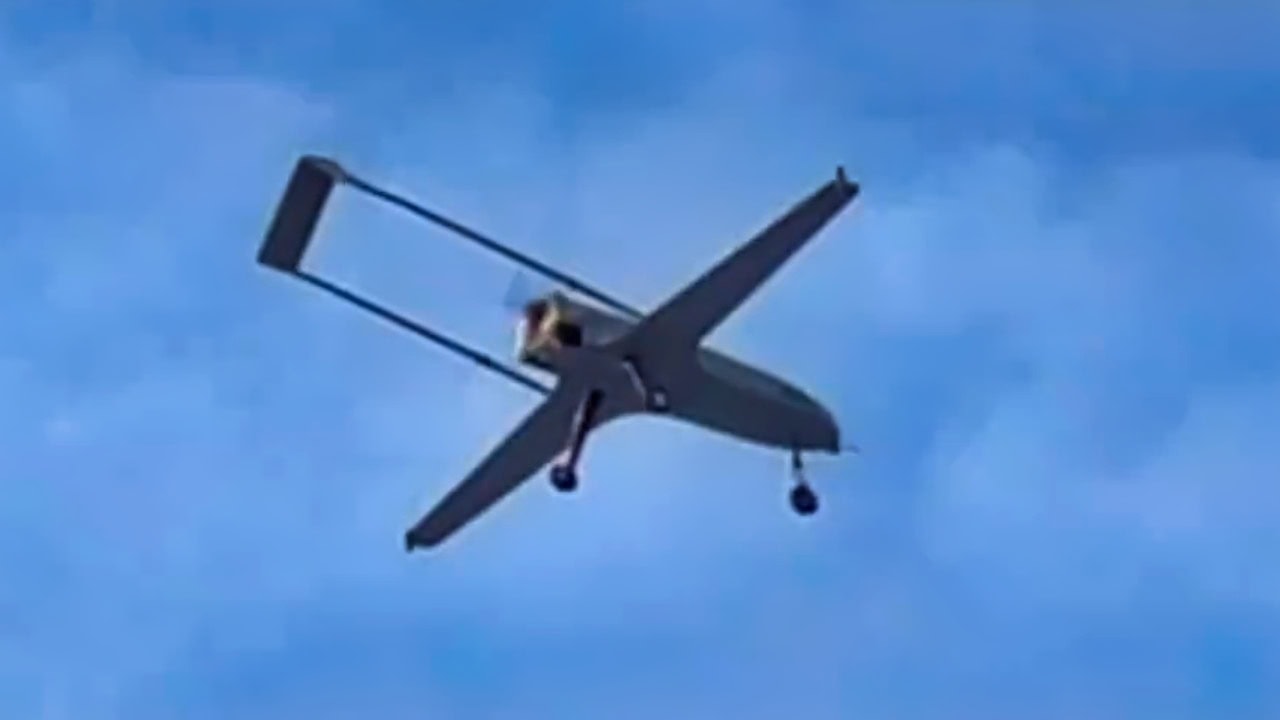
Lyutyi Drone from Ukraine.
These events are only exacerbating another common source of discontent: the random, lengthy blackouts of internet access, particularly mobile internet access on portable devices like smartphones. These internet blockages are often dubiously justified on grounds of national security and can last for days, and have occurred in a majority of Russian regions when they are really designed to keep local grievances and protests from expanding in size.
The internet shutdowns have also blocked or throttled back access to an increasing number of foreign apps — Facebook, YouTube, WhatsApp and Telegram. Russians are then told to use Russian-developed apps, such as the state-sponsored app MAX.
Many Russians are not anxious to have MAX, an unencrypted government-built “super” app that is almost a clone of the People’s Republic of China (PRC)- officially sanctioned messaging app Weixin (or WeChat) on their devices, as it makes it easier for users to be monitored and located.
“It’s like walking around with the FSB in your pocket,” said one Russian colleague who – like many others – is decidedly unhappy with Telegram and other apps no longer being usable in Russia. Many Russians are now turning to technological aids like VPN, which the Russian state is currently also trying to have banned.
As these blackouts and blockages have disrupted their day-to-day lives, Russians have tried to hold protests in some cities. The authorities have blocked them wherever possible and show all the signs of being afraid that those protest demonstrations will become too frequent and progressively larger.
Russians have also taken their complaints to social media. Angry messages have flooded the comments section of the Digital Development Ministry’s website. And when these internet outages peaked, so did searches on Google for “how to leave Russia” for good.
The fact that Putin is now placing increasing limits on the internet is a clear sign that he is worried about opposition to the war in Ukraine growing, said the retired intelligence official.
“These trends are all moving in a direction not favorable to Putin’s regime – the locals who are terrified by these attacks on the oil industry, the impact on the economy, the protests over internet blackouts, the increasing sense that this war in Ukraine has gone on too long, and continuing to prosecute it makes no sense any longer,” he said. “It is just now a question of when and where these unhappy trends all intersect.”
About the Author: Reuben F. Johnson
Reuben F. Johnson has thirty-six years of experience analyzing and reporting on foreign weapons systems, defense technologies, and international arms export policy. Johnson is the Director of Research at the Casimir Pulaski Foundation. He is also a survivor of the Russian invasion of Ukraine in February 2022. He worked for years in the American defense industry as a foreign technology analyst and later as a consultant for the U.S. Department of Defense, the Departments of the Navy and Air Force, and the governments of the United Kingdom and Australia. In 2022-2023, he won two awards in a row for his defense reporting. He holds a bachelor’s degree from DePauw University and a master’s degree from Miami University in Ohio, specializing in Soviet and Russian studies. He lives in Warsaw.