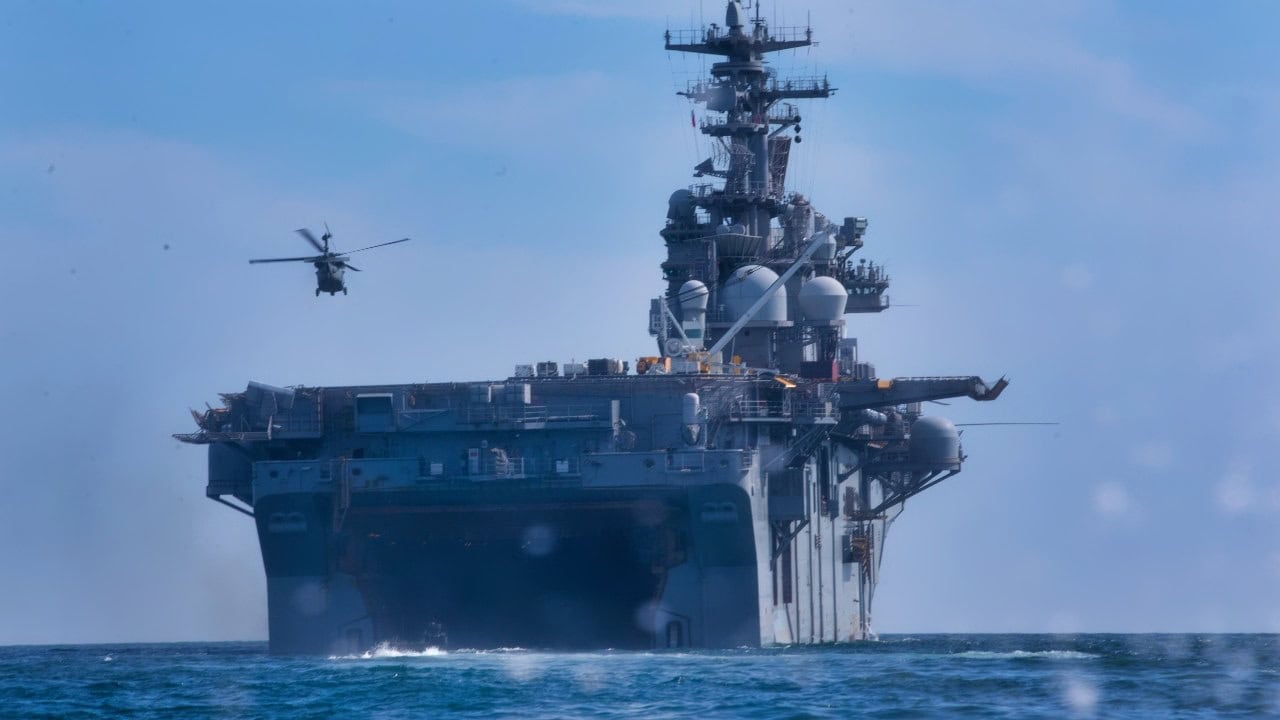
Why the Wasp-Class Is A Truly Powerhouse Assault Ship for the U.S. Military: Ship-to-shore attack is the core mission of the famous U.S. Marine Corps WASP-class amphibious assault ships, vessels capable of transporting 155mm Howitzer artillery onto a beachhead to seize and hold enemy territory.
Wasp-class ships are designed to carry and deploy Marine Expeditionary Units (MEUs), which are self-contained, highly mobile forces capable of conducting amphibious assaults.
Using a combination of helicopters, tiltrotor aircraft, and landing craft, the Wasp-class ships lead air-sea-land attacks. This flexibility allows commanders to tailor operations to specific environments, whether a hostile beach landing, an air insertion exercise, or a rapid evacuation mission.
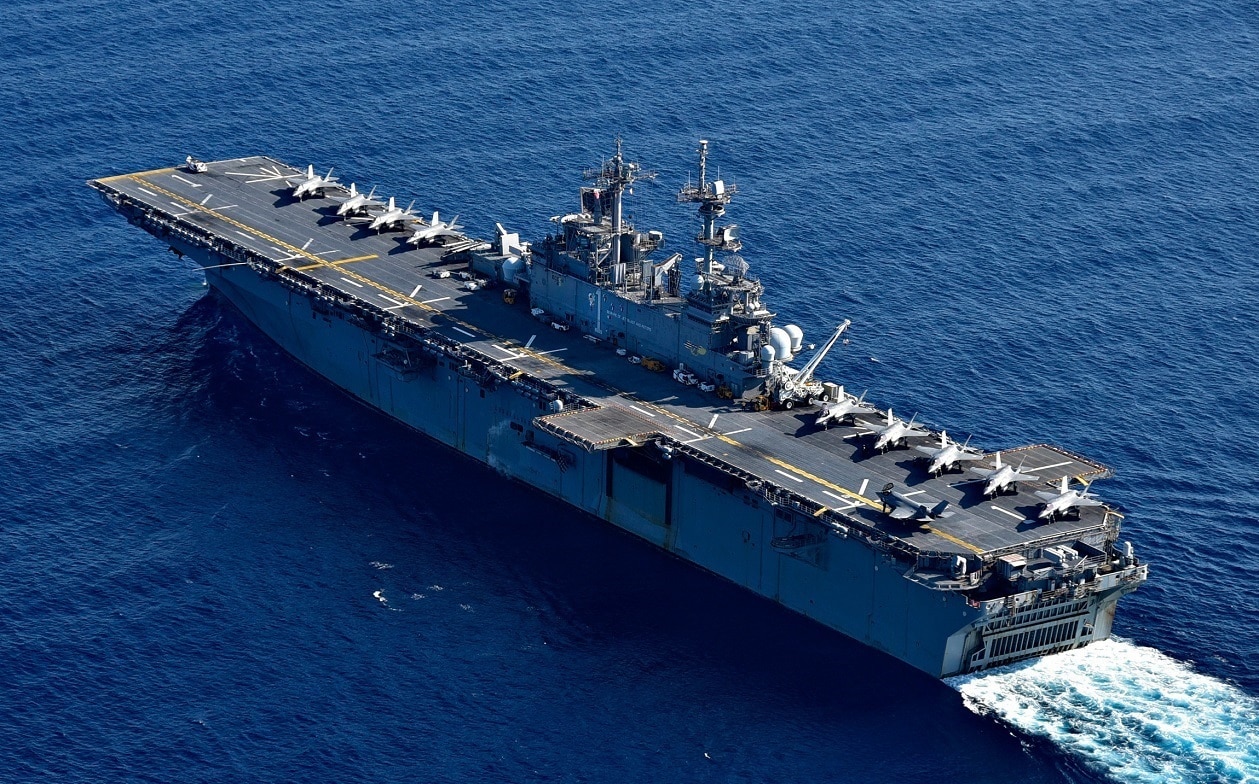
SOUTH CHINA SEA (April 5, 2019) The amphibious assault ship USS Wasp (LHD 1) is operating in the South China Sea in support of Exercise Balikatan 2019. In its 35th iteration, Balikatan is an annual U.S.-Philippine military training exercise focused on a variety of missions, including humanitarian assistance and disaster relief, counter-terrorism, and other combined military operations. (U.S. Navy photo by Mass Communication Specialist 1st Class Daniel Barker/Released)
In addition to their aviation capabilities, Wasp-class ships are equipped with well decks that allow them to launch and recover amphibious vehicles and landing craft.
This capability is crucial for transporting heavy equipment, such as tanks and armored vehicles, directly to shore.
The Wasp-Class Carries Marine Expeditionary Units With Abrams Tanks, Helicopters, Tiltrotors, and Landing Craft — Ship-to-Shore Assault Is Its Core Mission
Wasp-class amphibious ships have been upgraded to accommodate modern strategic thinking in the realm of amphibious assault. U.S. Amphibious Ready Groups and Marine Expeditionary Units are increasingly capable of disaggregated, yet securely networked operations.
While initially configured for close-group operations, technological breakthroughs in networking and surveillance have enabled U.S. amphibs to expand their concepts of operation and enable more separate, disaggregated, and independent operations for big-deck amphibs, Amphibious Transport Docks, and Dock Landing Ships.
This operational capability has been made possible by advanced antennas, networking connectedness, and greater aviation and command-and-control capabilities built into smaller support ships, such as LPDs and Dock Landing Ships.
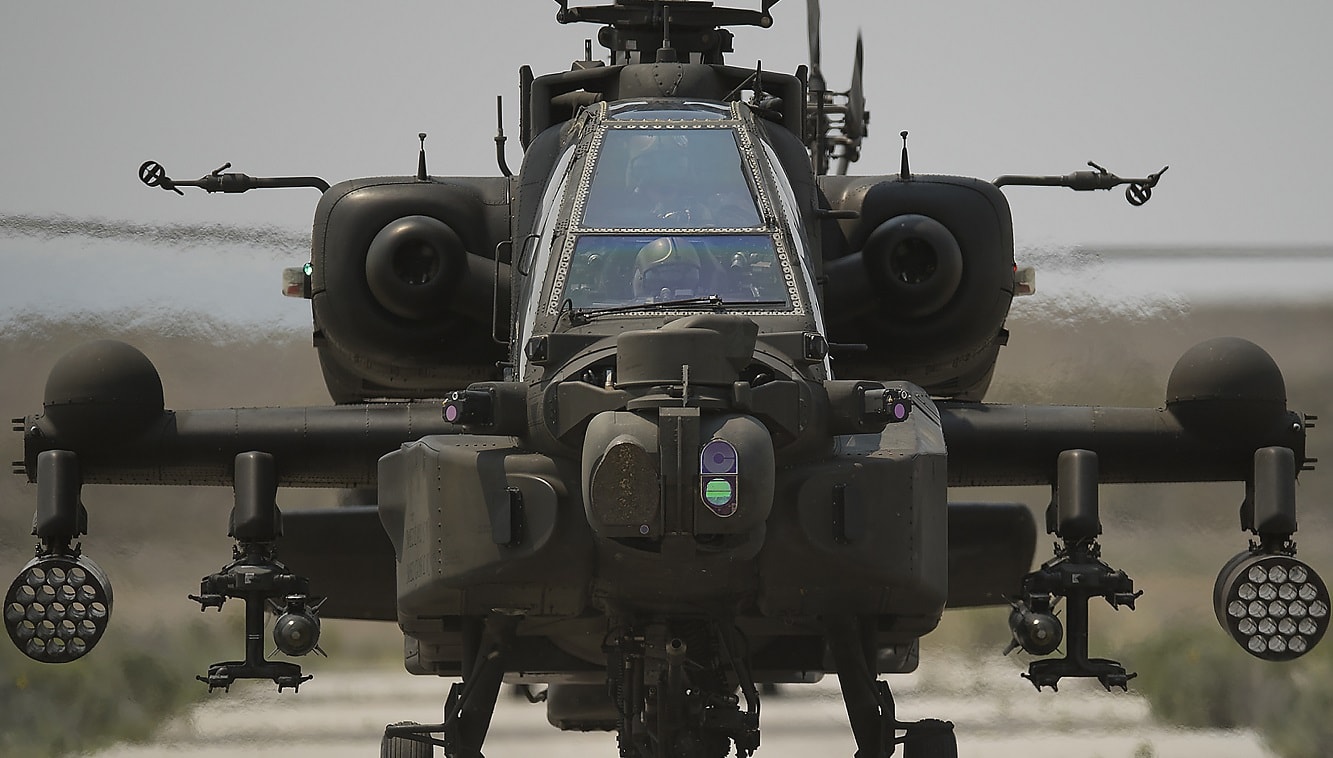
The second AH-64 Apache rolls onto the taxiway and to the takeoff pad. The Idaho Army National Guard’s Orchard Combat Training Center was host to elements of the Republic of Singapore Air Force during July. Based in Arizona, The Singapore contingent operates eight AH-64 Apache Helicopters as part of the Peace Vanguard Task Force. The Apache is an attack helicopter with a tandem cockpit for a crew of two. It features a nose-mounted sensor for target acquisition and night vision systems. It is armed with a 30 mm M230 chain gun. It also features four hardpoints mounted on stub-wing pylons for carrying armament, typically a mixture of AGM-114 Hellfire missiles and Hydra 70 rocket pods. The Apache’s first flight took place in 1975 and was formally introduced into the U.S. Army in 1986.
This formation greatly expands the operational envelope for amphibious operations while not decreasing any ability to operate in closer-in groups.
Wasp-class ships support the broader doctrine of expeditionary warfare.
In an era where conflicts can arise quickly and in remote locations, the ability to deploy forces without relying on foreign bases is a significant advantage.
These ships enable the U.S. military to operate in contested environments while maintaining logistical independence. This operational capacity reduces reliance on host nations and allows for greater operational freedom.
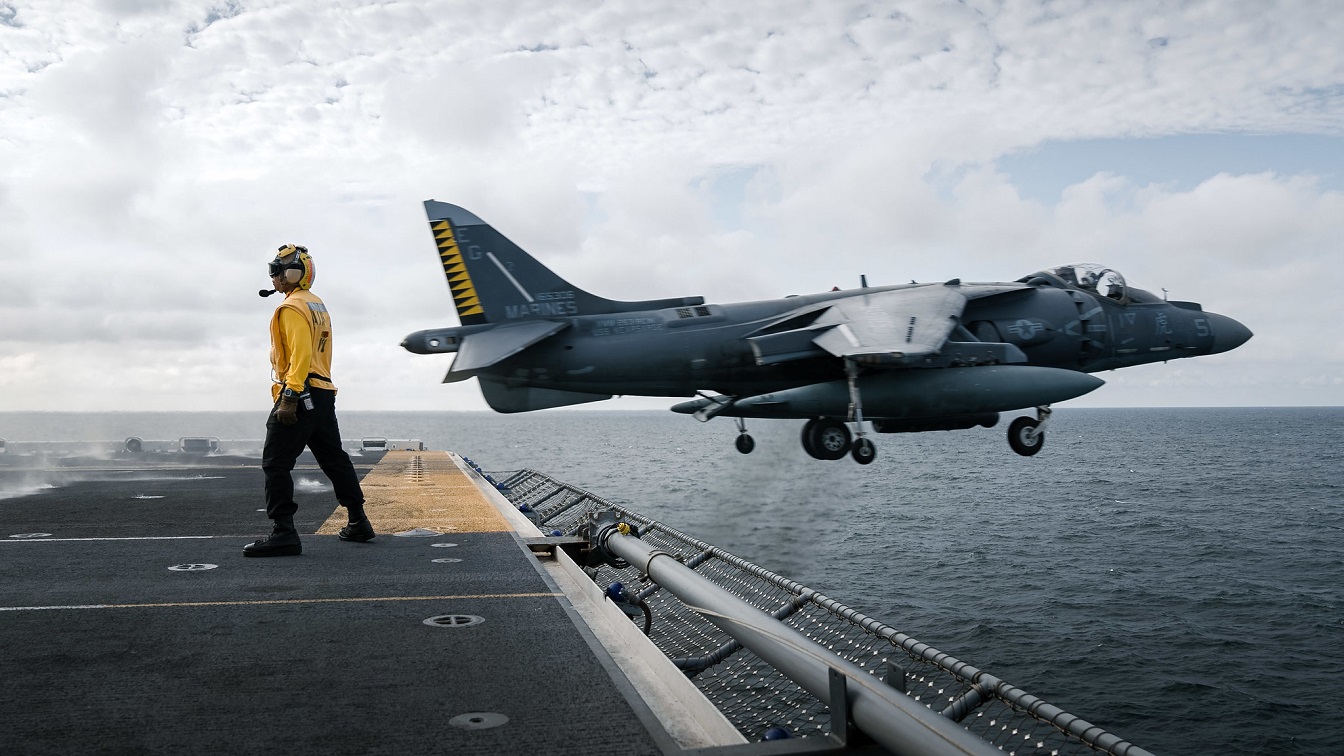
BALTIC SEA (Aug. 24, 2022) A U.S. Marine Corps AV-8B Harrier attached to the 22nd Marine Expeditionary Unit (MEU) flies past U.S. Navy Aviation Boatswain’s Mate (Handler) 1st Class Tu N. Chau during flight operations aboard the Wasp-class amphibious assault ship USS Kearsarge (LHD 3), Aug. 24, 2022. The Kearsarge Amphibious Ready Group and embarked 22nd MEU, under the command and control of Task Force 61/2, is on a scheduled deployment in the U.S. Naval Forces Europe area of operations, employed by U.S. 6th Fleet to defend U.S., allied and partner interests.
Future Marine Corps
As the backbone of the Corps’ amphibious fleet, the WASP-class has been a foundational element of the Marine Corps’ broader shift to a lighter, faster, more lethal, and more expeditionary force.
As part of this, the Marine Corps Force Design 2030 document calls for specific “stand-in” ready forces capable of conducting offensive operations in close proximity to enemy areas within the larger perimeter reach of longer-range weapons.
As a result, the Corps has been refining its ability to conduct warfare operations in coastal and island areas throughout the Pacific, such as the island chains in the South China Sea.
This transition, which includes a Corps emphasis on multi-domain operations and expeditionary weapons systems, has inspired the service to work with industry partners to anticipate future threats and requirements.
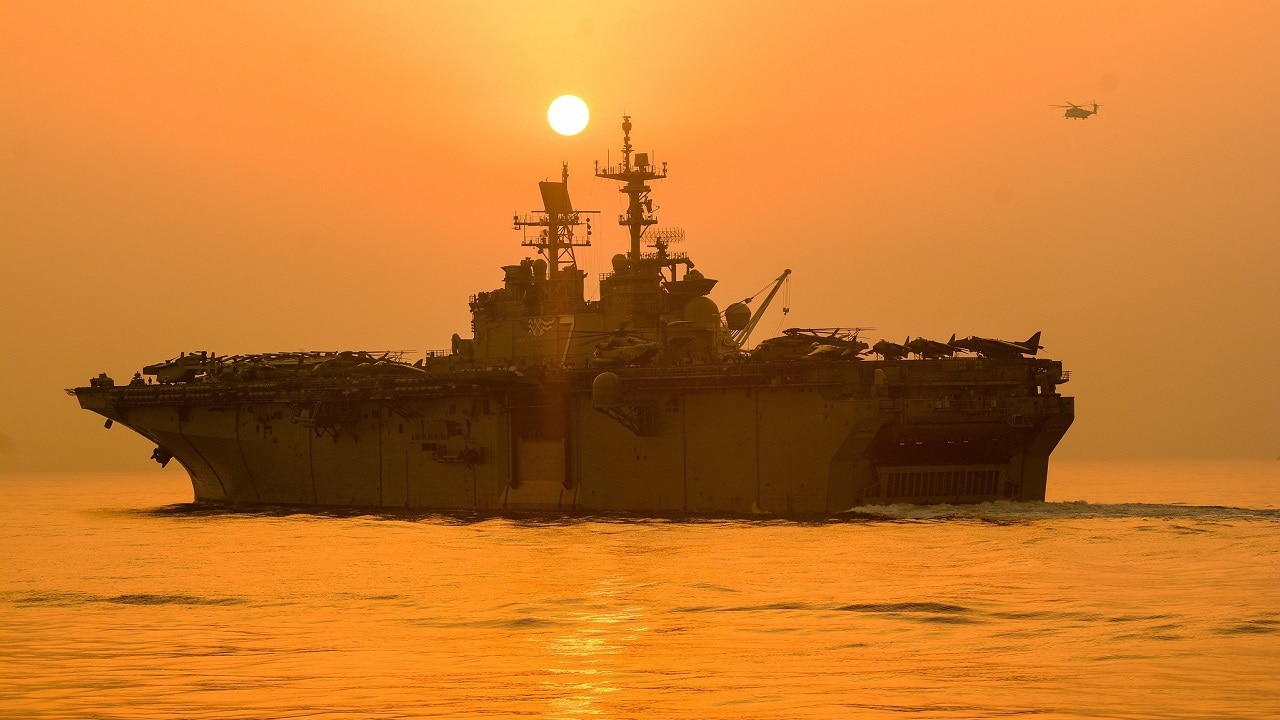
(Aug. 4, 2021) The Wasp-class amphibious assault ship USS Iwo Jima (LHD 7) transits the Strait of Hormuz, Aug. 4, 2021. Iwo Jima is deployed to the U.S. 5th Fleet area of operations to ensure maritime stability and security in the Central Region, connecting the Mediterranean and the Pacific through the western Indian Ocean and three strategic choke points. (U.S. Navy photo by Seaman Logan Kaczmarek)
For instance, forward operating stand-in forces will, according to Force Design, operate with a much greater concentration of drones, unmanned systems, and manned-unmanned teaming to ensure mobile intelligence, surveillance, reconnaissance (ISR), and targeting, and to sustain connectivity with stand-off forces and other command and control nodes.
Stand-In forces will also need self-protective capabilities and offensive firepower, typically less available to mobile, dismounted, island-hopping units.
Weapons Modifications
These kinds of tactical scenarios drive a need for multi-domain, expeditionary weapons systems, one reason why Corps industry partners have sought to be enterprising and anticipate future service warfighting requirements.
For example, Raytheon has been working with the Corps on a land-fired variant of the well-established ship-fired Naval Strike Missile.
This weapon would travel with the Marines from ship to shore and help defend stand-in forces holding territory with a land-fired variant able to hold enemy ships at risk.
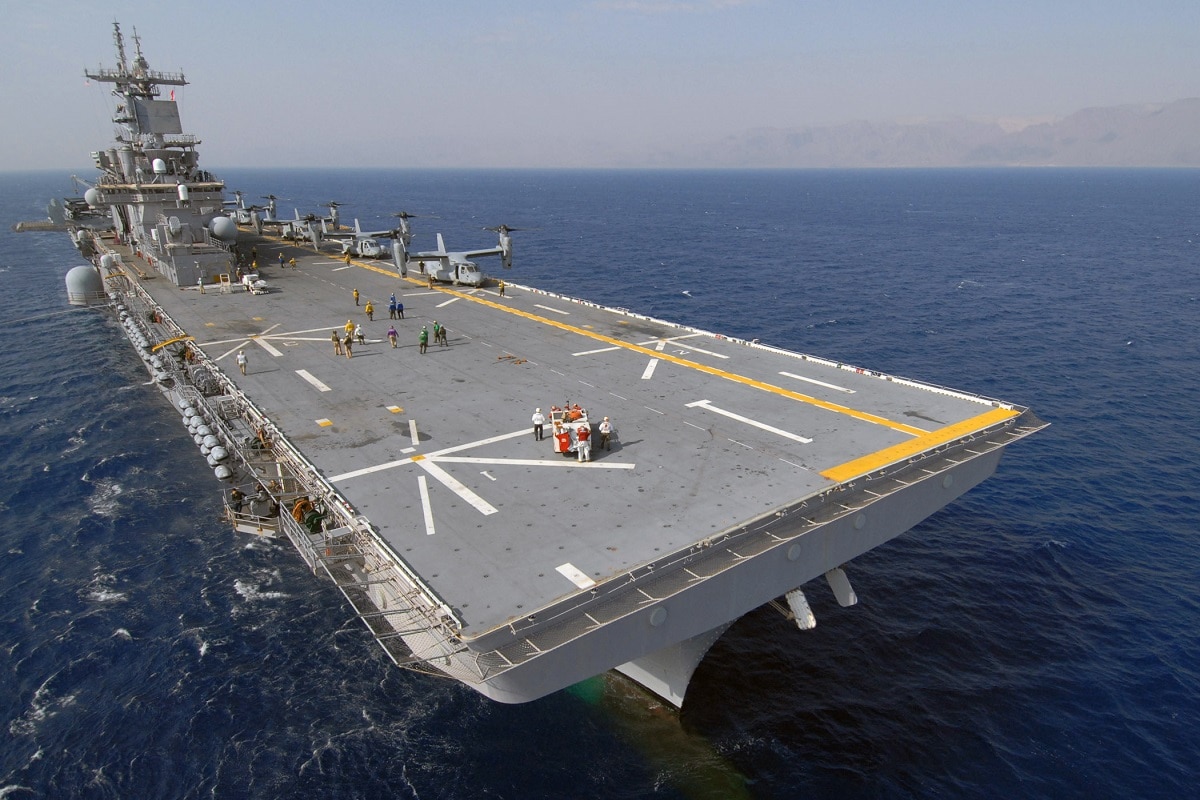
GULF OF AQABA (Oct. 4, 2007) – U.S. Marine Corps MV-22 Ospreys, assigned to Marine Medium Tiltrotor Squadron (VMM) 263, Marine Aircraft Group 29, prepare for flight on the deck of the multipurpose amphibious assault ship USS Wasp (LHD 1). Wasp is on surge deployment to the Middle East carrying the Osprey to its first combat deployment. U.S. Navy photo by Mass Communication Specialist 2nd Class Zachary L. Borden (RELEASED)
The Operational Concept is to enable closer-in, faster, lighter, and more expeditionary amphibious operations, and to quickly transit weapons and Marines from island to island or along littoral coastal areas without risking a larger, more vulnerable footprint.
Quick landings and close-in ship-to-shore operations will be required to a much greater extent should the Corps need to protect or take over island chains, littorals, and coastal areas.
About the Author: Kris Osborn, Warrior Maven
Kris Osborn is the President of Warrior Maven – Center for Military Modernization. Osborn previously served at the Pentagon as a highly qualified expert in the Office of the Assistant Secretary of the Army—Acquisition, Logistics & Technology. Osborn has also worked as an anchor and on-air military specialist at national TV networks. He has appeared as a guest military expert on Fox News, MSNBC, The Military Channel, and The History Channel. He also has a Masters Degree in Comparative Literature from Columbia University.