
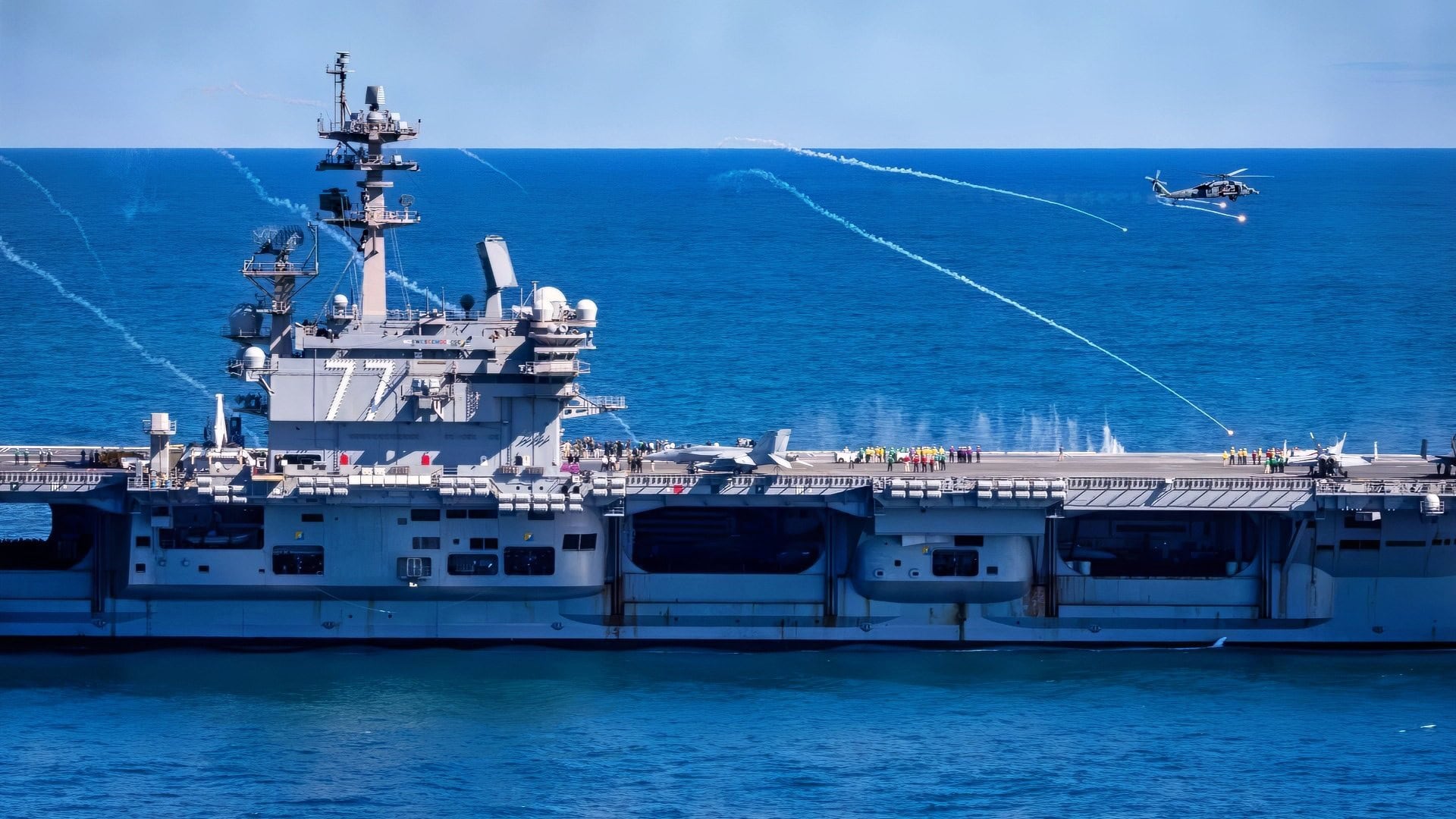
USS George Washington’s Four-Year Overhaul Became a Six-Year Navy Crisis – USS George Washington entered Newport News Shipbuilding on Aug. 4, 2017, for a 48-month Refueling and Complex Overhaul. The carrier was supposed to return to the Navy in August 2021. It was not redelivered until May 25, 2023, after 2,120 days in the yard.
The work was enormous. A carrier RCOH accounts for about 35 percent of all maintenance and modernization performed across a Nimitz-class ship’s 50-year service life. George Washington’s overhaul required 26 million labor-hours, refueled two nuclear reactors and touched more than 2,300 compartments, 600 tanks and hundreds of systems.
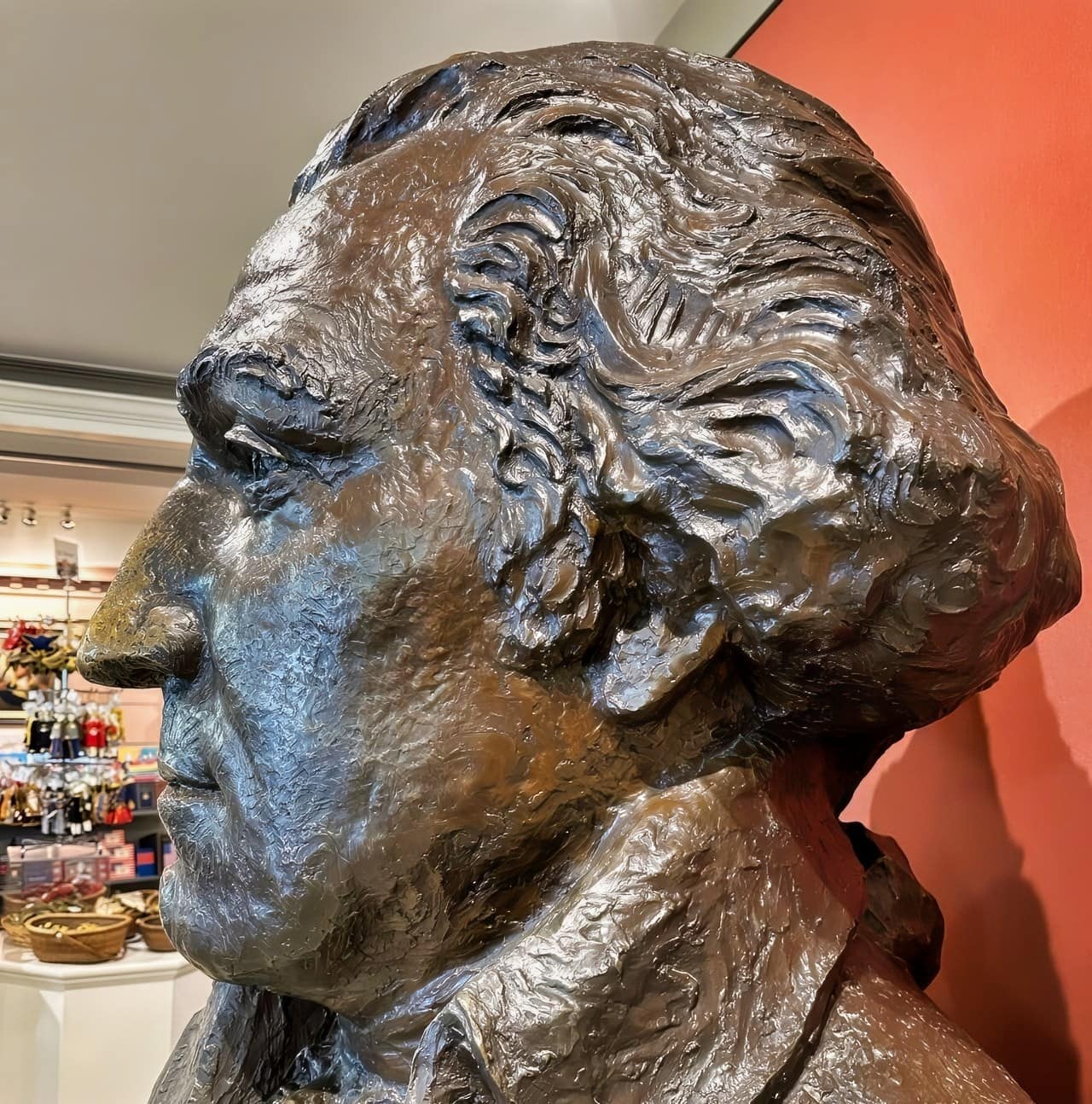
George Washington Bust at Mount Vernon. Image taken by Harry J. Kazianis for 19FortyFive back in 2022.
Newport News installed a new main mast, repaired propulsion equipment, refurbished propellers, modernized aircraft launch and recovery equipment, updated combat systems and prepared the carrier to operate the F-35C. The original $2.8 billion execution contract covered the central shipyard work.
The overhaul slipped because budget uncertainty weakened early planning, hidden mechanical damage created new work, COVID-19 reduced labor efficiency, suppliers fell behind and the nation’s only nuclear-carrier shipyard was handling several other capital ships.
The Navy Lost Time Before USS George Washington Entered the Yard
The first disruption arrived years before workers opened the ship. In 2014, the Pentagon considered retiring George Washington rather than paying for the midlife overhaul as sequestration squeezed defense spending. Congress resisted, and the Navy eventually funded the RCOH, but the uncertainty complicated advance procurement and long-range scheduling.
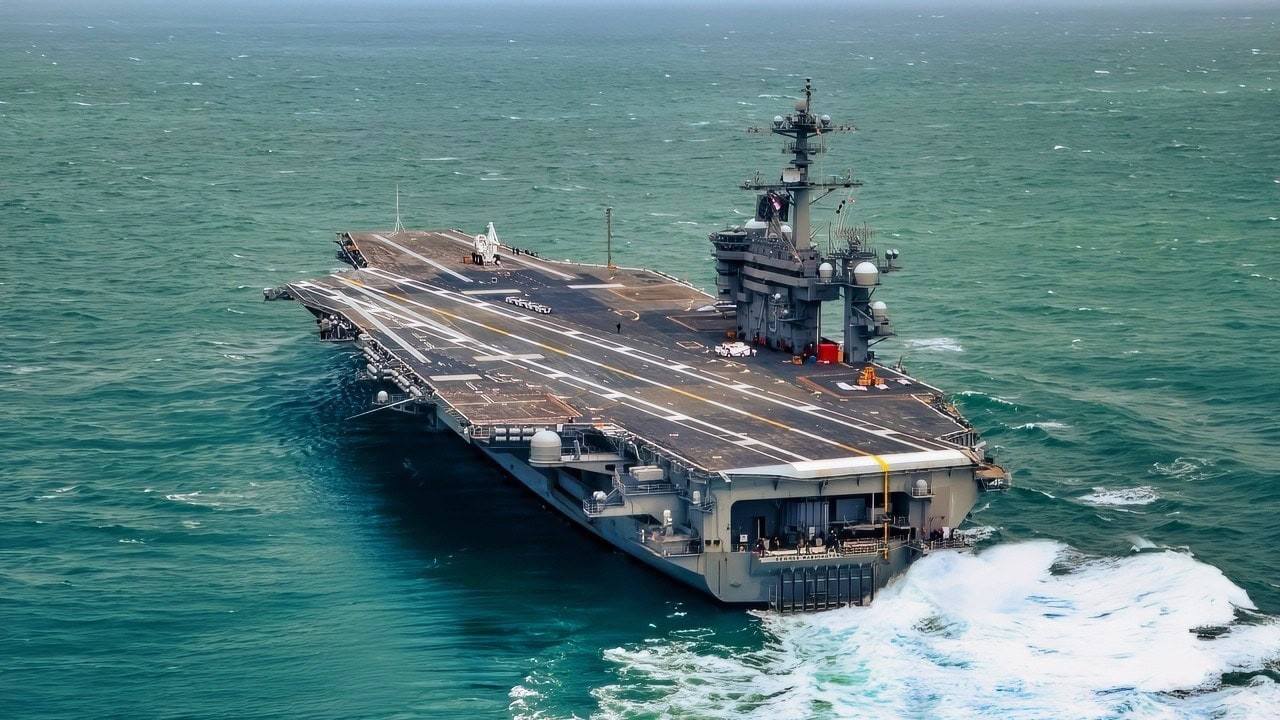
The Nimitz-class aircraft carrier USS George Washington (CVN 73) transits through the Atlantic Ocean May 25, 2023. George Washington was underway after completing its mid-life refueling and complex overhaul and sea trials, a comprehensive test of the ship’s system and technologies. (U.S. Navy photo by Mass Communication Specialist 3rd Class Nicholas A. Russell)
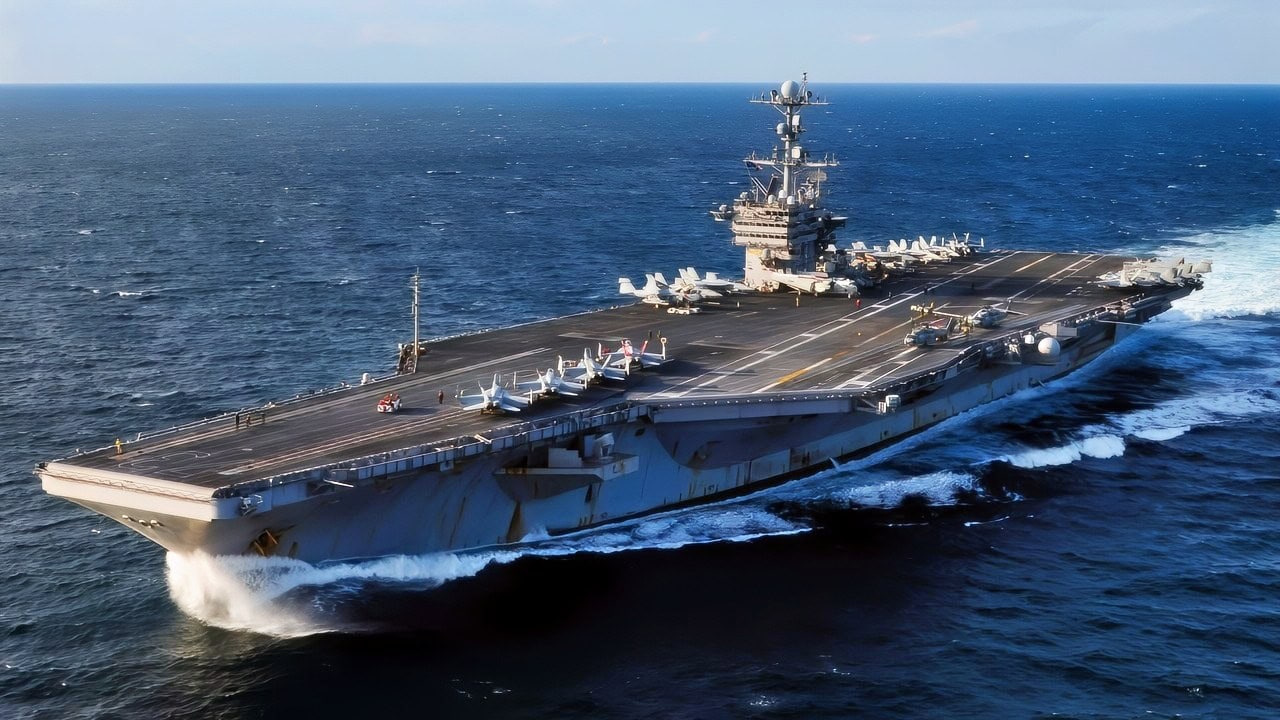
(Dec. 06, 2010) Sailors assigned to the Eagles of Strike Fighter Squadron (VFA) 115 move an F/A-18E Super Hornet on the flight deck aboard the aircraft carrier USS George Washington (CVN 73). George Washington is participating in Keen Sword 2010 with the Japanese Maritime Self-Defense Force through Dec. 10. (U.S. Navy photo by Mass Communication Specialist 3rd Class David A. Cox/Released)
George Washington also brought an unusual maintenance history home from Japan. As the forward-deployed carrier from 2008 to 2015, the ship followed shorter annual maintenance periods rather than the standard American cycle of a major availability, training and deployment. Many internal conditions remained invisible until equipment was opened and inspected during the full midlife overhaul.
That uncertainty became “growth work,” turning planned labor into additional repairs. The nearly six-year availability later became a warning about how quickly a carrier overhaul can expand beyond its original schedule.
Hidden Turbine Damage Added Major Unplanned Work
One of the hardest discoveries involved a turbine generator buried inside the ship. Naval Sea Systems Command later said inspections found significant damage to one of George Washington’s eight turbine generators. The equipment converts reactor-produced steam into electricity and was designed to last the carrier’s full service life.
Repairing a deeply installed component required access, engineering, replacement material and another round of testing. The same problem appeared on USS John C. Stennis during the next overhaul, showing that the Navy had underestimated a class-wide maintenance risk.
A 2022 Navy request sought another $158.6 million to prevent work from stopping. It included $30.8 million tied to contractor performance and $48 million for steam testing delayed by equipment failures, excess growth work and poor contractor performance.
The Pandemic Hit USS George Washington at the Worst Point
George Washington reached the halfway mark on schedule in August 2019 and left dry dock the following month. The pandemic then struck during final outfitting and testing, when thousands of jobs had to come together in sequence.
Quarantines removed teams from the job. Vendor delays held up parts. Labor efficiency fell as the shipyard tried to keep people separated while maintaining nuclear-quality standards. Newport News added overtime and created an operational command center, but those measures did not recover the schedule.
The yard was also supporting Gerald R. Ford, building John F. Kennedy, Enterprise and Doris Miller, beginning the Stennis RCOH and holding the retired Enterprise for disposal. The Navy later cited supplier interruptions and competing demands for resources. The problem reflected a carrier industrial base with almost no spare capacity.
The Delay Became a Crisis for the Crew
Sailors remained assigned to a ship that was partly dismantled, noisy and surrounded by industrial work. Berthing opened and closed as construction moved through the hull. Parking, food, housing and access to services became daily problems during an assignment with little connection to normal life at sea.
A series of sailor suicides prompted a major Navy investigation into shipyard conditions. The service later ordered better off-ship housing, food, parking, internet access and mental-health support. The RCOH had exposed how a maintenance delay can become a personnel failure, not only a readiness statistic.
USS George Washington Eventually Returned to the Pacific
The carrier completed sea trials and returned to Navy control in May 2023. It reached Yokosuka in November 2024 and resumed its place as the only forward-deployed American aircraft carrier in Japan.
The ship was modernized for another 25 years of service, but the schedule damage spread. Stennis inherited another delayed RCOH, and the Navy now has to prepare Harry S. Truman while Newport News remains the only American yard able to refuel a nuclear carrier.
On July 22, 2026, George Washington transited the Luzon Strait with Carrier Air Wing 5, operating again from the same Japanese base she had left more than a decade earlier.
About the Author: Harry J. Kazianis
Harry J. Kazianis (@Grecianformula) was the former Senior Director of National Security Affairs at the Center for the National Interest (CFTNI), a foreign policy think tank founded by Richard Nixon based in Washington, DC. Harry has over a decade of experience in think tanks and national security publishing. His ideas have been published in the New York Times, The Washington Post, The Wall Street Journal, CNN, and many other outlets worldwide. He has held positions at CSIS, the Heritage Foundation, the University of Nottingham, and several other institutions related to national security research and studies. He is the former Executive Editor of the National Interest and The Diplomat. He holds a master’s degree focusing on international affairs from Harvard University.

