
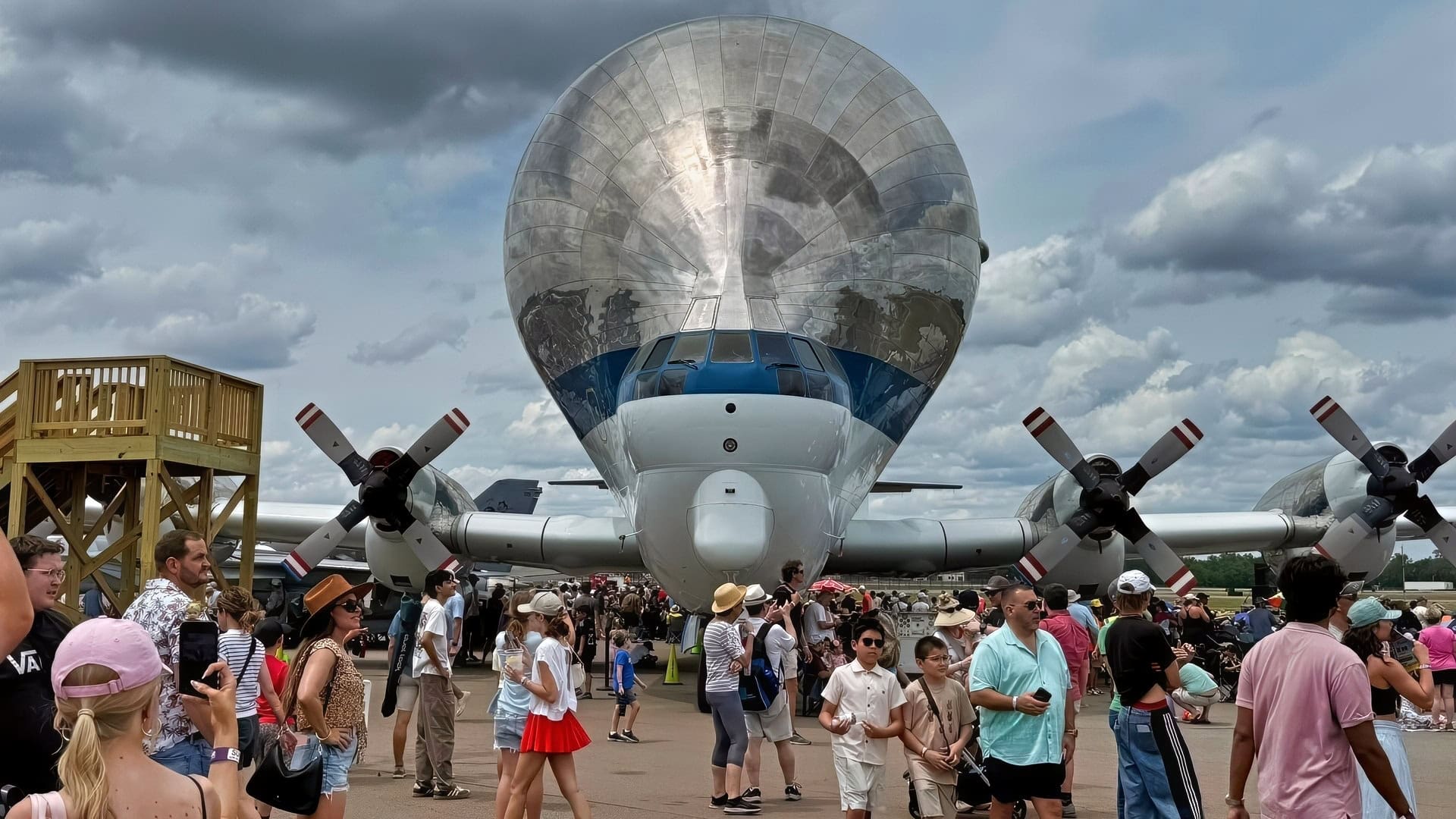
Our esteemed Editor, Mr. Harry J. Kazianis, was lucky enough to attend the SUN ‘n FUN Aerospace Expo (which ran April 14 to April 19, 2026) at Lakeland Linder International Airport, Florida, and in the process, he was lucky enough to not just photograph but actually touch one of the weirdest-looking airplanes ever built: the Aero Spacelines Super Guppy. “A picture is worth 1,000 words,” as the saying goes, but we’re going to double down by telling this ungainly-looking aircraft’s life story in pictures and with as much detail as we can.
What’s In a Name Part I: “Fishy” Flying Machines
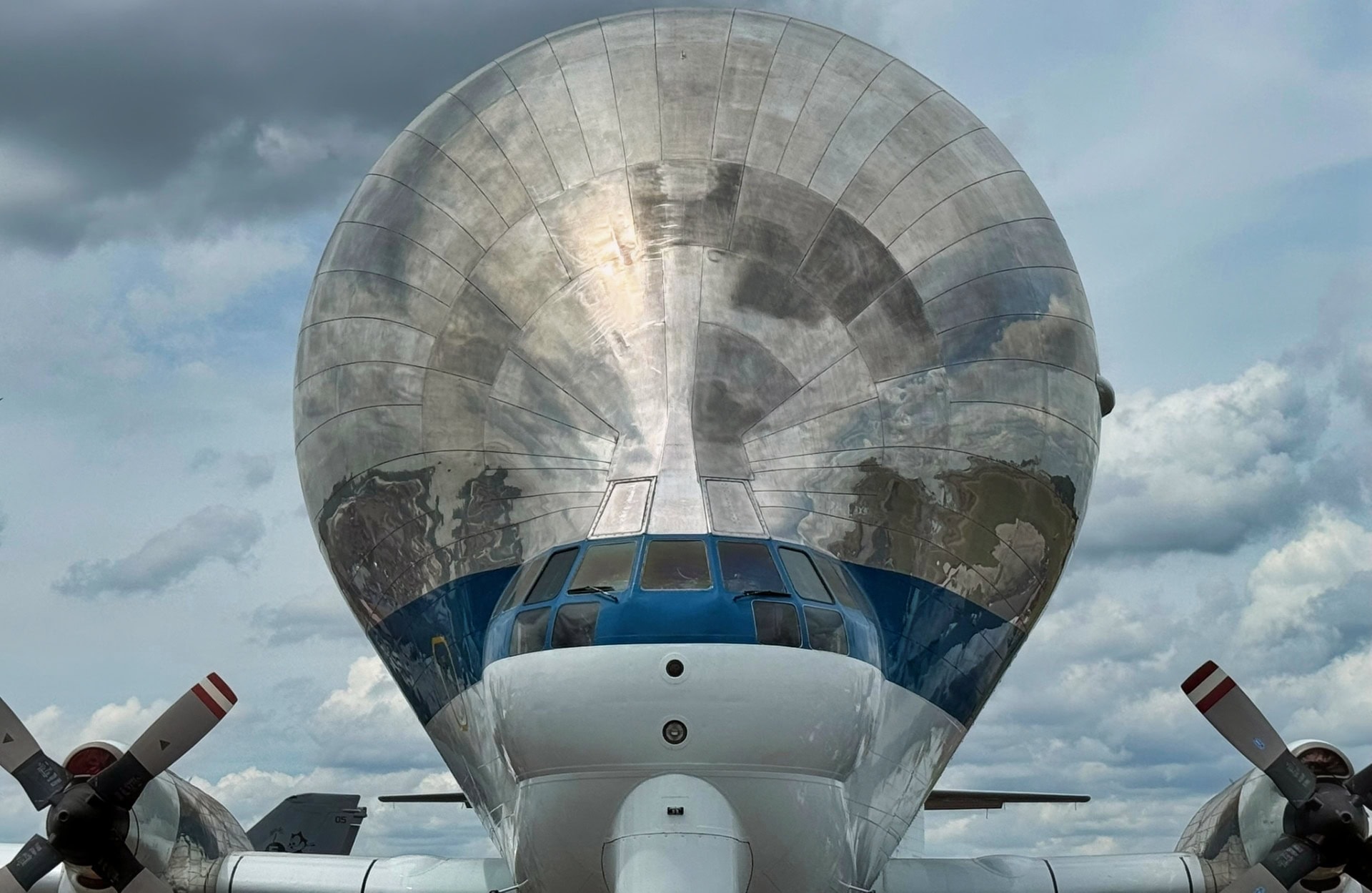
Super Guppy NASA 19FortyFive.com Image Taken on 4/19/2026.
Unsurprisingly, many fish species have served as the namesake for submarines’ names. The guppy (Poecilia reticulata) is among the relatively few fish species to have both a submarine—as in the GUPPY-class submarines of the early Cold War—and an airplane named in its honor. (Ironically enough, the flying fish does not bear that dual distinction. Go figure.)
Another famous example was the Swordfish: during WWII alone, there was the USS Swordfish (SS-193), the Royal Netherlands Navy Zwaardfisch class, and the Fairey Swordfish torpedo bomber, which proved to be a deadly warbird for the British Royal Navy’s Fleet Air Arm despite its seeming obsolescence as a biplane.
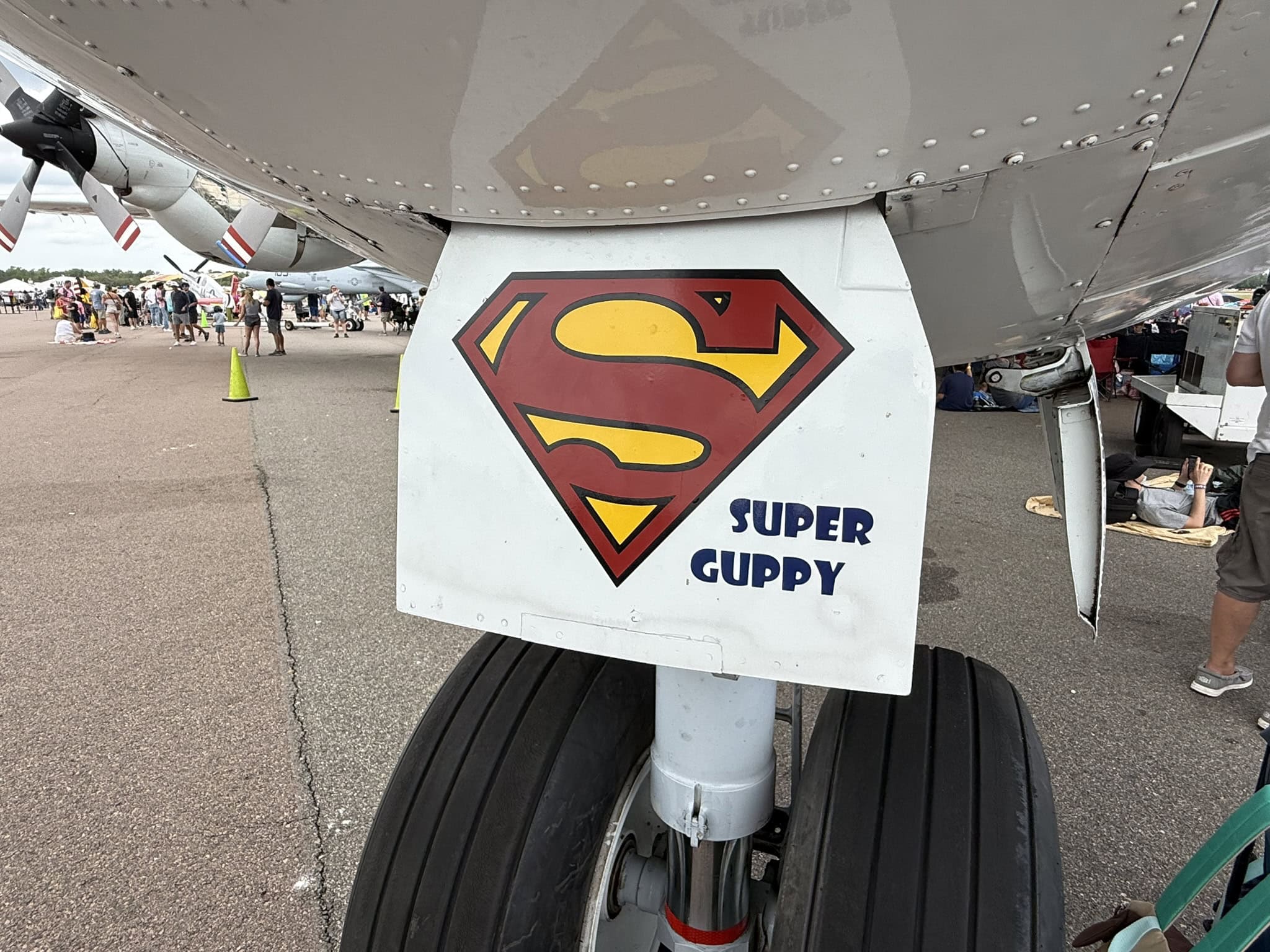
As for the Super Guppy, as with the GUPPY-class undersea boats, it was an American-made Cold War-era design. However, the airplane was a NASA project rather than a U.S. Department of Defense project.
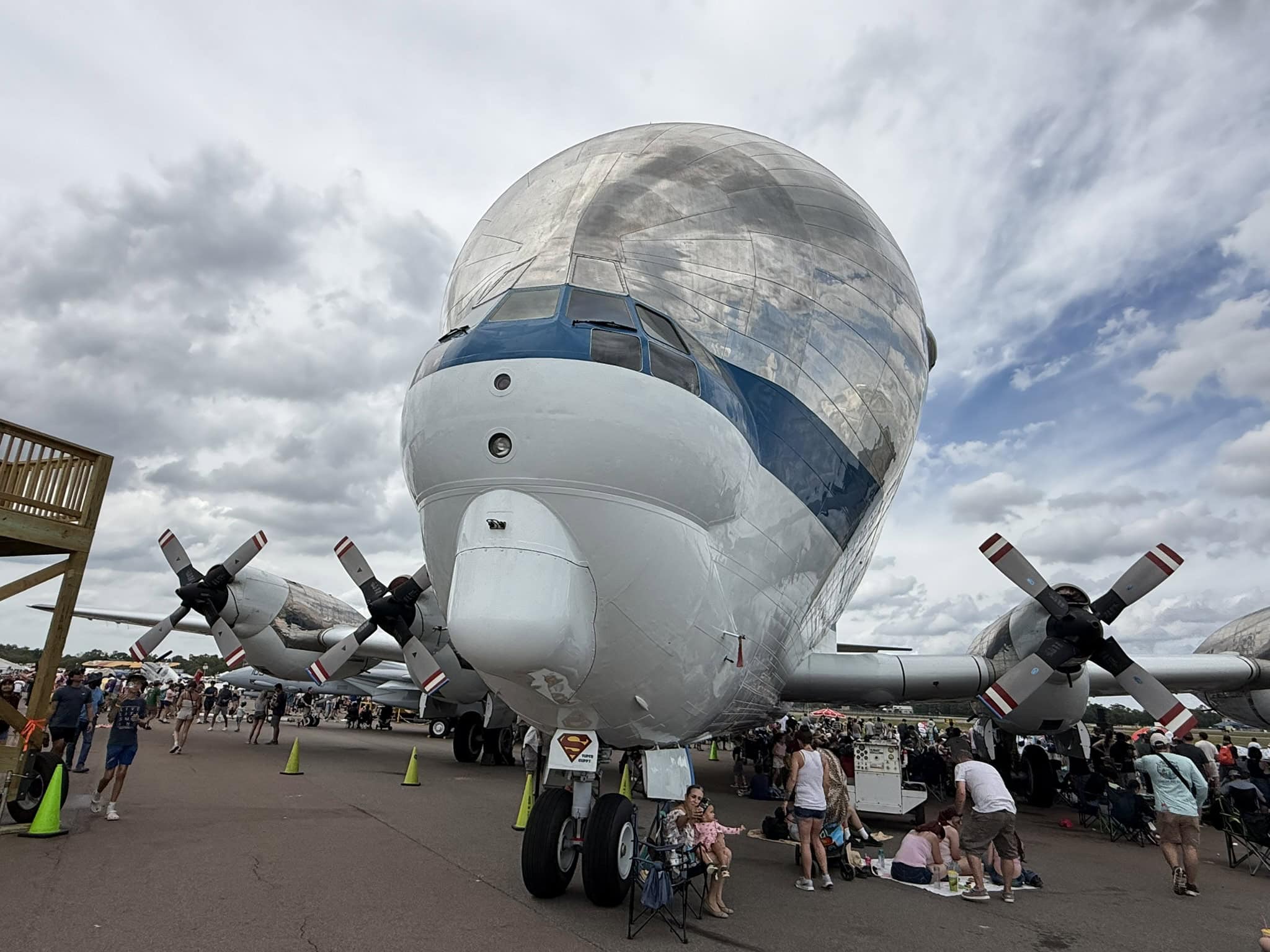
Super Guppy NASA 19FortyFive.com Image Taken on 4/19/2026.
What’s In a Name Part Deux: The Original Flying Guppy
Before there was the Super Guppy, there was the Pregnant Guppy, which was a converted Boeing 377 Stratocruiser.
When U.S. commercial airline companies started phasing out the piston-engined Stratocruiser in favor of jet-powered airliners (such as the 707, another Boeing product) circa 1960, an aircraft broker named Leo Mansdorf was stockpiling surplus Stratocruisers at Van Nuys Airport in Southern California for resale, and a former U.S. Air Force named John Michael “Jack” Conroy got an idea.
Noting that NASA was spending the proverbial arm and a leg NASA was using barges to transport increasingly large rocket components from manufacturers on the West Coast to test and launch sites on the East Coast (transiting laboriously through the Panama Canal or Gulf of Mexico [now known as the Gulf of America, of course]), Mr. Conroy realized that a modified 377 airframe could be used to transport the large but relatively lightweight components for the rockets of the Apollo space program for a lot less time and money.
He pitched the concept to NASA, whose officials were initially lukewarm on the idea; one of those officials conjured up the “Pregnant Guppy” nickname in derision (although some marine biology buffs might see more of a resemblance to a sperm whale in the attached photos, which would make Captain Ahab roll over in his watery grave.
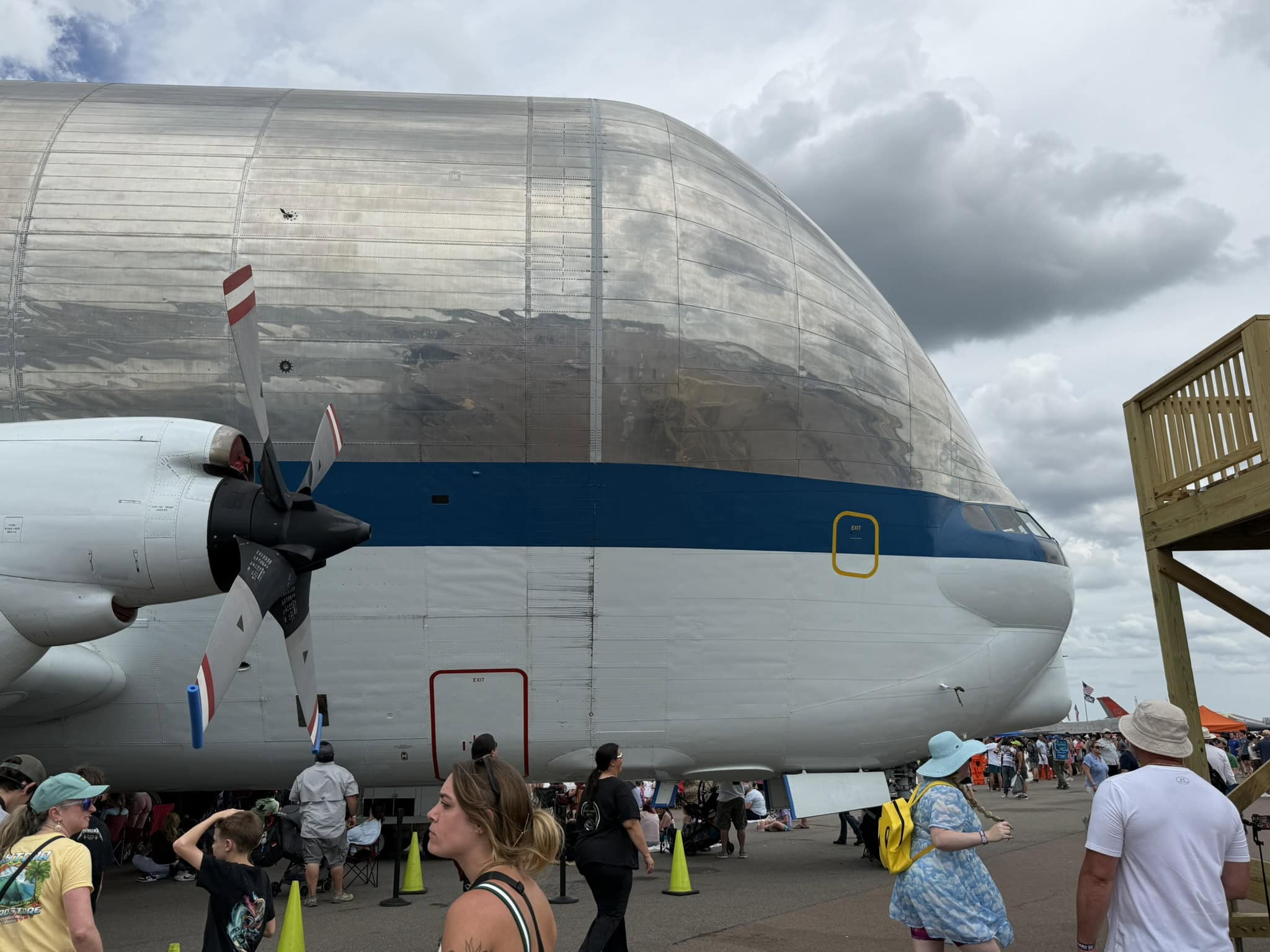
Super Guppy NASA 19FortyFive.com Image Taken on 4/19/2026.
However, Conroy didn’t give up easily, and he took a gamble by mortgaging his house and founding Aero Spacelines International (ASI) to build and operate the concept aircraft. His persistence and willingness to roll the dice paid off.
The Pregnant Guppy nickname stuck (which went to show that Jack Conroy had both a thick skin and a sense of humor, two typical traits of a fighter pilot), the plane made its maiden flight on September 19, 1962, NASA officially adopted it the following year, and the “fat fish” (so to speak) ended up delivered the S-IV Saturn I rocket stage three weeks faster than a barge, for the mere cost of $16.00 USD (equivalent to $166.09 in today’s dollars) per mile.
The Pregnant Guppy served faithfully until it was retired and scrapped in 1979. By sad coincidence, Jack Conroy passed away that same year, at the way too young age of 58, due to colon cancer.
Enter the Super Guppy: Initial History and Specifications
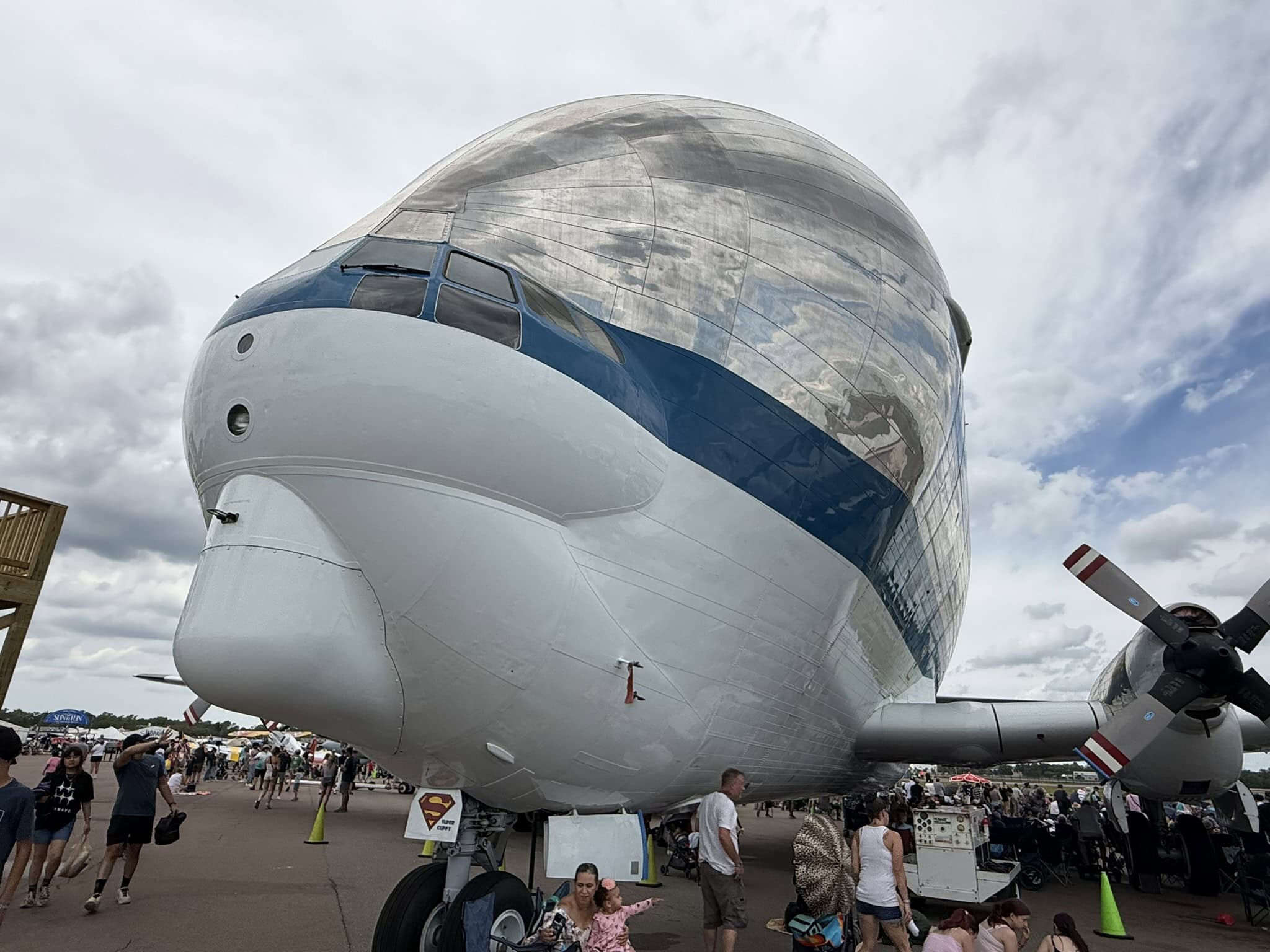
In the 16 years between the Pregnant Guppy’s acceptance by NASA and the death of both the plane and its developer, Jack Conroy wasn’t content to simply rest on his laurels, and on August 31, 1965, the Super Guppy (“SG”) made its own maiden flight.
Super Guppy NASA 19FortyFive.com Image Taken on 4/19/2026.
That first SG was based on the Boeing C-97 Stratofreighter (which fans of the late, great bestselling adventure novelist Clive Cussler will recognize as the airplane gracing the cover of his classic 1978 book “Vixen 03”).
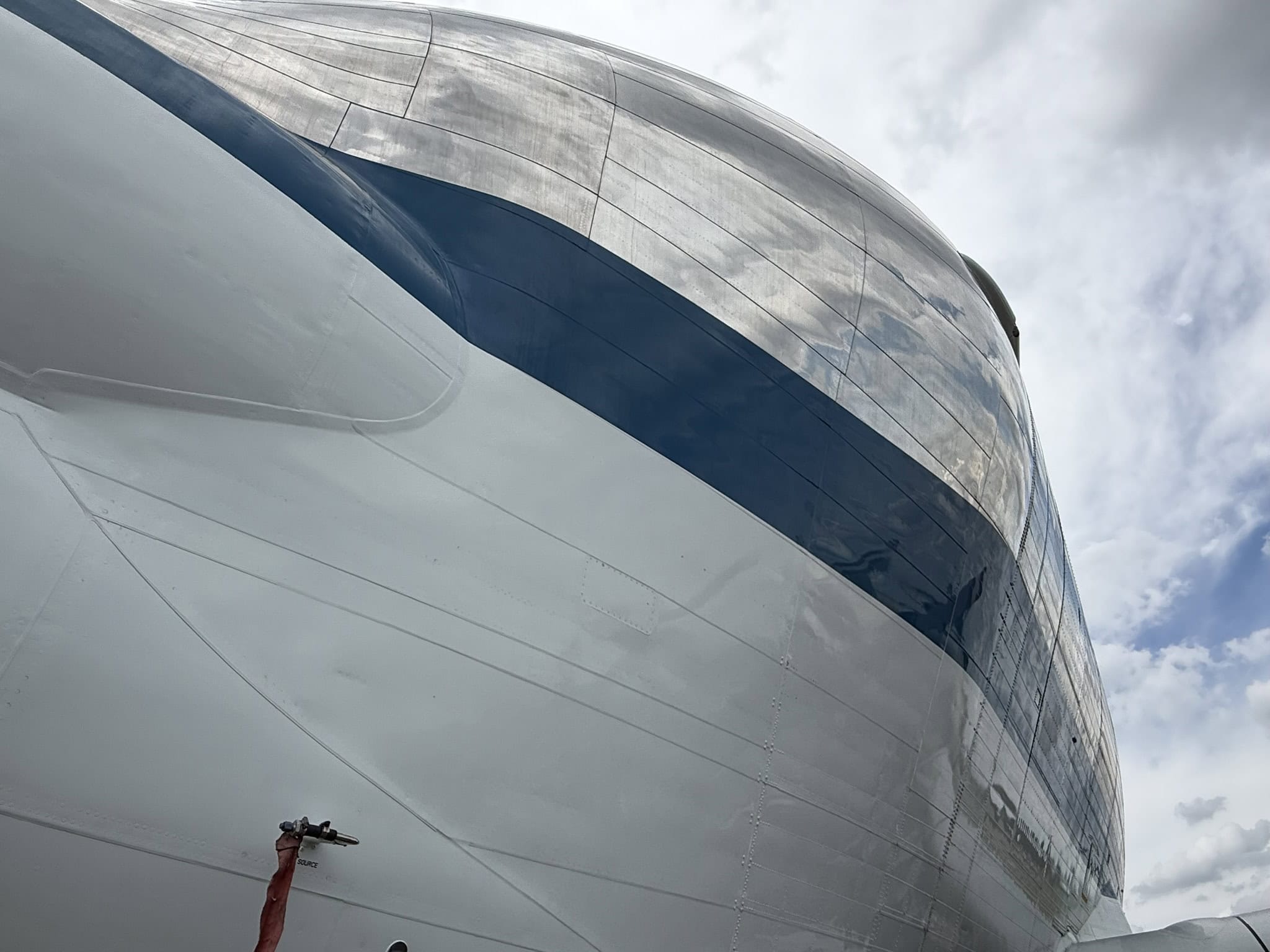
The original C-97 fuselage was lengthened to 141 feet (43 m), with the internal diameter expanded to 25 ft (7.6 m); cargo compartment length was 94.5 feet (28.8 m), but the cargo compartment floor width was still limited to 8.75 feet.
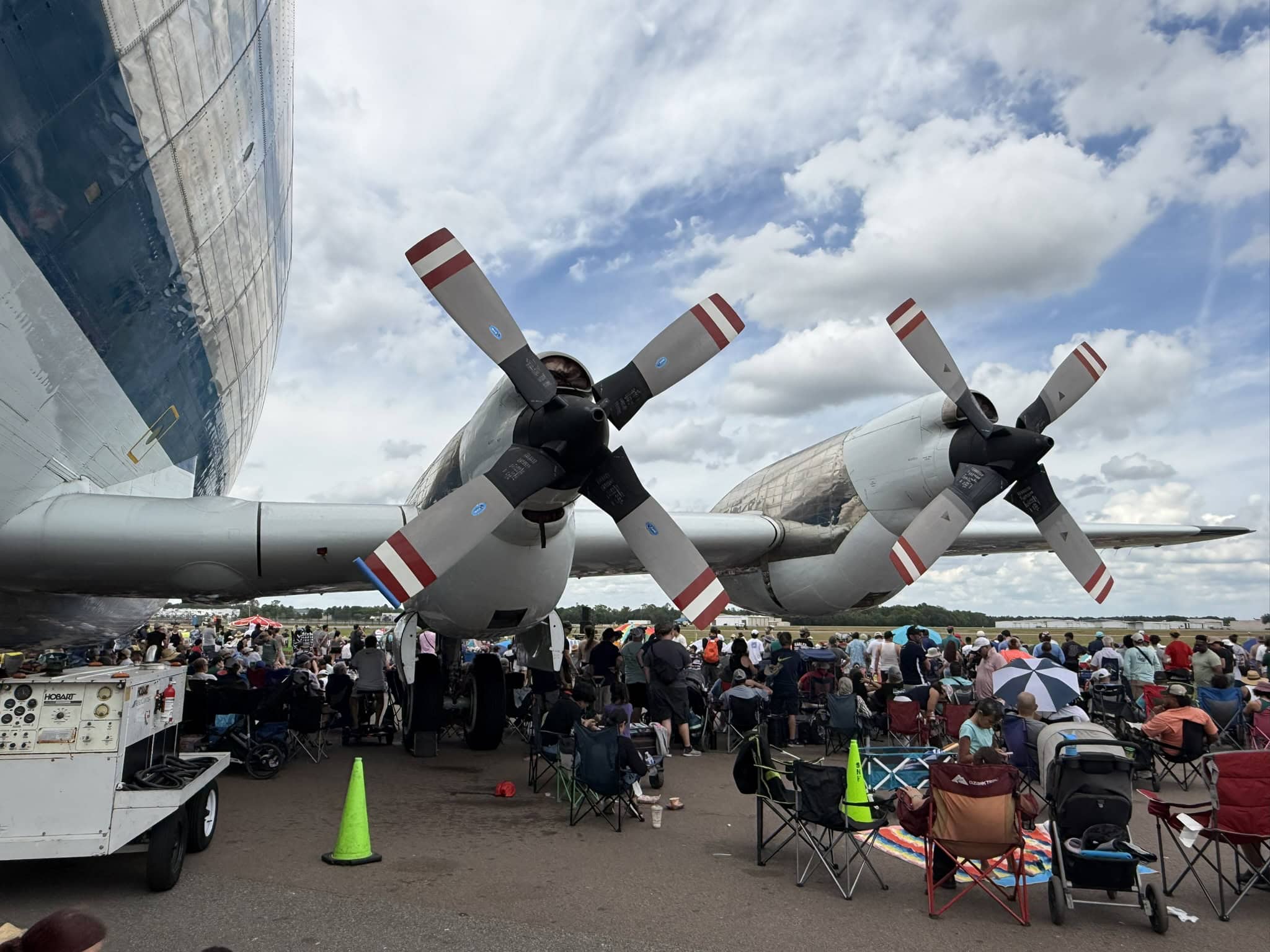
The plane used Pratt & Whitney T-34-P-7WA turboprop engines for increased power and range, along with modified wing and tail surfaces.
It had a carrying capacity of 54,000 lbs. and a cruise speed of 300 mph (Mach 0.39).
Alas, that first specimen suffered fuselage collapse on September 25, 1965, when undergoing high-speed dives (starting at 10,000 feet) during certification tests.
To make a scary situation even scarier, the fish-bird (so to speak) was 30,000 lbs. of borate in 100-lb. sacks, which were damaged and spilled, temporarily blinding the crew.
Fortunately, with the help of a DC-9 chase plane, the hardy crew was able to safely land the stricken Super Guppy on the dry bed of Rogers Dry Lake.
Super Guppy NASA 19FortyFive.com Image Taken on 4/19/2026.
Successful Super Guppy Sequel: The SGT
As we already noted, Mr. Conroy was not one to give up easily. He and his ASI crew got cracking on the next edition, the Super Guppy Turbine (SGT), of which 4 specimens were built.
This variant employed the more reliable and readily available Allison 501-D22C (aka T56) engines, which generated approximately 4,680 hp. Meanwhile, the main portion of its fuselage was constructed from scratch this time, which enabled the ASI engineers to widen the cargo compartment floor to 13 feet. (So much for 13 being an unlucky number.)
Overall cargo compartment length was increased to 111.5 feet; the improved fuselage and engines enabled a maximum load capacity of 52,500 lb.; and a hinged nose made it far easier to onload and offload that extra cargo.
Super Guppy NASA 19FortyFive.com Image Taken on 4/19/2026.
A pressurized crew cabin (with a crew capacity of four) enabled cruising at much higher altitude, with a service ceiling of 25,000 feet; optimal cruise speed and altitude were 250 mph (Mach 0.32) at 20,000 feet, whilst max airspeed was 290 mph (Mach 0.37). Wingspan was 156.25 feet.
To this day, the plane is known as the world’s largest-volume cargo transporter with a uniquely designed fuselage.
According to the official NASA info page, the original Super Guppies flew over three million miles in support of the Apollo, Gemini, Skylab, and the International Space Station programs.
Airbus eventually purchased the SGTs from ASI and used them to ferry large A300 fuselage sections throughout Europe from the 1970s to the 1990s.
Airbus retired the fleet to museums in 1997, at which point NASA purchased SGT Serial No. 0004 to replace the aging original Super Guppy under an International Space Station barter agreement with the European Space Agency.
One Super Guppy Driver’s Perspectives
In a December 2025 interview for the Wings Over the Rockies Air & Space Museum’s Facebook page, NASA pilot Ray Heineman had this to say about the challenges of flying the Super Guppy: “It takes all your strength to move the airplane around, there are no hydraulically boosted controls, and you’re in here using muscle power to move the airplane around the sky…The landings are the biggest challenge. Any kind of a crosswind with a large side area really makes this airplane a handful.”
Super Guppy NASA 19FortyFive.com Image Taken on 4/19/2026.
Where Are They Now?
Serial No. 0004 (current Registration No. N941NA; formerly F-GEAI), the one whose pictures you see herein, is the only airworthy Super Guppy specimen still left. It’s based at El Paso International Airport in Texas, and its crews work with the Department of War and government contractors to move aircraft and large components around the continent, including T-38 Talons for the Air Force and V-22 Ospreys for the Navy.
As for the others:
-The original Super Guppy, Serial No. 52-2693, is on display at the Pima Air & Space Museum near Tucson, Arizona
-The first of the SGT batch, Serial No. 0001, was broken up in December 2020, with the cockpit preserved by the South Wales Aviation Museum
-Serial No. 0002 is on static display at the Aeroscopia museum near the Airbus factory at Toulouse–Blagnac Airport in France
-Serial No. 0003 is on static display near the Airbus factory at Hamburg Finkenwerder Airport in Germany.
About the Author: Christian D. Orr
Christian D. Orr is a Senior Defense Editor. He is a former Air Force Security Forces officer, Federal law enforcement officer, and private military contractor (with assignments worked in Iraq, the United Arab Emirates, Kosovo, Japan, Germany, and the Pentagon). Chris holds a B.A. in International Relations from the University of Southern California (USC) and an M.A. in Intelligence Studies (with a concentration in Terrorism Studies) from American Military University (AMU). He is also the author of the book “Five Decades of a Fabulous Firearm: Celebrating the 50th Anniversary of the Beretta 92 Pistol Series,” the second edition of which was recently published.