
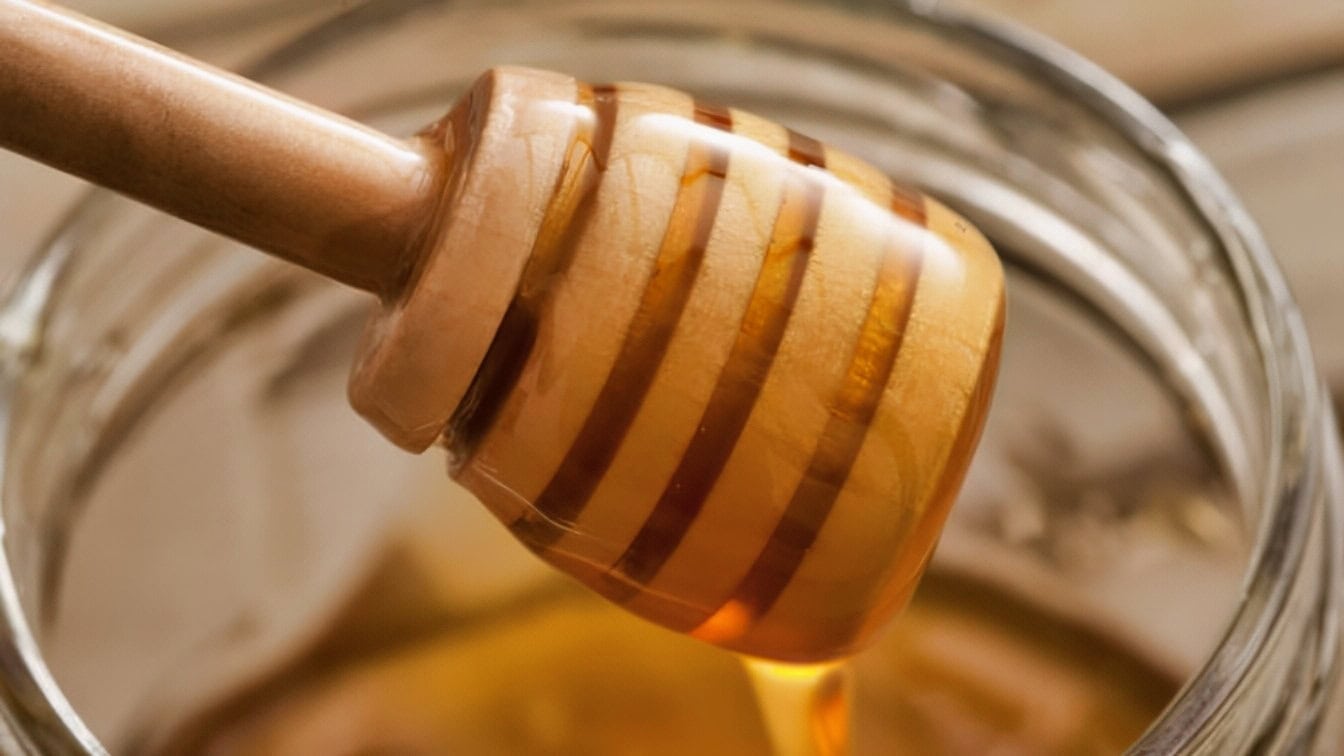
Archaeologists opening Egyptian tombs sealed more than 3,000 years ago have found jars of honey still liquid, still sweet, and still perfectly edible — because honey is one of the only foods on Earth that never spoils, and the reason comes down to three things a bee does to it before it ever reaches the comb
The 3,000-Year-Old Jar
When archaeologists open a tomb that has been sealed for three thousand years, they expect to find bone, gold, painted plaster, the dry remains of a world that stopped. Every so often they find something stranger: a sealed jar of honey, and inside it, honey. Not fossilized, not turned to stone, not a brown crust at the bottom of a pot. Liquid. Sweet. Honey recovered from ancient Egyptian tombs has been reported still edible after thousands of years, one of the few foods a person could lift from a grave and eat without a second thought.
Egypt buried its dead with what they would need on the far side. Jewelry, games, clothing, furniture, and food for the journey, jars of honey set among the grave goods. Almost all of it decayed on the ordinary schedule of buried things. The honey did not. It sat in the dark through the rise and fall of empires, through the whole span of recorded history, and stayed close to what it had been the day the lid went on.
This is the thing worth stopping on before any chemistry: not a preserved food, but a food that was never in much danger of spoiling in the first place. The reason is not the tomb, or the dry Egyptian air, or any trick of the embalmers. The reason came with the honey. It was built in by the bee.
The Food That Never Spoils
Almost everything people eat is on a clock. Fruit softens and molds, meat rots, bread goes hard and then green, milk turns. The whole apparatus of the modern kitchen, refrigerator and freezer and sealed can, exists to slow that clock for a few days or a few months. A very short list of foods ignore it entirely and keep, in their raw state, more or less forever: salt, sugar, dried rice. Honey belongs on that list, and it is the only one a person would want to eat straight from a thousand-year-old jar.
Kept sealed and kept dry, honey does not spoil. Not in a year, not in a century, not in the reign of a pharaoh and out the other side. That word sealed matters, and it is the one honest asterisk on the whole story, because honey is not supernatural. Leave a jar open in a humid kitchen and it will slowly draw water from the air until, as Lewis Bartlett, a University of Georgia biologist who studies honey bees, explains, the water rises to a point where yeast can grow and the honey ferments. The long life is real, but it is conditional, and the condition is a closed lid.
One more point belongs here, because it trips people up. Honey that has gone thick, pale, and grainy in the back of the cupboard has not spoiled. That is crystallization, the natural sugars settling out of the liquid, and it is not a sign of anything wrong. Set the jar in warm water for a while and the crystals melt back into the smooth, clear honey they came from. A solid jar is not a dead one.
What makes the whole thing possible is not magic, though it can look like it. It is closer to engineering, a set of conditions so hostile to spoilage that nothing which causes spoilage can get a foothold. And nearly all of that engineering is done, before the honey ever reaches the comb, by the bee.
Three Things a Bee Does
Spoilage is not something a food does on its own. It is the work of living things, bacteria, molds, and yeasts, that move in, feed, and multiply. Stop them from living in the food and the food does not spoil. Honey stops them three separate ways.
The first is water, or the near-total absence of it. Honey starts as nectar, which is mostly water, by some estimates sixty to eighty percent of it. Finished honey is down around seventeen to eighteen percent water, and closing that gap is the bees’ doing. Back at the hive, they fan their wings over the open cells, driving the moisture off and thickening the nectar toward its dry final state. Honey is also hygroscopic, meaning it holds almost no free water of its own and will pull moisture from whatever sits near it. To a microbe, this is a desert. As Amina Harris of the Honey and Pollination Center at the University of California, Davis, put it, “Very few bacteria or microorganisms can survive in an environment like that.” There is simply not enough water to live on.
The second is acid. Honey is naturally acidic, with a pH that falls roughly between three and four and a half, typically near 3.9, in the range of vinegar. That is a chemistry most microbes cannot tolerate. It is not the whole answer on its own, and there is a comparison that proves the point: molasses is also thick and hygroscopic and somewhat acidic, and molasses, given enough time, spoils. One barrier is not enough. It is the barriers together that make honey what it is.
The third comes from the bee’s own body, and it is the one that turns honey from merely inhospitable into actively antibacterial. Bees carry an enzyme called glucose oxidase, which they mix into the nectar as they process it. As the honey ripens, that enzyme drives a slow reaction that produces gluconic acid and, along with it, small amounts of hydrogen peroxide, the same compound sold in brown bottles as a disinfectant. It is not sitting in the jar in any quantity; it is generated a little at a time, as the honey matures and again when it is diluted. But it is enough. On top of the drought and the acid, the honey makes its own low dose of antiseptic.
Water, acid, and a trace of peroxide, three barriers stacked one behind another. That is the whole secret of the jar in the tomb. Nothing that could rot it was ever able to live in it long enough to try.
The Life’s Work in a Spoonful
There is a second wonder folded into the first, and it is about the labor. Honey is cheap and it comes in big plastic bottles, and that ordinariness hides what it takes to make.
Start with a single bee. Over her entire life, the average worker honey bee produces about one-twelfth of a teaspoon of honey. Not a jar. Not a spoonful. One-twelfth of a spoonful, and that is the sum of everything she does. Now scale up to something a hand can hold. To make a single pound of honey, the bees of a hive together visit somewhere on the order of two million flowers, and in the gathering they fly a combined distance of more than fifty-five thousand miles. The planet is about twenty-five thousand miles around at the equator, which means a pound of honey stands for more than two laps around the Earth, flown a few hundred yards at a time and a single flower at a stop.
Those figures deserve a word of honesty, because they are averages and they wander from source to source. Beekeeping bodies that run the arithmetic themselves land in the same neighborhood without landing on the same number, and the Canadian Honey Council, laying out its own calculation, says plainly that “the values used for the calculation are averages.” Two million flowers is a good round headline, not a figure measured with a ruler. What holds, whatever the exact count, is the sheer scale of it.
And it is not one tireless bee doing all of that. A worker bee in the warm months lives only about six to eight weeks, and she spends much of that short life on jobs inside the hive before she ever flies out to forage. The two million flowers are the pooled work of a large, rotating, short-lived workforce, each bee adding her twelfth of a teaspoon and then being replaced by the next. A jar of honey is less a grocery item than a record of an enormous amount of small, repeated effort, most of it done by insects that did not live to see the jar filled.
Why It Still Matters
The chemistry that keeps a pharaoh’s honey edible is not only a museum curiosity. It is the same chemistry that puts honey on wounds, and it has been doing that job for as long as there are written records to check. Sumerian clay tablets list honey in a large share of their medical prescriptions, by one count nearly a third of them. Egyptian physicians spread it on burns, skin, and eye complaints. The logic is exactly the three-part defense already described: a dressing that holds no water, runs acidic, and gives off a trace of hydrogen peroxide is a dressing bacteria struggle to colonize.
That ancient practice has walked back into the modern hospital. Licensed medical-grade honey, sterilized and standardized, is used today in wound and burn care, and in laboratory testing it works against a wide range of bacteria, including drug-resistant strains such as MRSA that shrug off frontline antibiotics. Researchers who have systematically reviewed the evidence note something striking, that bacteria do not appear to develop resistance to honey the way they do to conventional drugs. Some medical-grade honey draws its strength from that same peroxide reaction; one well-known variety, Manuka honey from a shrub native to New Zealand and Australia, gets most of its power from a different compound, methylglyoxal, concentrated from the plant’s nectar. The clinical picture is still being worked out, and honey is no miracle cure. But the oldest wound dressing on record is, in a real sense, back on the shelf.
There is one place, and only one, where the food that never spoils carries a hard and non-negotiable exception, and it has to be said plainly. Never give honey to a baby under one year old. Honey can carry dormant spores of a bacterium called Clostridium botulinum, and while the acid and dryness that kill ordinary spoilage organisms cannot make those tough spores grow inside a sealed jar, an infant’s immature gut is a different setting, one where the spores can wake, multiply, and produce a dangerous toxin. This is not a flaw in the honey and it is not a disease of the bees; the spores are a stray environmental contaminant, carried into the hive on dust or water. Public health authorities are blunt that honey is, in their words, “the one identified and avoidable food reservoir of C. botulinum,” even though most infant cases trace to ordinary household dust rather than to food. The rule from pediatricians is simple and absolute: no honey before the first birthday, not in food, not in water, not even a taste off a pacifier. After a year, a child’s gut has matured, its resident bacteria hold the spores in check, and the same honey is safe.
Which brings the story back to the jar in the tomb. The honey an Egyptian sealed away three thousand years ago and the honey a hospital spreads on a burn today are protected by the very same three things, the dryness, the acid, and the faint self-made antiseptic, all of it arranged by an insect a twelfth of a teaspoon at a time. The oldest edible thing ever lifted from the ground and one of the oldest medicines still in use turn out to be the same substance, keeping for the same reasons, worked out by the bee long before anyone thought to ask how it held.
About the Author: Harry J. Kazianis
Harry J. Kazianis (@Grecianformula) was the former Senior Director of National Security Affairs at the Center for the National Interest (CFTNI), a foreign policy think tank founded by Richard Nixon based in Washington, DC. Harry has over a decade of experience in think tanks and national security publishing. His ideas have been published in the NY Times, The Washington Post, The Wall Street Journal, CNN, and many other outlets. He has held positions at CSIS, the Heritage Foundation, the University of Nottingham, and several other institutions related to national security research and studies. He is the former Executive Editor of the National Interest and the Diplomat. He holds a Master’s degree focusing on international affairs from Harvard University.