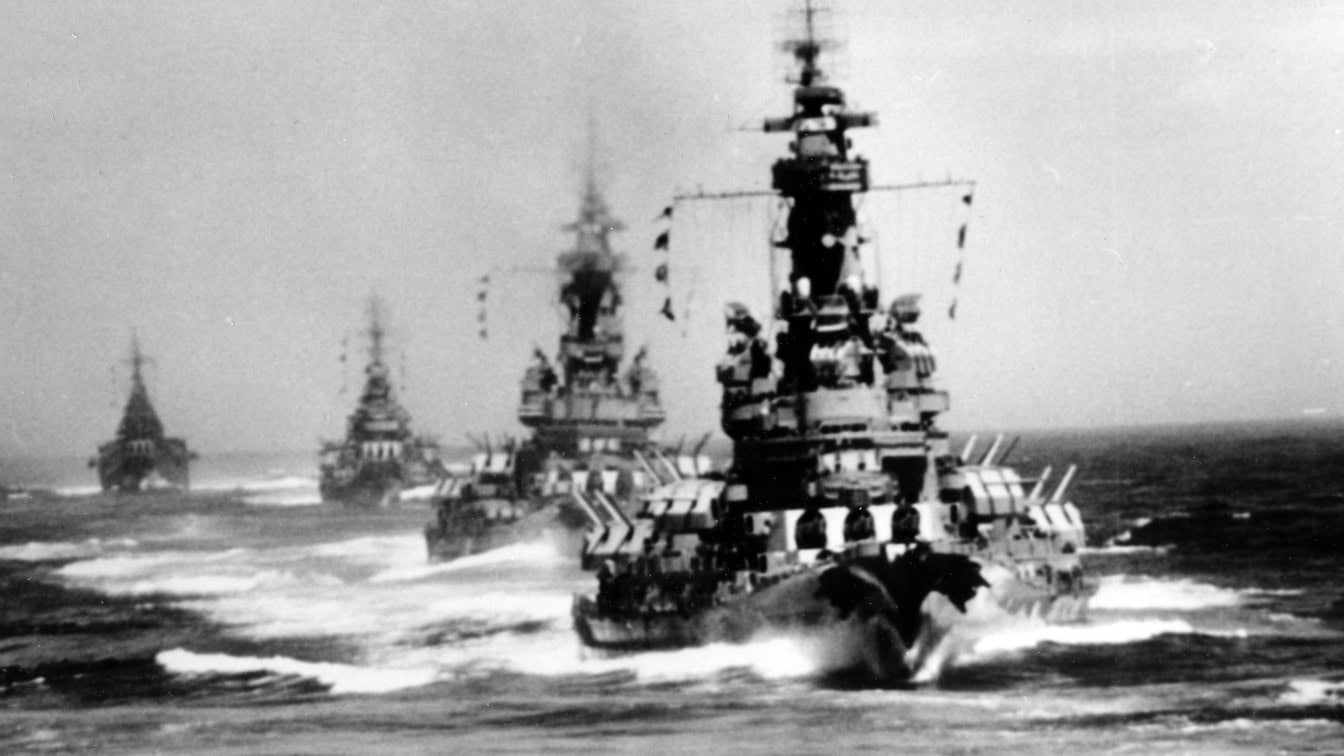
Summary and Key Points: The South Dakota-class battleship USS Indiana (BB-58), commissioned April 30, 1942, fought from Guadalcanal to Kwajalein and Saipan, then bombarded the Japanese home islands. Her nine 16-inch guns fired 2,700-pound shells 23 miles; at Saipan she fired 584 rounds and survived two Japanese weapons that failed to explode. In January 1944, the USS Washington’s bow tore through her starboard side during night maneuvers. Decommissioned in 1947, she was sold for scrap in 1963.
No Iowa-Class Battleship But Still Amazing: USS Indiana Was a Powerhouse
The South Dakota-class battleship was one of World War II’s most important warships of World War II.
One ship of that class stands out.
The USS Indiana (BB-58) made quite a name for itself in the Pacific Theater of World War II.
Specs on USS Indiana
Commissioned on April 30, 1942, this leviathan had an impressive combat record, including ship-to-ship engagements, critical shore bombardment missions, fleet defense missions, and even near-misses that would make lesser ships shudder.
Indiana could displace up to 44,000 tons fully loaded.
The ship had four geared steam turbines driving four propeller shafts and was powered by eight boilers, producing 130,000 shaft horsepower.
This battleship could reach up to 27 knots (31 miles per hour).
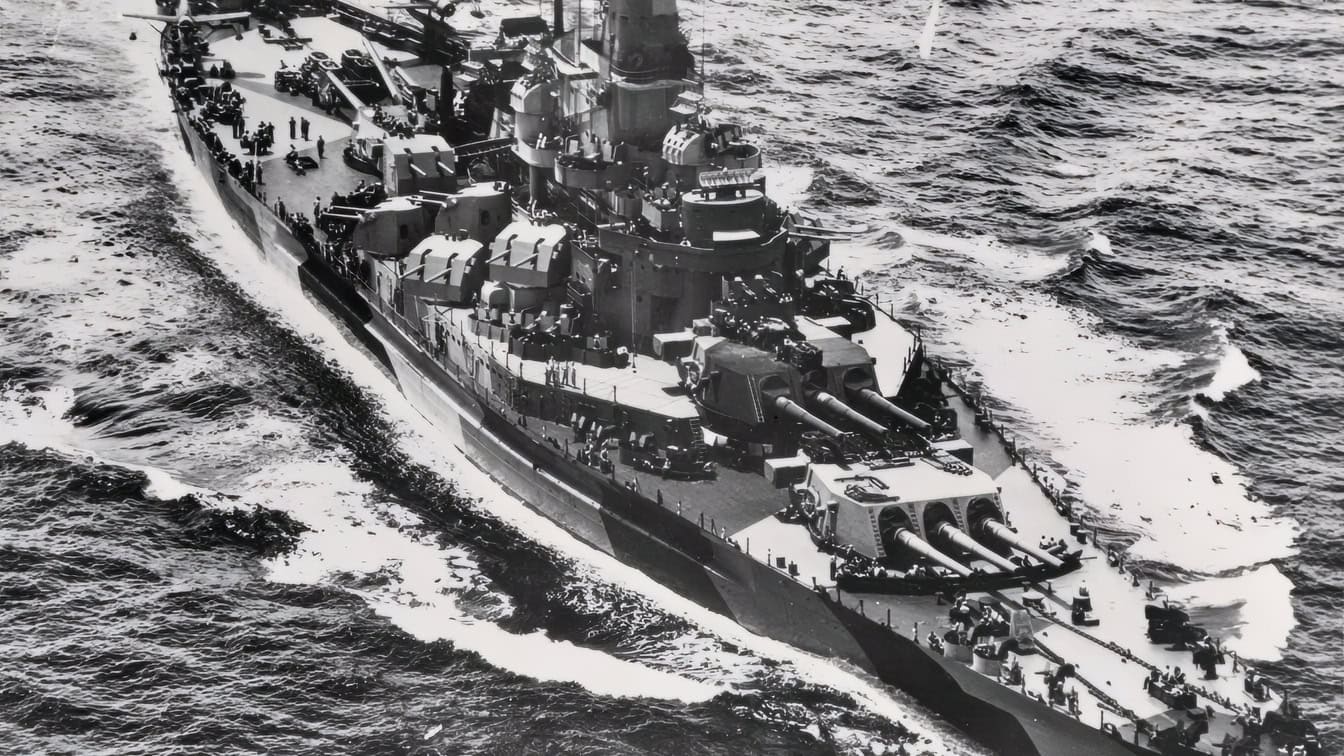
USS Indiana Image Credit Creative Commons
Indiana’s nine 16-inch/45-caliber Mark 6 naval guns were mounted in three triple turrets.
Each gun fired a 2,700-pound armor-piercing shell to a maximum range of about 23 miles.
Her secondary armament consisted of 20 five-inch/38-caliber dual-purpose guns in ten twin turrets.
These weapons could engage enemy aircraft and surface targets.
Her anti-aircraft armament consisted of twenty five-inch/38-caliber dual-purpose guns in ten twin turrets. These weapons were meant to engage enemy aircraft and surface targets.
The Navy ultimately installed multiple 40mm Bofors and 20mm Oerlikon automatic weapons.
Protection included a 12.2-inch-thick armor belt and turret faces about 18 inches thick.
At the start of her life, the Indiana carried a crew of around 1,800 personnel, and that number eventually grew to 2,000 as the Navy upgraded the ship with more weapons and gear.
An Impressive Record
When the Indiana arrived in the South Pacific in November 1942, she joined the Battle of Guadalcanal.
The battleship’s early assignments included escorting US aircraft carriers and supporting attacks on Japanese positions in the Solomon Islands.
Because Japanese surface warships and aircraft remained persistent threats to the US Navy, battleships formed an essential protective shield for the Navy’s ships fighting in the Pacific.
The year 1943 was a critical year for Indiana, in which she supported the US invasion of the Japanese island of Tarawa.
On her way to Tarawa, though, she was dispatched to facilitate the attack on Japanese-held positions in places like Nauru before joining the attack on the Gilbert Islands.
In November 1943, she ultimately participated in the Marine attack on Tarawa.
Indiana and her sister battleships provided naval gunfire support to destroy Japanese coastal positions and other targets before the Marines waded ashore on the fortress island.
When the Indiana attacked the Marshall Islands with the fleet in January 1944, she attacked targets on Kwajalein from 19,000 yards offshore.
Then, the fighting pivoted to a traditional sea battle.
The Indiana and another battleship engaged Japanese ships trying to escape the embattled island’s harbor.
The night after she fought at Kwajalein, the Indiana conducted nighttime maneuvers with her fellow battleship, the USS Washington (BB-56).
During the maneuvers, something went wrong, and the Washington’s bow tore through the Indiana’sstarboard side.
Indiana suffered damage to its key armor plating.
Part of the Washington’s bow even embedded itself into Indiana’s hull.
The Indiana was forced to return to port for major repairs.
But the Indiana’s fight wasn’t finished.
The battleship returned to the Pacific War in June 1944 for the invasion of the Mariana Islands.
During the Battle of Saipan, the Indiana fired 584 rounds from her 16-inch guns.
Most of those rounds were high-capacity explosive shells. Japanese aircraft attacked the American formation near Saipan and Tinian.
Then, Indiana opened fire on approaching Japanese aircraft.
Her guns struck the plane, but it kept attacking and dropped a torpedo that failed to explode.
The burning aircraft crashed just 400 yards from the battleship.
Indiana’s test with fate wasn’t over, though. Shortly after, another Japanese warplane approached and launched a weapon at the battleship, but it failed to explode.
Instead, the Japanese plane crashed into the sea nearby.
Gone But Not Forgotten
Indiana joined US battleships bombarding industrial and military targets in the Japanese home islands. Her 16-inch guns brought heavy naval firepower directly against Japanese territory.
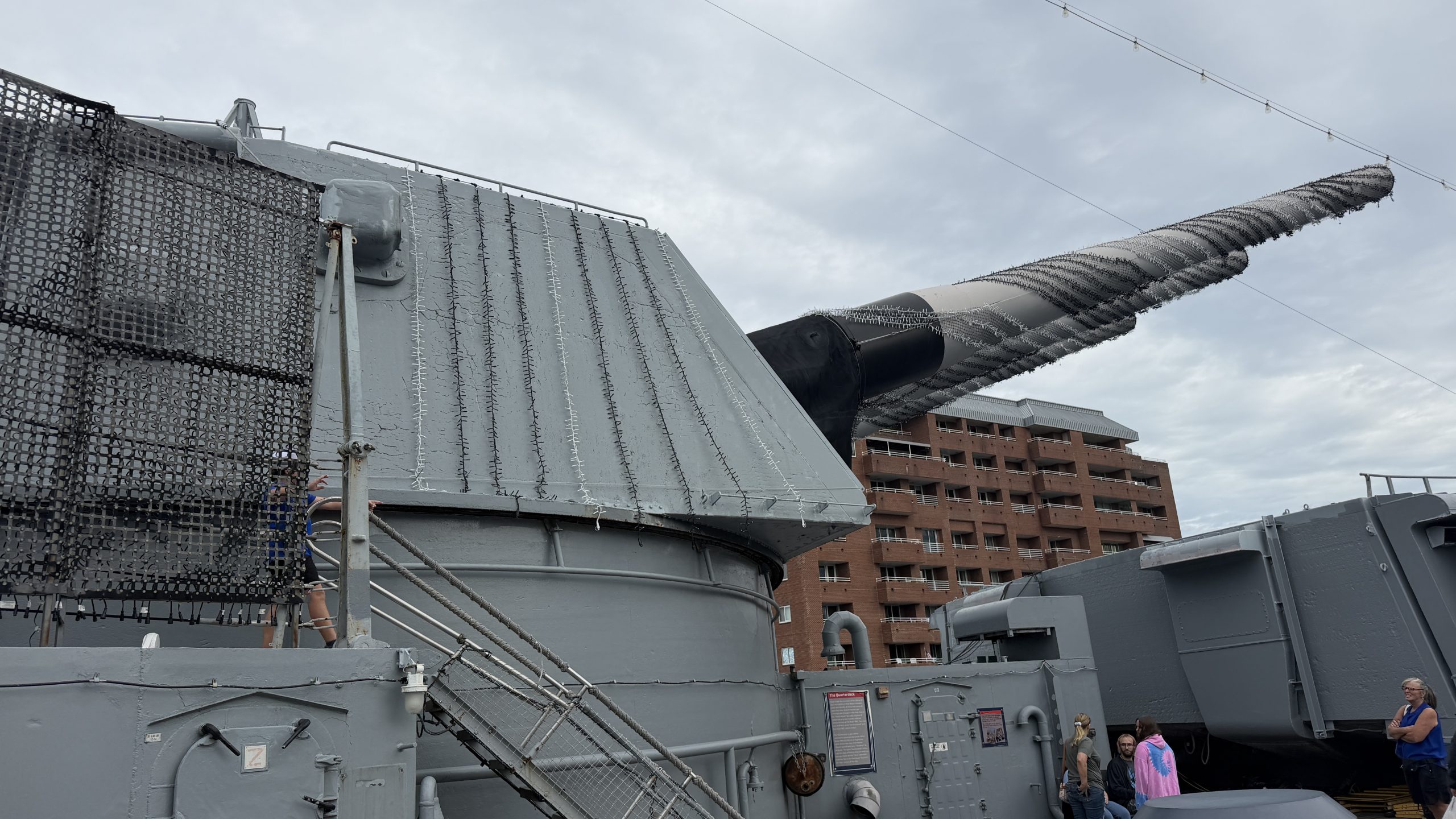
USS Wisconsin Iowa-Class Battleship Tour. Photo by 19FortyFive Reporter Christian D. Orr.
USS Wisconsin Iowa-Class Battleship Tour. Photo by 19FortyFive Reporter Christian D. Orr.
She survived the war.
But she did not survive the massive post-war military downsizing.
After returning to the United States, the Indiana entered reserve in 1946.
The Navy decommissioned her in September 1947 and eventually sold her for scrap in 1963.
While WWII became the war of the aircraft carrier, the battleship remained remarkably useful and relevant as the Navy pushed across the Pacific.
These great ships brought heavy armor, massive firepower, and reliability to a conflict that raged from the Hawaiian Islands to Japan. These battleships were the unsung heroes of that effort.
About the Author: Brandon J. Weichert
Brandon J. Weichert is the Senior National Security Editor at 19FortyFive.com. He also manages The Weichert Brief on Substack. Weichert is the co-host for The Mario Nawfal Show on Twitter/X. He is the author of four bestselling national security books, most recently A Disaster of Our Own Making: How the West Lost Ukraine (Encounter Books). His next book, Fortress Americas: A New Monroe Doctrine (Tucker Carlson Books), is due out December 8. Follow him via Twitter/X @WeTheBrandon.