
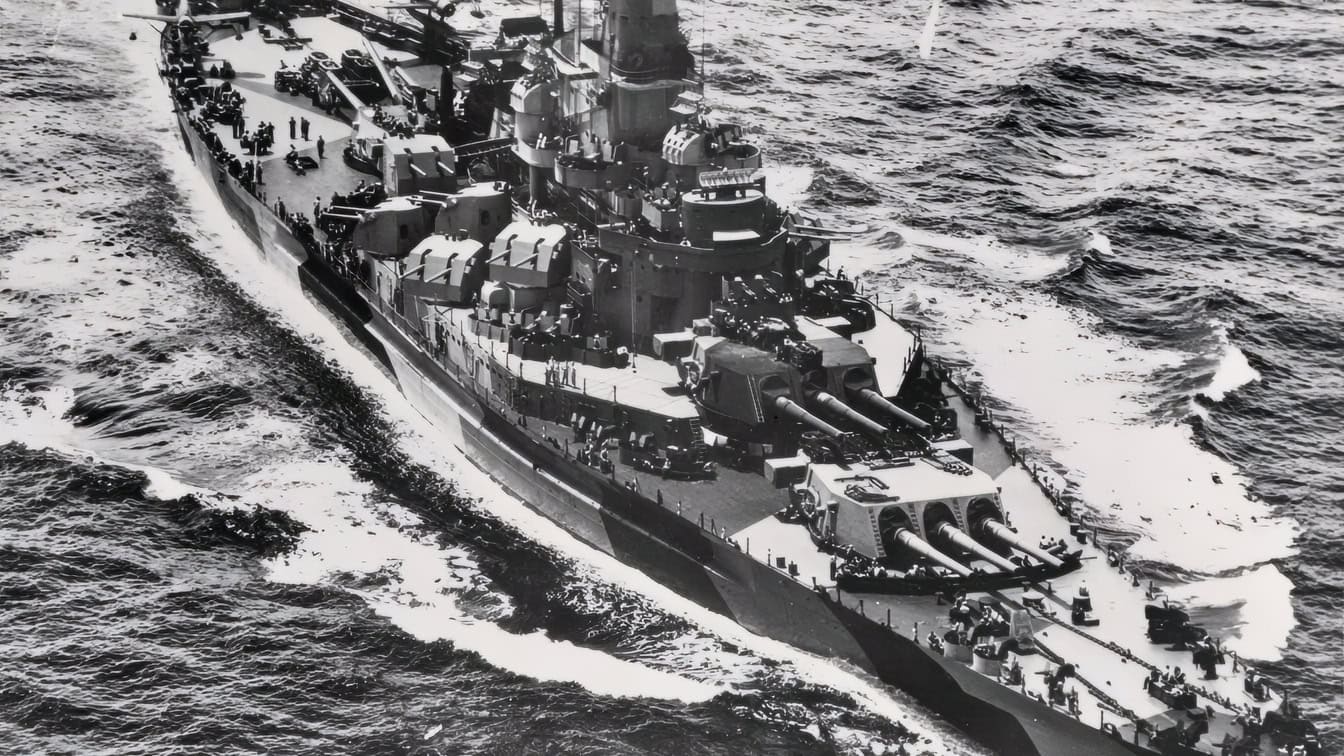
USS Indiana by the Numbers: 44,519 Tons, Nine 16-Inch Guns and Nine Battle Stars: USS Indiana cost about $70 million, displaced 44,519 long tons at full combat load and carried nine 16-inch guns. The South Dakota-class battleship earned nine battle stars during World War II without firing her main battery at an enemy battleship.
Newport News Shipbuilding laid her keel on November 20, 1939, launched her on November 21, 1941, and commissioned her on April 30, 1942. Indiana remained in commission until September 11, 1947, an active career of five years and four months.
The battleship measured 680 feet overall, with a beam of 108 feet 2 inches. Eight boilers supplied four geared turbines, producing 130,000 shaft horsepower through four propeller shafts. Indiana reached 27.5 knots and had a range of 15,000 nautical miles at 15 knots.
Her main battery consisted of nine 16-inch/45-caliber Mark 6 guns in three triple turrets. Each gun fired a 2,700-pound armor-piercing shell, giving Indiana a 24,300-pound broadside. Twenty 5-inch dual-purpose guns and growing batteries of 40mm and 20mm weapons defended the ship against aircraft and smaller vessels.
The South Dakota Design Packed 44,519 Tons Into 680 Feet
Indiana belonged to a four-ship class shaped by the 35,000-ton treaty limit. Later technical histories place her standard displacement at 37,970 long tons, while wartime fuel, ammunition, and anti-aircraft weapons pushed full load to 44,519 tons. The compact hull carried a 12.2-inch armor belt, 18-inch turret faces, and deck protection reaching 6 inches.
That concentration of armor, machinery, and weapons made the South Dakota-class ships powerful but crowded. Indiana’s wartime complement rose toward 2,500 as radar sets and antiaircraft mounts filled limited space. Archival launch material placed construction cost at about $70 million, a contemporary estimate rather than a modern audited program total.
Indiana Fought a Carrier War, Not a Battleship War
Indiana reached the South Pacific late in 1942 and replaced the damaged USS South Dakota around Guadalcanal. She protected convoys, supported troops ashore, and screened fast carriers during raids against Marcus Island, Tarawa, Kwajalein, Truk, and targets across the Central Pacific.
Her record reflected the new naval order. The 16-inch guns had been selected for combat against armored warships, but Indiana spent most of the war defending carriers or firing at land. No documented gun duel with a Japanese surface warship appears in her combat record. Aircraft and submarines usually found Japan’s major warships before American battle lines reached them.
Other American battleships did receive surface engagements. USS South Dakota fought Japanese ships off Guadalcanal while USS Washington fatally crippled Kirishima. USS Massachusetts fired on the French battleship Jean Bart off Casablanca. Those rare encounters form part of the broader record behind America’s most successful World War II battleships. Indiana’s only violent contact with another battleship came from the U.S. Navy.
USS Washington Tore Open Indiana’s Starboard Quarter
Indiana and Washington were operating near Kwajalein in darkness on February 1, 1944, when Indiana turned across Washington’s path. Washington’s bow drove into Indiana’s starboard quarter, tearing away armor and damaging the torpedo-defense system and an outboard propeller shaft.
Three men aboard the Indiana died, six were injured, and one of the wounded later died. An investigation blamed Indiana for failing to properly notify the other ships of her course change. Temporary repairs at Majuro allowed her to reach Pearl Harbor, where repairs continued until April 7.
After trials and a main-battery test, Indiana returned to the fleet in time for the Marianas campaign.
Saipan Put 584 Heavy Shells Through the Main Battery
Indiana fired 584 16-inch shells during the pre-invasion bombardment of Saipan in June 1944. During the Battle of the Philippine Sea, her antiaircraft crews fired 416 5-inch shells, 4,832 rounds of 40mm ammunition and about 9,000 20mm rounds while protecting the carrier force.
The main battery fired another 200 rounds during a January 1945 bombardment of Iwo Jima. Indiana later supported Okinawa and attacks against Japan. She fired 271 16-inch shells at Kamaishi on July 14, 270 at Hamamatsu later that month and another 270 at Kamaishi on August 9.
Those missions produced nine battle stars. They also turned Indiana’s heaviest guns into long-range artillery for amphibious forces and carrier-led raids.
A $120 Million Missile Conversion Never Left the Drawing Board
Indiana entered Tokyo Bay after Japan’s surrender and helped process liberated Allied prisoners. She returned to San Francisco in September 1945 carrying 1,013 passengers, then moved toward reserve status as the Navy reduced its wartime fleet.
The ship was decommissioned on September 11, 1947, and remained at Bremerton for nearly 15 years. A 1950s proposal would have removed all three 16-inch turrets and added Talos and Tartar missiles, anti-submarine weapons, and helicopter facilities. The projected $120 million cost ended the plan.
The Navy struck Indiana from the Naval Vessel Register on June 1, 1962, and sold her for scrap in 1963. Her prow was rededicated beside the ship’s mast and gun mounts at Indiana University’s Memorial Stadium on September 7, 2013.
About the Author: Harry J. Kazianis
Harry J. Kazianis (@Grecianformula) was the former Senior Director of National Security Affairs at the Center for the National Interest (CFTNI), a foreign policy think tank founded by Richard Nixon based in Washington, DC. Harry has over a decade of experience in think tanks and national security publishing. His ideas have been published in the NY Times, The Washington Post, The Wall Street Journal, CNN, and many other outlets worldwide. He has held positions at CSIS, the Heritage Foundation, the University of Nottingham, and several other institutions related to national security research and studies. He is the former Executive Editor of the National Interest and the Diplomat. He holds a Master’s degree focusing on international affairs from Harvard University.

