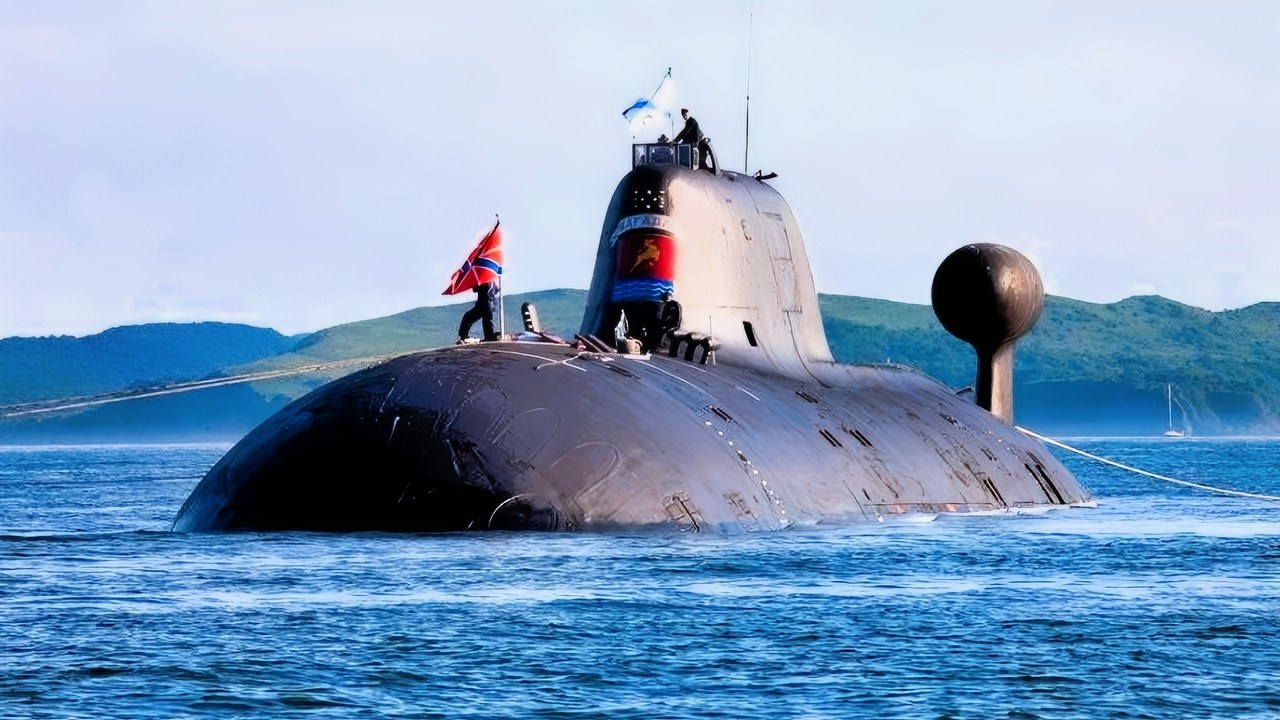
Summary and Key Points: The Project 971 Akula was the Soviet answer to the one leg of the US nuclear triad Moscow could not target: the Ohio-class missile submarines. The plan called for 25 boats, two for each of the 10 Ohios at sea by the end of the 1980s, with a SOKS wake detector to sniff a submarine’s trail. Money ran out with the Soviet Union: the order fell to 20, five were never finished, one went to India on a 10-year lease, and 15 served.
The Akula-Class SSN: Gunning for the US Navy’s Ohio-Class
The US nuclear deterrence strategy during the Cold War centered on the Nuclear Triad.
It consisted of Strategic Air Command bombers, land-based intercontinental ballistic missiles, and submarine-launched ICBMs from Ohio-class SSBNs.
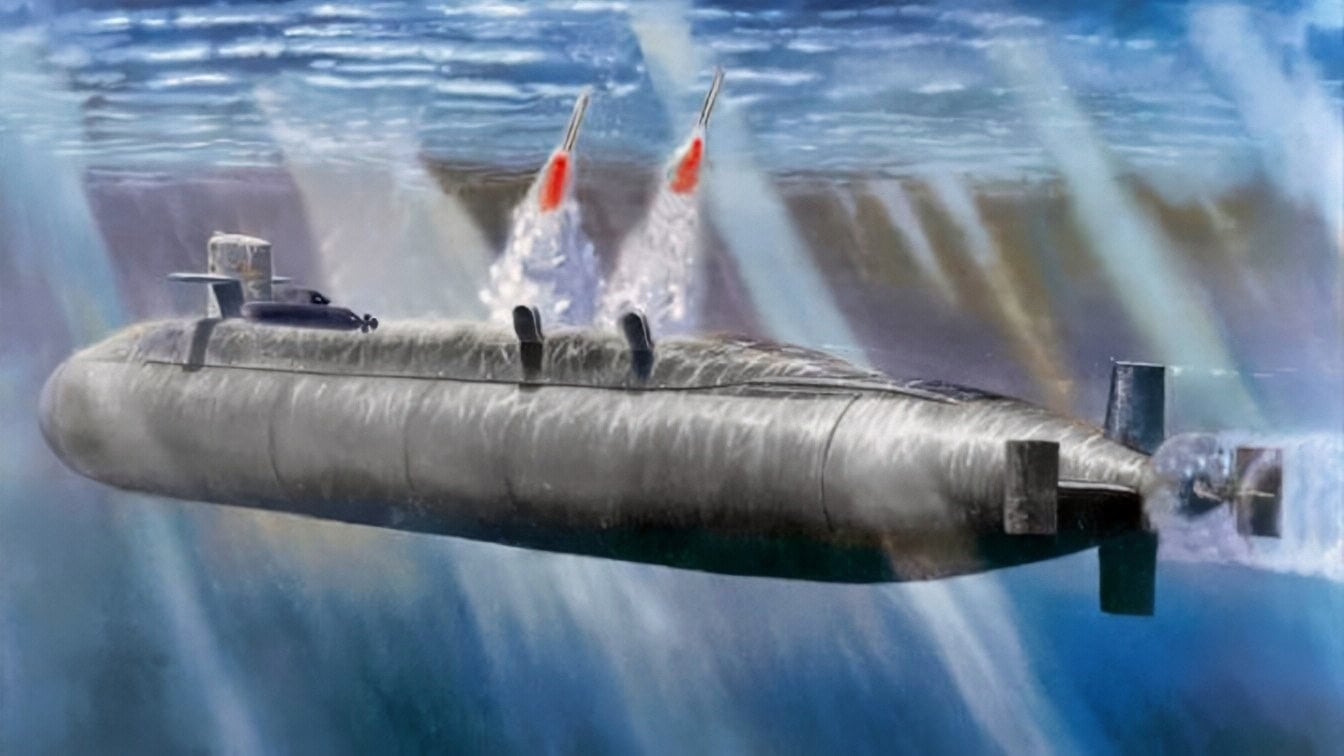
Puget Sound Naval Shipyard, Wash. (Aug. 14, 2003) — Illustration of USS Ohio (SSGN 726) which is undergoing a conversion from a Ballistic Missile Submarine (SSBN) to a Guided Missile Submarine (SSGN) designation. Ohio has been out of service since Oct. 29, 2002 for conversion to SSGN at Puget Sound Naval Shipyard. Four Ohio-class strategic missile submarines, USS Ohio (SSBN 726), USS Michigan (SSBN 727) USS Florida (SSBN 728), and USS Georgia (SSBN 729) have been selected for transformation into a new platform, designated SSGN. The SSGNs will have the capability to support and launch up to 154 Tomahawk missiles, a significant increase in capacity compared to other platforms. The 22 missile tubes also will provide the capability to carry other payloads, such as unmanned underwater vehicles (UUVs), unmanned aerial vehicles (UAVs) and Special Forces equipment. This new platform will also have the capability to carry and support more than 66 Navy SEALs (Sea, Air and Land) and insert them clandestinely into potential conflict areas. U.S. Navy illustration. (RELEASED)

The Ohio-class guided-missile submarine USS Florida (SSGN 728) departs Naval Submarine Base Kings Bay. Florida will perform routine operations while at sea. (U.S. Navy photo by Mass Communication Specialist 1st Class James Kimber/Released)
Each system supported the vulnerability of the others.
Land-based silos were immobile, while SSBNs were not; bombers offered flexibility by virtue of their ability to change targets in the air rapidly.
The idea was that the Soviet Union might pull off a first strike that eliminated the land-based silos and bomber bases, but the US Navy’s hidden SSBNs would survive to unleash a devastating 2nd strike.
The object of any war is to win, so there is little point in starting a nuclear war in which both sides would be utterly destroyed within hours.
The Akula Was Made To Find The Wildcard In A Game Of Cold War Poker
While the Soviets were able to carefully target each US missile and bomber base dispersed around the country, the Navy’s SSBNs represented a wild card in the strategic nuclear game of poker that was being played.
The Soviets had to find a way to locate and continuously track the US Ohio-class submarines silently prowling the deep in the Atlantic and Pacific Oceans.
In the late Cold War period, the Ohio-class was the backbone of the SSBN submarine force.
That was the specific purpose of a new class of Soviet attack submarines (SSN), the Project 971 Shchuka-B or “Akula” as it was called in the West.
A submarine fast enough and quiet enough to pursue US ballistic missile submarines and destroy them in the first minutes of a war with the US.
Trying To Find A Black Cat In A Pitch-black Room
Between 1984 and 1990, the Soviets completed 7 Akulas, intending to build 25.
That number had a strategic purpose.
By the end of the 1980s, the US had 10 Ohio-class SSBNs at sea.
If the Akula could find and silently track an Ohio on its 70-90 day deployment, they would have enough submarines to assign two Akula to each Ohio.
When the Ohio returned to port,t it would typically spend a month in refit and swap out the crew.
In that time, a fresh Akula could be sent to wait silently for it outside its port, pick up its trail when it left, and follow it again for its next deployment.
For this purpose, the Soviets made the Akula as quiet as they could make a submarine at the time.
They would have to, as the Ohio-class could truthfully boast that it had never been successfully detected or tracked by any Soviet sub.
The Ohio, moving at a leisurely speed of less than 12 kts (the actual speed remains classified), was extraordinarily quiet and could detect and avoid a Soviet submarine well beyond the range at which the Soviet submarine could detect it.
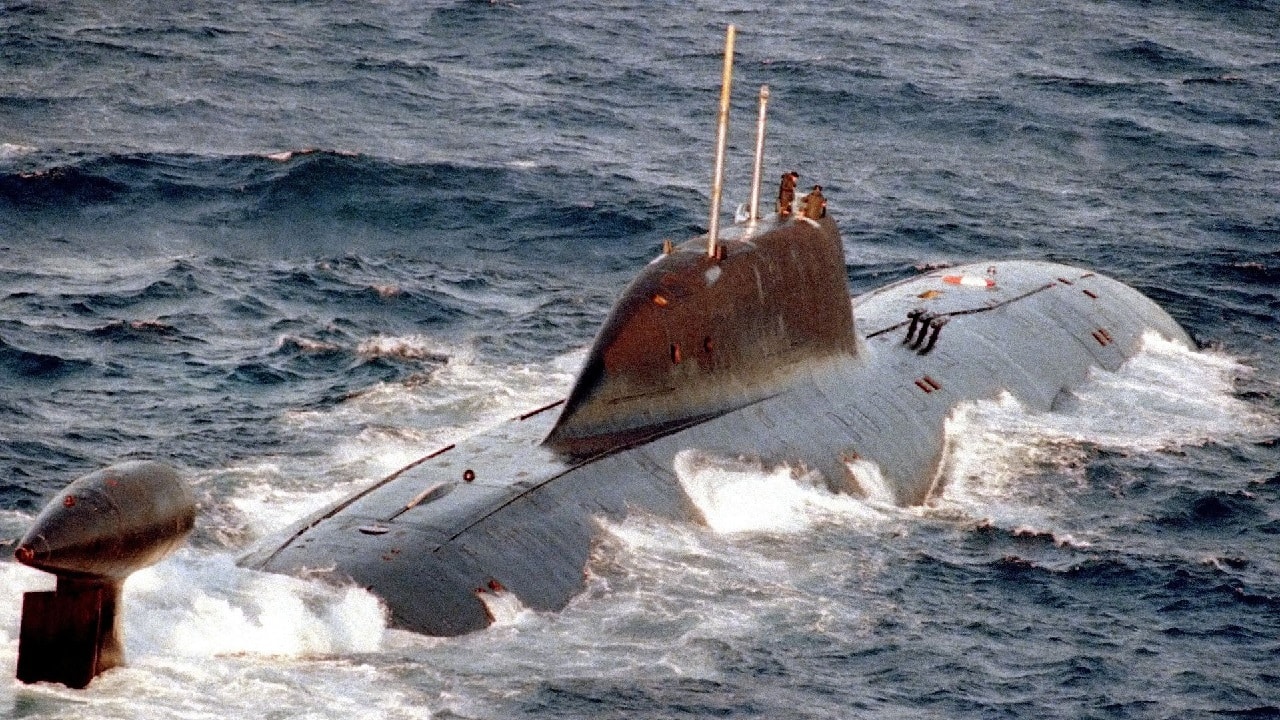
K-322 Cachalot, Akula class submarine underway. A port quarter aerial view of the Russian Northern Fleet AKULA class nuclear-powered attack submarine underway on the surface.
Imagine a horse clopping around in a pitch-black room listening for the sound of a moving black cat, and you get the general idea.
And just like a cat, an Ohio was notoriously unpredictable.
The Soviets found they could never predict where an Ohio’s patrol area might be or when it would arrive, making long-term active or passive tracking difficult and rare.
If you did find one by luck or other fortunate circumstances, you had to stay dangerously close to maintain contact and risk colliding with it underwater.
To improve their chances of tracking an Ohio, Akulas had the sophisticated SOKS hydrodynamic wake detection system mounted in the sail.
This system could detect trace elements and chemicals, as well as changes in salinity and temperature caused by a passing submarine’s wake.
The Akula’s Strategic Aspirations Ran Into The Economic Realities
The Akulas were very expensive submarines by Soviet standards, and in the waning years of the Soviet Union, the USSR was strapped for cash, so the order was reduced to 20.
Of those, 5 were never completed; 1 was leased to the Indian Navy for 10 years, meaning 15 saw active service in either the Soviet or Russian Federation navies since 1986, when the first was launched.
Today, 3-4 remain in service.
Design Evolution From The Akula To The Akula III
After completing the first 7 by 1989, the Soviets continued to improve the design, perhaps motivated by attempts to employ them against Ohio-class submarines.
6 Akula Improved (Project 971I) followed with machinery noise isolation and cancellation improvements, upgrades to the combat information systems, electronics, and SOKS.
Earlier Akulas would be retrofitted with SOKS as well.
1 Akula II (Project 971U) was completed.
This boat was 700 tons heavier due to a 3-meter hull extension for even quieter machinery, creating a sub said to be stealthier than the US Los Angeles-class attack submarines.
Akula III (Project 971M) in 2001.
This Akula was even heavier and longer than the Akula II, with a redesigned towed array, larger sail, and even more noise reduction for her hull and equipment.
This was the final word in the design until submarines like the Borei and Yasen-class were built.
The Akula, even in limited numbers, achieved some notable accomplishments.
In 2012, an Akula believed to be the Tigr operated in the Gulf of Mexico (now the Gulf of America) for at least a month without being detected.
The Russian and US navies both denied this occurred, but the submarine’s commander received a high decoration from the Russian government within 6 months of the alleged event.
In 2009, the Pentagon confirmed a report that 2 Akulas operated off the East coast of the US.
This deployment to southern Atlantic waters meant these submarines could leave their base in the Arctic region of the Kola Peninsula and pass between Greenland, Iceland, and the UK without being detected by the SOSUS (now called the Integrated Undersea Surveillance System, IUSS) arrays embedded on the sea bottom.
Did an Akula Successfully Track an Ohio-class Sub in 1996?
But the Akula-class may have achieved its ultimate success in 1996, when one of them found and tracked an Ohio-class submarine.
More remarkably, the Akula did not catch the US submarine returning to or leaving its home port, but in its patrol area.
The US has never confirmed or denied this report, as it maintains a strict code of silence regarding the activities of its SSBNs, and critics say that Russia made it up to shore up support for the Russian government’s military budget.
However, the Russian claims did not originate from state-run media reports but from the citation for the “Hero of the Russian Federation” medal given to its captain for the achievement.
This is the Russian Federation’s highest award for bravery and valor. Russian naval records of the Akula’s deployment confirmed this public award, and the captain later attained the rank of Vice-Admiral.
Ultimately, the Project 971 Akula represented the best of late Cold War engineering as a counterweight seeking parity with US SSBNs.
With unprecedented acoustic stealth and Soviet technology like SOKS, the Akula seemed to have broken through a wall of stealth that the Ohio-class had built around itself.
Although too few existed to permanently shift the balance of power beneath the waves before the collapse of the Soviet Union, they still left a legacy that credibly challenged the dominance of US ballistic missile submarines, which formed the third leg of its Nuclear Triad deterrent strategy.
General Specifications for the Akula-class
Cost: 300 million rubles in 1984($1.6 billion)
Surface displacement: 8,140 tons
Submerged displacement: 12,770 tons
Length: 110.3 meters
Beam: 13.6 meters
Draft: 9.7 meters
Test Depth: 600 meters
Speed: submerged 30kts, 10 kts on the surface
Torpedo tubes: bow-mounted, 4 x 650 mm and4 x- 533 mm
Armament: (depending on variant) Type 53 torpedoes.
Igla-M surface-to-air missiles, Granat Cruise missiles, Kalibr cruise missiles, RPK-2 missiles, RPK-6 missiles, RPK-7 missiles, naval mines.
Sensors: MRK-50 Albatross-series (Snoop Pair) surface search/navigation radar.
MGK-540 Skat-3 (Shark Gill) low-frequency sonar. Passive flank array passive sonar,
MGK-503 low-frequency active/passive sonar.
MGK-519 high-frequency active mine avoidance sonar.
Large aperture, towed passive low-frequency linear hydrographic array.
About the Author: Sean Spoonts
Sean Spoonts is the former Editor-In-Chief of SOFREP.com. He is a military analyst, writer, and commentator whose work has appeared in Newsweek, CS News, Ukrinform, and various military/veteran media networks and professional publications, including the Military Intelligence Professional Bulletin. He is a U.S. Navy veteran, having served as an Aviation Anti-Submarine Warfare Operator and Search and Rescue Helicopter Aircrewman.