
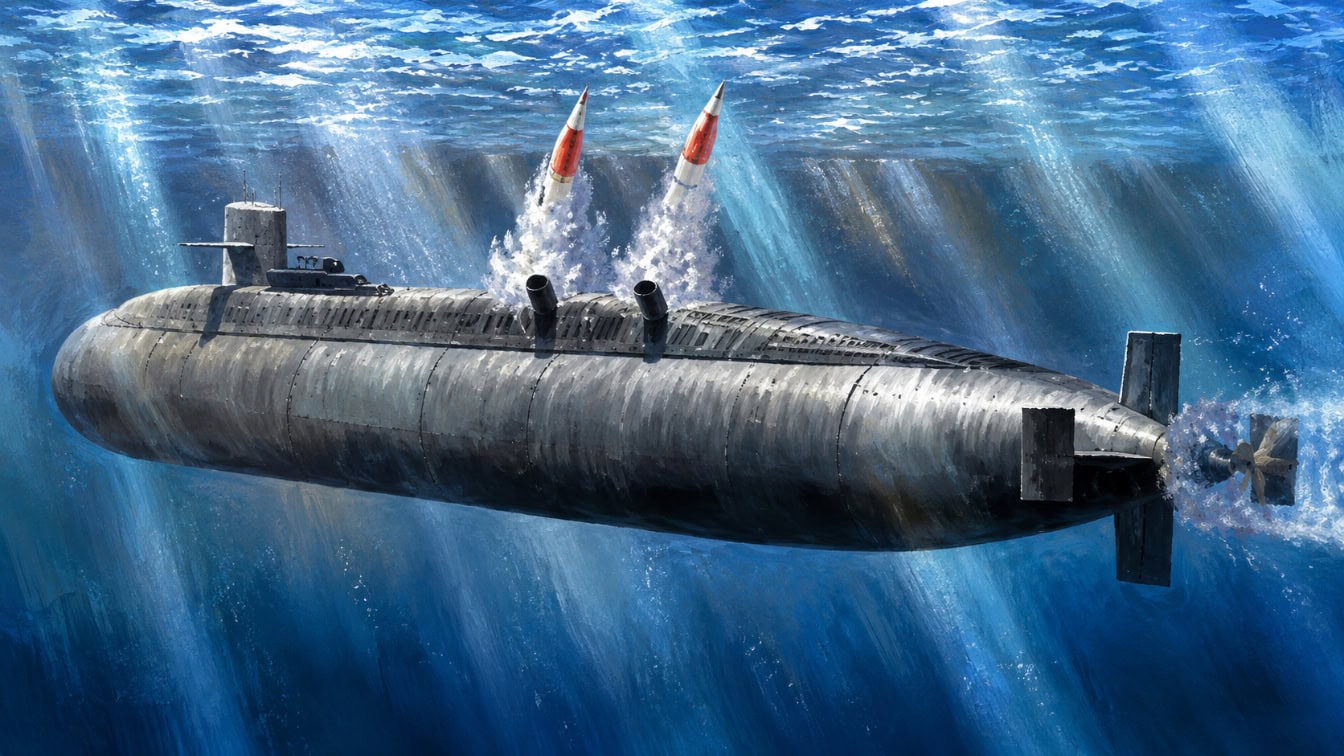
Summary and Key Points: USS Georgia returned to Naval Submarine Base Kings Bay on 27 July after her final deployment, and inactivation began days later. She is 42 years old, commissioned in February 1984, and is the first of the Navy’s four Ohio-class guided-missile submarines to begin retiring. Each of those four can carry up to 154 Tomahawk cruise missiles — twenty-two former ballistic missile tubes, each holding a canister of seven — along with 66 special operations personnel and two tubes converted into lock-out chambers for putting them in the water. No submarine ever built has carried more conventional firepower. Across all four boats, that is 616 launch positions, more than half the entire submarine force’s vertical-launch payload capacity, and the Navy will lose all of it over the next several years.
The Ohio-Class SSGN Problem
The U.S. Navy has started the process of retiring its most heavily armed submarines ever to enter service.
The process will see hundreds of cruise missile launch positions removed from the American fleet over several years, with no direct replacement planned.
USS Georgia, an Ohio-class guided missile submarine, returned to Naval Submarine Base Kings Bay on July 27 after completing its final deployment.
The inactivation process then began at the end of the month.
It’s a 42-year-old submarine and the first of the Navy’s four Ohio-class SSGNs to begin its retirement, and the news means the Navy has now lost a hugely valuable platform capable of carrying up to 154 Tomahawk cruise missiles.
Without a submarine that can replace that incredible concentration of conventional firepower, analysts are asking: what does the U.S. do now?
USS Georgia’s Origins
USS Georgia entered service in February 1984, but it was a very different kind of submarine then. Designated SSGN-729, Georgia was built to carry a submarine-launched nuclear ballistic missile.

The Ohio-class guided-missile submarine USS Florida (SSGN 728) departs Naval Submarine Base Kings Bay. Florida will perform routine operations while at sea. (U.S. Navy photo by Mass Communication Specialist 1st Class James Kimber/Released)
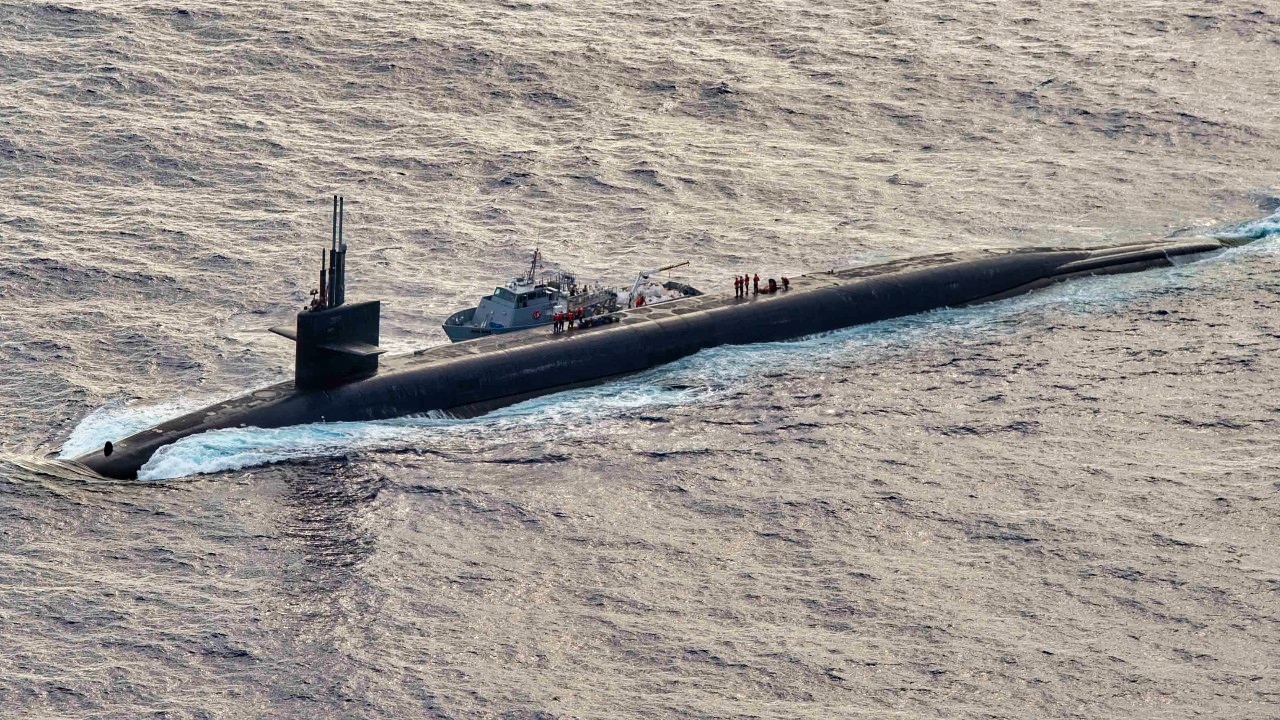
The Ohio-class ballistic missile submarine USS Kentucky (SSBN 737) sails alongside a submarine support vessel during a routine armed air escort (AAE) exercise, April 24, 2025. AAEs are designed to improve interoperability between our services, increasing lethalitythrough multi-domain integration.. Commander, Submarine Group (SUBGRU) 9, exercises administrative control authority for assigned submarine commands and units in the Pacific Northwest providing oversight for shipboard training, personnel, supply and material readiness of submarines and their crews. SUBGRU-9 is also responsible for nuclear submarines undergoing conversion or overhaul at Puget Sound Naval Shipyard in Bremerton, Washington. (U.S. Navy photo by Mass Communication Specialist 1st Class Ryan Riley)
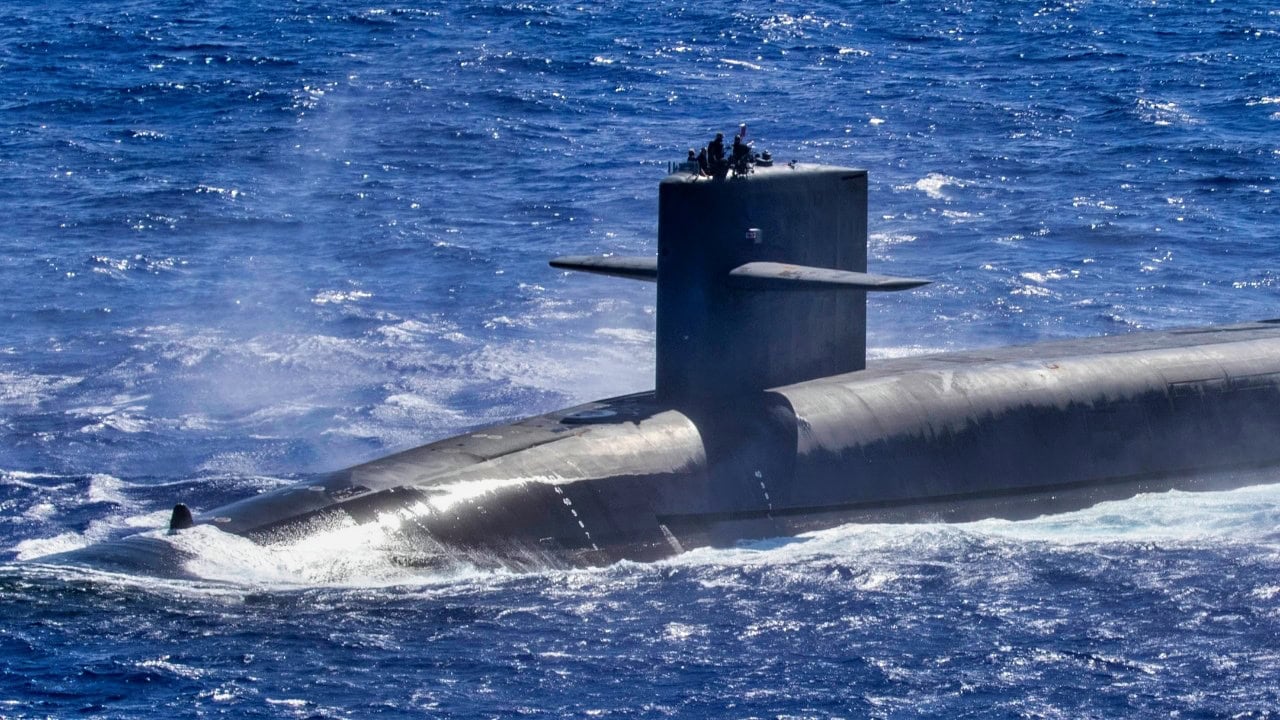
PACIFIC OCEAN (June 28, 2024) – An AS-332 Super Puma assigned to the Lewis and Clark-class dry cargo ship USNS Cesar Chavez (T-AKE 14) delivers supplies to the Ohio-class ballistic missile submarine USS Louisiana (SSBN 743) during a vertical replenishment at sea, June 28, 2024. The presence of the SSBN in the Pacific demonstrates the flexibility, survivability, readiness, and capability of the U.S. Navy submarine forces and complements the many exercises, training, operations, and other military cooperation activities conducted by Strategic Forces to ensure they are available and ready to operate around the globe at any time. Homeported in Bangor, Washington and currently assigned to Submarine Squadron 17, Louisiana is an undetectable launch platform for submarine-launched ballistic missiles, providing the United States with its most survivable leg of the nuclear triad. (U.S. Navy Photo by Mass Communication Specialist Seaman Andrew McPeek)
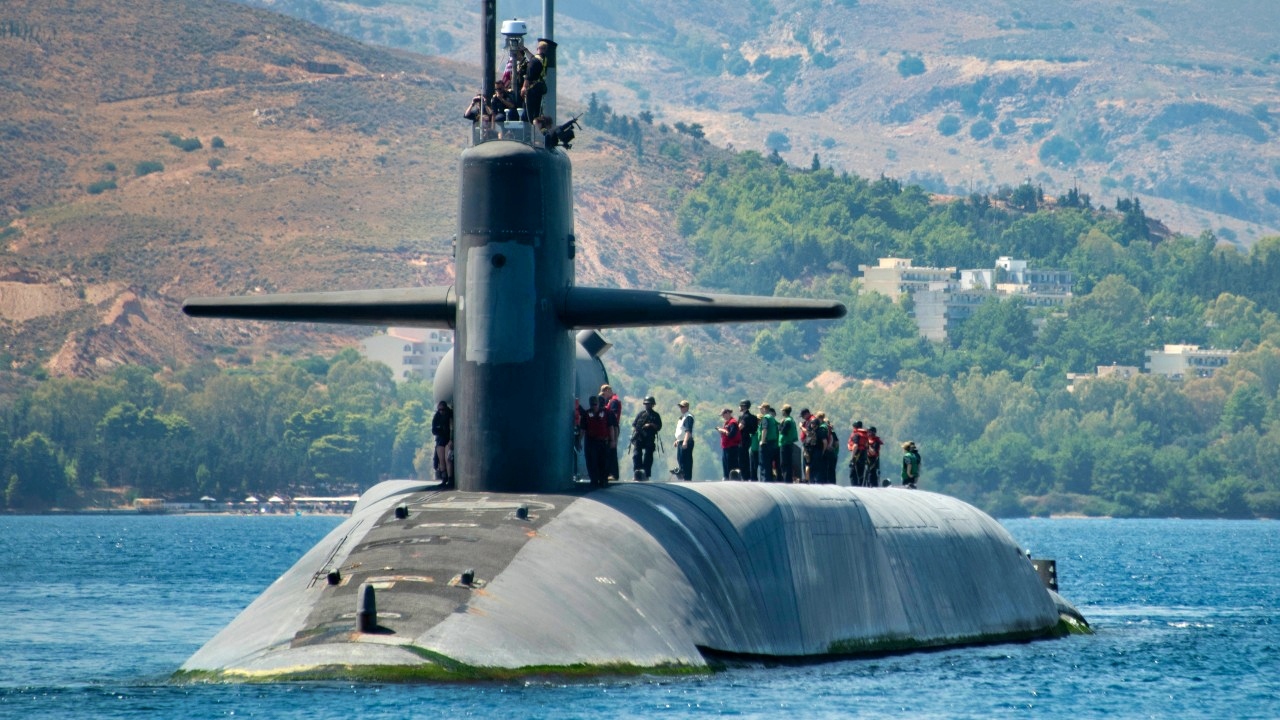
190907-N-UR565-0660NAVAL SUPPORT ACTIVITY SOUDA BAY, Greece (Sept. 7, 2019) The Ohio-class cruise missile submarine USS Florida (SSGN 728) arrives in Souda Bay, Greece, for a scheduled port visit, Sept. 7, 2019. NSA Souda Bay is an operational ashore base that enables U.S., allied, and partner nation forces to be where they are needed and when they are needed to ensure security and stability in Europe, Africa, and Southwest Asia. (Photo by Joel Diller/Released)
It also spent much of the Cold War as part of the U.S. strategic nuclear deterrence mission.
The submarine completed 65 strategic deterrent patrols before the Navy decided to convert it for a whole new role, giving it decades of extra life.
After the 1994 Nuclear Posture Review, the first department-wide evaluation of U.S. nuclear weapons policy and doctrine conducted by the Department of Defense after the end of the Cold War, it was determined that only 14 of the 18 Ohio-class ballistic-missile submarines were necessary.
But instead of immediately retiring the four oldest boats – Ohio, Michigan, Florida, and Georgia – the Navy chose to convert them into conventionally armed guided-missile submarines.
Georgia entered Norfolk Naval Shipyard for refueling and conversion in 2005.
By 2007, the work was complete — and the U.S. Navy received an incredibly large nuclear-powered submarine that was capable of remaining hidden while carrying a cruise missile arsenal comparable to several smaller warships.
Meet the Tomahawk
The newly refurbished Georgia was now armed with Tomahawks, making it a conventional strike platform suited for special operations.
Each one of the converted submarines had its former ballistic missile tubes converted to accommodate canisters that could hold seven Tomahawk missiles each.
That gave each SSGN a theoretical maximum load of 154 Tomahawk missiles.
Two large tubes on each submarine were also converted into look-out chambers, intended for special operations forces.
The vessel could also accommodate 66 special operations personnel.
The Tomahawk is a long-range, conventional cruise missile designed to strike land targets from far outside heavily defended areas.
Current Block IV and Block V Tomahawks have a range of roughly 1,000 miles and can fly at low altitude and high subsonic speed.
The Block V missiles include upgraded navigation and communications systems, and newer variants are being designed for maritime strike missions.
With the Tomahawk, an SSGN can position itself silently and undetected relatively close to hostile territory before launching a barrage of precision-strike missiles at a target.
Four Retirements Is A Huge Loss
The retirement of four of these submarines means the U.S. is losing a huge number of missile positions — 616, in fact.
Together, the four retiring submarines represent more than half of the submarine force’s total vertical-launch payload capacity.
But the Navy cannot keep the boats indefinitely. Their hulls and nuclear propulsion plants were designed to last for several decades, but cannot be maintained and refurbished indefinitely.
All were commissioned in the 1980s.
But that doesn’t stop their retirement from being an enormous loss, especially as the United States finds itself entangled in a major conflict in the Middle East and facing the prospect of other future conflicts in the Indo-Pacific.
The U.S. needs long-range weapons and dispersed operations arguably more than ever, and is losing some of its most valuable assets.
And the importance of the Tomahawk itself has only increased. On August 17, the Navy announced a $22.9 billion contract with Raytheon to accelerate missile production and expand industrial capacity.
What Now?
The Navy does have a plan. The newer Virginia-class submarines will replace some of that firepower, but not all of it.
On August 3, the Navy announced that 19 planned Virginia-class boats equipped with the Virginia Payload Module will be redesignated as SSGNs, meaning they will take on an expanded strike role.
The module will add four large payload tubes capable of carrying 28 Tomahawk missiles, increasing each submarine’s total Tomahawk capacity of each submarine to 40 missiles.
The Navy is counting on that smaller capacity working out, arguing that spreading the weapons across more survivable and flexible submarines ultimately provides sufficient capacity.
The first of those newly designated SSGNs, SSGN-803, is expected to be delivered in fiscal year 2029.
About the Author: Jack Buckby
Jack Buckby is a British researcher and analyst specializing in defense and national security, based in New York. His work focuses on military capability, procurement, and strategic competition, and he produces and edits analysis for policy and defense audiences. He brings extensive editorial experience, with a career output spanning over 1,000 articles at 19FortyFive, and has previously authored books and papers on extremism and deradicalization.