
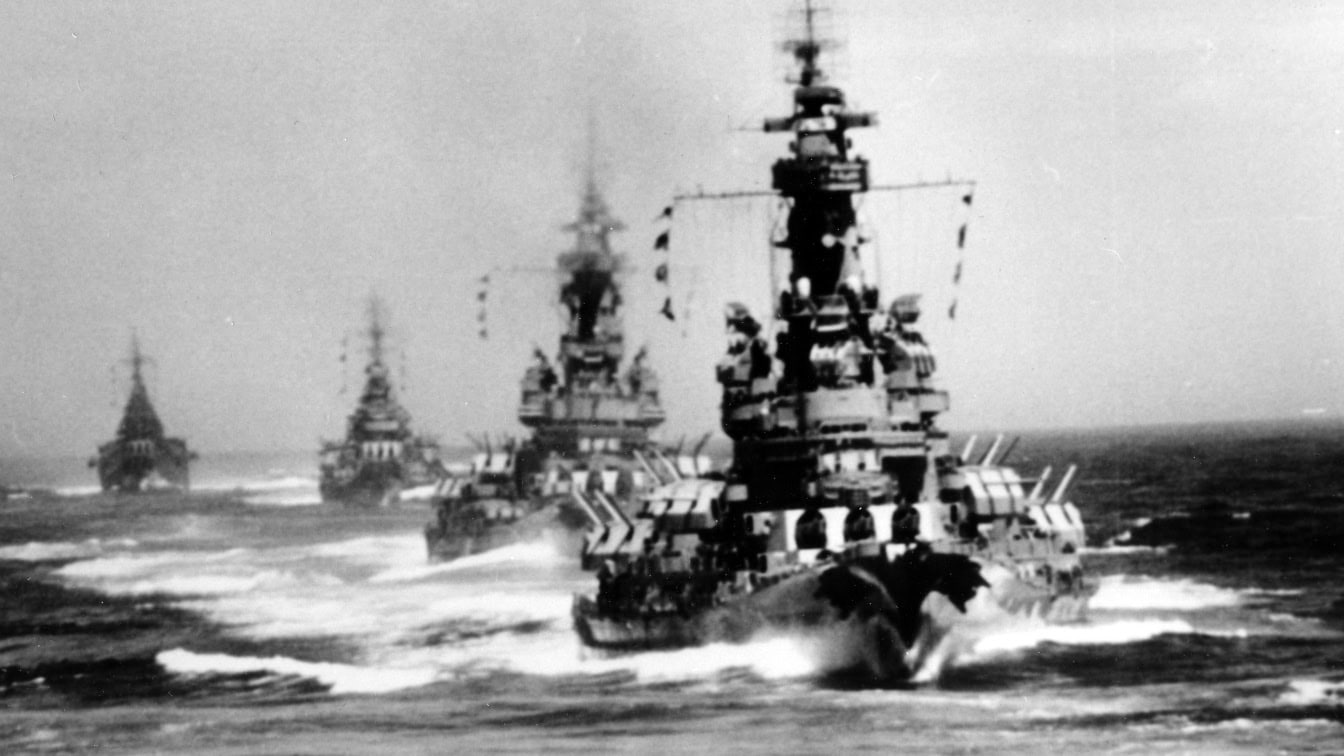
USS Massachusetts by the Numbers: The $80,000,000 Battleship With Nine 16-Inch Guns – USS Massachusetts entered the water on September 23, 1941, as a 35,000-ton battleship that contemporary Associated Press coverage priced at $80 million. That was an enormous national investment before the United States had formally entered World War II.
Using the 1941 Consumer Price Index and the June 2026 CPI-U, the figure equals roughly $1.8 billion in current purchasing power. The conversion does not reproduce the cost of a modern warship, but it shows the scale of the commitment.
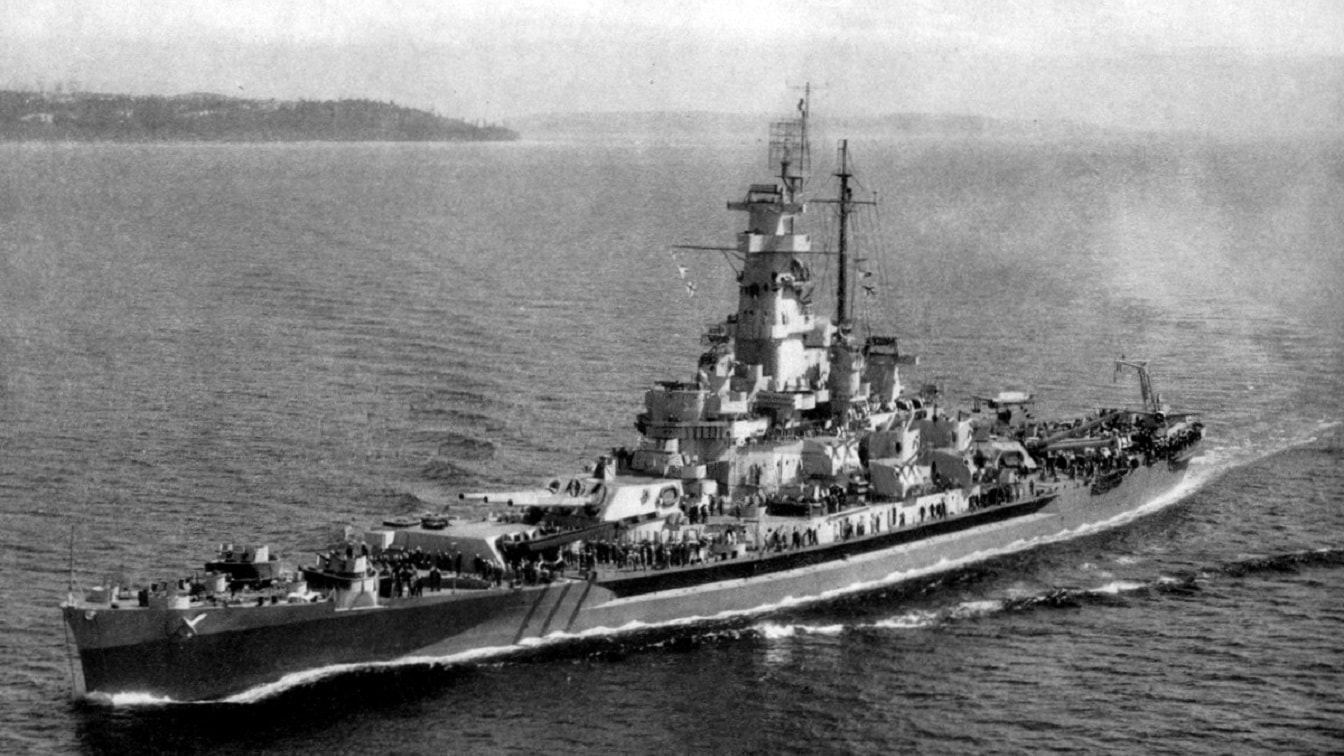
The U.S. Navy battleship USS Massachusetts (BB-59) underway, most probably after her refit at the Puget Sound Naval Shipyard, Washington (USA), circa in July 1944. She is painted in Camouflage Measure 22.
“Big Mamie” was laid down at the Fore River Shipyard in Quincy on July 20, 1939, commissioned on May 12, 1942, and sent into combat six months later. She served in both major naval theaters and earned 11 battle stars.
The ship’s numbers explain why she mattered. Massachusetts packed 130,000 shaft horsepower, nine 16-inch guns, twenty 5-inch guns, heavy armor, aircraft facilities and as many as 2,500 people into a hull only 680 feet long.
44,519 Tons and 130,000 Horsepower Fit Into 680 Feet
Massachusetts belonged to the four-ship South Dakota class, a compact design shaped by treaty-era limits. She measured 680 feet overall, with a 108-foot, 2-inch beam and a draft above 35 feet. Her designed displacement was 37,970 long tons, rising to 44,519 long tons at full combat load. The density of weapons and armor defined the South Dakota-class design.
Eight oil-fired Babcock & Wilcox boilers supplied four General Electric turbines, each turning its own shaft. The 130,000-shaft-horsepower plant drove four bronze propellers more than 17 feet in diameter, pushed the ship to a designed 27.5 knots, and supported a 15,000-nautical-mile range at 15 knots.
The machinery, weapons, and damage-control organization required people. The peacetime complement was 1,793 officers and enlisted sailors. Wartime additions raised the crew to about 2,500, nearly the population of a small town living inside armored compartments.
Nine 16-Inch Guns Fired a 24,300-Pound Broadside
The main battery consisted of nine 16-inch/45 Mark 6 guns in three triple turrets. Each gun weighed 192,310 pounds without its breech. Each turret weighed between 1,403 and 1,437 tons and required 172 officers and sailors, making a South Dakota-class gun turret a heavily armored machine shop.
The Mark 6 fired a 2,700-pound armor-piercing projectile with a 535-pound propellant charge. Muzzle velocity reached 2,300 feet per second, and maximum range approached 36,900 yards, almost 21 miles. Firing all nine guns sent 24,300 pounds, or 12.15 tons, of steel toward the target. At the rated two rounds per minute per gun, the theoretical one-minute output reached 48,600 pounds.
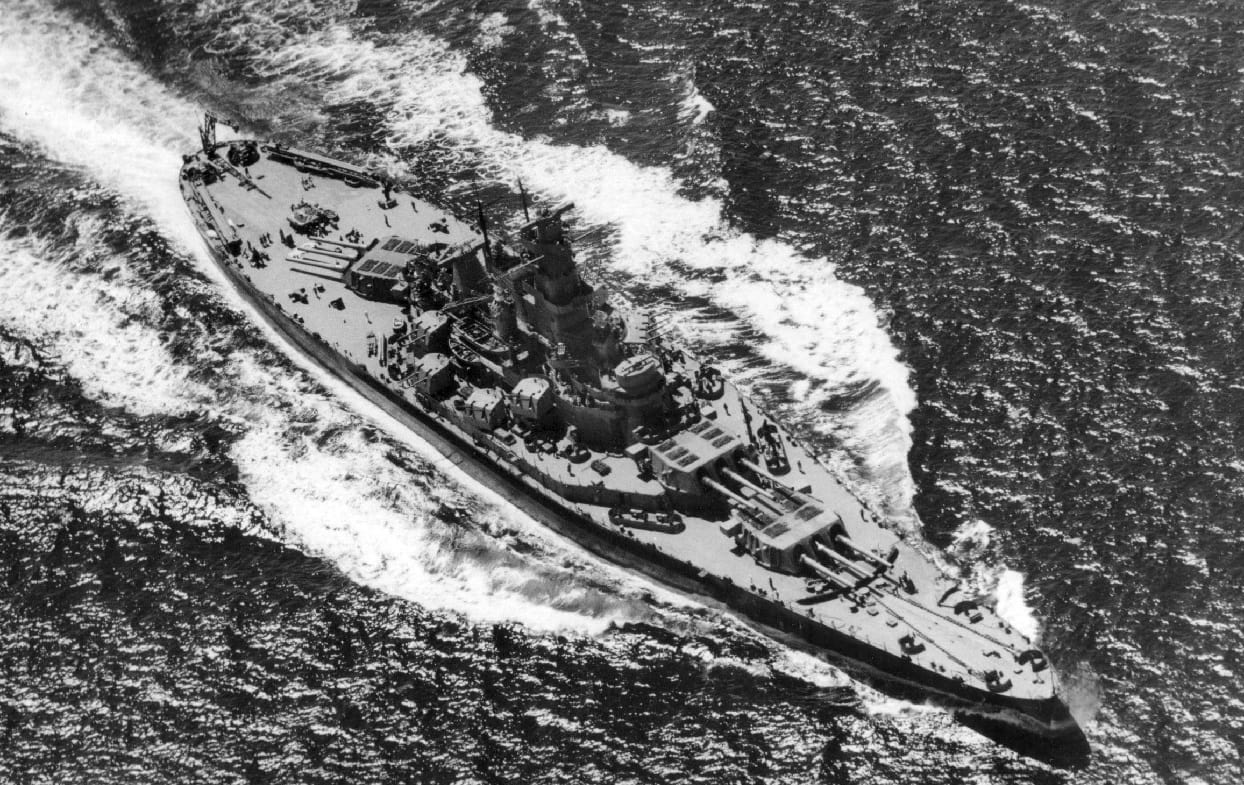
USS South Dakota. Image: Creative Commons.
Ordnance plans provided space for 1,333 main-battery projectiles: 404 rounds for Turret I, 525 for the elevated Turret II and 404 for Turret III. The combination of shell weight and magazine depth explains why the surviving South Dakota-class battleships remain striking demonstrations of naval firepower.
Twenty 5-Inch Guns Defended the Fleet
Massachusetts carried twenty 5-inch/38 dual-purpose guns in ten twin mounts. They attacked surface targets and formed the medium-range antiaircraft layer. Her early wartime battery also included 24 Bofors 40 mm barrels and 35 Oerlikon 20 mm guns, with the lighter battery expanding as aerial threats grew.
Three Vought OS2U Kingfisher floatplanes and two stern catapults supported reconnaissance and gunfire spotting. In the Pacific, Massachusetts often used her 5-inch, 40 mm and 20 mm weapons to shield fast carriers, showing how fast battleships moved with carrier task forces.
Casablanca Put the Main Battery Into Combat
Massachusetts opened fire off Casablanca on November 8, 1942, during Operation Torch. At 7:04 a.m., she fired the first American 16-inch warshot of World War II. Over the next 16 minutes, the battleship fired nine main-battery salvos and scored five hits on the unfinished French battleship Jean Bart.
The hits silenced Jean Bart’s main turret for the day. Massachusetts also engaged shore batteries, destroyers, merchant shipping, and a floating dry dock. She took a 7.6-inch shell hit from the El Hank coastal battery but remained in action.
The battle gave her a rare battleship-against-battleship engagement before her mission shifted in the Pacific.
Eleven Battle Stars Followed From the Pacific War
Massachusetts passed through the Panama Canal in February 1943 and remained in the Pacific. She supported operations around New Guinea and the Solomon Islands, covered the Gilbert and Marshall invasions, joined carrier raids against Truk, and later fought around Palau, the Philippines, Iwo Jima, and Okinawa.
The record shows why American fast battleships stayed useful after carriers became the fleet’s offensive center.
Massachusetts supplied anti-aircraft protection and delivered 16-inch bombardment. Her armor belt measured 12.2 inches, turret faces reached 18 inches, and the conning tower carried 16 inches of protection.
In July and August 1945, Massachusetts operated off Japan, screening carrier strikes and shelling industrial facilities at Kamaishi and Hamamatsu. Naval history records credit her August 9 return to Kamaishi with what was likely among the final 16-inch rounds fired in combat during World War II.
Fall River Saved Big Mamie From Scrapping
Massachusetts was decommissioned on March 27, 1947, after less than five years in commission. She remained in the Atlantic Reserve Fleet until the Navy struck her from the register on June 1, 1962. Scrapping appeared next.
Former crew members and Massachusetts schoolchildren raised the money needed to preserve the ship. Big Mamie reached Fall River in June 1965 and opened that August, becoming the centerpiece of the collection at Battleship Cove and one of America’s surviving battleship museums.
Battleship Cove now lists the 680-foot warship at 5 Water Street in Fall River. Her three main turrets remain trained fore and aft in what the museum calls the posture of peace.
Fun fact: when I was a Boy Scout in the 1980s, I slept over on this battleship with Troop 6 out of Rhode Island.
MORE – Aircraft Carrier USS Gerald R. Ford Has a 5-Acre Flight Deck
About the Author: Harry J. Kazianis
Harry J. Kazianis (@Grecianformula) was the former Senior Director of National Security Affairs at the Center for the National Interest (CFTNI), a foreign policy think tank founded by Richard Nixon based in Washington, DC. Harry has over a decade of experience in think tanks and national security publishing. His ideas have been published in the NY Times, The Washington Post, The Wall Street Journal, CNN, and many other outlets worldwide. He has held positions at CSIS, the Heritage Foundation, the University of Nottingham, and several other institutions related to national security research and studies. He is the former Executive Editor of the National Interest and the Diplomat. He holds a Master’s degree focusing on international affairs from Harvard University.

