
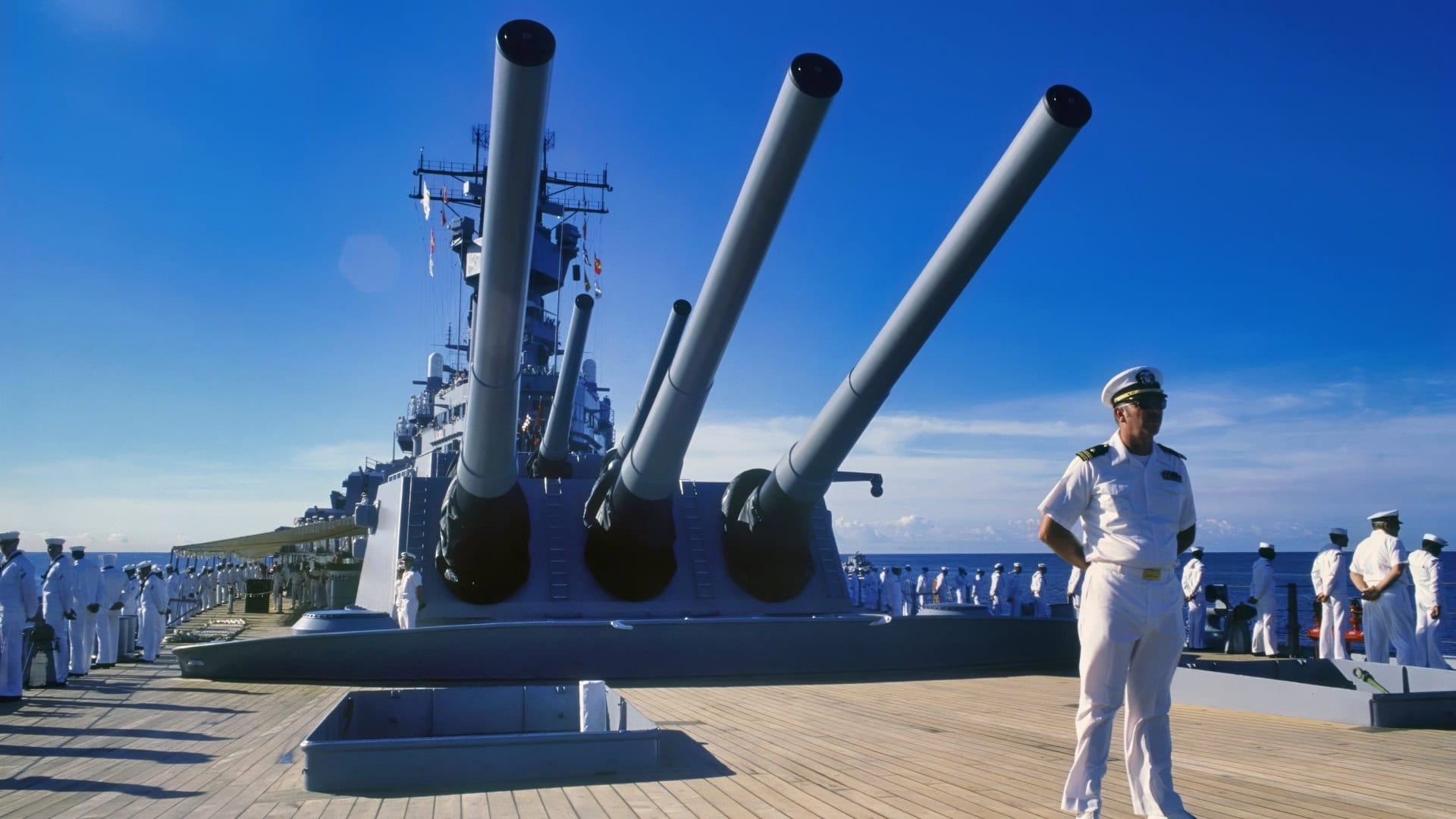
Summary and Key Points: The Iowa-class battleships carried nine 16-inch guns, and by raw caliber, they were outmatched by the 18.1-inch monsters on Japan’s Yamato, the largest battleship guns ever made. Yet the American 16-inch/50 Mark 7 is widely regarded as the finest battleship gun ever put to sea, and it nearly matched Yamato’s armor penetration while weighing far less. The reason was not a bigger barrel. It was a smarter shell, a better fire-control system, and a design philosophy that valued precision over sheer size, a combination that kept a 1940s weapon militarily useful for half a century until it fired its last shot over Kuwait.
NOTE: This article includes original photos of the USS Iowa’s 16-inch guns from a tour back in August of 2025.
The Iowa-Class Battleships’ Guns Were Special
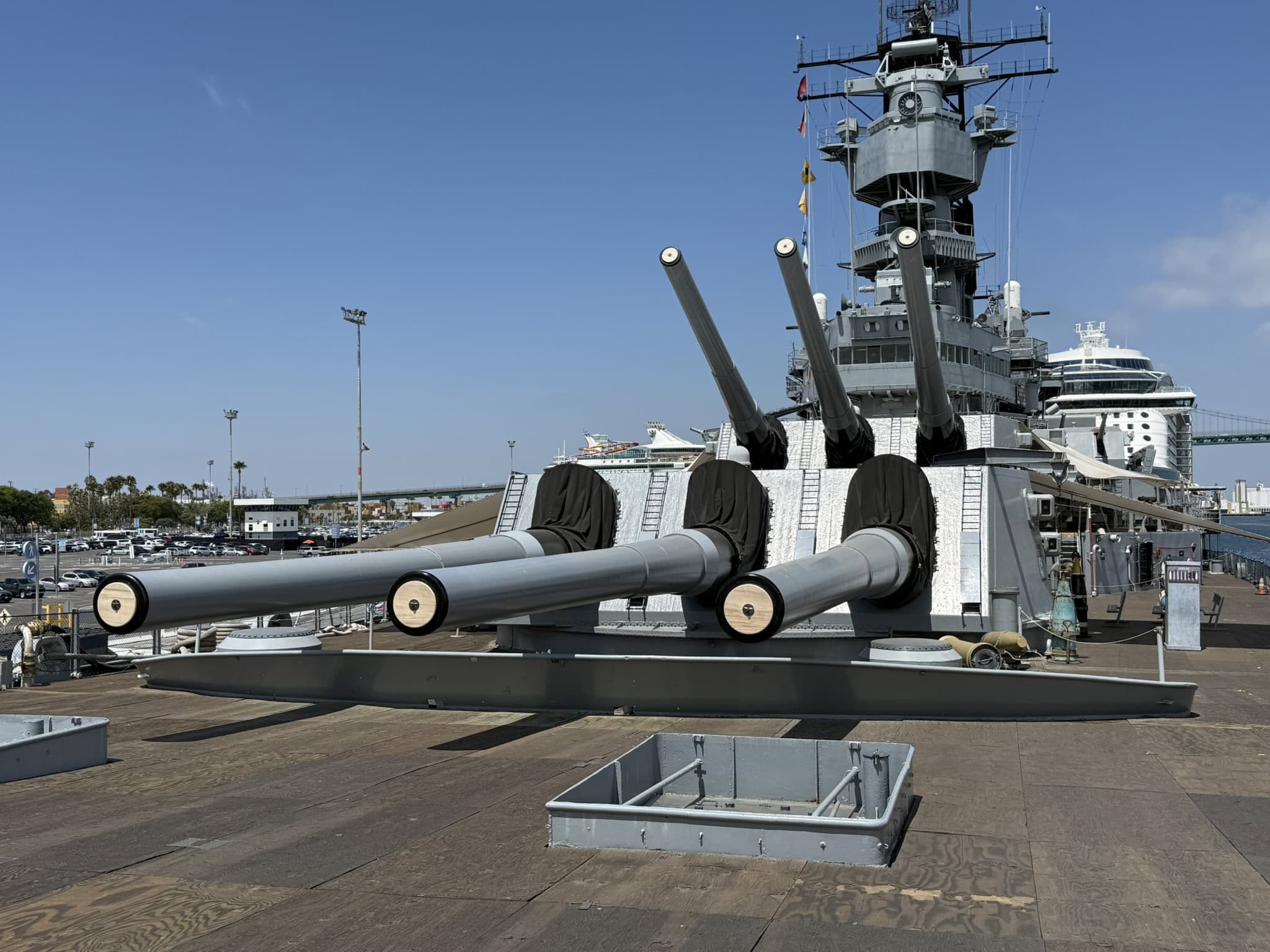
USS Iowa 16-Inch Guns. Image Credit: Harry J. Kazianis.
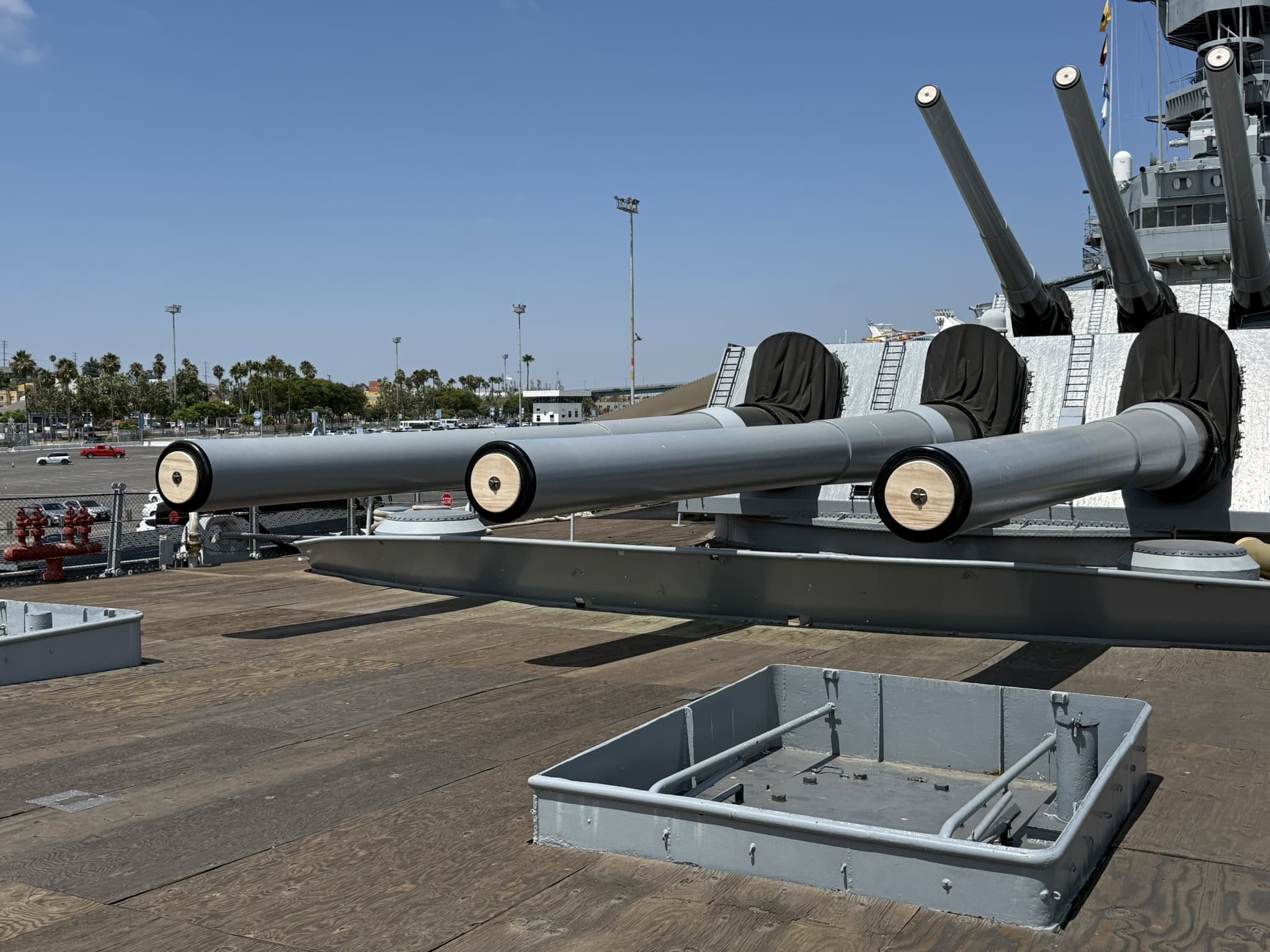
USS Iowa 16-Inch Guns. Image Credit: Harry J. Kazianis.
When people picture a battleship’s power, they picture the caliber of its guns, and by that measure, the Iowa class should have lost. The Imperial Japanese Navy’s Yamato and Musashi mounted 18.1-inch guns firing shells that weighed 3,200 pounds, and no gun the United States ever fielded on a ship matched that bore. But the story of the Iowa-class main battery is a lesson in why caliber is not the same as capability, and why the smaller American gun is the one naval historians tend to call the best of its kind. The answer to what made the 16-inch Mark 7 special lies in three things the Japanese never fully matched: the shell, the brain behind it, and the discipline of the whole system.
The Super-Heavy Shell
The single most important decision came before any of Iowa was even under construction. The Mark 7 was originally intended to fire a 2,240-pound armor-piercing shell, but the Navy redesigned the entire shell-handling system to fire a much heavier round, the 2,700-pound “super-heavy” Mark 8, before the first keel was laid. That heavier projectile is the heart of the gun’s reputation. According to the naval-weapons reference NavWeaps, the super-heavy shell made these guns nearly the equal in penetration to the 18.1-inch guns of the Yamato class, despite the American shell weighing far less than three-quarters as much as the caliber gap would suggest.
The physics behind that is elegant. A shell’s ability to punch through armor depends heavily on its sectional density, the weight packed behind each square inch of its cross-section. By making a 16-inch shell unusually heavy and long, American designers gave it exceptional sectional density, enabling it to retain velocity and penetrate armor better than a lighter shell of the same diameter. As the professional journal of the U.S. Naval Institute documented in its analysis of the Navy’s “supershells,” the 2,700-pound Mark 8 stretched to 72 inches long, and in a hypothetical Iowa-versus-Yamato duel, it would have mattered that the super-heavy 16-inch shells were just as effective as Yamato’s much larger 18.1-inch projectiles. The naval historians William Garzke and Robert Dulin reached the same conclusion, judging that for all practical purposes the Mark 7 could match the penetration of the Japanese 18.1-inch gun because of that superior frontal density.
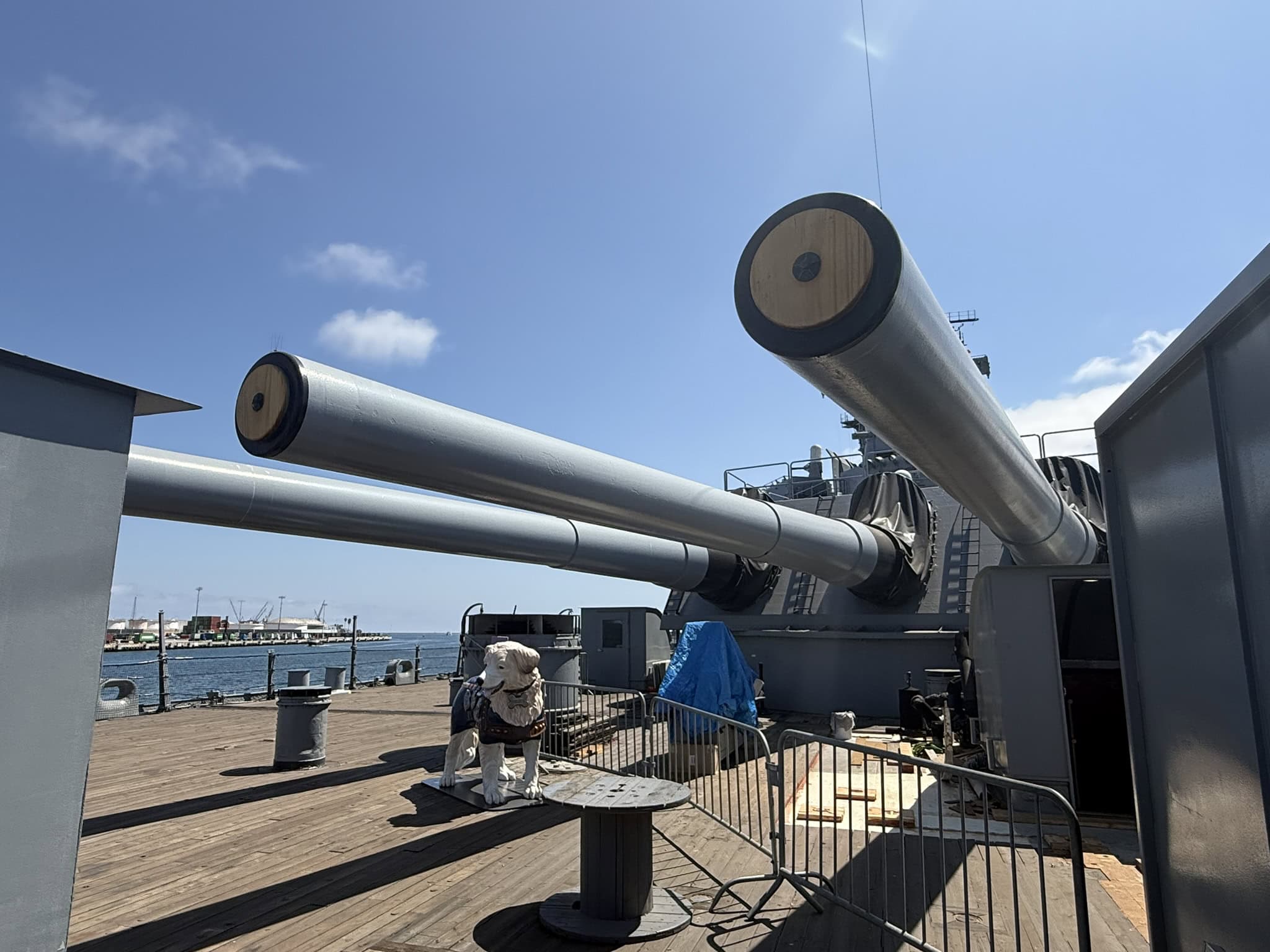
USS Iowa 16-Inch Guns. Image Credit: Harry J. Kazianis.
The destructive effect was staggering by any measure. NavWeaps records that the armor-piercing round could penetrate nearly 30 feet of reinforced concrete, depending on range and angle, and the high-capacity bombardment shell could gouge a crater 50 feet wide and 20 feet deep. During the Vietnam War, the recalled battleship New Jersey occasionally fired a single high-capacity round into the jungle and created a helicopter landing zone 200 yards across, defoliating trees for hundreds of yards beyond.
The Brain Behind the Gun
A gun that hits hard is useless if it cannot hit at all, and this is where the Mark 7 truly separated itself from its Japanese rivals. Hurling a shell weighing as much as a small car at a target more than twenty miles away, from a platform pitching and rolling on the open ocean, at another ship that is itself moving, is a mathematical problem of brutal complexity. The Iowa class solved it with the Ford Instrument Company Mark 8 Rangekeeper, an analog mechanical computer that continuously calculated a firing solution by accounting for the target’s speed and course, the shell’s long travel time, wind, air resistance, the earth’s rotation, and even the wear on the gun barrels.
This was the American advantage that Japan never closed. Using radar data, the system could track and fire at targets with far greater accuracy, day or night, in clear weather or fog. The U.S. Navy’s integration of radar and automated fire control gave it a decisive edge in the second half of World War II, because the Japanese did not develop radar-directed gunnery to anything like the same standard. A Yamato might throw a slightly heavier shell, but an Iowa was far more likely to land hers on the first salvo, and in a gun duel, the ship that finds the range first usually wins.
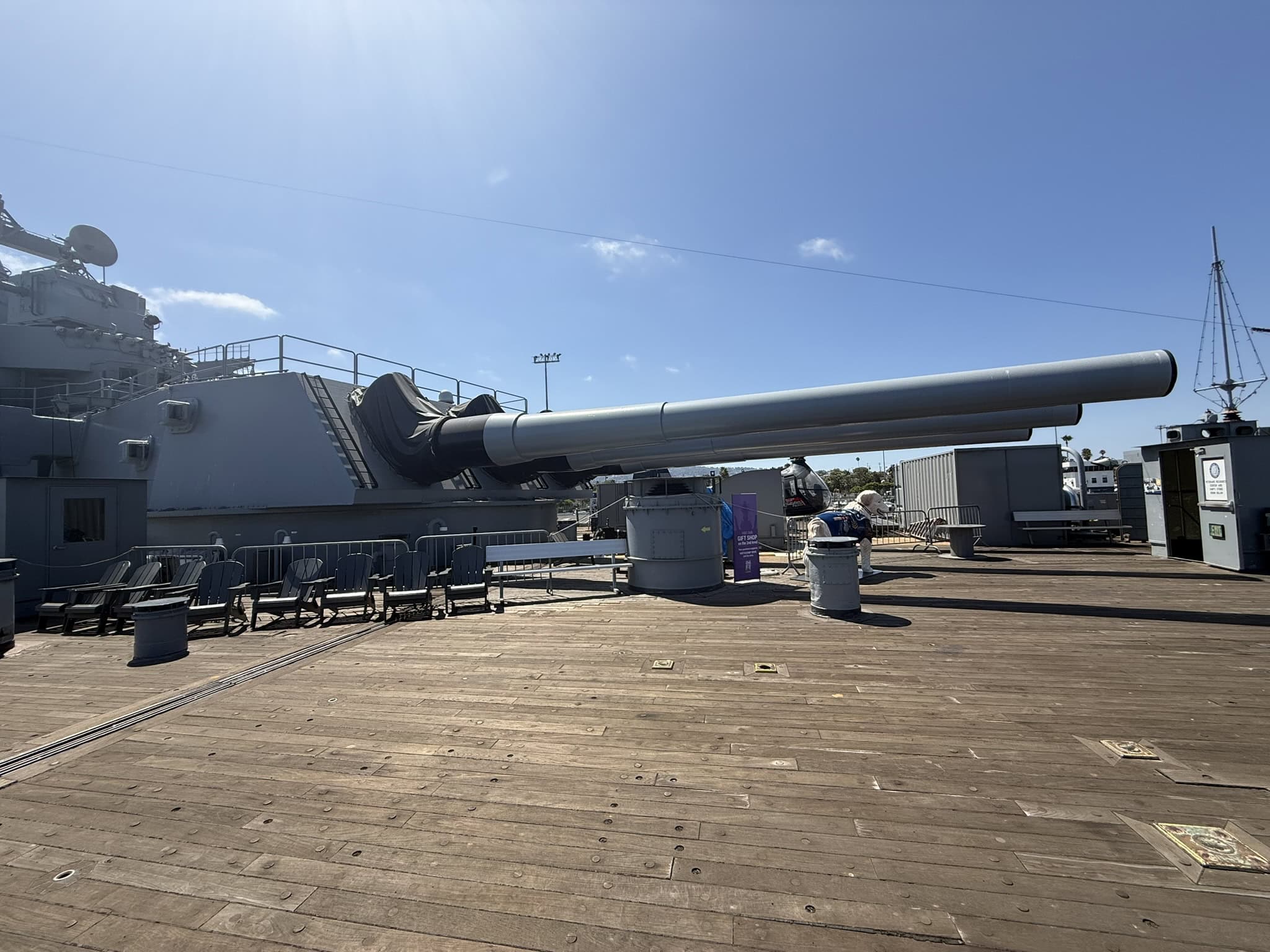
USS Iowa 16-Inch Guns. Image Credit: Harry J. Kazianis.
The precision only improved with age. When all four ships were modernized in the 1980s under the Reagan-era naval buildup, each turret received a DR-810 radar that measured the exact muzzle velocity of every individual gun, feeding that data into the modern Mark 160 fire-control system. Combined with more consistent modern propellant, these upgrades made the Mark 7, according to NavWeaps, the most accurate battleship-caliber guns ever placed in service, a 1940s weapon firing with late-20th-century precision.
The Discipline of the System
The gun itself was a masterpiece of built-up construction, assembled from a liner, tube, jacket, and a series of hoops and locking rings, with a chromium-plated bore for longer barrel life. Each gun weighed roughly 239,000 pounds without its breech, and the three triple turrets that held them were among the most complex mechanical structures ever fitted to a warship, with shell and powder-handling machinery running from the magazines deep in the hull up to the guns. The turrets were also the site of the gun’s darkest moment, the April 1989 explosion in USS Iowa’s Turret Two that killed 47 sailors and prompted an exhaustive Navy investigation and a lasting review of powder-handling safety.
What made the whole system remarkable was its longevity. A weapon conceived in 1938 for a clash of battle lines that never came remained genuinely useful across five decades because its combination of penetrating shell, accurate fire control, and enormous destructive radius translated so well to a mission its designers had treated as secondary: bombarding targets ashore. In Korea, Vietnam, and Lebanon, the guns spoke only to the land, and by the time the ships were reactivated in the 1980s, bristling with Tomahawk and Harpoon missiles, the 16-inch guns remained the weapon of choice against coastal targets.
The Last Shots
The Mark 7’s combat career ended where the battleship era did. During Operation Desert Storm in 1991, Missouri and Wisconsin closed on the Kuwaiti coast and fired more than 1,000 16-inch shells at Iraqi bunkers, artillery positions, and troop concentrations, the last time American battleship guns were fired in anger, and the missile age intruded even then when an Iraqi Silkworm anti-ship missile nearly struck Missouri before a British destroyer’s missile destroyed it. Wisconsin fired the final rounds of the age on May 16, 1991, emptying her barrels for the last time and closing the book on nearly a century of big-gun naval warfare.
What made the 16-inch Mark 7 special, in the end, was not that it was the biggest gun, because it was not. It was that American engineers understood that a well-designed shell driven by superior fire control could outperform a larger weapon, and they built a gun that hit above its caliber and hit where it aimed. That philosophy, precision and cleverness over brute size, gave the United States the finest battleship gun ever made and kept it relevant for fifty years, from the closing battles of World War II to the final bombardments of a desert war fought long after everyone assumed the battleship was dead.
About the Author: Harry J. Kazianis
Harry J. Kazianis (@Grecianformula) was the former Senior Director of National Security Affairs at the Center for the National Interest (CFTNI), a foreign policy think tank founded by Richard Nixon based in Washington, DC. Harry has over a decade of experience in think tanks and national security publishing. His ideas have been published in the NY Times, The Washington Post, The Wall Street Journal, CNN, and many other outlets. He has held positions at CSIS, the Heritage Foundation, the University of Nottingham, and several other institutions related to national security research and studies. He is the former Executive Editor of the National Interest and the Diplomat. He holds a Master’s degree focusing on international affairs from Harvard University.

