
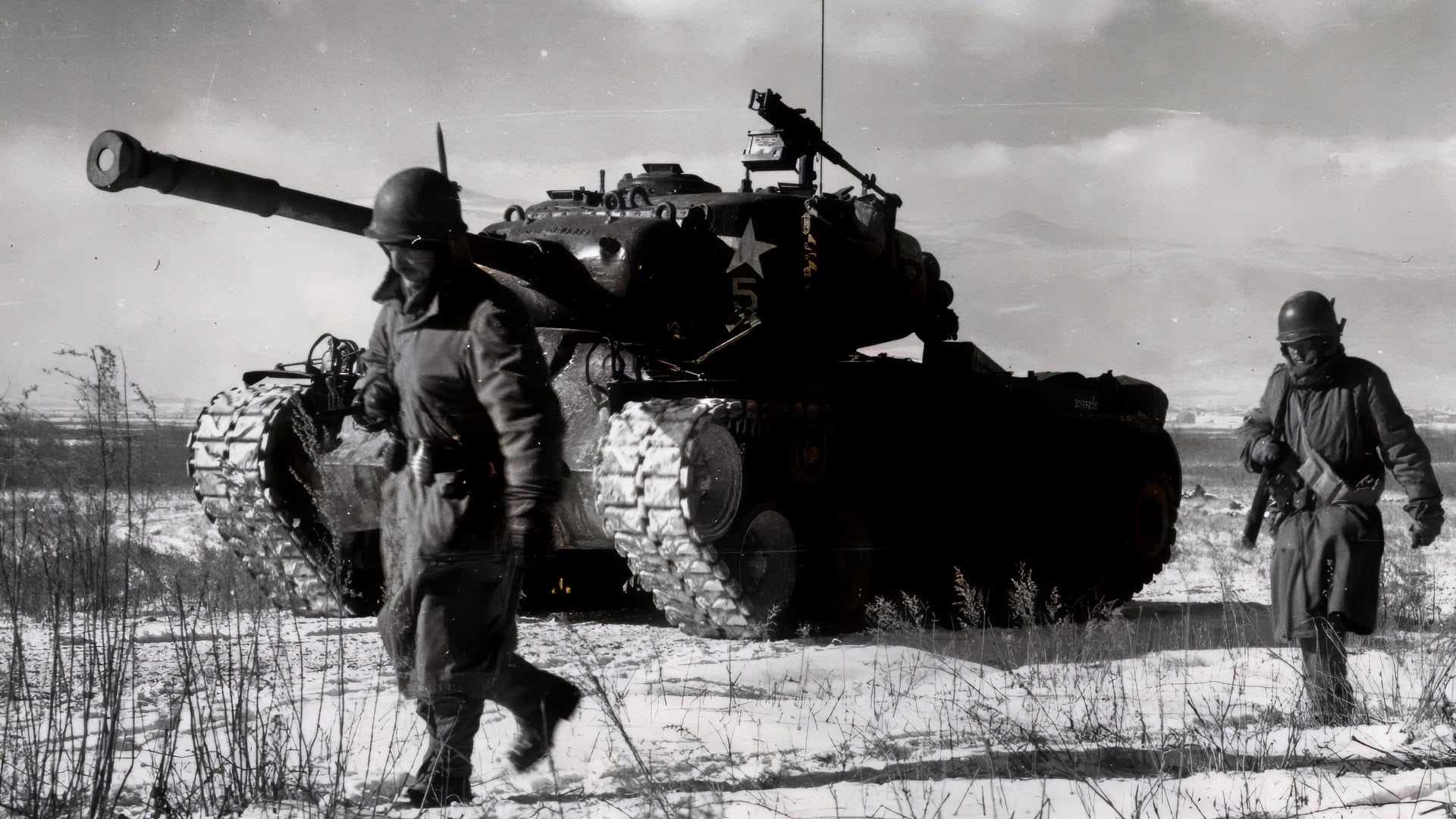
In the first days of December 1950, at a frozen crossroads village in North Korea called Hagaru-ri, war correspondents put the obvious question to the quiet, pipe-smoking Marine general whose division was surrounded and outnumbered many times over: was he retreating? The reply that went out over the wires became the most famous sentence of the Korean War: “Retreat, hell! We’re just attacking in a different direction.” Honesty, as always, improves the story: Major General Oliver P. Smith later said he had not put it quite that colorfully, and his actual remark to the press was the more professorial observation that his Marines were not retreating, merely attacking in another direction; the punchy version was the press’s polish, and the “Retreat, hell” flourish had its own Marine pedigree dating to Belleau Wood in 1918.
But here is what makes the line immortal rather than merely quotable: as a military statement, it was exact.
When you are surrounded, there is no rear to retreat toward; movement in any direction is an attack. What follows is the plain history of the thirteen days that proved it, 75 years on.
The Trap
The war had seemed nearly won. After the Inchon landing in September 1950, United Nations forces chased the broken North Korean army toward the Yalu River, and General Douglas MacArthur promised the troops would be home by Christmas.
Smith did not believe it. Ordered up a single mountain road into the wilderness around the Chosin Reservoir as winter closed in, he slowed his advance against his superiors’ impatience, kept his regiments within supporting distance, stockpiled supplies along the road, and started his engineers scraping an airstrip out of the frozen earth at Hagaru-ri, preparations his own account treated as simple prudence and history treats as the salvation of the division.
On the night of November 27, the trap sprang: Song Shilun’s Ninth Army Group, roughly twelve divisions and some 120,000 soldiers who had crossed from China undetected, fell on about 30,000 UN troops strung around the reservoir. The battlefield itself was a weapon.
Temperatures fell to 25 and 35 below zero; rifles froze, blood plasma froze solid in aid stations, rations froze so hard men pocketed them against their skin to thaw, and the ground was too hard to dig without explosives.
Frostbite would maim as many Americans as bullets.
East of the Reservoir
The first destruction came on the reservoir’s east shore, where a hastily assembled Army force, Regimental Combat Team 31, soon known as Task Force Faith for its last commander, held the right flank against massed night assaults for four days.
Lieutenant Colonel Don Faith was killed leading the final breakout attempt down the ice road, and the task force was overrun and effectively annihilated; of its roughly 3,000 men, only about 385 unwounded survivors reached the Marine lines, where they formed a provisional battalion and kept fighting.
For decades, their sacrifice was slighted as a defeat, but the modern reassessment is blunt: by absorbing two Chinese divisions for four days, Task Force Faith likely saved the vital base and half-built airstrip at Hagaru-ri from being taken before it could be defended.
Faith received a posthumous Medal of Honor, and in 1999, the Army finally awarded the unit the Presidential Unit Citation it had been denied.
Attacking in a Different Direction
Smith’s breakout was exactly what his sentence described: an attack, fought for every ridgeline.
The two Marine regiments isolated at Yudam-ni fought fourteen miles back to Hagaru-ri and marched into the perimeter in formation, singing the Marines’ Hymn, carrying their wounded and their dead. The road they used stayed open because one rifle company, Fox Company, 2nd Battalion, 7th Marines, under Captain William Barber, an Iwo Jima veteran, held the frozen saddle of Toktong Pass against overwhelming assaults for six days and five nights, while Lieutenant Colonel Ray Davis led a battalion on a night march over the ridges, through a blizzard, to reach them; both men received the Medal of Honor.
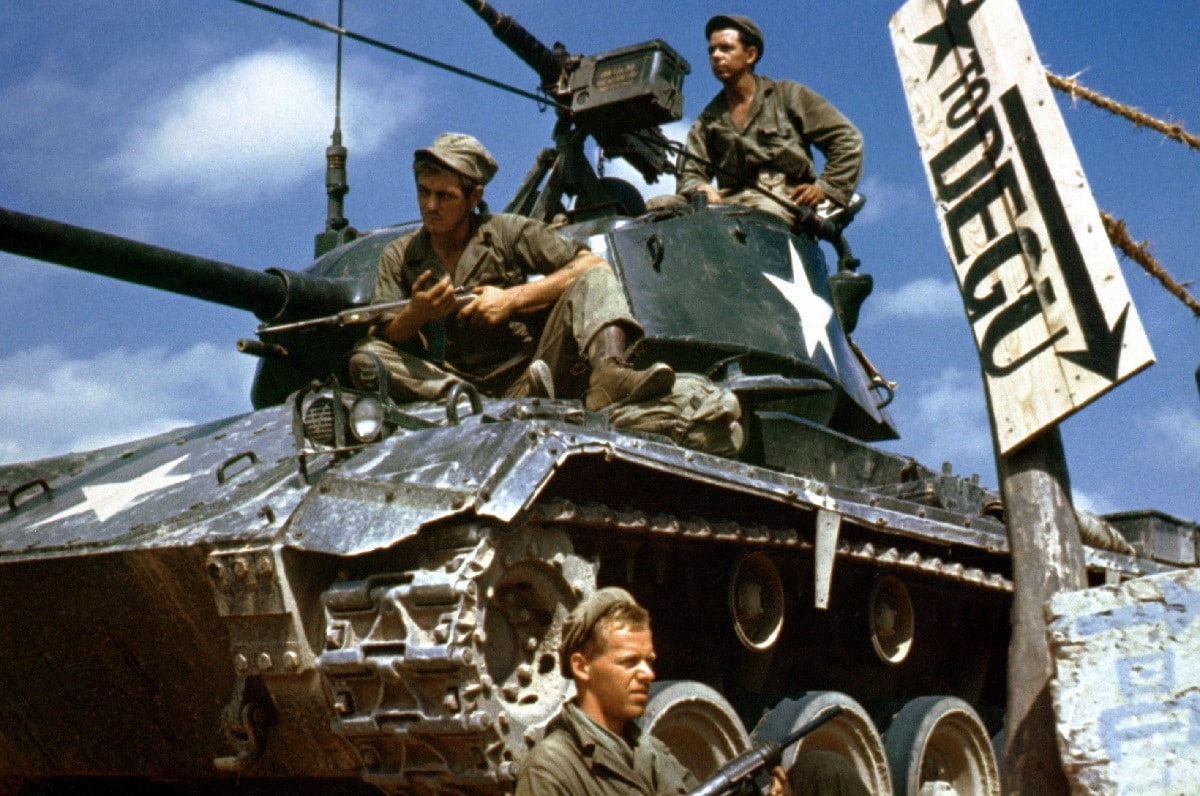
Crew of an M-24 tank along the Naktong River front. On the ground is Pfc. Rudolph Dotts, Egg Harbor City, N.J. gunner (center); Pvt. Maynard Linaweaver, Lundsburg, Kansas, cannoner; and on top is Pfc. Hugh Goodwin, Decature, Miss., tank commander. All are members of the 24th Reconnaissance, 24th Division.
At Hagaru-ri, the airstrip opened on December 1 with the battle still raging, and transports began lifting out thousands of casualties while flying in replacements.
Then the division attacked south again, through the ambush gauntlet named Hell Fire Valley, to Koto-ri, and came to the campaign’s most audacious problem: at Funchilin Pass, the Chinese had blown the one-lane bridge over a sheer drop, on the only road to the sea.
The solution remains unique in warfare: transports parachuted eight two-ton steel Treadway bridge sections into the perimeter, and engineers assembled a span under fire; on December 10 the division rolled down the pass with its tanks, its guns, its wounded, and its dead, and on December 11 the lead elements reached the port of Hungnam.
They came out as a fighting formation, not a mob, which is the entire difference the famous sentence claimed.
The Sea, and the Cost
What followed was the greatest sealift evacuation in American military history. Task Force 90 took off more than 105,000 troops, 17,500 vehicles, and 350,000 tons of supplies, and then, in an act the men aboard never forgot, some 98,000 North Korean civilians who chose exile over Communist rule, including 14,000 refugees packed aboard the single freighter Meredith Victory.
The cost of the thirteen days was terrible on every side of the ledger. More than a thousand Americans were killed in action and thousands more wounded, with the cold claiming casualties by the thousands on its own; hundreds of the fallen were buried where they fell and remain unrecovered, a debt the Pentagon’s accounting agency still works today.
Chinese losses, between the fighting and the cold Mao’s rushed divisions were never equipped for, ran to many tens of thousands, and the Ninth Army Group was effectively wrecked for months. Seventeen Medals of Honor came out of the campaign, fourteen to Marines, two to soldiers, one to a Navy pilot, among the most ever awarded for a single battle, and the survivors took a name they hold to this day: the Chosin Few.
The Line, 75 Years On
Smith, whom his Marines called the Professor, commanded with a pipe and a library, never raised his voice, and spent his later years gently correcting the quote while conceding its substance; he died on Christmas Day 1977.
The sentence outlived him in the Corps’ permanent vocabulary, and this past November, on the 75th anniversary, a congressional resolution honoring the Chosin Marines quoted it once more, noting precisely that the press had captured it.
That is the right verb. The words were polished by reporters, as the best Marine lines often were, but the claim inside them was audited by thirteen days at 30 below, against twelve divisions, over one blown bridge, and it passed.
Surrounded and outnumbered, the 1st Marine Division did not surrender, did not scatter, and did not retreat. It attacked in a different direction, all the way to the sea, and brought its dead home with it.
About the Author: Harry J. Kazianis
Harry J. Kazianis (@Grecianformula) was the former Senior Director of National Security Affairs at the Center for the National Interest (CFTNI), a foreign policy think tank founded by Richard Nixon based in Washington, DC. Harry has over a decade of experience in think tanks and national security publishing. His ideas have been published in the NY Times, The Washington Post, The Wall Street Journal, CNN, and many other outlets. He has held positions at CSIS, the Heritage Foundation, the University of Nottingham, and several other institutions related to national security research and studies. He is the former Executive Editor of the National Interest and the Diplomat. He holds a Master’s degree focusing on international affairs from Harvard University.

