
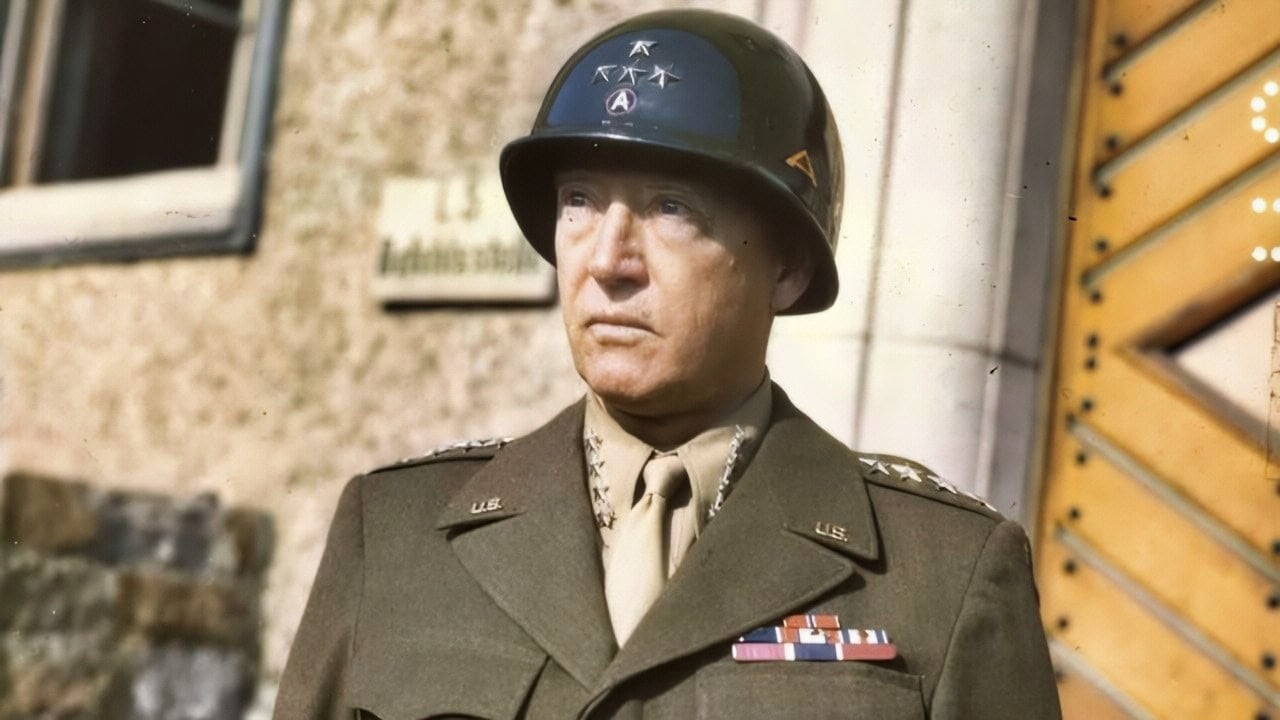
On June 5, 1944, in England, General George S. Patton stood on a platform before soldiers of the Third Army and talked to them about fear. “Battle is the most magnificent competition in which a human being can indulge,” runs the passage as the tradition preserves it. “It brings out all that is best; it removes all that is base. All men are afraid in battle. The coward is the one who lets his fear overcome his sense of duty. Duty is the essence of manhood.”
The men in front of him were, for the most part, soldiers who had never been shot at.
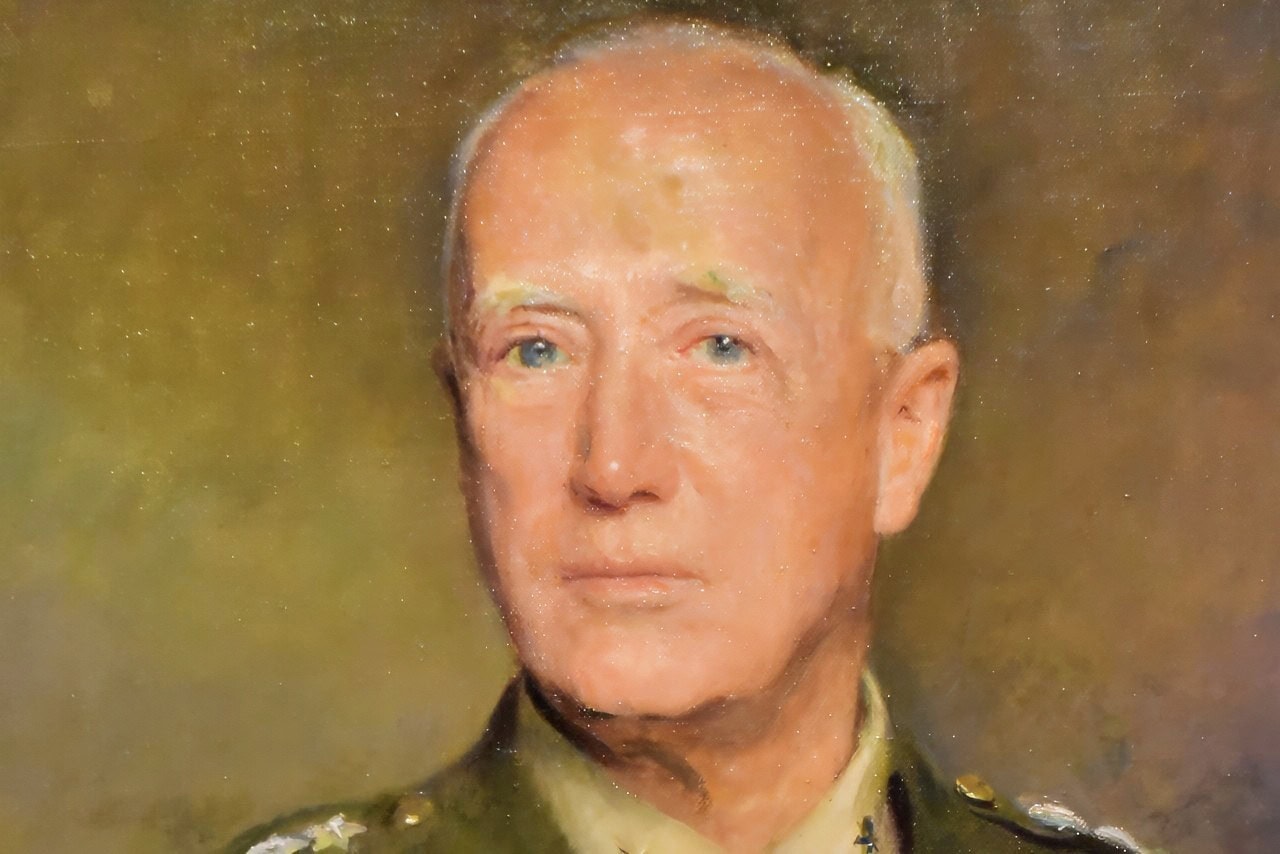
General George Patton National Portrait Gallery Photo. Image Taken by 19FortyFive on 1/23/2026 in Washington, DC.
Within weeks they would cross the Channel into Normandy and become one of the most feared field armies in American history.
The speech survives only in reconstructions, because Patton spoke from notes and profanity, and delivered versions of it to division after division that spring; in the standard reconstructed text, the thought runs: every man is scared in his first battle, and if he says he is not, he is a liar.
The polished six words at the center, all men are afraid in battle, are the form the tradition kept.
Ten months before he said them, Patton had slapped two hospitalized soldiers in Sicily for being afraid. What follows is the sequence, in order, with the conclusions left where they belong, to the reader.
Sicily, August 1943
On August 3, 1943, Patton, then commanding the Seventh Army in the Sicilian campaign, visited the 15th Evacuation Hospital near Nicosia.
Days earlier, a division commander had told him the front seemed to be thinning while the hospitals filled with malingerers.
In a ward tent, Patton came to Private Charles H. Kuhl of Mishawaka, Indiana, who showed no visible wound. When asked what was wrong, Kuhl said he guessed he could not take it.

General Patton Portrait. Image Credit: Creative Commons.
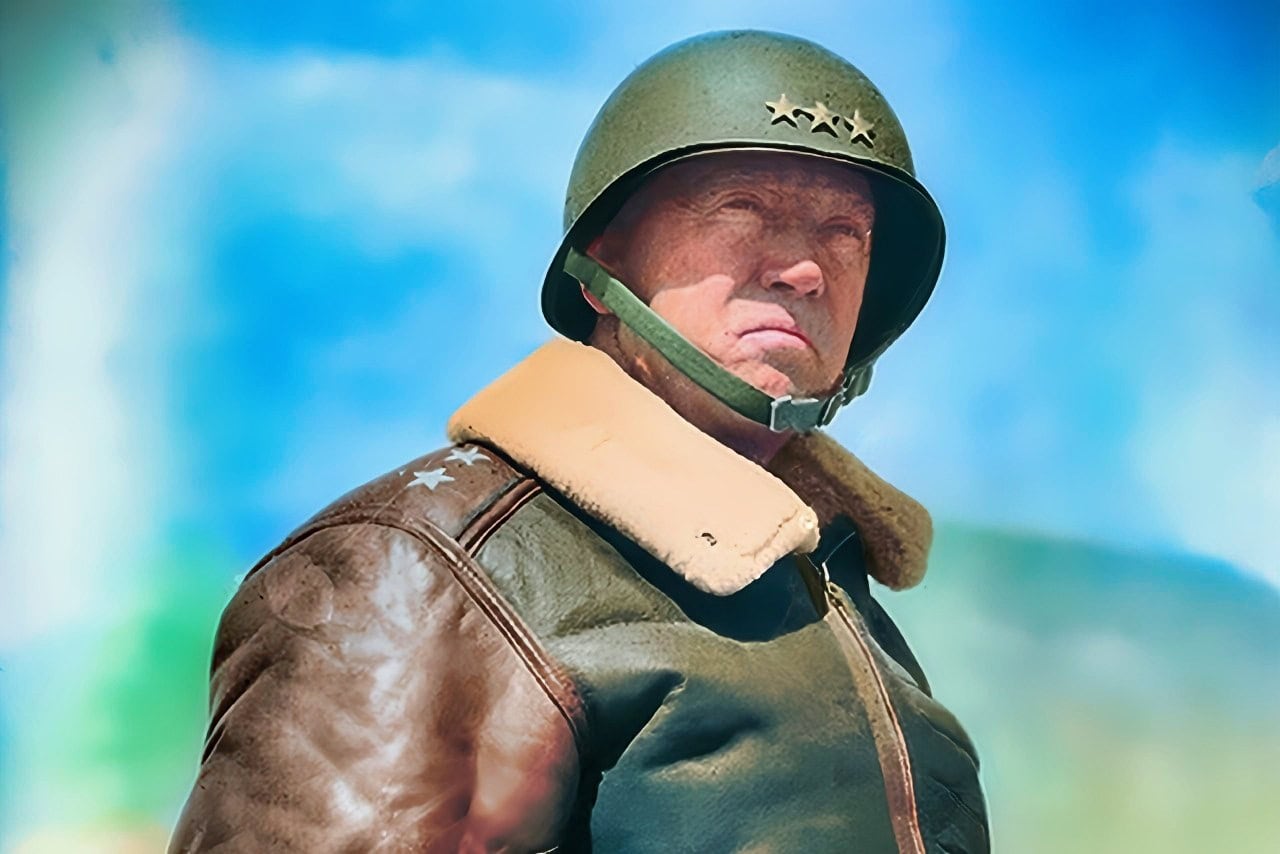
George Patton U.S. Army Photo
Patton slapped him across the face with his gloves, seized him by the collar, threw him from the tent, kicked him, and shouted that he was a coward who was going back to the front.
Kuhl’s admission card already read psychoneurosis, anxiety state, moderately severe; after the incident, the doctors additionally found chronic dysentery and malaria, with a fever above one hundred degrees.
One week later, on August 10, at the 93rd Evacuation Hospital, Patton encountered Private Paul G. Bennett, a 21-year-old artilleryman with four years of service, admitted with battle fatigue.
Patton struck him, and by the accounts of those present, drew his ivory-handled pistol and threatened to shoot him himself. The hospital commanders sent reports up the medical chain.
Eisenhower received them within days and wrote Patton a letter that historians rank among the harshest a theater commander ever sent a subordinate he intended to keep, questioning his judgment and self-discipline while declining to open a formal investigation.
He ordered Patton to apologize: to the two soldiers, to the hospital staff who had watched, and, division by division, to the men of Seventh Army. Patton spent late August making those rounds.
The war correspondents in Sicily knew the whole story and, at Eisenhower’s request, sat on it.
The Price Patton Paid
The story broke anyway. On the evening of November 21, 1943, the columnist Drew Pearson opened his national radio program with the report that Patton had struck a soldier in a field hospital and been severely reprimanded; the War Department answered the wire services with no comment, and Allied headquarters in Algiers issued a statement denying any reprimand had ever been made.
The public reaction split the country, some demanding Patton’s relief, some defending him, and Congress divided the same way, but Eisenhower and Army Chief of Staff George Marshall had already made the decision that mattered: Patton was too valuable to fire and too damaged to trust with the main event.
The cost was delivered in assignments.
Patton kept his rank and lost the future: no role in planning the invasion of France, no army command for D-Day, and a public position as commander of a fictitious army group in southeast England whose purpose was to make the Germans watch the wrong coast.
A careless speech at Knutsford in April 1944 nearly finished him a second time.
When the invasion sailed on June 6, the day after the speech above, Patton stayed behind, and his letter to his wife Beatrice that day survives: “It is Hell to be on the side lines and see all the glory eluding me.”
His Third Army followed him to France in July, and it, and he, made the history the sidelines had nearly cost him.
June 5, 1944: The Patton Speech
The speech itself belongs to that spring of waiting.
Patton delivered it, in variations, to the green divisions of his new army across the English staging areas, and the delivery attested that June 5 came the day before other men landed in France.
The full performance, the profanity, the showmanship, the doctrine of ceaseless advance, this publication has treated on its own; what matters here is the passage about fear.
To an audience of men who had never been in combat, the general built his case in steps: battle as the great competition, fear as universal, all men are afraid in battle, cowardice defined not as feeling fear but as letting it overrule duty.
The Army War College scholarship on Patton and battle fatigue notes that his beliefs about fear were older than the war, formed in an era that treated ridicule as medicine for it, and the record of the speech shows those beliefs organized, ten months after Sicily, into sentences that conceded the fear and demanded the duty. The men cheered him.
The correspondents of the time and the historians since have read the passage every way.
About the Author: Harry J. Kazianis
Harry J. Kazianis (@Grecianformula) was the former Senior Director of National Security Affairs at the Center for the National Interest (CFTNI), a foreign policy think tank founded by Richard Nixon based in Washington, DC. Harry has over a decade of experience in think tanks and national security publishing. His ideas have been published in the NY Times, The Washington Post, The Wall Street Journal, CNN, and many other outlets. He has held positions at CSIS, the Heritage Foundation, the University of Nottingham, and several other institutions related to national security research and studies. He is the former Executive Editor of the National Interest and the Diplomat. He holds a Master’s degree focusing on international affairs from Harvard University.

