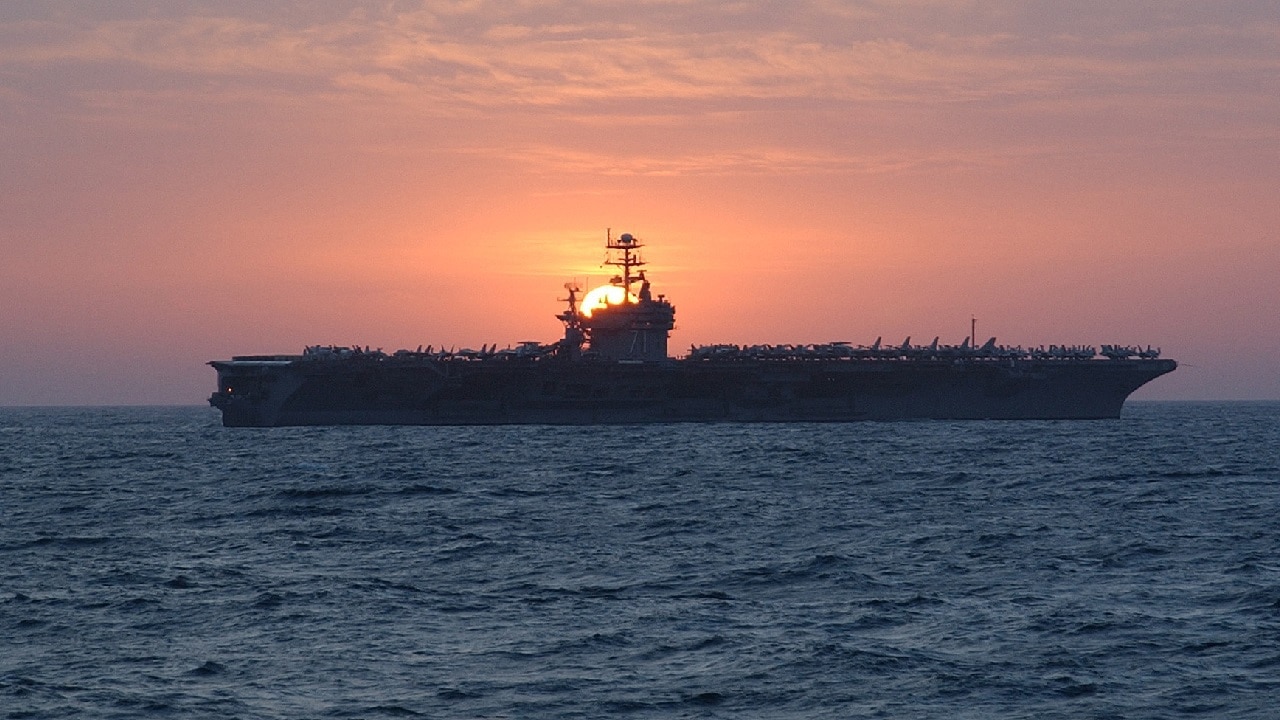
US Navy Aircraft Carrier Collision That History Has Forgotten: People take for granted the fact that the United States Navy operates some of the world’s most complex warships daily.
Few, except those who have served on such leviathans, understand the complexities and focus required to sustain and maintain these great ships under extraordinary conditions.
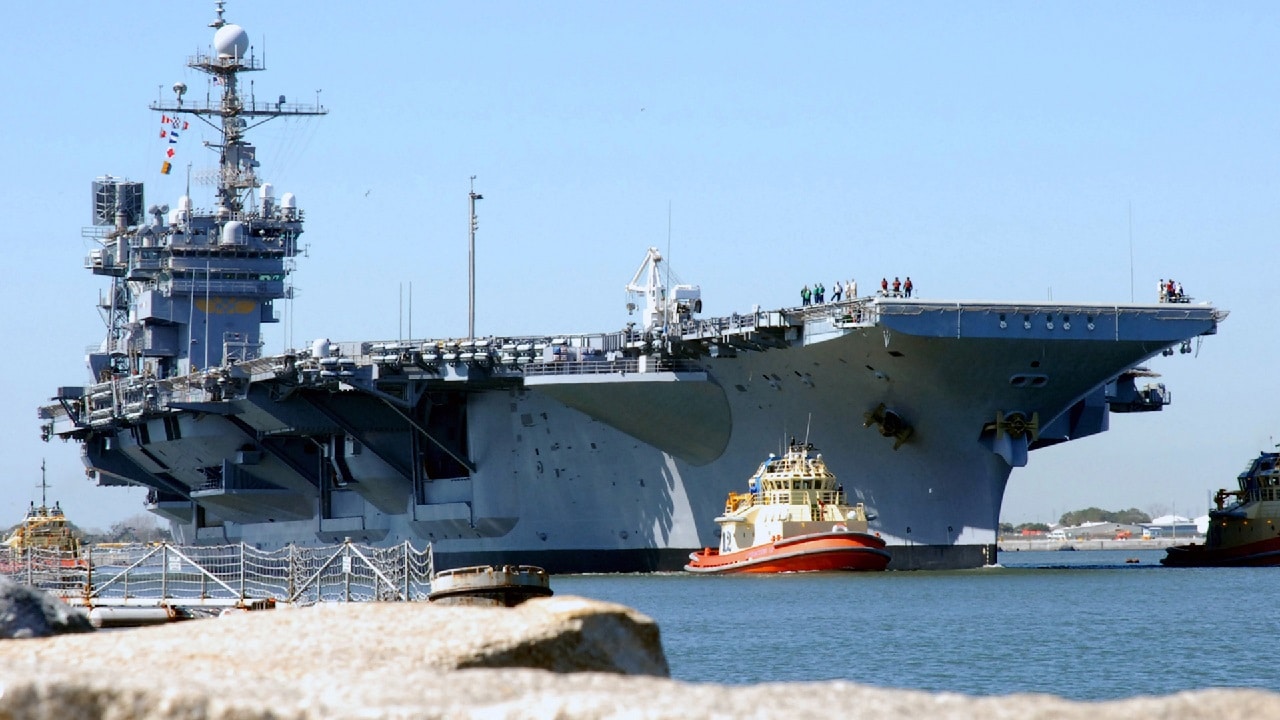
Mayport, Fla (Feb. 20, 2007) – USS John F. Kennedy (CV 67) departs Naval Station Mayport for the last underway period before her decommissioning in March. U.S. Navy photo by Mass Communication Specialist 2nd Class Elizabeth Williams (RELEASED)
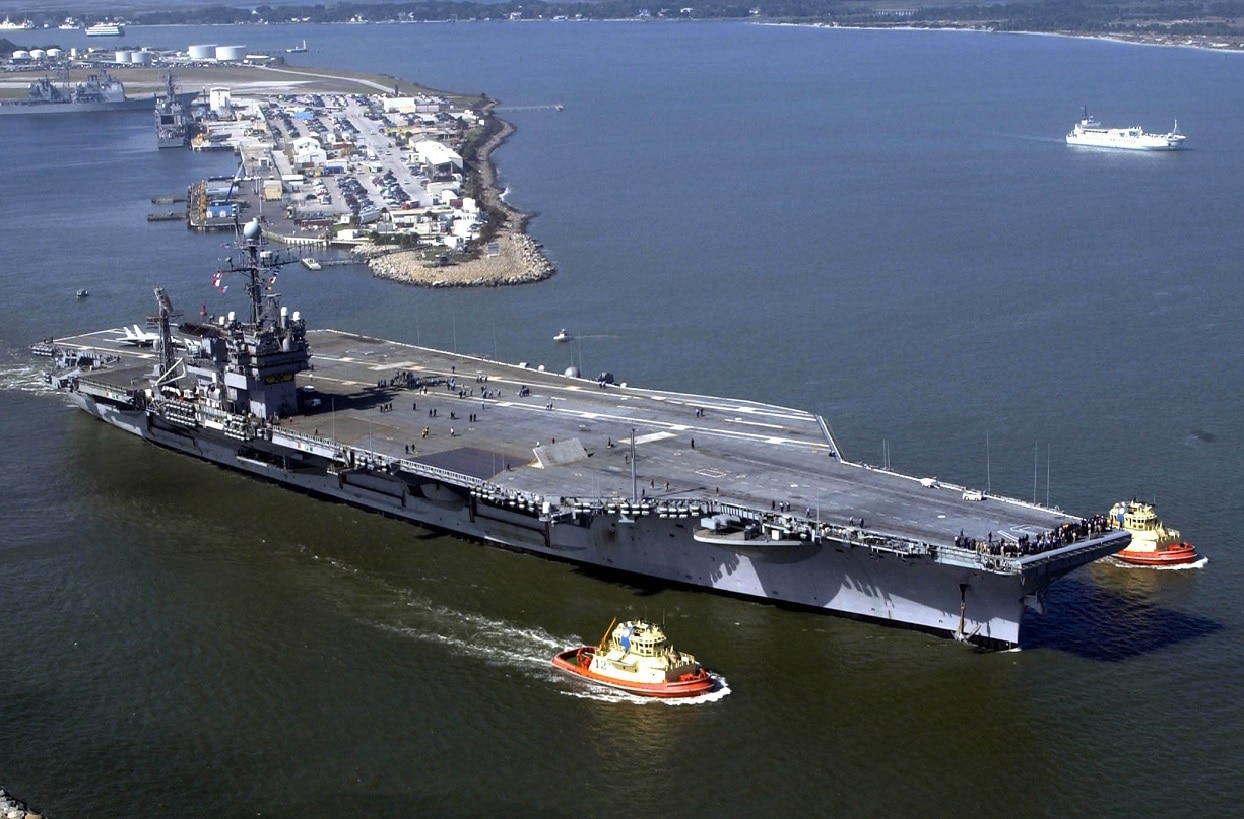
Mayport, Fla. (Nov. 11, 2003) — USS John F. Kennedy (CV 67) departs Naval Station Mayport under her own power following a ten month Extended Service Repair Availability (ESRA). During a short at sea period the ship will test numerous systems installed or upgraded while in port. The $300 million maintenance period included renovation of berthing compartments, and new navigational radar system. U.S. Navy photo by Photographer’s Mate 1st Class Greg Curry. (RELEASED)
Yet, as with all human endeavors, mistakes can happen. Accidents occur. And when they do, the ensuing drama can be the stuff of nightmares.
A Nightmare at Sea: Aircraft Carrier Problem
Take, for example, the collision between the USS John F. Kennedy (CV-67) and the guided-missile cruiser USS Belknap (CG-26) on the evening of November 22, 1975.
At that time, during the height of the Cold War, the carrier and its attendant battle group were operating in the Mediterranean Sea, conducting nighttime flight operations.
Specifically, the carrier was attached to Task Force Group 60.1 operating 70 nautical miles east of Sicily.
As the Kennedy was preparing for the final aircraft recovery of the night, the JFK turned into the wind. This is a normal maneuver to enhance flight deck operations.
By turning into the wind during flight operations, carrier crews naturally increase airflow across the deck, which helps with aircraft launch and recovery.
As the JFK made its turn, the Belknap was keeping a tight formation with the mothership.
And as she kept tight formation, unbeknownst to almost anyone outside of the Navy’s brass until years later, the Belknap harbored a terrible secret stored in the bowels of her hull.
She carried W45 nuclear warheads for the cruiser’s Terrier surface-to-air missiles.
The Navy’s official account indicates that mass confusion erupted on the bridge of the Belknap as the JFK was turning into the wind.
Due to that confusion, the cruiser unexpectedly moved into the carriers’ path.
At 9:59 pm local time that night, the two ships slammed into each other.
We are not talking about a fender bender at sea.
This was a serious matter that threatened the safety of the two ships — an existential threat to the smaller guided-missile cruiser.
The Can Opener Effect
Think of what happened as being akin to opening a can with a can opener. Because of JFK’s awkward structure, the cruiser did not just collide with the hull of the taller and wider carrier.
The Belknap crashed into the overhanging structure that supported the carrier’s angled flight deck. That structure tore through the cruiser’s superstructure and the bridge aft.
Hence, comparisons to a can opener, because that upper structure on the carrier cutting through the cruiser was akin to a blade slicing through the smaller warship.
The ships were going through a patch of inclement weather, and the seas were particularly rough. Because of those rough seas and the proximity with which the carrier and the Belknap were operating, the two vessels collided.
To be clear, the USS Belknap was about 547 feet long and 55 feet wide.
Her displacement was at most 8,957 tons, and she carried a crew of up to 610.
Belknap could reach a top cruising speed of 34 knots.
The John F. Kennedy, 1,052 feet long and 252 feet wide, displaced over 82,000 tons when fully loaded. JFK’s crew complement was more than 3,200 sailors and Marines.
The Kennedy could achieve speeds of up to 34 knots, like the Belknap.
Still, the momentum of the seas, the chop, and the weight of the carrier likely amplified whatever speed she was traveling at during the accident (most reports place JFK’s speed between 25 and 30 knots.
Just imagine that disparity in size and weight, paired with that speed. There’s a reason that the USS John F. Kennedy earned the nickname “The Can Opener,” after that incident.
But the initial collision was only the start of the Belknap’s problems.
Bathed In Blood, Melting Aluminum, and Nuclear Hellfire
As the smaller and lighter (compared to the carrier) guided-missile cruiser scraped along the port side of the Kennedy, the carrier’s complement of JP-5 aviation-fuel lines ruptured.
Jet fuel poured downward onto the mangled cruiser and eventually ignited, leading to a major fire on the warship. The Kennedy was not spared from this fate. It, too, endured a nasty series of onboard conflagrations.
Because the Belknap’s superstructure was made from aluminum, and under extreme temperatures aluminum melts, parts of the guided-missile cruiser’s superstructure literally melted and collapsed.
Once that occurred, the ammunition stored on the guided-missile cruiser began igniting, spreading the fire across the warship.
All night, the sailors of the USS Belknapstrove to keep their guided-missile cruiser afloat.
Indeed, the Belknap’s sister ship, the USS Claude V. Ricketts, and the destroyer USS Borderlon moved alongside to help fight the fires despite the dangerous conditions.
At that point, ammunition stored in one of the Belknap’s ready-service lockers detonated, showering the two warships assisting the stricken Belknap with debris.
Seven sailors on the Belknap perished during the fire when they were trapped in engineering spaces below deck.
An additional 47 members of the cruiser’s crew were injured.
The John F. Kennedy, however, was not out of the woods.
Flight deck firefighters brought the carrier’s topside fire under control in about ten minutes.
The other fire belowdecks continued burning for several hours.
Heavy smoke forced the evacuation of the carrier’s fire rooms, leaving Kennedy temporarily dead in the water.
One sailor aboard the carrier died due to smoke inhalation.
Aircraft still airborne were diverted to Naval Air Facility Sigonella in Sicily, while Kennedy’s SH-3D helicopters participated in rescue operations all night.
“Broken Arrow”
During the fire, the Sixth Fleet issued what’s known as a “Broken Arrow” alert after the collision because many feared that those W45 nuclear warheads onboard the cruiser were at risk.
Indeed, the fire onboard the cruiser came within only a few meters of the nuclear weapons before firefighters contained the fire.
Ultimately, the disaster ended with only eight lives lost.
But the world came very close in 1975 to a nuclear disaster in the Mediterranean Sea.
Literally within meters.
All because a cruiser got too close to its mothership in rough seas, and communications between the mothership and the cruiser were poor.
That collision remains one of the strangest incidents involving an American supercarrier.
The Kennedy earned a macabre unofficial nickname—the “Can Opener”—while the Belknap was so damaged that it spent years rebuilding from scratch, ultimately returning to service in 1980.
It’s a reminder, though, of how dangerous even routine training can be when dealing with the complex, large warships of the US Navy.
About the Author: Brandon J. Weichert
Brandon J. Weichert is the Senior National Security Editor at 19FortyFive.com. He also manages The Weichert Brief on Substack. Weichert also hosts “National Security Talk” on Rumble. He is the author of four bestselling national security books, the most recent of which is A Disaster of Our Own Making: How the West Lost Ukraine (Encounter Books). Follow him via Twitter/X @WeTheBrandon.