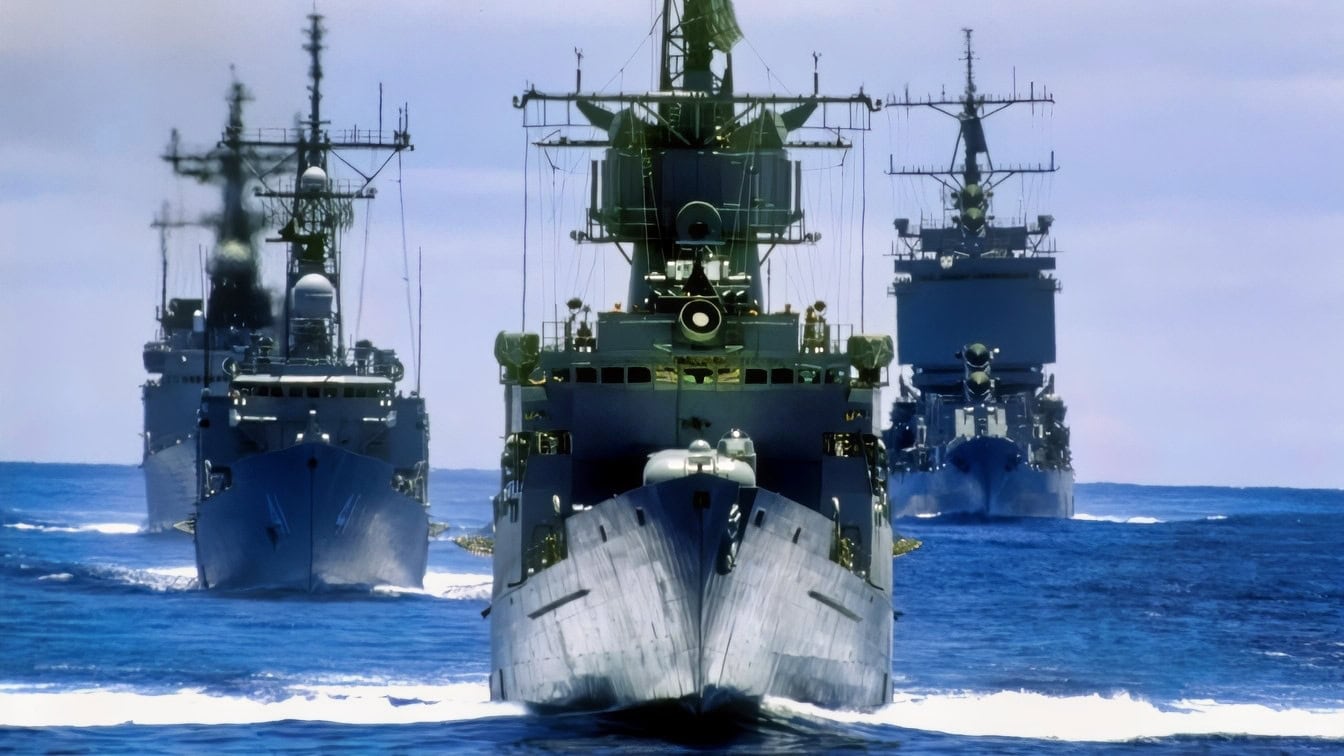
Commissioned on September 9, 1961, the USS Long Beach (CGN-9) was the world’s first nuclear-powered surface combatant and the only member of her class.
She was also the first new American cruiser design completed after World War II.
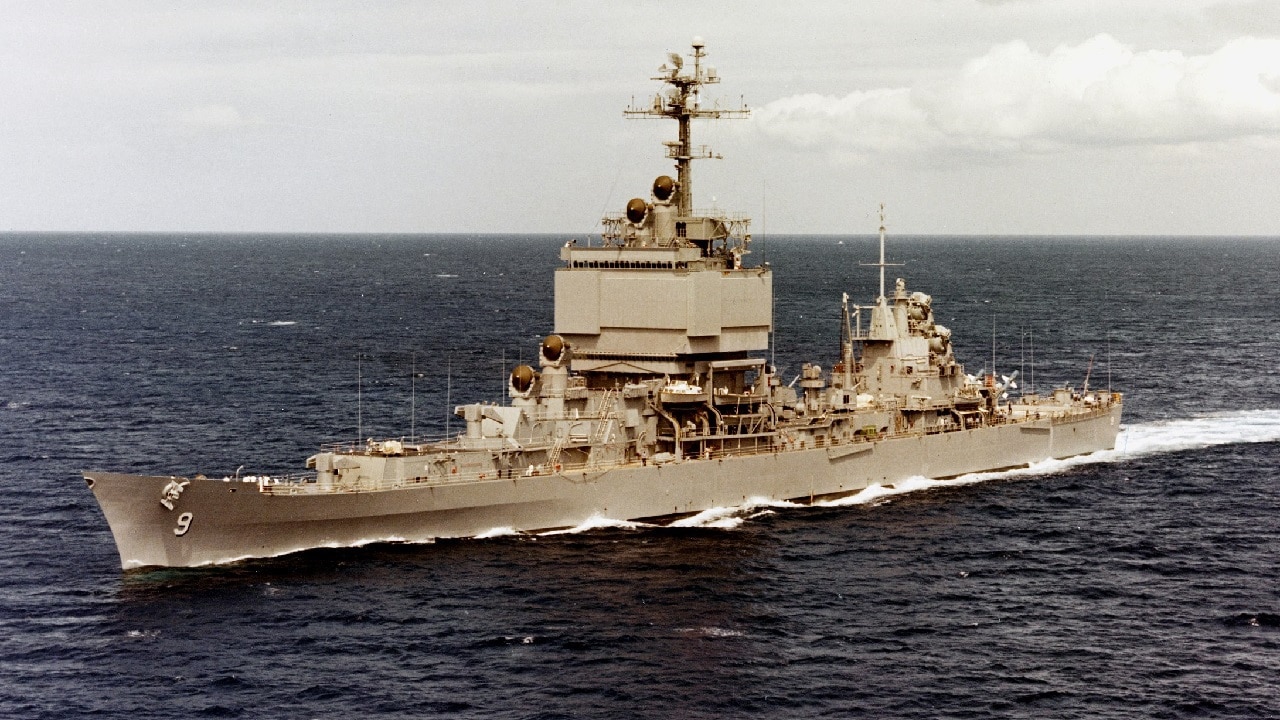
The U.S. Navy guided missile cruiser USS Long Beach (CGN-9) underway off Oahu, Hawaii (USA), 9 May 1973.
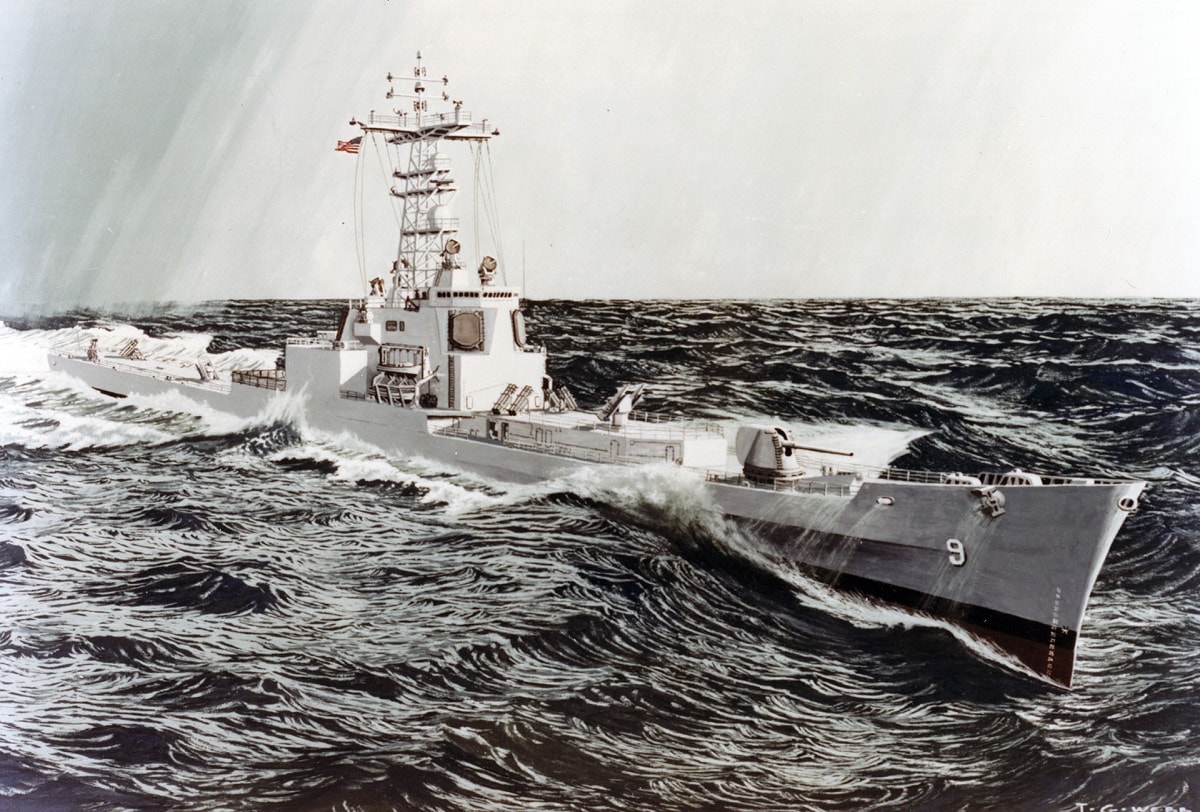
Image: Creative Commons.
Long Beach was also the last American cruiser constructed around a traditional cruiser hull rather than a design derived from a destroyer or a frigate.
Oh, and the Long Beach was massive by today’s standards for cruisers.
Indeed, there’s never been a cruiser quite like the Long Beach since this unique warship cut across the High Seas for the Navy.
The Specs
Long Beach was extraordinary for its time and unique even by today’s standards. Just look at her size. She measured around 721 feet long, with a beam of roughly 71.5 feet.
The ship displaced 15,000 tons and carried a crew of 1,160. Two Westinghouse C1W nuclear reactors supplied steam to two General Electric (GE) turbines producing 80,000 shaft horsepower, propelling the large cruiser to more than 30 knots.
Because she was nuclear-powered, the crew did not have to worry about conventional fuel or its limitations.
The Mission
One of the most interesting aspects of this ship, though, was its weapons loadout. At its core, the weapons package focused on the layered surface-to-air missile system.
That system was meant to better defend carrier battle groups against the rising threat from Soviet bombers and anti-ship aircraft.
The Soviets lacked the kind of surface-warfare power that aircraft carriers gave the US Navy’s surface-warfare fleet.
So, if the Cold War ever turned hot, the Soviets had plans to use their anti-ship ballistic missiles (ASBMs) and long-range bombers against US carriers.
And the carriers, despite their significant aircraft-launch capabilities, had only a pittance of self-defense. It needed other ships operating alongside it to form a defensive screen.
USSLong Beach was built for that very contingency.
This cruiser would employ its massive surface-to-air missile arsenal to defend the carrier against Soviet bombers and ASBMs.
At the bow of the nuclear-powered cruiser were two twin-arm Mk 10 missile launchers for the RIM-2 Terrier medium-range surface-to-air missile.
Sources differ slightly on magazine configuration, but the ship could carry roughly 120 Terriers in her original configuration.
The Terrier provided the intermediate layer of Long Beach’s air-defense umbrella, with later versions capable of engaging targets beyond 30 miles.
The heavyweight weapon was the RIM-8 Talos.
A twin-arm Mk 12 launcher aft was supplied by a magazine containing 52 Talos missiles.
Talos was massive by modern SAM standards–roughly 30 feet long and weighing several thousand pounds.
Its operational range ultimately exceeded 80 nautical miles in some variants, allowing Long Beach to engage aircraft far beyond the immediate formation she was protecting.
That capability was tested in real combat.
In 1968, during the Vietnam War, the USS Long Beach used the Talos missiles against North Vietnamese MiGs. She was credited with two MiG kills, including engagements against aircraft tens of miles away.
The cruiser therefore became one of the earliest demonstrations that a surface warship could use long-range guided missiles to destroy aircraft operating far from the ship itself.
But the Long Beach wasn’t the only thing that made it so different (and so powerful for its era). The cruiser had impressive submarine-warfare capabilities.
It possessed an eight-cell Mk 16 launcher for the RUR-5 Anti-Submarine Rocket (ASROC).
The launcher rapidly fired an anti-submarine torpedo to a distant underwater contact rather than forcing the ship to maneuver close enough to use conventional torpedo tubes.
Indeed, published loadout figures indicate that ASROCs are ready in the launcher, with another 12 reloads, for approximately 20 weapons.
The cruiser also carried two Mk 32 triple torpedo launchers for lightweight anti-submarine torpedoes such as the Mk 46.
JFK Wanted Lots of Conventional Guns, Too
Ironically, Long Beach had originally been envisioned as essentially a missile truck. Two single five-inch/38-caliber Mk 30 gun mounts were subsequently installed amidships, reportedly following President John F. Kennedy’s insistence that the cruiser needed conventional guns.
They gave Long Beach a weapon for surface targets, shore bombardment, and situations where firing an expensive guided missile made little sense.
By 1961 standards, the Long Beach was in a league of its own. And her huge superstructure reflected the era’s optimism.
It was more futuristic-looking than other warships in America’s fleet. The ship also housed the SCANFAR system. That sensor node combined the AN/SPS-32 and AN/SPS-33 phased-array radars. This system was a direct precursor to the Navy’s current Aegis combat system.
As the Cold War progressed, the Long Beach’s weapons changed with the times, too.
In the late 1970s, the ship removed those Talos missiles.
The Standard Missile inevitably replaced the ship’s Terrier missiles.
An expensive early-1980s modernization enabled the Long Beach to employ SM-2ER extended-range surface-to-air missiles. She could eventually carry around 120 Standard missiles.
Two Mk 41 quadruple launchers were added, giving this ship a significant offensive capability.
These quadruple launchers could deploy eight RGM-84 Harpoon anti-ship missiles.
Two Mk 143 Armored Box Launchers subsequently provided eight BGM-109 Tomahawk cruise missiles, giving the nuclear cruiser a long-range land-attack capability.
Two 20mm Mk 15 Phalanx Close-In Weapon Systems (CIWS) were installed to provide comprehensive defense against any incoming aircraft and anti-ship missiles.
An Unbeatable History
So, the Long Beach had evolved from a fleet-air-defense cruiser into what’s known as a multi-mission missile warship carrying a vast array of missiles and guns by the time of its refit in 1980.
Ultimately, the unique cruiser was decommissioned on May 1, 1995.
Few warships matched the technological ambitions of the early Cold War era like the USS Long Beach.
She combined nuclear endurance and massive missile capabilities with advanced sensors, ultimately turning the nuclear-powered cruiser into a multi-mission warship.
Although her service life ended in 1995, she taught the Navy a series of invaluable lessons that later shaped many of its designs.
About the Author: Brandon J. Weichert
Brandon J. Weichert is the Senior National Security Editor at 19FortyFive.com. He also manages The Weichert Brief on Substack. Weichert also hosts “National Security Talk” on Rumble. He is the author of four bestselling national security books, the most recent of which is A Disaster of Our Own Making: How the West Lost Ukraine (Encounter Books). Follow him via Twitter/X @WeTheBrandon.